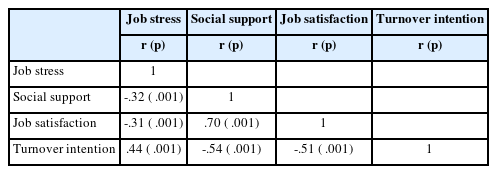
Purpose Hemodialysis units require a highly specialized nursing workforce, and frequent nurse turnover may compromise continuity of care and patient safety. This study aimed to identify factors associated with turnover intention among hemodialysis nurses using Price’s causal model of turnover. Methods: A model-testing design was used. Data were collected from 180 hemodialysis nurses in three metropolitan cities using structured questionnaires that measured job stress, social support, job satisfaction, and turnover intention. Descriptive statistics were analyzed using IBM SPSS version 27.0, and path analysis was conducted using IBM SPSS AMOS version 26.0. Results: Turnover intention was significantly lower among nurses aged 40 years or older, those with at least 20 years of clinical experience, those with at least 10 years of hemodialysis-unit experience, and those with an adaptation period longer than 90 days. Job stress showed a significant direct path to turnover intention (β=.38, p<.001). Social support showed significant direct paths to job satisfaction (β=.64, p<.001) and turnover intention (β=–.42, p<.001), as well as a significant indirect path to turnover intention through job satisfaction (β=–.19, p=.028). The model explained 39.7% of the variance in turnover intention. Conclusion: Strategies to reduce job stress and strengthen social support may help reduce turnover intention and support the retention of experienced hemodialysis nurses.
Purpose This study aimed to investigate the relationship between socio-cognitive mindfulness, job stress, social support, and turnover intention among general hospital nurses and identify the factors influencing nurses’ turnover intention.
Methods A descriptive survey was conducted among 218 nurses from five general hospitals located in G metropolitan city. The participants completed a questionnaire measuring the study variables, and the data were analyzed using t-tests, ANOVA, Pearson’s correlation coefficient, and hierarchical multiple regression analysis in SPSS/WIN 28.0.
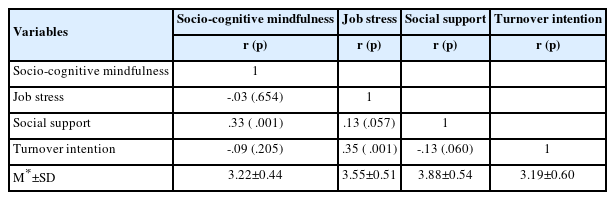
Results Significant differences were found in turnover intention by gender (t=-2.12, p=.036), family type (t=-3.09, p=.002), work department (F=7.01, p<.001), and work type (t=2.55, p=.011). Socio-cognitive mindfulness was positively related to social support (r=.331, p<.001), and turnover intention was positively related to job stress (r=.347, p<.001). The factors influencing nurses’ turnover intention included job stress (β=.317, p<.001), work department (artificial kidney room: β=-.287, p=.004; emergency room: β=-.219, p=.015), social support (β=-.183, p=.005), and work type (shift work: β=.170, p=.036), respectively. These factors explained 23.4% of the variance.
Conclusion The findings indicate the need to develop programs to effectively cope with job stress and implement mentoring systems or psychological support programs to reduce turnover intention among nurses at the organizational level.
Citations
Citations to this article as recorded by
Effects of Job Satisfaction, Job Stress, and Social Support on the Turnover Intention of Employed Pharmacists Working in Community Pharmacies Kwang Mo Yang, Yun Jeong Lee Korean Journal of Clinical Pharmacy.2026; 36(1): 43. CrossRef
The Influence of Socio-Cognitive Mindfulness, Job Stress and Social Support on Turnover Intention in General Hospital Nurses Chun Ha Kim, Mikyoung Lee Journal of Korean Academy of Nursing Administration.2025; 31(2): 155. CrossRef
Factors Influencing Organizational Socialization in New Nurses: A Focus on Job Stress, Resilience, and Nursing Performance Kyungok Park, Yeoungsuk Song Journal of Korean Academy of Fundamentals of Nursing.2025; 32(1): 118. CrossRef
A Structural Equation Model of Nurses' Happiness Soo Ji Lee, Mi-Jung Kang Journal of Korean Academy of psychiatric and Mental Health Nursing.2025; 34(4): 515. CrossRef
Effects of Job Stress, Social Support, and Infection Control Fatigue on Professional Quality of Life among Nurses in Designated COVID-19 Hospitals Minyoung Shin, Woojoung Joung Journal of Korean Academy of Nursing Administration.2023; 29(5): 603. CrossRef
Factors Influencing Nurses’ Job Performance in Korea and Mongolia: A Cross-Sectional Study Zolzaya Bayarsaikhan, YunHee Shin Journal of Korean Academy of Fundamentals of Nursing.2023; 30(3): 404. CrossRef
Influence of Nursing Practice Readiness and Resilience on the Nursing Performance among New Nurses Hae Ok Kim, Mun Hee Nam, Yo Na Kim Journal of Korean Academy of Nursing Administration.2022; 28(4): 352. CrossRef
Emotional Labor Is Associated With the Mental Health of Respiratory Therapists in Hospitals Yu-Hua Yan, Chih-Ming Kung, Shu-Chen Hsing Respiratory Care.2021; 66(1): 50. CrossRef
The Experience of Emotional Labor and Its Related Factors among Nurses in General Hospital Settings in Republic of Korea: A Systematic Review and Meta-Analysis Da-Jung Ha, Jung-Hyun Park, Su-Eun Jung, Boram Lee, Myo-Sung Kim, Kyo-Lin Sim, Yung-Hyun Choi, Chan-Young Kwon Sustainability.2021; 13(21): 11634. CrossRef
The influence of social support and health promotion behaviors on nursing work performance among nurses Eunbi Choi, Kyung Hee Yoo The Journal of Korean Academic Society of Nursing Education.2021; 27(3): 333. CrossRef


 First
 Prev