• KANAD
  • Contact us
  • E-Submission
ABOUT
BROWSE ARTICLES
EDITORIAL POLICY
FOR CONTRIBUTORS

Page Path

2
results for

"조직사회화"

Filter

Article category

Keywords

Publication year

Authors

"조직사회화"

Original Articles
The Effects of Organizational Socialization and Nursing Competence on Organizational Commitment among Clinical Nurses
Sangyun Park, Seunghee Lee
J Korean Acad Nurs Adm 2026;32(4):254-263.   Published online September 29, 2026
DOI: https://doi.org/10.11111/jkana.2025.0066
Purpose
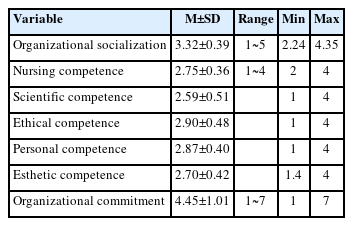
This study examined the effects of organizational socialization and nursing competence on organizational commitment among clinical nurses. Methods: Data were collected from August 12 to August 31, 2024, from 207 nurses with more than 6 months of clinical experience at five general hospitals in a metropolitan area. Data were analyzed using descriptive statistics, the independent t-test, one-way analysis of variance, Pearson correlation coefficients, and multiple regression in IBM SPSS version 27.0. Results: Organizational commitment was positively correlated with organizational socialization and with scientific, ethical, personal, and aesthetic competence. Multiple regression identified organizational socialization (β=.59, p<.001), aesthetic competence (β=.18, p=.012), ethical competence (β=.15, p=.023), and married status (β=.16, p=.010) as significant factors associated with organizational commitment. These variables explained 57.0% of the variance, and the regression model was significant (F=12.65, p<.001). Conclusion: Healthcare institutions should strengthen organizational socialization and nursing competence through structured education and institutional support to enhance nurses’ organizational commitment.
  • 258 View
  • 19 Download
Factors Influencing Resilience in Long-term Care Hospital Nurses
Ju Hui Moon, Sook Hee Yoon
J Korean Acad Nurs Adm 2019;25(5):373-383.   Published online December 31, 2019
DOI: https://doi.org/10.11111/jkana.2019.25.5.373
PURPOSE
The purpose of this study was to investigate factors affecting the resilience of emotional intelligence, job stress coping, and organizational socialization of nurses working in long-term care hospitals.
METHODS
The participants were 153 nurses working in 8 long-term care hospitals in B city. Data were collected from February. 1 to Feb. 15, 2019 SPSS/WIN 23.0 was used for analysis with t-test, ANOVA, Scheffé test, Pearson correlation coefficients, and stepwise regression.
RESULTS
Factors influencing resilience in the participants were emotional intelligence (β=.38, p < .001), coping behavior-focusing on the positive (β=.29, p < .001), nurse motivation (β=.16, p=.006), organizational socialization (β=.17, p=.009), coping behavior-tension reduction (β=.14, p=.023). These factors contributed 54% of the total variance in resilience.
CONCLUSION
It is necessary to study emotional intelligence and hospital nurses' coping with job stress while carrying out highly emotional activities on the job and to develop a program that can enhance the resilience of the nurses to improve psychological wellbeing and verify the effects.

Citations

Citations to this article as recorded by  
  • Vicarious Resilience in Hospital Nurses: A Concept Analysis
    Miri Jeong
    Healthcare.2025; 13(18): 2279.     CrossRef
  • Mediation Analysis of Emotional Intelligence on the Relationship between Social Support and Resilience by Clinical Nurses in COVID-19
    Hye-Yeon Shin, Myoung-Lyun Heo
    Journal of Korean Academy of Nursing Administration.2023; 29(3): 181.     CrossRef
  • 1,317 View
  • 29 Download
  • 2 Crossref
TOP