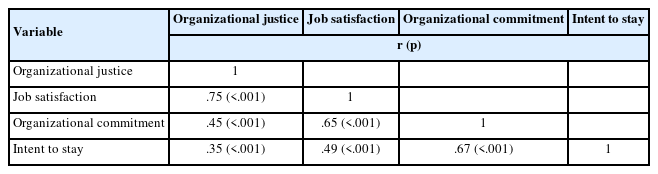
Purpose This study investigated the influence of organizational justice on junior nursing officers’ intent to stay in their positions and explored the mediating roles of job satisfaction and organizational commitment. Methods: A descriptive correlational design was employed, and data were analyzed using SPSS 29.0 software. Statistical analyses included descriptive statistics, the t-test, one-way analysis of variance, Pearson’s correlation coefficients, and multiple linear regression. The mediating effects of job satisfaction and organizational commitment were evaluated following Baron and Kenny’s three-step mediation procedure, and significance was confirmed through the bootstrapping method. Results: Organizational justice, job satisfaction, organizational commitment, and intent to stay were all significantly positively correlated. The mediating effects of job satisfaction and organizational commitment on the relationship between organizational justice and intent to stay were confirmed. Conclusion: Based on the findings of this study, job satisfaction and organizational commitment were found to fully mediate the relationship between organizational justice and intent to stay. Therefore, to enhance the intent to stay among junior nursing officers, it is considered necessary to develop supportive measures and establish systems within the military and nursing corps that strengthen organizational justice for junior nursing officers.
Purpose This study examined the association between nurse staffing and in-hospital 30-day mortality among stroke patients considering the stroke type in the intensive care units in Korea using the Health Insurance Review and Assessment Service-National Inpatient Sample 2018 (HIRA-NIS 2018).
Methods: The data included a total of 2,876 stroke patients admitted to intensive care units across 72 general hospitals and 39 tertiary hospitals between January and November 2018. Nurse staffing levels were measured using the nurse staffing grades of adult intensive care units in the 2nd quarter of 2018. The relationship between nurse staffing levels and mortality were analyzed using multi-level logistic regression analysis after controlling for patient and hospital characteristics.
Results: In patients with ischemic stroke, the risk of death was lower in nurse staffing Grade 5 to 6 compared to Grade 1 (Odds ratio [OR] 0.43, 95% Confidence interval [CI] 0.24~0.75). In hemorrhagic stroke patients, the risk of death tended to be higher in nurse staffing grade 5 to 6 compared to Grade 1 (OR 2.11, 95% CI 1.00~4.45), which was marginally significant (p=.050).
Conclusion: Health policies for adequate nurse staffing in intensive care units should be implemented to enhance the quality of care and lead to better outcomes in patients with stroke.


 First
First Prev
Prev