
| Chung Hee Woo | 2 Articles |
Purpose
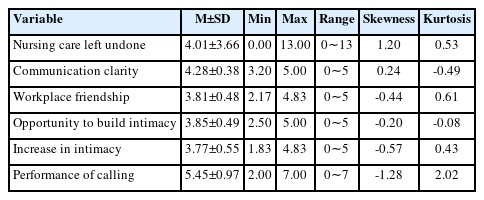
This study aimed to investigate the effects of communication clarity, workplace friendship, and performance of calling on nursing care left undone among oncology nurses. Methods: Data were collected from 159 oncology nurses with more than one year of experience working in cancer wards between September 11 and September 30, 2024. Statistical analyses included descriptive statistics, the independent t-test, one-way analysis of variance, the Scheffé post hoc test, Pearson’s correlation coefficients, and hierarchical multiple regression analysis, all conducted using IBM SPSS Statistics version 29.0. Results: Communication clarity, workplace friendship, and performance of calling were significantly correlated with nursing care left undone. Hierarchical multiple regression analysis identified communication clarity (β=-.37, p<.001) and being aged 30–39 years (β=-.24, p<.001) as the main factors influencing nursing care left undone, collectively explaining 37% of the total variance. Conclusion: Communication clarity was the most influential factor affecting nursing care left undone in cancer wards. To reduce the incidence of nursing care left undone and ensure high-quality nursing services in oncology units, strategies aimed at enhancing communication clarity are essential. Institutions should consider implementing simulation-based training or ongoing education tailored to their organizational context. Further research is warranted to examine the effects of communication clarity on nursing care left undone.
Purpose
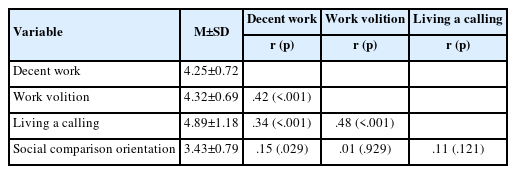
To identify the factors influencing the perception of “decent work” by nurses. Methods: Data were collected from 208 nurses who had worked in hospitals for over six months, from January 23 to February 11, 2024. The collected data were analyzed using descriptive statistics, t-tests, analysis of variance, Pearson's correlation, and hierarchical multiple regression analysis using IBM SPSS Statistics 29.0. Results: Statistically significant positive correlations were observed among “decent work,” “work volition,” “living a calling,” and “social comparison orientation.” The core factors that significantly affected the perception of “decent work” by nurses were ‘work volition” (β=.30, p<.001), shift type (β=-.28, p<.001), aged in their 40s (β=-.22, p=.003), “living a calling” (β=.18, p=.012), and “social comparison orientation” (β=.14, p=.021). These variables explained 32% of the variance in the perception of “decent work.” Conclusion: The study results confirmed that, in addition to “work volition” and “living a calling’,” “social comparison orientation” also plays a significant role in how nurses perceive “decent work.” To understand the “decent work” conditions in nursing, it is necessary to explore the relationship between these factors and the variables that reflect professionalism or social recognition. Citations Citations to this article as recorded by

|
|