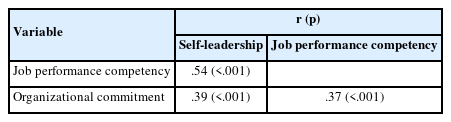
Purpose This study aimed to determine the effects of self-leadership on job performance competency and organizational commitment among insurance review nurses. Methods: A nationwide online survey was conducted using structured questionnaires. Participants included 189 insurance review nurses working in advanced general hospitals and general hospitals in South Korea. Data were collected through self-administered questionnaires between August 19 and September 17, 2021. Data analysis was performed using descriptive statistics, independent t-tests, one-way analysis of variance, Pearson’s correlation coefficients, and hierarchical multiple regression with IBM SPSS version 23.0. Results: The mean score for self-leadership was 3.64±0.43 out of 5, for job performance competency was 3.10±0.68 out of 5, and for organizational commitment was 4.38±1.09 out of 7. Statistically significant positive correlations were observed among self-leadership, job performance competency, and organizational commitment in insurance review nurses. Hierarchical multiple regression analysis showed that self-leadership explained an additional 13.9 percentage points of variance in job performance competency and an additional 5.3 percentage points in organizational commitment. Self-leadership emerged as a statistically significant predictor of both job performance competency and organizational commitment. Conclusion: This study empirically demonstrates that self-leadership has significant effects on job performance competency and organizational commitment among insurance review nurses. These findings provide empirical evidence relevant to human resource management strategies for insurance review nurses.


 First
First Prev
Prev