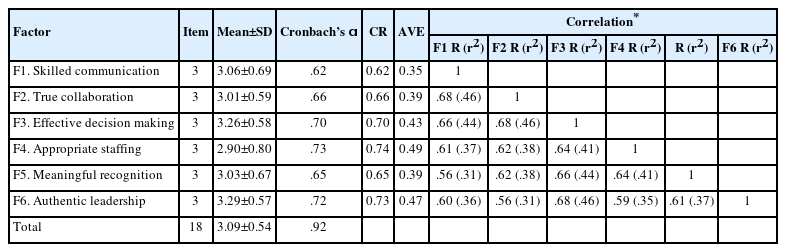
Purpose This study was conducted to evaluate the validity and reliability of the Korean version of the Healthy Work Environment Assessment Tool (K-HWEAT), originally developed by the American Association of Critical-Care Nurses. Methods: The study was conducted among nurses working at three university hospitals located in metropolitan areas between May 29 and October 10, 2019. A total of 543 nurses participated. Data were analyzed using AMOS version 26.0 to assess the construct validity of the K-HWEAT. Results: Confirmatory factor analysis initially failed to meet acceptable model fit indices. Model fit improved after reassigning item 1 from factor 1 to factor 2 and item 12 from factor 4 to factor 6, as well as allowing correlated error terms based on high modification indices. Following these adjustments, standardized root mean square residual remained unchanged (0.05 to 0.05) and root mean square error of approximation decreased from 0.09 to 0.07, whereas goodness of fit index increased from 0.88 to 0.91, adjusted goodness of fit index from 0.83 to 0.86, Normed Fit Index from 0.85 to 0.89, and comparative fit index from 0.88 to 0.92. The K-HWEAT demonstrated a moderate correlation with the Korean version of the Practice Environment Scale of the Nursing Work Index (r=.60, p<.001), supporting criterion validity. The overall Cronbach’s α was .92, with the six factors showing internal consistency coefficients ranging from 0.62 to 0.74. Conclusion: These findings support the reliability and validity of the K-HWEAT. However, further conceptual refinement of individual items may be necessary to enhance construct clarity.
 First
First Prev
Prev