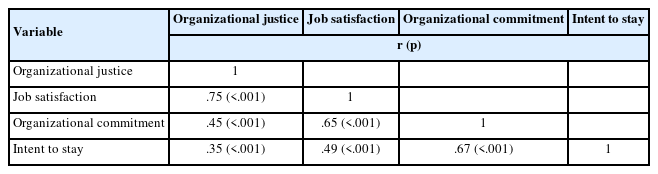
Purpose This study investigated the influence of organizational justice on junior nursing officers’ intent to stay in their positions and explored the mediating roles of job satisfaction and organizational commitment. Methods: A descriptive correlational design was employed, and data were analyzed using SPSS 29.0 software. Statistical analyses included descriptive statistics, the t-test, one-way analysis of variance, Pearson’s correlation coefficients, and multiple linear regression. The mediating effects of job satisfaction and organizational commitment were evaluated following Baron and Kenny’s three-step mediation procedure, and significance was confirmed through the bootstrapping method. Results: Organizational justice, job satisfaction, organizational commitment, and intent to stay were all significantly positively correlated. The mediating effects of job satisfaction and organizational commitment on the relationship between organizational justice and intent to stay were confirmed. Conclusion: Based on the findings of this study, job satisfaction and organizational commitment were found to fully mediate the relationship between organizational justice and intent to stay. Therefore, to enhance the intent to stay among junior nursing officers, it is considered necessary to develop supportive measures and establish systems within the military and nursing corps that strengthen organizational justice for junior nursing officers.
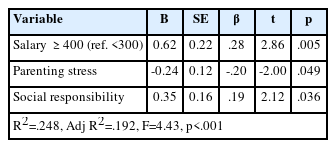
Purpose This study aimed to examine the factors influencing the retention intention of female nurses raising young and school-age children during the COVID-19 pandemic. Methods: In total, 131 female nurses working in hospitals with 30 or more beds who remained employed throughout the pandemic participated in this cross-sectional descriptive study. Data were collected using a structured self-report questionnaire in July 2023 and analyzed using descriptive statistics, correlation analysis, and multiple regression analysis with IBM SPSS 29.0. Results: The mean score for retention intention was 3.98 out of 5. Parenting stress averaged 3.02, family support 4.08, family-friendly policies 1.83 (out of 4), family-friendly organizational culture 2.98, and social responsibility 3.56. Regression analysis identified a monthly salary over 4 million KRW (β=.28, p=.005), parenting stress (β=–.20, p=.049), and social responsibility (β=.19, p=.036) as significant factors influencing retention intention, with an explanatory power of 19.2% (F=4.43, p<.001). Conclusion: Retention intention among nurses with young children during the COVID-19 pandemic was associated with financial stability, reduced parenting stress, and a strong sense of social responsibility. To enhance nurse retention during future public health crises, policies should incorporate practical childcare support and strengthen professional social responsibility.


 First
First Prev
Prev