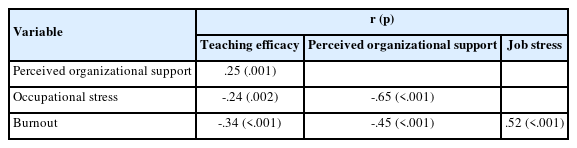
Purpose This study aimed to investigate the effects of teaching efficacy, perceived organizational support, and occupational stress on burnout among preceptor nurses. Methods: Participants included 156 nurses who had at least one month of preceptor experience within the past year. Data were collected using a structured self-report questionnaire and analyzed with SPSS version 27.0. Descriptive statistics, independent sample t-tests, one-way analysis of variance with Scheffé post-hoc tests, Pearson’s correlation analysis, and multiple regression analysis were performed. Results: Occupational stress (β=.36, p<.001) and teaching efficacy (β=-.17, p=.017) were significant predictors of burnout among preceptor nurses, jointly explaining 36.0% of the variance. Conclusion: Occupational stress and teaching efficacy were identified as key determinants of burnout in preceptor nurses. Effective burnout prevention strategies should focus on reducing occupational stress through workload management and strengthening teaching efficacy via continuous training and organizational support.
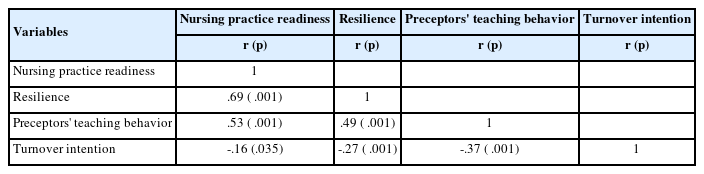
Purpose This study investigated the effects of newly graduated nurses’ perceived readiness for nursing practice, resilience, and preceptors’ teaching behaviors on turnover intention.
Methods A survey was conducted among 168 newly graduated nurses between August 7 and 31, 2023. The data were analyzed using descriptive statistics, t-tests, one-way ANOVA, Pearson's correlation, and hierarchical multiple regression analysis.
Results The factors that significantly affected turnover intention included preceptors' teaching behavior (β=-.29, p=.001) and resilience (β=-.21, p=.026). This model explained 32.0% of the variance.
Conclusion Newly graduated nurses’ resilience and their initial training environment are key factors influencing turnover intention. Therefore, nursing managers should develop strategies to enhance the resilience of newly graduated nurses and improve training systems. Additionally, efforts should be made to promote positive teaching behaviors among the educators responsible for training newly graduated nurses.
Citations
Citations to this article as recorded by
Experiences of work performance among physician assistant nurses during the period of healthcare disruption in South Korea: a qualitative content analysis Juyoung Ha, Minji Kim Journal of Korean Academy of Nursing.2026; 56(1): 98. CrossRef
Educational Innovation in Nursing Management after Reforms in the National Nurse Licensure Examination: A Narrative Review Yoomi Jung Journal of Korean Academy of Nursing Administration.2026; 32(3): 137. CrossRef
Factors Associated With Nursing Profession Self‐Efficacy Among Newly Graduated Nurses: A Cross‐Sectional Study Yujeong Kim, Eunhee Nam, Myojeong Kim, Dokyung Kim, Heejin Sim Nursing Open.2026;[Epub] CrossRef
Perceptions on Fixed Night Shift System and Turnover Intention of General Hospital Nurses Mi-Aie Lee, Hye-Jin Cho, Sung-Hee Ahn, Hyo-Ju Kim Journal of Korean Academy of Nursing Administration.2015; 21(5): 519. CrossRef


 First
First Prev
Prev