Purpose This study examines how the use of generative artificial intelligence (AI) in research may be interpreted and regulated under South Korea’s National Research and Development Innovation Act and its Enforcement Decree. It also evaluates how AI-assisted research practices challenge the conceptual boundaries of the statutory categories of research misconduct. Methods: Through doctrinal legal analysis of Article 31 of the Act and Article 56 of the Enforcement Decree, common AI-assisted practices across the research cycle—design, literature review, data generation and analysis, manuscript writing, and the input of data into AI systems—were mapped to the Act’s misconduct taxonomy and related legal duties. Results: Generative AI may plausibly implicate fabrication, falsification, plagiarism, and improper authorship (Article 31(1)1), as well as improper ownership of research and development outcomes and breaches of security measures (Article 31(1)3–4). The analysis further indicates that AI use destabilizes categorical boundaries, as individual outputs may simultaneously involve invented content, distorted interpretation, and unattributed reproduction. Numerous research-integrity risks arise from failures in research processes, including nondisclosure, inadequate verification, weak provenance tracking, and irreproducible analysis pipelines. Conclusion: Legal and institutional responses should prioritize transparency across the research cycle and the development of auditable workflows, rather than focusing solely on sanctioning problematic outputs. Clear disclosure standards, verification obligations, reproducibility requirements, and stringent data-stewardship rules are necessary to address these emerging risks.
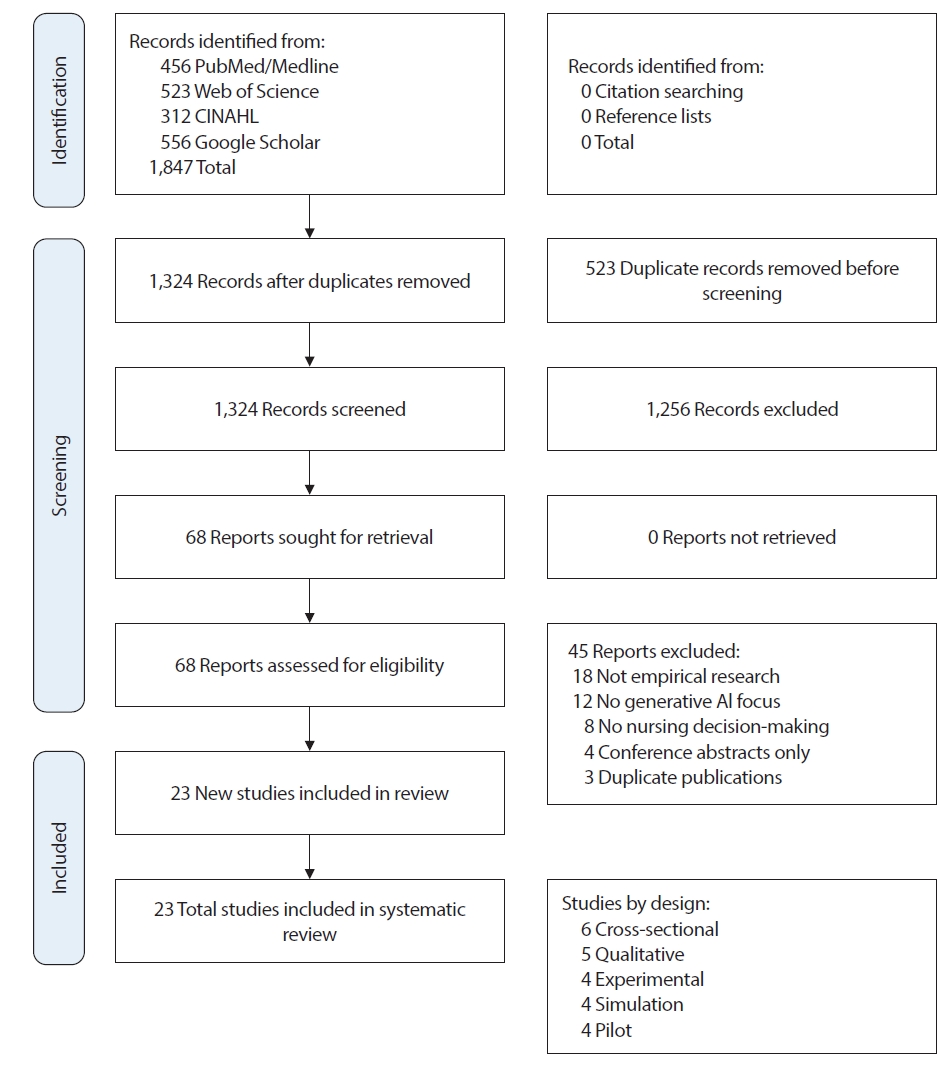
Purpose This systematic review examined the impact of generative artificial intelligence (AI) on nurses' clinical decision-making. Methods: Following PRISMA guidelines, we searched four databases for empirical studies (2000-2025) examining generative AI in nursing decision-making. Two reviewers independently conducted study selection and quality assessment. Results: Twenty-three studies were included (simulation studies n=7, cross-sectional n=4, qualitative n=3, implementation n=3, retrospective evaluation n=3, observational comparison n=3, experimental n=2). Large language models, particularly ChatGPT and GPT-4, were most commonly examined. Benefits included 11.3-fold faster response times, high diagnostic appropriateness (94-98%) in neonatal intensive care, improved emergency triage agreement (Cohen's κ 0.899-0.902), and documentation time reductions (35% to >99%). Challenges included limitations in therapeutic reliability, hallucinations in vital sign processing, demographic biases, and over-reliance risks (only 34% high trust reported). Conclusion: Generative AI shows promise for augmenting nursing decision-making with appropriate oversight, though evidence is limited by predominance of simulation studies and insufficient patient-level outcome data. AI literacy integration in nursing education and robust institutional governance is essential before routine deployment. Large-scale randomized controlled trials are needed.
Purpose Based on a literature review of artificial intelligence (AI) applications within nursing tasks, this study delves into the feasibility of employing AI to improve nursing practice in Korea. Methods We used "nursing" and "artificial intelligence" as keywords to search academic databases, resulting in 96 relevant studies from an initial pool of 940.
After a detailed review, 35 studies were selected for analysis based on nursing process stages. Results AI improves nursing assessment by enhancing pain diagnosis, fall detection, and movement monitoring in older adults. It aids nursing diagnosis through clinical decision support, risk prediction, and emergency patient triage. Further, it expedites the creation of precise plans utilizing predictive models in nursing planning. AI also forecasts medication errors and reduces the nursing documentation burden for nursing implementation. Additionally, it manages (re)hospitalization risks by assessing patient risk and prognoses in nursing evaluation. Conclusion AI in Korean nursing can enhance assessment and diagnosis accuracy, promote a prevention-focused paradigm through risk prediction, and ease the burden of nursing practice amidst human resource shortages.
Citations
Citations to this article as recorded by
Readiness, Attitudes, and Behavioral Intention toward Artificial Intelligence among Clinical Nurses: A Cross-Sectional Study Jeong-Eun Son, Yeon-Hwan Park Korean Journal of Adult Nursing.2026; 38(2): 169. CrossRef
Research trends in generative artificial intelligence in nursing: a scoping review Myung Jin Choi, Myoung Hee Seo, Jihun Kim, Sunmi Kim, Seok Hee Jeong Journal of Korean Academy of Nursing.2025; 55(3): 468. CrossRef
Concept Analysis of Social Intelligence of Nurses Using Hybrid Model Kyung Ran Lee, Na Kyoung Lee, Hee Oh, Kyoung Ae Park Journal of Korean Academy of Nursing.2024; 54(3): 459. CrossRef
Why nursing cannot be replaced with artificial intelligence Hae-Kyung Jo Women's Health Nursing.2024; 30(4): 340. CrossRef


 First
First Prev
Prev