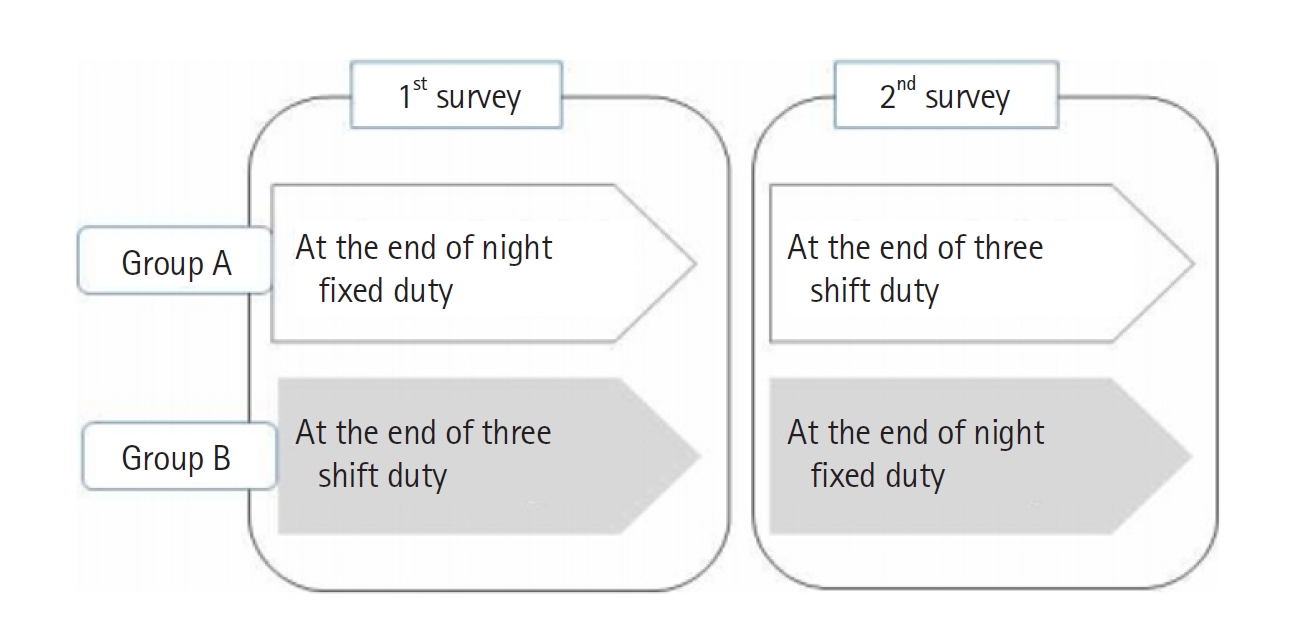
Purpose This study aimed to compare fatigue, adaptation to night shifts, and resilience among nurses who had experience with both fixed night duty and three-shift duty. Methods: This repeated-measures comparative study included 41 nurses at a university hospital in Incheon who had experienced both fixed night duty and three-shift duty. The measured variables were general characteristics, fatigue, adaptation to night shifts, and resilience. Data were analyzed using descriptive statistics, including frequencies, percentages, means, and standard deviations, as well as the paired t-test. Results: No statistically significant differences were found in fatigue or resilience between periods of fixed night duty and three-shift duty. However, adaptation to night shifts was significantly higher during fixed night duty. Conclusion: Because adaptation to night shifts was significantly higher during fixed night duty, fixed night duty may be considered an alternative work arrangement that broadens nurses’ scheduling options. Because fixed night duty is based on voluntary participation, its potential benefits should be clearly communicated to nurses.
Purpose The purpose of this study was to establish a structural model explaining the factors affecting advanced beginner-stage nurses' intention to continue employment. This model was designed to provide basic data for improving the intention to continue employment among advanced beginner-stage nurses and to efficiently manage nurses as human resources. Methods In order to construct a hypothetical model, latent factors affecting nurses' intention to continue employment were identified through systematic review and meta-analysis. As a result of systematic review, hypothetical model was constructed with nursing professionalism, calling, work environment, positive psychological capital, and job satisfaction. Structural equation modeling was then conducted through SPSS 25.0, AMOS 22.0, and Mplus 6.12 statistics programs. Results First, none of the pathways affected by nursing professionalism were statistically significant. Second, the final structural model showed fit very well based on the fit indices RMSEA=.062, SRMR=.052, RMR=.048, CFI=0.95, and TLI=0.94. Conclusion This study’s results identified that job satisfaction, calling, work environment, and positive psychological capital affected advanced beginner-stage nurses' intention to continue employment. Among these, job satisfaction was the most powerful variable influencing the decision to continue employment for advanced beginner-stage nurses.
Citations
Citations to this article as recorded by
The Effect of Needs Satisfaction, Job Crafting, and Nursing Practice Environment on Retention Intention in Advanced Beginner-Stage Nurses Sunghyun Baek, Kyoung Ja Moon Journal of Korean Academy of Nursing Administration.2026; 32(2): 93. CrossRef
Retention and Associated Factors among Nurses in Small- and Medium-Sized Hospitals across South Korea Eun Mi Kim, Su Jung Choi, mi sug Lee, Hyun Jin Park, Jeong Yun Park Journal of Korean Critical Care Nursing.2025; 18(3): 16. CrossRef
The Influences of Positive Psychological Capital and Nursing Work Environment on Job Embeddedness among Advanced Beginner Nurses Eunhye Gil, Mi-Ae You, Ji Yea Lee, Sunjoo Boo Journal of Korean Academy of Nursing Administration.2025; 31(5): 549. CrossRef
The Influences of Teamwork and Grit on Job Adaptation and Intention to Remain among Advanced Beginner Nurses Seon Kyeong Jeong, Kyoung Ja Kim, Eun Ji Choi Journal of Korean Academy of Nursing Administration.2024; 30(4): 379. CrossRef



 First
First Prev
Prev