Purpose This study aimed to identify leadership development needs among novice and advanced beginner nurses sand provide empirical evidence for developing targeted leadership competency enhancement programs. Methods: Data were collected through a nationwide online survey from January 15 to February 28, 2025, using proportional quota sampling. The sampling quotas reflected hospital region and hospital type. Data from 283 nurses were analyzed. Descriptive statistics, including frequencies, percentages, means, and standard deviations, were calculated using IBM SPSS version 27.0. Results: Participants had a mean age of 27.5 years and a mean clinical experience of 1.75 years. Self-leadership was the leadership type most desired for development (3.97±0.84). The need for leadership programs was high among nurses with 1–3 years of clinical experience, with a mean score of 3.90. The most desired competencies were clinical performance and practical skills (49.1%), stress management (40.3%), and communication (39.2%). Intention to use mobile-based leadership programs was moderate. Short video lectures (70.0%) and self-directed learning (42.8%) were the most preferred content format and learning method, respectively. Conclusion: These findings indicate a need for practical, systematic programs centered on self-leadership that address clinical performance, practical skills, stress management, and communication during the early career stage of nursing.
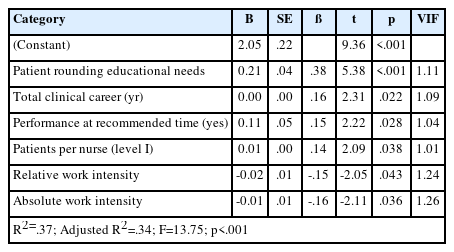
Purpose This study aimed to identify factors associated with nurses’ perceptions of patient rounding. Methods: A descriptive cross-sectional online survey was conducted. A total of 147 nurses working in general hospital wards were recruited online. The survey assessed general characteristics, including demographic, job-related, and work-related characteristics; patient rounding educational needs; and organizational factors, including nursing workload and nursing work intensity. Factors associated with nurses’ perceptions of patient rounding were analyzed using multiple regression analysis. Results: Nurses’ perceptions of patient rounding were positively associated with patient rounding educational needs (β=.38, p < .001), total clinical career (β=.16, p=.022), performance of rounding at recommended times (β=.15, p=.028), and the number of Level I patients assigned during the current shift (β=.14, p=.038). In contrast, relative work intensity (β=−.15, p=.043) and absolute work intensity (β=−.16, p=.036) were negatively associated with nurses’ perceptions of patient rounding. Conclusion: Nurses’ perceptions of patient rounding were associated with both individual and organizational factors. These findings support the need for structured rounding education and organizational strategies that account for nurses’ workload, work intensity, and patient acuity to facilitate patient rounding in clinical practice.



 First
 Prev