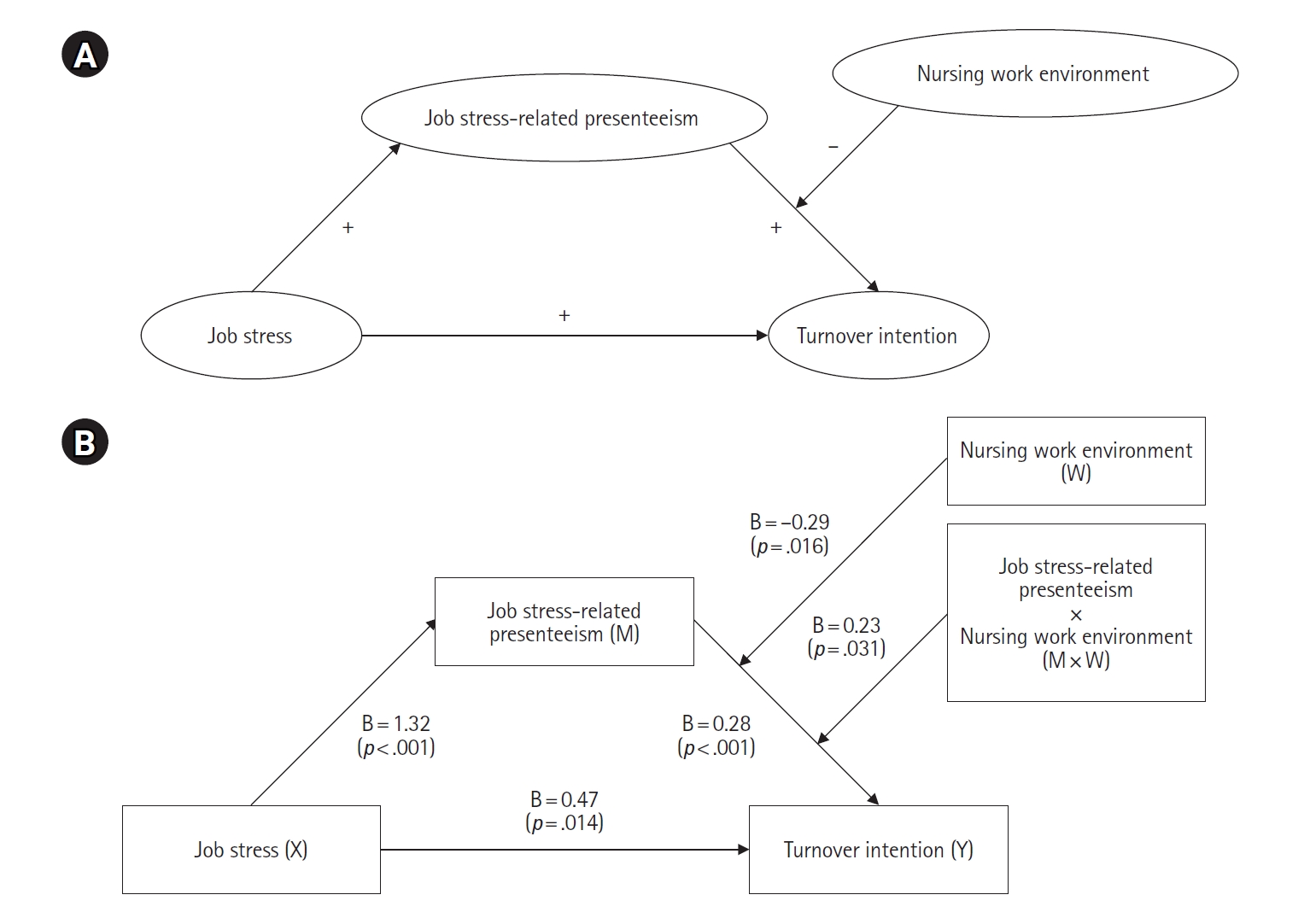
Purpose This study examined the mediating effect of job stress-related presenteeism and the moderated mediating effect of the nursing work environment on the relationship between job stress and nurses’ turnover intention. Methods: A predictive correlational research design was employed from September 8 to September 26, 2023, involving 176 nurses working in general and tertiary hospitals nationwide. Data were analyzed using IBM SPSS Statistics version 25.0, the PROCESS macro version 4.2, and the EasyFlow Statistics macro version 1.8. Results: The mean scores were 2.76±0.38 for job stress, 3.11±0.81 for job stress-related presenteeism, 2.47±0.50 for nursing work environment, and 3.57±0.75 for turnover intention. Job stress was positively associated with turnover intention through job stress-related presenteeism (B=1.32, p<.001), and the nursing work environment significantly moderated this partial mediating effect (B=0.31; 95% CI, 0.04~0.53). Conclusion: These findings may inform the development of strategies and policies aimed at reducing nurses’ turnover intention and improving human resource management in clinical settings. In addition, this study contributes to the growing body of research on job stress, job stress-related presenteeism, nursing work environment, and turnover intention among nurses.
Purpose This study aimed to explore the effects of presenteeism, burnout, and nursing performance on intention to retention among nurses of an intensive care unit in one tertiary hospital.
Method The data were collected from from July 1 to July 31, 2023, from 172 nurses at intensive care units. Data were analyzed using the SPSS/WIN 26.0 program.
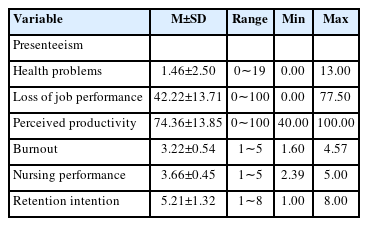
Results A four-step hierarchical regression model, including control variables, presenteeism, burnout, and nursing performance, accounted for 44.9% of the factors influencing intention to retention. Burnout (β=-.54, p<.001), nursing performance (β=.21, p=.002), health problem (β=-.07, p=.040), and experience of turnover (β=-.16, p=.008) were identified as the significant predictor of intention to retention. Model III, which adds burnout, has a significant 23.5%p increase in explanatory power over Model II, indicating that burnout has the strongest impact on intention to retention.
Conclusion For enhancing the intention to retention of the intensive care nurses, it is necessary to provide a systematic strategy and support to increase the performance of nurses and to try to reduce the burnout and health problems of nurses.
Citations
Citations to this article as recorded by
Job Burnout Associated with Work Environment among Physician Assistant Nurses: A Secondary Analysis of the 2025 Survey on Working Conditions of Health and Medical Workers Kyongok Park, Hanyi Lee, Hyeon Sik Chu Journal of The Korean Society of Living Environmental System.2026; 33(2): 188. CrossRef


 First
First Prev
Prev