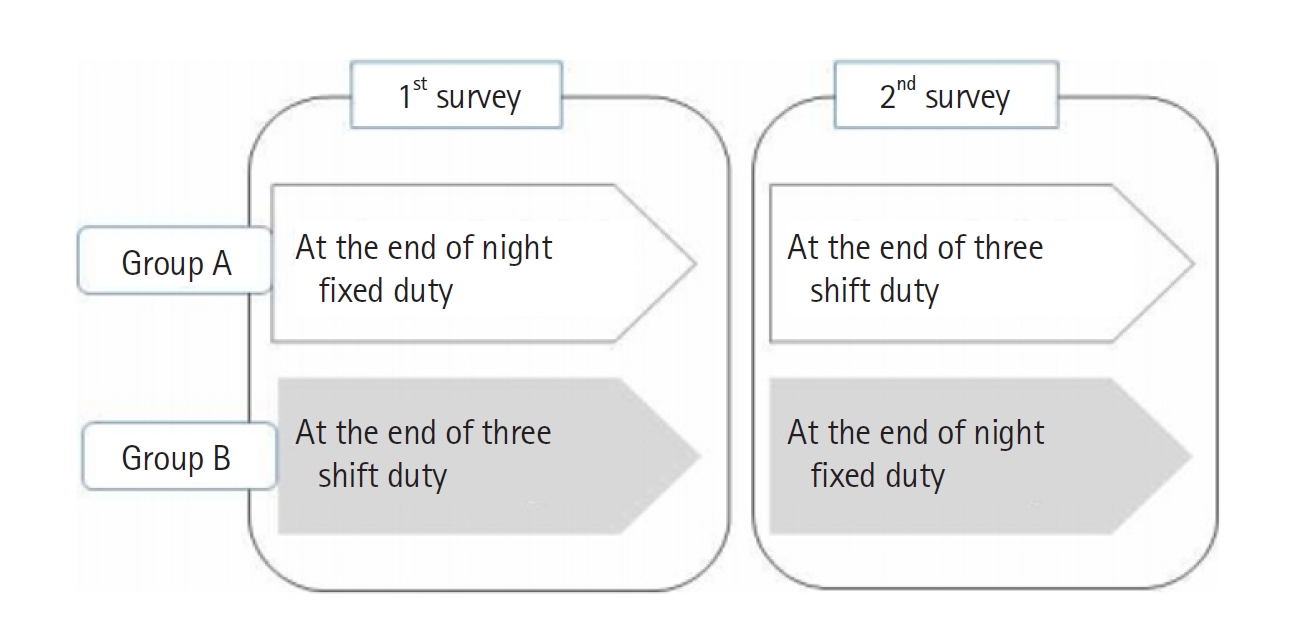
Purpose This study aimed to compare fatigue, adaptation to night shifts, and resilience among nurses who had experience with both fixed night duty and three-shift duty. Methods: This repeated-measures comparative study included 41 nurses at a university hospital in Incheon who had experienced both fixed night duty and three-shift duty. The measured variables were general characteristics, fatigue, adaptation to night shifts, and resilience. Data were analyzed using descriptive statistics, including frequencies, percentages, means, and standard deviations, as well as the paired t-test. Results: No statistically significant differences were found in fatigue or resilience between periods of fixed night duty and three-shift duty. However, adaptation to night shifts was significantly higher during fixed night duty. Conclusion: Because adaptation to night shifts was significantly higher during fixed night duty, fixed night duty may be considered an alternative work arrangement that broadens nurses’ scheduling options. Because fixed night duty is based on voluntary participation, its potential benefits should be clearly communicated to nurses.
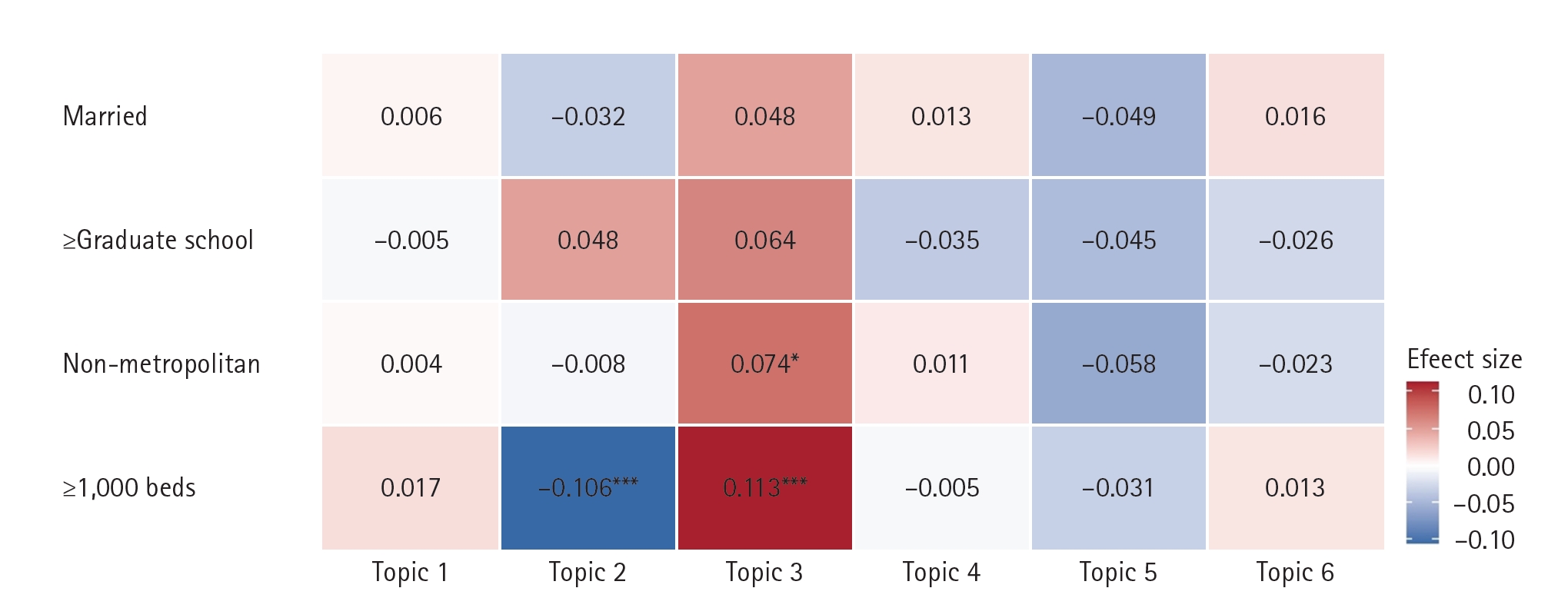
Purpose This study explored nurses’ experiences and perspectives regarding the shift system improvement pilot project, as well as their recommendations for shift work policies, and examined variations according to nurse and hospital characteristics. Methods: Structural topic modeling was applied to open-ended survey responses from 208 nurses. Topic prevalence was examined according to career length, marital status, education, hospital location, and bed capacity. Findings: Six topics emerged: experiences with implementing a pilot project for shift system improvement; shift system improvements for sustainability; physical burden and challenges of fixed night shifts; the impact of shift system improvement on personal life; nurse staffing levels for providing safe nursing care; and nursing workforce expansion and work distribution for quality care. Workforce adequacy showed the highest prevalence and was the dominant theme across all career lengths. The prevalence of system improvement was higher among nurses with ≤3 years and >10 years of experience, whereas nurses with 3–10 years of experience focused more on project participation. Smaller hospitals prioritized system improvements, whereas larger hospitals emphasized the physical burden. Conclusion: Nursing workforce adequacy emerged as nurses’ primary concern, surpassing concerns related to shift system design. Policy should prioritize legally mandated nurse staffing ratios as the foundation for sustainable shift systems, with interventions tailored to organizational capacity and career length.
Purpose This study aimed to identify the changes in dietary behavior of shift work nurses and its influencing factors over time.
Methods: This was a secondary data analysis study based on the Shift Work Nurses’ Health and Turnover study. Data of 165 shift work nurses, who were followed for three-time points [before shift work (T0), after 6 months (T1), and after 18 months(T2) of shift work], were analyzed. Dietary behavior, level of stress, fatigue, depressive symptoms, and the amount of physical activity were measured. SPSS 28.0 was used to analyze the data to acquire descriptive statistics, repeated-measures ANOVA, and multiple linear regression with generalized estimating equations (GEE).
Results: Dietary behavior of shift work nurses was poorer at T1 and T2 as compared to T0. As a result of GEE, shift work duration, level of stress, fatigue, and depressive symptoms were found to have negative impacts on dietary behavior.
Conclusion: Dietary behavior deteriorated and remained poor over time since shift work began. Shift work, along with stress, fatigue, and depressive symptoms, were the factors influencing their dietary behavior. Thus, to improve shift work nurses’ dietary behavior, efforts to decrease stress, and alleviate fatigue and depressive symptoms are urgently required.
Citations
Citations to this article as recorded by
Factors Associated With Insomnia in Shift-Working Airline Mechanics Da-In Park, Jung-Ha Kim Workplace Health & Safety.2025; 73(11): 562. CrossRef
Eating behaviors, home meal replacement consumption, and nutrition quotient: a comparative study of male shift and non-shift workers in Chungcheong, Korea Yeon Jin Lee, Munkyong Pae Nutrition Research and Practice.2025; 19(5): 758. CrossRef
Dietary behavior and its influencing factors among experienced shiftwork nurses: a secondary analysis Soyeon Kim, Jison Ki, Ji Yun Choi, Woan Heui Choi, Smi Choi-Kwon Korean Journal of Women Health Nursing.2023; 29(1): 32. CrossRef



 First
First Prev
Prev