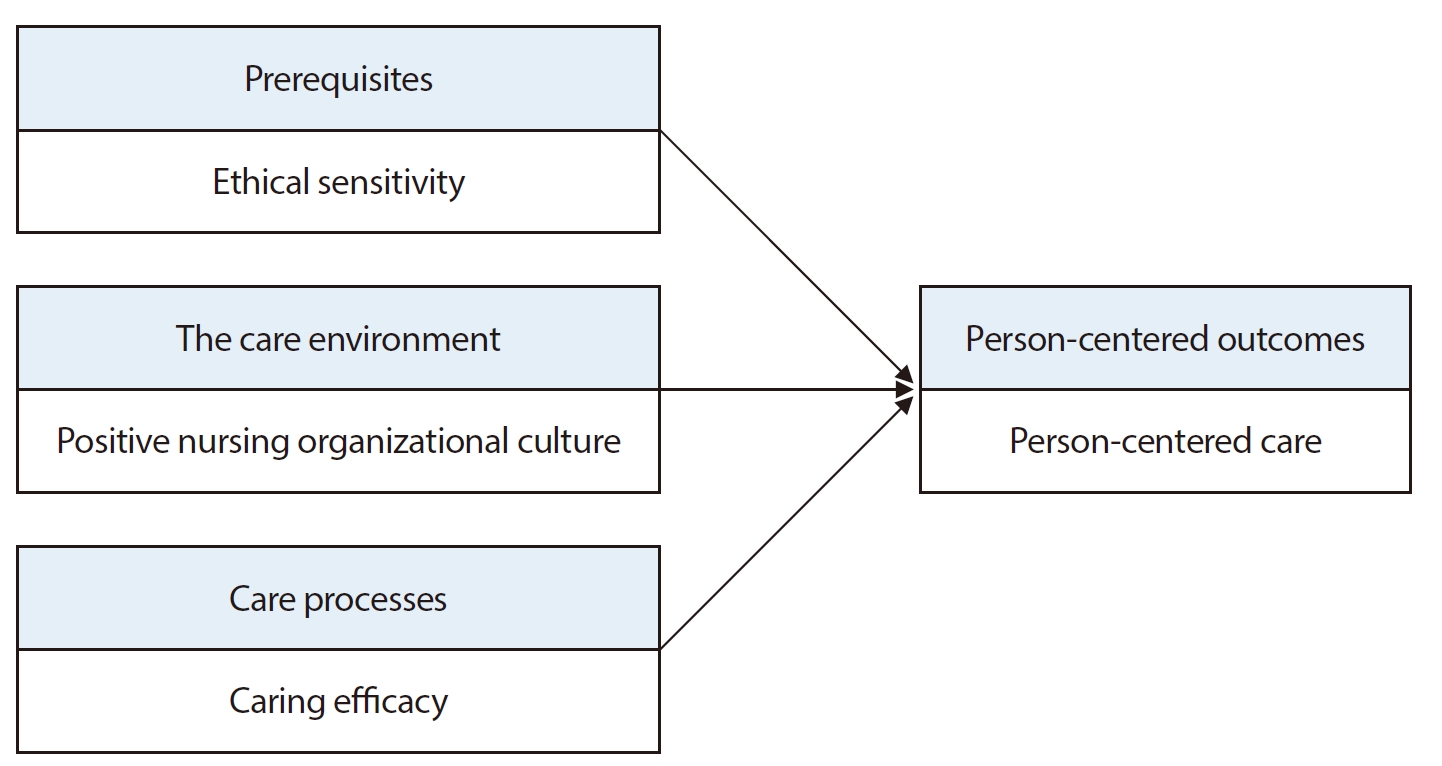
Purpose This study aimed to identify the influence of ethical sensitivity, positive nursing organizational culture, and caring efficacy on person-centered care among clinical nurses in general hospitals. Methods: The participants were 181 clinical nurses working in general hospitals located in Jinju and Changwon cities, Gyeongnam Province, South Korea. Data were collected from December 17, 2024, to January 25, 2025. Data analysis was performed using SPSS Statistics 27.0 and included descriptive statistics, the independent t-test, one-way analysis of variance, Pearson correlation analysis, and multiple regression analysis. Results: The participants’ mean scores were 4.16±0.42 for ethical sensitivity, 3.76±0.64 for positive nursing organizational culture, 4.23±0.67 for caring efficacy, and 3.90±0.50 for person-centered care. Person-centered care showed a significant positive correlation with ethical sensitivity (r=.49, p<.001), positive nursing organizational culture (r=.54, p<.001), and caring efficacy (r=.58, p<.001). Caring efficacy had the most significant effect on person-centered care (β=.41, p<.001), followed by positive nursing organizational culture (β=.30, p<.001) and ethical sensitivity (β=.19, p=.005). These variables accounted for 47.8% of the variance in person-centered care. Conclusion: To improve person-centered care, educational programs aimed at improving ethical sensitivity and caring efficacy, along with the establishment of a nursing organizational culture based on trust and respect, should be implemented.
Purpose This descriptive correlation study sought to evaluate the mediating effect of nursing work environment on the relationship between work-family conflict and turnover intention among married female nurses. Methods This study enrolled 149 married female nurses employed at a university hospital in G. province J City. For data analysis, the SPSS/WIN 25.0 program and SPSS PROCESS Macro version 4.2 was used. Results The mean score of work-family conflict among married female nurses was 2.99±72 out of 5 points, nursing work environment was 2.50±39 out of 4 points, and turnover intention was 3.96±69 out of 5 points. Turnover intention was positively correlated with work-family conflict (r=.34, p<.001), and negatively correlated with nursing work environment (r=-.34, p<.001). The nursing work environment had a parial mediating effect (β=.32, p<.001) on the relationship between work-family conflict and turnover intention. Conclusion Work-family conflict and turnover intention among married female nurses influenced each other, with the nursing work environment having a partial mediating effect. This study can serve as basis for addressing work-family conflict, improving the nursing work environment and reducing turnover among married female nurses.
Citations
Citations to this article as recorded by
Development and psychometric evaluation of the Work-Family Enrichment Scale for married shift-working nurses in Korea: a methodological study Mi-Jin Park, Il-Ok Kim Women's Health Nursing.2026; 32(1): 16. CrossRef
The mediating effects of nurses’ professional values on the relationship between work environment and organizational commitment among long-term care hospital nurses Won Hee Jun BMC Nursing.2025;[Epub] CrossRef
A Grounded Theory Approach to Understanding Retention among Career Nurses in Clinical Practice Su Mi Choi, Ji Won Kim The Korean Journal of Health Service Management.2025; 19(2): 57. CrossRef
Purpose This study aimed to identify the mediating effects of positive psychological capital on the relationship between occupational stress and organizational commitment in physician assistant nurses. Methods The participants were 152 physician assistant nurses recruited from two university hospitals. Data was collected through a survey. The SPSS/WIN program (version 25.0) was used for the data analysis. Data was analyzed using descriptive stastics, t-test, ANOVA, Pearson’s correlation analysis, and hierarchical regression. Results There was a significant negative correlation organizational commitment and occupational stress (r=-.57, p<.001), and a positive correlation with positive psychological capital (r=.47, p<.001). There was a negative correlation (r=-.32, p<.001) between occupational stress and positive psychological capital. In addition, positive psychological capital had a partial mediating effect on the relationship between occupational stress and organizational commitment (β=.32, p<.001). Conclusion Positive psychological capital serves as a partial mediator in the relationship between occupational stress and organizational commitment among physician assistant nurses. The results of this study can be used reduce occupational stress and improve organizational commitment by improving the positive psychological capital of physician-assistant nurses.
Citations
Citations to this article as recorded by
Job Burnout Associated with Work Environment among Physician Assistant Nurses: A Secondary Analysis of the 2025 Survey on Working Conditions of Health and Medical Workers Kyongok Park, Hanyi Lee, Hyeon Sik Chu Journal of The Korean Society of Living Environmental System.2026; 33(2): 188. CrossRef
The influence of occupational stress and grit on clinical nurses’ organizational commitment Sun Mi Ha The Journal of Korean Academic Society of Nursing Education.2026; 32(2): 170. CrossRef
Nurses’ Experiences of Physician Assistant Roles during the 2024 Residents’ Strike in Korea before the Enactment of the Nursing Act: A Phenomenological Study Ji Won Ryu, Su Mi Kim Journal of Korean Academy of Nursing Administration.2026; 32(4): 232. CrossRef
Role Transformation and Adaptation of Physician Assistants during the 2024 Medical Workforce Shortage: A Phenomenological Study Tae Yeong Yang, Nahyun Lee Journal of Korean Academy of Nursing Administration.2025; 31(3): 259. CrossRef
The Influence of Clinical Practice Nurses' Self-Leadership, Role Conflict, and Practice Environment on Patient Safety Competency Jeong Hwa Heo, Ji Hyun Sung Journal of Korean Academy of Nursing Administration.2025; 31(4): 458. CrossRef
The Influences of Positive Psychological Capital and Nursing Work Environment on Job Embeddedness among Advanced Beginner Nurses Eunhye Gil, Mi-Ae You, Ji Yea Lee, Sunjoo Boo Journal of Korean Academy of Nursing Administration.2025; 31(5): 549. CrossRef
Purpose The purpose of this study was to identify the effects of organizational justice, organizational culture and emotional intelligence on intention to stay in reemployed nurses.
Methods: Data were collected from 154 reemployed nurses working in the two university hospitals located in G Province. Data were analyzed using t-test, ANOVA, Pearson’s Correlation Coefficient and Multiple Regression Analysis with SPSS/WIN 25.0.
Results: Factors influencing intention to stay in the participants were period willing to stay (β=.36, p<.001), emotional intelligence (β=.35, p<.001), career break (β=.16, p=.015), organizational justice (β=.14, p=.046). The total explanatory power was 31%.
Conclusion: In this study, organizational justice, emotional intelligence, career interruption, period willing to stay were found to be influential factors affecting intention to stay in reemployed nurses. A systematic intervention program for emotional intelligence is needed to increase the intention of retention in reemployed nurses. Further, human resource managers and specialists should consider organizational justice when designing the talent retention strategies.
Citations
Citations to this article as recorded by
The Influence of Role Conflict and Organizational Justice on Nursing Service Quality: A Cross-Sectional Survey on Nurses’ Perceptions Jeon Seung Ahn, Jeong Eun Moon The Korean Journal of Health Service Management.2026; 20(1): 75. CrossRef
Influence of Nurses' Moral Distress and Ethical Nursing Competence on Retention Intention Ji-Hyun Choi, Mi-Jin Byun, Thi Ninh Do Journal of Korean Academy of Nursing Administration.2025; 31(1): 36. CrossRef
Effect of emotional intelligence and organizational culture on clinical reasoning competence among oncology nurses Mijeong Gu, Yoonjung Kim, Hyeji Shin European Journal of Oncology Nursing.2025; 79: 103038. CrossRef
Mediating Effects of Job Satisfaction and Organizational Commitment on the Relationship between Organizational Justice and Intent to Stay among Junior Nursing Officers Ji Soo Bae, Sung-Heui Bae Journal of Korean Academy of Nursing Administration.2025; 31(5): 527. CrossRef
Effects of Professional Self-concept and Nursing Organizational Culture on Intention of Retention of Middle-aged Nurses Jinju Kim, Yeongmi Ha Journal of Korean Academy of Nursing Administration.2024; 30(2): 130. CrossRef
The Influence of Transformational Leadership and Organizational Justice on Intention to Stay with Mediated Work Engagement Gregorius Deri Saputra, Giriati, Hasanudin, Ahmad Shalahuddin Ilomata International Journal of Management.2024; 6(2): 539. CrossRef
Exploring research trends in nursing organizational culture using topic modeling Eun-Jun Park, Chan Sook Park The Journal of Korean Academic Society of Nursing Education.2024; 30(4): 371. CrossRef
Factors Influencing Clinical Nurses’ Perception of Structural and Content Career Plateau Ji Hye Kim, Ji Yun Lee Journal of Korean Academy of Nursing.2024; 54(4): 534. CrossRef
The Effect of Work Value, Psychological Ownership and Nursing Working Environment on Intention of Retention in Hospital Nurses Ji Hey Kim, Yoon Ju Cho, So Eun Jang Journal of Korean Critical Care Nursing.2023; 16(3): 62. CrossRef
The impact of organizational justice on intention to stay: The mediating role of organizational commitment Shatha Mahfouz, Mutia Sobihah Abd Halim, Ayu Suriawaty Bahkia, Noryati Alias Corporate Governance and Organizational Behavior Review.2022; 6(1): 139. CrossRef
Workplace spirituality and organizational justice in turnover intention of mental health professionals at small‐sized centres Eunmi Hwang, Yeojin Yi Journal of Nursing Management.2022; 30(1): 328. CrossRef
The Factors That Affect Turnover Intention According to Clinical Experience: A Focus on Organizational Justice and Nursing Core Competency Hanna Choi, Sujin Shin International Journal of Environmental Research and Public Health.2022; 19(6): 3515. CrossRef
Purpose The purpose of this study was to test the mediating effects of resilience in the relationship between role conflict and burnout in physician assistant nurses. Methods Participants were 144 physician assistant nurses recruited from 2 university hospitals. A questionnaire scale was used to collect the data. Data were analyzed using descriptive statistics, independent t-test, one-way ANOVA, Pearson correlation analysis. and liner regression analysis. Results There were significant positive relationships for burnout and role conflict (r=.45, p<.001), and a negative correlation with resilience (r=-.47, p<.001). There was a negative correlation (r=-.30, p<.001) between role conflict and resilience. In addition, resilience partial mediates role conflict and burnout. As a result of testing the significance of mediating effect using bootstrapping, the mediating effect was significant by resilience ((y=.11, p=.008). Conclusion In this study, role conflict and burnout of physician assistant nurses were the factors that had an impact on each other and resilience had a partial mediating effect in the relationship between role conflict and burnout. The results of this study can be used as basic data for establishing management plans on role conflict and burnout by improving the resilience of physician assistant nurses.
Citations
Citations to this article as recorded by
The Influence of Role Conflict, Emotional Labor, and Resilience on Burnout in Nurses: A Descriptive Correlational Study Ahsil Lee, Kuem Sun Han, Soo Kyung Park, Sung Reul Kim, Soo Yeon Lee, Nari Lee, Siyoung Koak STRESS.2026; 34(1): 25. CrossRef
Job Burnout Associated with Work Environment among Physician Assistant Nurses: A Secondary Analysis of the 2025 Survey on Working Conditions of Health and Medical Workers Kyongok Park, Hanyi Lee, Hyeon Sik Chu Journal of The Korean Society of Living Environmental System.2026; 33(2): 188. CrossRef
Organizational Climate, Role Conflict, and Job Esteem Among Registered Nurses in Physician-Delegated Roles in South Korea: A Cross-Sectional Study Youngeun Lee, Gaeun Kim Healthcare.2026; 14(10): 1368. CrossRef
Factors Influencing Burnout of Nurses in Comprehensive Nursing Care Service Wards: Focusing on Positive Psychological Capital, Role Conflict, and Authentic Leadership Jung Wha Park, Kyoung Ja Kim, Ji Young Im, Ji Young Kim Journal of Korean Academy of Nursing Administration.2025; 31(4): 345. CrossRef
The Influence of Clinical Practice Nurses' Self-Leadership, Role Conflict, and Practice Environment on Patient Safety Competency Jeong Hwa Heo, Ji Hyun Sung Journal of Korean Academy of Nursing Administration.2025; 31(4): 458. CrossRef
Effects of Organizational Cynicism and Socialization on Nurses’ Job Burnout: A Career‐Stage‐Based Analysis Hee Jin Kim, Hae Jeong An, Soo-hyun Nam, Jungmin Lee, Maria Engström Journal of Nursing Management.2025;[Epub] CrossRef
Role Conflict of Physician Assistants with Nursing Licenses in Korea Byeongkwan Kim, Wonhee Jung Journal of Korean Academy of Nursing Administration.2024; 30(2): 141. CrossRef
Job satisfaction and moral distress of nurses working as physician assistants: focusing on moderating role of moral distress in effects of professional identity and work environment on job satisfaction Minsub Kim, Younjae Oh, Joo Yun Lee, Eunhee Lee BMC Nursing.2023;[Epub] CrossRef
Intention to Stay in Specialist Trauma Nurses: Relationship With Role Conflict, Stress, and Organizational Support Jeong Eun Yoon, Ok-Hee Cho Journal of Trauma Nursing.2022; 29(1): 21. CrossRef
Impact of Nurse–Physician Collaboration, Moral Distress, and Professional Autonomy on Job Satisfaction among Nurses Acting as Physician Assistants Yunmi Kim, Younjae Oh, Eunhee Lee, Shin-Jeong Kim International Journal of Environmental Research and Public Health.2022; 19(2): 661. CrossRef
Effect of Role Conflict on Job Satisfaction by Comprehensive Nursing Care Service Ward Nurse: Moderating and Mediating Effect of Resilience So Hee Lee, Roma Seol, Min Hye Kim Journal of Korean Critical Care Nursing.2021; 14(3): 50. CrossRef
Types of Perceptions Regarding Professionalism of Physician Assistant Geunmyun Kim, Junghyun Seo, Sunok Lee, Junhee Bae, Youngju Yang Stress.2020; 28(4): 202. CrossRef



 First
First Prev
Prev