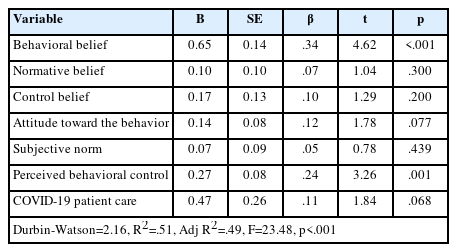
Purpose The coronavirus disease 2019 (COVID-19) pandemic has substantially influenced nursing environments and has underscored the importance of active patient care. Nursing intention plays a critical role in the provision of care for patients with COVID-19; however, limited evidence exists regarding the factors that influence nurses’ intention to provide patient care specific to COVID-19. This study aimed to examine factors associated with nursing intention for COVID-19 patient care, guided by the Theory of Planned Behavior. Methods: This study employed a cross-sectional descriptive design. Data were collected from August 30 to October 1, 2020, using structured questionnaires completed by 169 clinical nurses working in hospitals with more than 600 beds in Seoul, Korea. The collected data were analyzed using multiple regression analysis. Results: Behavioral beliefs (β=.34, p<.001) and perceived behavioral control (β=.24, p<.001) were significantly associated with nursing intention for COVID-19 patient care. Conclusion: There is a need to develop specific strategies and educational programs to enhance nursing intention for COVID-19 patient care in the context of emerging infectious diseases by strengthening behavioral beliefs and perceived behavioral control. Providing up-to-date care protocols or simulation-based education may help increase nurses’ behavioral beliefs and perceived behavioral control.
Purpose This study was conducted to identify the influences of critical thinking disposition and perceived nurse managers' leadership style on nurses' competency with evidence based practice in hospitals. Methods The participants were 147 nurses working in two university hospitals in Seoul, Korea. Data were collected during February and March in 2017 and were analyzed with Multiple Regression Analysis using SPSS/WIN 18.0. Results The most influential factor on nurses' competency of evidence based practice was critical thinking disposition (β=.55, p<.001), followed by transformation (β=.20, p=.011) which together explained their competency of evidence based practice up to 53.0%. Conclusion It is necessary to develop intervention programs and curriculum to enhance competence for nurses. It is also necessary to draw plans to develop nursing managers’ transformational leadership. Therefore not only clinical nurses but also throughout the organization, strategies and curriculums should be developed to help nurses perform evidence based practice.
Citations
Citations to this article as recorded by
Managerial Competency and Perceived Organizational Support in Relation to Job Stress Among Nurse Managers in the Republic of Korea: A Cross-Sectional Study Eun Ju Lee, Se Young Jung Healthcare.2026; 14(16): 2526. CrossRef
The associations of grit, self-leadership, and followership with competency in evidence-based practice among nurses in Korea: a descriptive correlational study Ha-young Kim, Jin-il Kim Journal of Korean Biological Nursing Science.2025; 27(2): 244. CrossRef
Association between Nurses’ Perceptions of Patient Safety Culture, Willingness to Report Near Misses, Critical Thinking Disposition, and Nursing Care Activities for Patient Safety Da Eun Lee, Bo Gyeong Lee Journal of Korean Academy of Nursing Administration.2024; 30(3): 283. CrossRef
Effects of Length of Employment and Head Nurse Leadership Style on the Clinical Competency of Staff Nurses in Taiwan Yu-Wen LIN, Chung-Fan NI, Shu-Fen HSU, Shiow-Luan TSAY, Heng-Hsin TUNG Journal of Nursing Research.2024; 32(3): e331. CrossRef
Influence of Nursing Students’ Competencies Who Participated in Simulation Training on Competency with Evidence-based Practice Yeon Jeong Su Journal of Korea Society for Simulation in Nursing.2024; 12(1): 33. CrossRef
Influence of Job Crafting on Evidence-Based Practical Skills of Dental Hygienists Min-ji Kim, Kyu-ri Kim, Yun-ji Kim, Seo-yeon Im, You-bin Cho, Ru-by Choi, Hee-jung Lim Journal of Dental Hygiene Science.2023; 23(4): 330. CrossRef
The Leadership Experience of Advanced Practice Nurses in a Tertiary Hospital Setting : Focus Group Interview Eun Sook Kim, Nayeon Kim, Su Jung Choi, Nari Kim, Young Hee Kim, Jung Yoon Lee, Eun-Hye Kim Journal of Korean Critical Care Nursing.2023; 16(3): 48. CrossRef
Validity and Reliability of a Korean Version of the ConCom Safety Management Scale Mi Young Kwon, Nam Yi Kim International Journal of Environmental Research and Public Health.2021; 18(23): 12514. CrossRef
Purpose This study was done to provide basic data for nursing intervention to increase communication ability of operating room nurses by identifying the relation among their verbal violence experience, job stress, resilience, and communication ability. Methods The participants were 136 nurses, working in the operating rooms of six academic and general hospitals located in Seoul and Gyeonggi-Do. Data were collected from May 1st through October 31st, 2016. Collected data were analyzed for frequency and percentage, mean and standard deviation, association among related factors, and stepwise multi-regression using the SPSS 21.0 program. Results It was found that the strongest factor influencing the communication ability of operating room nurses was persistence (β=.41, p <.001; sub-item of Resilience), followed by support (β=.26, p =.001; sub-item of Resilience). These two sub-items have positive influences on communication ability of operating room nurses. The lack of professional knowledge and skill (β=-.19, p <.001; sub-item of job stress) and verbal violence experience from nurse (β=-.16, p <.001; sub-item of verbal violence experience) have negative influences on communication ability of operating room nurses. These sub-items explained 47.0% of communication ability of operating room nurses. Conclusion The study results can be used as basic data to develop effective communication. Also, the results show the necessity of developing and applying concrete nursing interventions to improve job satisfaction of operating room nurses.
Citations
Citations to this article as recorded by
Workplace violence against operating room nurses: A systematic review Mohammadreza Zarei, Mahboubeh Rezaei, Mohammadreza Abedzadeh Perioperative Care and Operating Room Management.2026; 43: 100640. CrossRef
The Influence of Verbal Violence Experience, Surgical Teamwork, and Resilience on Burnout among Operating Room Nurses Yu Shin Kim, Jung Suk Park Journal of Korean Academy of Nursing Administration.2026; 32(2): 114. CrossRef
Understanding work-related stress among nurses in Indonesian community health centers: A qualitative study Fatma Siti Fatimah, Hartono, Suwarto, Sapja Anantanyu Multidisciplinary Science Journal.2026; 8(11): 2026758. CrossRef
Influence of Self-awareness, Communication Efficacy, Empathy, and Nursing Organizational Culture on Communication Competence among Hospital Nurses Sunhee Jung, Sunyoung Jung Journal of Korean Academy of Nursing Administration.2025; 31(3): 280. CrossRef
The Effects of Operating Room Nurses’ Experiences of Verbal Violence, Resilience, and Social Support on Post-Traumatic Stress Do Kyun Kim, Sung Hee Shin Healthcare.2025; 13(16): 2027. CrossRef
Effects of Verbal Abuse Experience and Communication Competence on Burnout among Operating Room Nurses Yesol Byon, Yoon Goo Noh Journal of Health Informatics and Statistics.2024; 49(2): 117. CrossRef
The Effects of Communication Ability, Job Satisfaction, and Organizational Commitment on Nursing Performance of Intensive Care Unit Nurses Nu Ri Kim, Sung Eun Kim, So Eun Jang Journal of Korean Critical Care Nursing.2022; 15(1): 58. CrossRef
Clinical nurses’ experiences of workplace verbal violence: a phenomenological study Min Soo Woo, Hyoung Suk Kim, Jeung-Im Kim Korean Journal of Women Health Nursing.2022; 28(2): 154. CrossRef
Communication competence and resilience are modifiable factors for burnout of operating room nurses in South Korea Eun Yeong Lee, Kyoung-ja Kim, Sangjin Ko, Eun Kyeung Song BMC Nursing.2022;[Epub] CrossRef
Moderating Effect of Nursing Organizational Culture on the Relationship between Verbal Violence and Burnout in Operating Room Nurses Sojeong Lim, Sujin Shin Korean Journal of Adult Nursing.2022; 34(2): 196. CrossRef
Influences of Workplace Bullying and Job Satisfaction on Happiness among Perioperative Nurses Song I Park, Key Ha Kim Journal of Korean Academy of Nursing Administration.2021; 27(1): 54. CrossRef


 First
First Prev
Prev