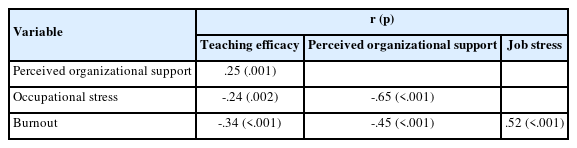
Purpose This study aimed to investigate the effects of teaching efficacy, perceived organizational support, and occupational stress on burnout among preceptor nurses. Methods: Participants included 156 nurses who had at least one month of preceptor experience within the past year. Data were collected using a structured self-report questionnaire and analyzed with SPSS version 27.0. Descriptive statistics, independent sample t-tests, one-way analysis of variance with Scheffé post-hoc tests, Pearson’s correlation analysis, and multiple regression analysis were performed. Results: Occupational stress (β=.36, p<.001) and teaching efficacy (β=-.17, p=.017) were significant predictors of burnout among preceptor nurses, jointly explaining 36.0% of the variance. Conclusion: Occupational stress and teaching efficacy were identified as key determinants of burnout in preceptor nurses. Effective burnout prevention strategies should focus on reducing occupational stress through workload management and strengthening teaching efficacy via continuous training and organizational support.


 First
First Prev
Prev