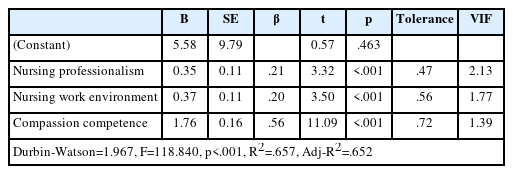
Purpose This study aimed to identify the influence of nursing professionalism, the nursing work environment, and compassion competence on person-centered care among nurses working in comprehensive nursing care units. Methods: An online survey using structured self-report questionnaires was administered to 190 nurses in comprehensive nursing care units at three tertiary general hospitals. The collected data were analyzed using descriptive statistics, the independent t-test, the Mann-Whitney U-test, one-way analysis of variance, Pearson’s correlation coefficient, and multiple linear regression using SPSS version 29.0 program. Results: The average score for person-centered care was 3.70±0.49, nursing professionalism was 3.56±0.51, the nursing work environment was 2.53±0.46, and compassion competence was 4.01±0.47. Person-centered care demonstrated significant positive correlations with nursing professionalism (r=.636, p<.001), the nursing work environment (r=.542, p<.001), and compassion competence (r=.743, p<.001). Factors influencing person-centered care included compassion competence (β=.56, p<.001), nursing professionalism (β=.21, p<.001), and the nursing work environment (β=.20, p<.001), with an explanatory power of 65.2% (F=118.84, p<.001). Conclusion: To improve person-centered care among nurses in comprehensive nursing care units, it is necessary to strengthen nurses’ compassion competence and professionalism, as well as enhance the nursing work environment. The findings of this study may be used as foundational evidence for developing programs to promote person-centered care in comprehensive nursing care units.
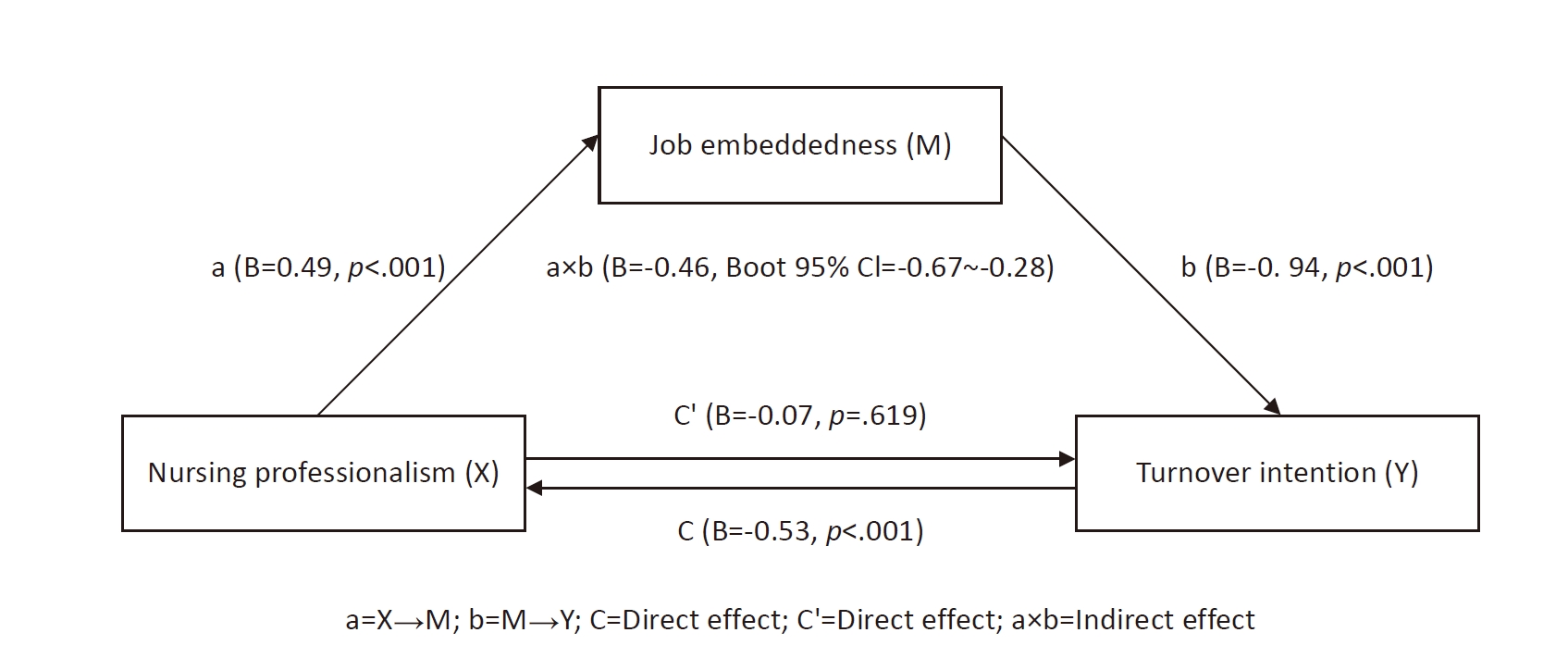
Purpose This study investigates the mediating effect of job embeddedness in the relationship between nursing professionalism and turnover intention among clinical nurses. Methods: A nationwide online survey was conducted using a structured questionnaire. Participants included 204 clinical nurses from tertiary hospitals in South Korea. Data on general characteristics, nursing professionalism, job embeddedness, and turnover intention were collected through self-reported questionnaires from March 19 to March 22, 2024. The analysis involved descriptive statistics, independent t-tests, one-way analysis of variance, Scheffé test, Pearson's correlation coefficients, multiple linear regression analysis, and bootstrapping, using SPSS/WIN version 29.0 and the SPSS PROCESS macro 4.2 version programs. Results: The mean score of nursing professionalism was 3.48±0.45 out of 5, job embeddedness was 3.13±0.52 out of 5, and turnover intention was 2.80±1.00 out of 5. Nursing professionalism did not directly impact turnover intention (B=-0.07, p=.649). Job embeddedness acted as a mediating factor in the relationship between nursing professionalism and turnover intention (B=-0.46, p<.05). Conclusion: These findings suggest that increasing job embeddedness can reduce nurses' turnover intention. Therefore, to decrease nurses' turnover intention, it is essential to enhance nursing professionalism while simultaneously promoting job embeddedness.


 First
First Prev
Prev