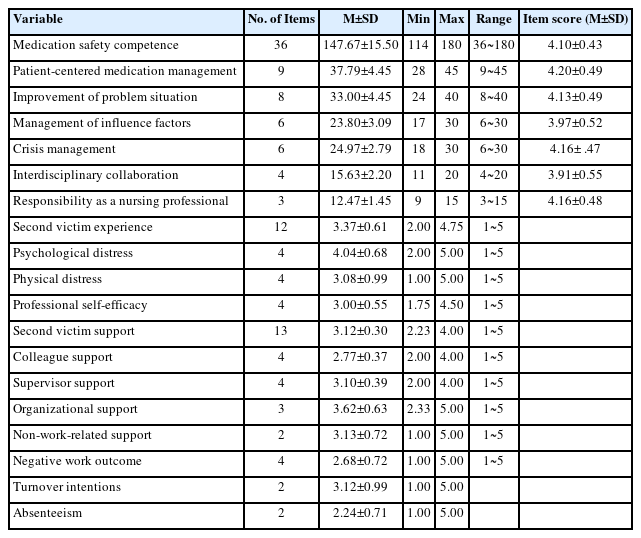
Purpose This study aimed to identify clinical nurses’levels of medication safety competence, second victim experience, second victim support, and negative work outcomes, and to examine the interrelationships among these variables. Methods: A cross-sectional study was conducted with 142 nurses working in university or general hospitals in Gyeonggi-do, South Korea, using self-administered questionnaires collected between June 10 and July 5, 2024. Data were analyzed with IBM SPSS statistics 29.0 using descriptive statistics and Pearson correlation analysis. Results: The mean scores were as follows: medication safety competence (4.10±0.43), second victim experience (3.37±0.61), second victim support (3.12±0.30), and negative work outcomes (2.68±0.72). Medication safety competence was negatively correlated with negative work outcomes (r=-.17, p=.047) and positively correlated with psychological distress, a subdomain of second victim experience (r=.21, p=.013). Second victim experience was positively correlated with both second victim support (r=.53, p<.001) and negative work outcomes (r=.56, p<.001). Conclusion: This study demonstrated that nurses with greater medication safety competence experienced fewer negative work-related outcomes but higher levels of psychological distress. Strengthening medication safety competence may improve patient safety and occupational performance; however, the associated psychological burden must not be overlooked. Initiatives to enhance competence should therefore be accompanied by strategies designed to mitigate psychological distress.
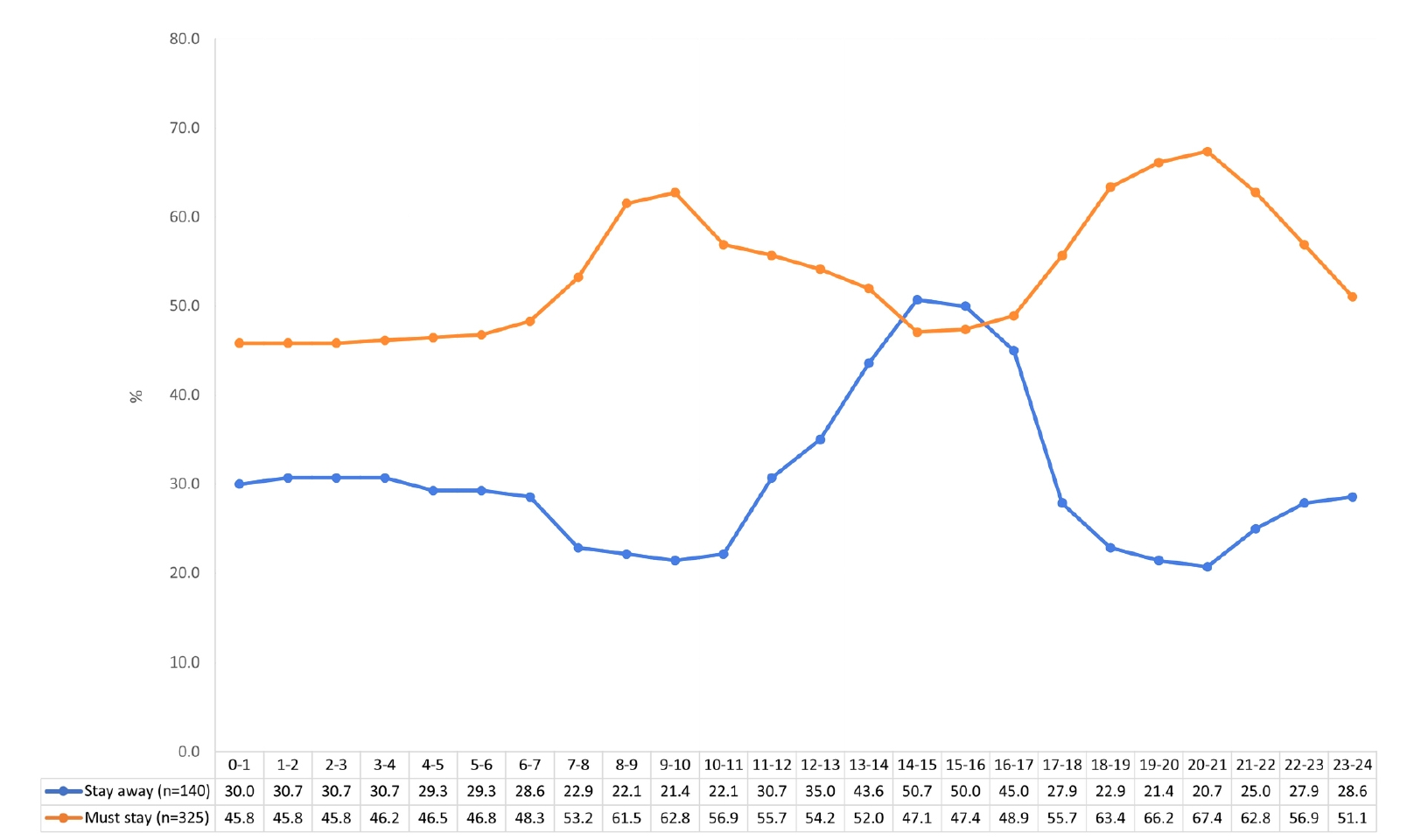
Purpose This study examined how nurse staffing and parental caregiving burden influence patient experiences in pediatric wards. Methods: The sample included 326 parents of pediatric patients at a tertiary children’s hospital. Nurse staffing was measured using parent-perceived staffing adequacy (4-point scale) and registered nurse hours per patient day (RN HPPD). Parent experiences were evaluated using the Child Hospital Consumer Assessment of Healthcare Providers and Systems (Child HCAHPS), with items rated on 3-, 4-, or 11-point scales and subsequently converted to scores on a 0–100 scale. Parents also reported their caregiving burden experienced during their child’s hospitalization. Results: Among the Child HCAHPS domains, nurse–parent communication received the highest score, while lower scores were reported in child-specific domains, including teen involvement, quietness, and child comfort. Most parents (80.4%) stayed at the hospital either all or nearly all the time, and 63.5% perceived caregiving as burdensome. Commonly reported burdens included economic and work-related challenges, physical and psychological stressors, and responsibilities related to caring for other children. Higher levels of parent-perceived staffing adequacy and greater RN HPPD were significantly associated with better patient experiences. Conclusion: Improving nurse staffing may alleviate parental caregiving burden and improve patient and parent experiences in pediatric wards.
PURPOSE The present study was done to provide understanding of how female nurses adapt to male nurses and to derive an entity concept that explains the experience process for female nurses. METHODS Data were collected through in-depth interviews with 16 female nurses who had work experience with male nurses. Collected data were analyzed using the grounded theory methodology of Strauss and Corbin. RESULTS The core category found in the adjustment experience of female nurses to male nurses was “win-win partnership with male nurses who struggle to keep up in the clinical settingâ€. The central phenomenon was “unprepared meeting with male nurses who are different from usâ€. The action/interaction strategies the participants used were “recognition of differences,â€, “positive approach,†and “acceptance as a colleague.†CONCLUSION: The results showed that female nurses tried to have a win-win partnership with male nurses by using several strategies. This result broadened the range of understanding of female nurses' adjustment to male nurses and provides new information on their adaptation to practical work.
Citations
Citations to this article as recorded by
Seroprevalence of measles, mumps, rubella, and varicella-zoster antibodies in new female nurses in the Republic of Korea Yeongjae Yoo, Won-Ju Park, Seunghyeon Cho, Dae-Young Lim, Suwhan Kim, Wonyang Kang, Hyeonjun Kim, Jai-Dong Moon Annals of Occupational and Environmental Medicine.2021;[Epub] CrossRef



 First
First Prev
Prev