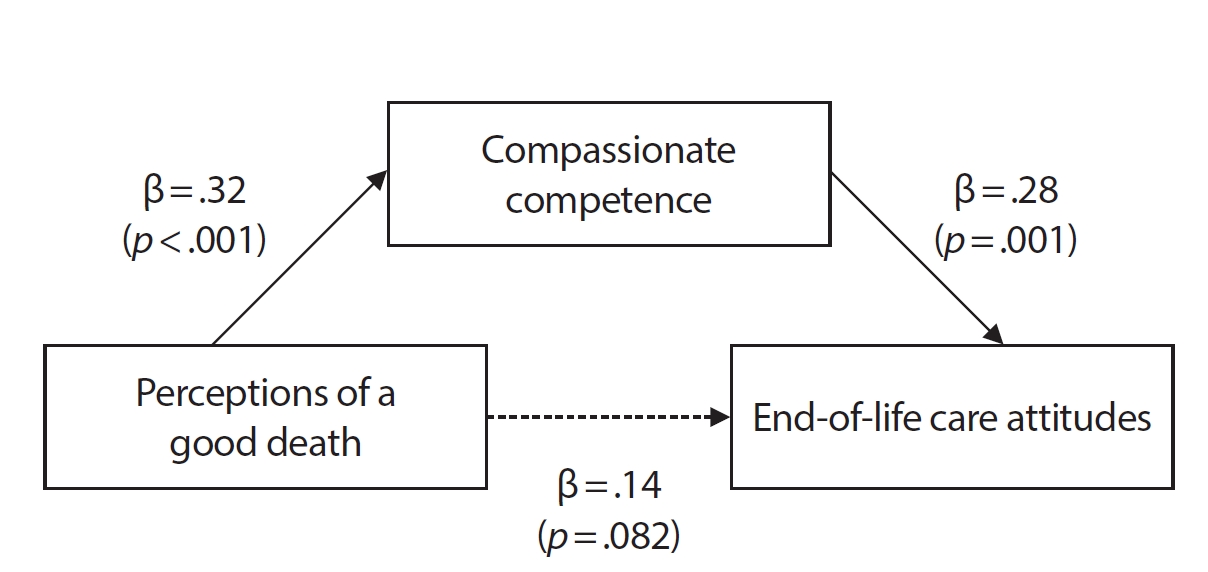
Purpose This study aimed to confirm the mediating effect of compassionate competence in the relationship between perceptions of a good death and end-of-life care attitudes among ward nurses in younger generations. Methods: A total of 175 nurses in their 20s and early 30s who were working in general wards of a public hospital in Seoul were recruited. Data were collected using a self-report questionnaire from February 20 to March 20, 2023, and were analyzed using the IBM 29.0 program. Results: Participants’ end-of-life care attitudes were positively correlated with perceptions of a good death (r=.22, p=.004) and compassionate competence (r=.32, p<.001), and compassionate competence was positively correlated with perceptions of a good death (r=.32, p<.001). Nurses’ compassionate competence was identified as a significant predictor of end-of-life care attitudes. As a result of the mediation analysis, a complete mediating effect of compassionate competence was confirmed in the relationship between perceptions of a good death and end-of-life care attitudes. Conclusion: To improve positive end-of-life care attitudes among young generation ward nurses, educational initiatives that emphasize compassionate competence, as well as understanding of a good death, are needed in both nursing education and clinical practice.
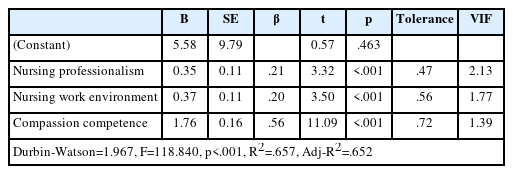
Purpose This study aimed to identify the influence of nursing professionalism, the nursing work environment, and compassion competence on person-centered care among nurses working in comprehensive nursing care units. Methods: An online survey using structured self-report questionnaires was administered to 190 nurses in comprehensive nursing care units at three tertiary general hospitals. The collected data were analyzed using descriptive statistics, the independent t-test, the Mann-Whitney U-test, one-way analysis of variance, Pearson’s correlation coefficient, and multiple linear regression using SPSS version 29.0 program. Results: The average score for person-centered care was 3.70±0.49, nursing professionalism was 3.56±0.51, the nursing work environment was 2.53±0.46, and compassion competence was 4.01±0.47. Person-centered care demonstrated significant positive correlations with nursing professionalism (r=.636, p<.001), the nursing work environment (r=.542, p<.001), and compassion competence (r=.743, p<.001). Factors influencing person-centered care included compassion competence (β=.56, p<.001), nursing professionalism (β=.21, p<.001), and the nursing work environment (β=.20, p<.001), with an explanatory power of 65.2% (F=118.84, p<.001). Conclusion: To improve person-centered care among nurses in comprehensive nursing care units, it is necessary to strengthen nurses’ compassion competence and professionalism, as well as enhance the nursing work environment. The findings of this study may be used as foundational evidence for developing programs to promote person-centered care in comprehensive nursing care units.
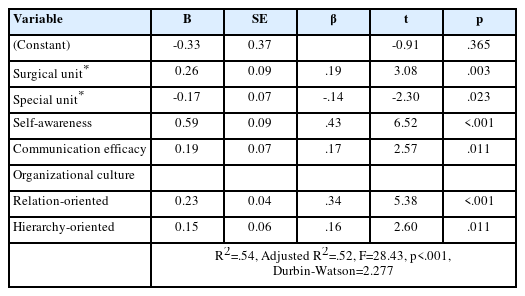
Purpose This study aimed to identify factors influencing communication competence among hospital nurses. Methods: The participants were 136 nurses working at five general or tertiary hospitals with over 100 beds in Busan, Ulsan, and Geoje Island. Data were collected using structured self-report online questionnaires from July 18 to August 31, 2023. The data were analyzed using descriptive statistics, the t-test, one-way analysis of variance, the Scheffé test, Pearson's correlation coefficients, and stepwise regression analysis using IBM SPSS version 25.0. Results: Self-awareness (β=.43, p<.001), a relationship-oriented organizational culture (β=.34, p<.001), working in a surgical ward (β=.19, p=.003), communication efficacy (β=.17, p=.011), hierarchy-oriented organizational culture (β=.16, p=.011), and working in a special unit (β=-.14, p=.023) were factors that significantly influenced nurses' communication competence. The model explained 52% of the variance in communication competence (F=28.43, p<.001) Conclusion: To improve communication competence in hospital nurses, healthcare institutions should provide learning opportunities to improve nurses’ self-awareness and communication efficacy. It is also essential to establish rules and order within a hierarchy-oriented organizational culture, while simultaneously promoting a relationship-oriented organizational culture based on trust and respect among colleagues.
Citations
Citations to this article as recorded by
Factors Influencing Psychiatric Nursing Competency among Emergency Nurses: The Mediating Effect of Psychological Safety in a Cross-Sectional Study Yu Jin Lee, Chung Hee Woo Journal of Korean Academy of psychiatric and Mental Health Nursing.2026; 35(1): 53. CrossRef



 First
First Prev
Prev