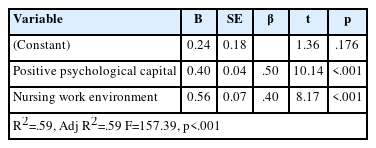
Purpose This study aimed to investigate the factors influencing job embeddedness among advanced beginner nurses, with particular emphasis on the roles of positive psychological capital and the nursing work environment. Methods: This cross-sectional study included 216 advanced beginner nurses from two university-affiliated hospitals. Data were obtained using standardized questionnaires and analyzed with descriptive statistics, the independent t-test, one-way analysis of variance, Pearson correlation coefficients, and multiple regression analysis. Results: The average score for job embeddedness was 3.34±0.54, for positive psychological capital was 4.00±0.67, and for the nursing work environment was 2.67±0.39. Multiple regression analysis showed that positive psychological capital and the nursing work environment significantly predicted job embeddedness, accounting for 59.3% of its variance. Conclusion: The findings suggest that enhancing positive psychological capital and improving the nursing work environment are essential for promoting job embeddedness among advanced beginner nurses. These results provide empirical support for the development of targeted interventions that facilitate their transition toward becoming competent nurses.
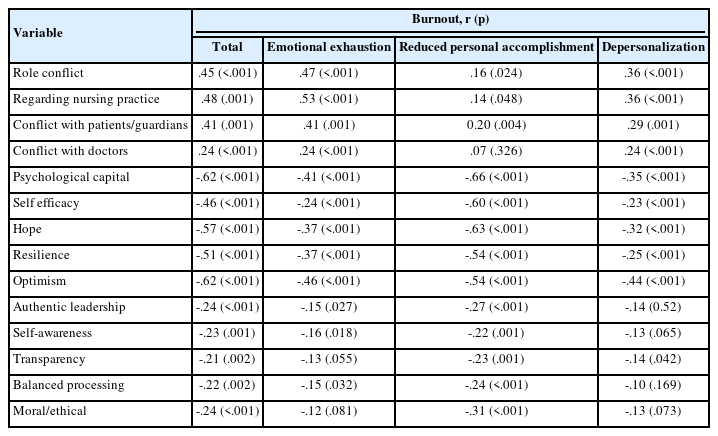
Purpose This study aimed to identify the influence of positive psychological capital, role conflict, and authentic leadership on burnout among nurses working in comprehensive nursing care service wards of general hospitals. Methods: A descriptive cross-sectional survey was conducted with 208 nurses from four general hospitals. Data were collected using structured questionnaires between September 26, 2024, and October 18, 2024, and were analyzed using descriptive statistics, independent t-tests, one-way analysis of variance, Pearson’s correlation coefficient, and hierarchical multiple regression analysis. Results: Burnout showed a correlation with role conflict (r=.45, p<.001), positive psychological capital (r=-.62, p<.001) and authentic leadership (r=-.24, p<.001). In the regression analysis, the factors significantly associated with burnout included conflict with patients/guardians (β=.24, p<.001) and conflict regarding nursing practices (β=.22, p<.001), which are subdomains of role conflict. Among the components of positive psychological capital, optimism (β=-.37, p<.001) was identified as a significant protective factor against burnout. However, authentic leadership was not found to be a statistically significant predictor. Conclusion: To effectively manage nurse burnout, it is essential to develop strategic programs that focus on enhancing optimism. Furthermore, establishing clear delegation guidelines between nurses and nursing assistants is recommended.
Citations
Citations to this article as recorded by
The Influence of Role Conflict and Organizational Justice on Nursing Service Quality: A Cross-Sectional Survey on Nurses’ Perceptions Jeon Seung Ahn, Jeong Eun Moon The Korean Journal of Health Service Management.2026; 20(1): 75. CrossRef



 First
First Prev
Prev