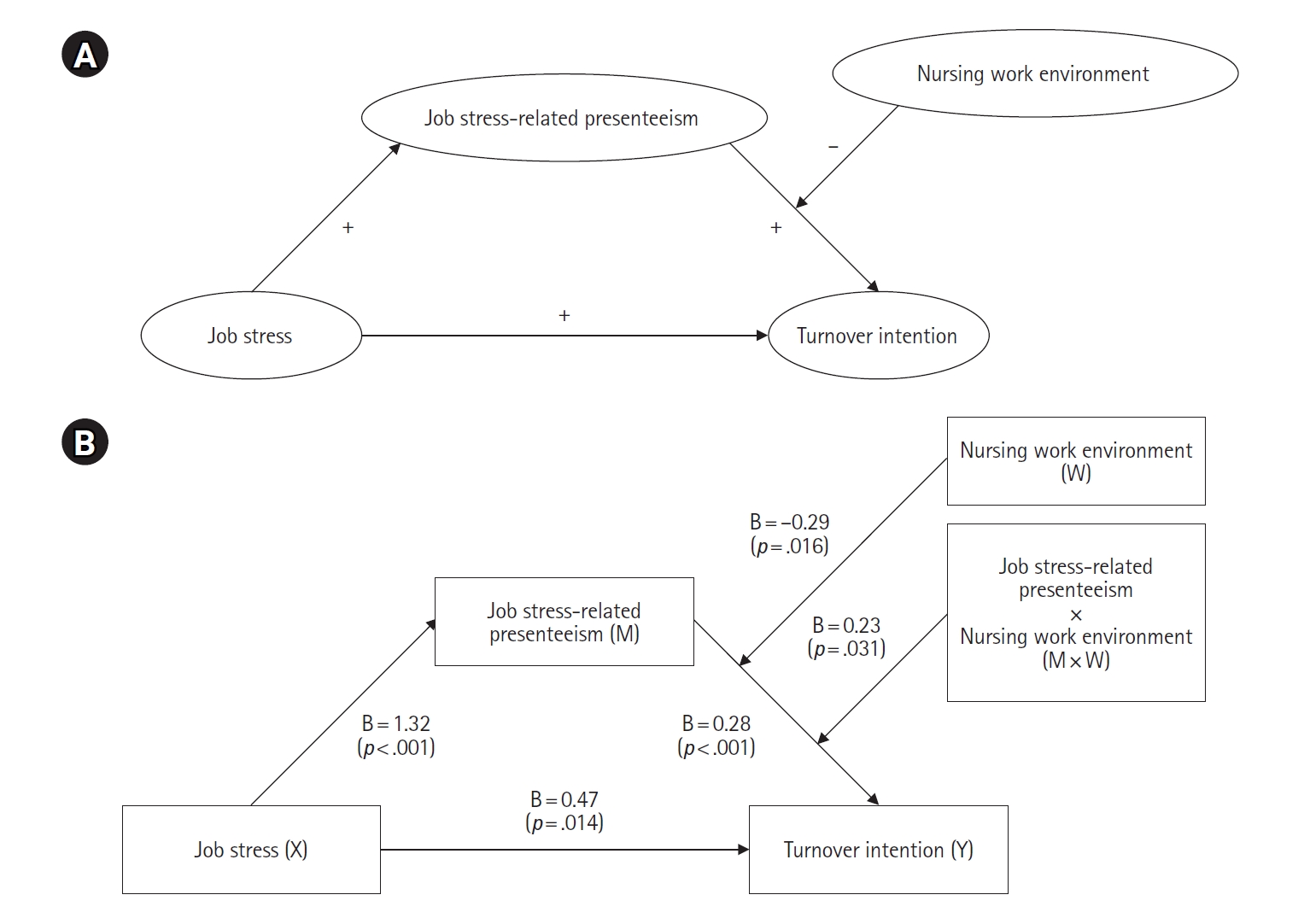
Purpose This study examined the mediating effect of job stress-related presenteeism and the moderated mediating effect of the nursing work environment on the relationship between job stress and nurses’ turnover intention. Methods: A predictive correlational research design was employed from September 8 to September 26, 2023, involving 176 nurses working in general and tertiary hospitals nationwide. Data were analyzed using IBM SPSS Statistics version 25.0, the PROCESS macro version 4.2, and the EasyFlow Statistics macro version 1.8. Results: The mean scores were 2.76±0.38 for job stress, 3.11±0.81 for job stress-related presenteeism, 2.47±0.50 for nursing work environment, and 3.57±0.75 for turnover intention. Job stress was positively associated with turnover intention through job stress-related presenteeism (B=1.32, p<.001), and the nursing work environment significantly moderated this partial mediating effect (B=0.31; 95% CI, 0.04~0.53). Conclusion: These findings may inform the development of strategies and policies aimed at reducing nurses’ turnover intention and improving human resource management in clinical settings. In addition, this study contributes to the growing body of research on job stress, job stress-related presenteeism, nursing work environment, and turnover intention among nurses.
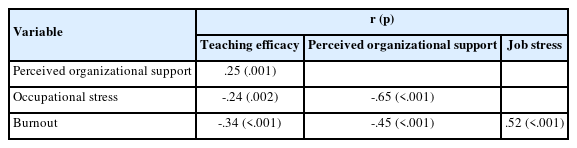
Purpose This study aimed to investigate the effects of teaching efficacy, perceived organizational support, and occupational stress on burnout among preceptor nurses. Methods: Participants included 156 nurses who had at least one month of preceptor experience within the past year. Data were collected using a structured self-report questionnaire and analyzed with SPSS version 27.0. Descriptive statistics, independent sample t-tests, one-way analysis of variance with Scheffé post-hoc tests, Pearson’s correlation analysis, and multiple regression analysis were performed. Results: Occupational stress (β=.36, p<.001) and teaching efficacy (β=-.17, p=.017) were significant predictors of burnout among preceptor nurses, jointly explaining 36.0% of the variance. Conclusion: Occupational stress and teaching efficacy were identified as key determinants of burnout in preceptor nurses. Effective burnout prevention strategies should focus on reducing occupational stress through workload management and strengthening teaching efficacy via continuous training and organizational support.
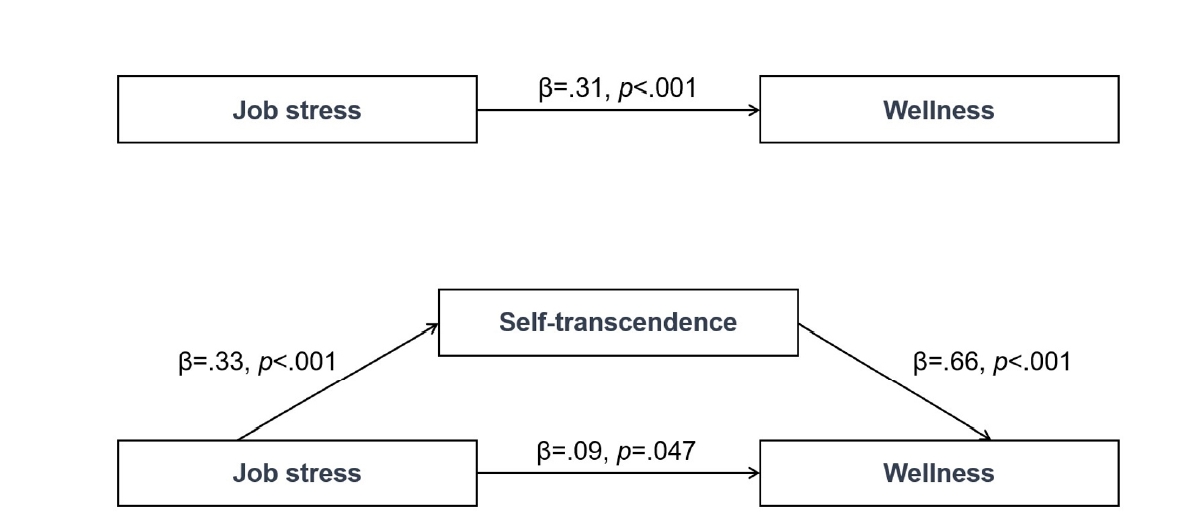
Purpose This study aimed to explore the mediating role of self-transcendence in the relationship between job stress and wellness among nurses based on self-transcendence theory. Methods: A descriptive cross-sectional design was adopted, and data were collected via an online survey using Google Forms from July 22 to August 20, 2024. This study analyzed data from 290 nurses working in 10 hospitals. Correlation and multiple regression analyses were conducted, alongside simple mediation analysis with bootstrapping, to evaluate the mediating role of self-transcendence. All statistical analyses were performed using Jamovi software. Results: Positive correlations were identified among job stress, self-transcendence, and wellness in nurses. Regression analyses revealed that self-transcendence was positively associated with wellness (β=.62, p<.001), while job stress had no significant association with wellness. Mediation analysis demonstrated that self-transcendence significantly mediated the relationship between job stress and wellness (β=.22, p<.001). Conclusion: The findings highlight the influence of self-transcendence on the relationship between job stress and wellness among nurses. This underscores the importance of designing interventions to enhance self-transcendence as a strategy to promote wellness among nurses.
Citations
Citations to this article as recorded by
Self-transcendence and professional identity among undergraduate nursing students: a moderated mediation model of learning engagement and career self-efficacy Ziyun Yuan, Yong Fang BMC Psychology.2026;[Epub] CrossRef


 First
First Prev
Prev