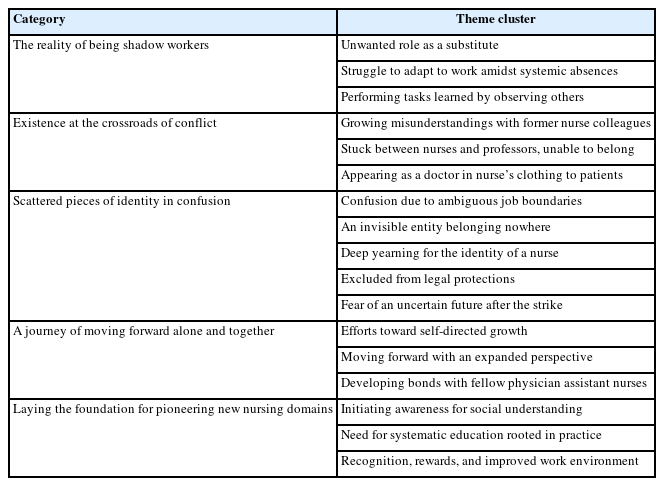
This study explored nurses’ experiences of physician assistant (PA) roles during the 2024 residents’ strike in South Korea, before enactment of the Nursing Act, and aimed to provide foundational evidence for developing PA nursing systems and related policies. Methods: In-depth, one-on-one interviews were conducted with 13 PAs working at an advanced general hospital in A Province between July and August 2024. Data were analyzed using Colaizzi’s phenomenological method. Results: Five categories were identified: “The reality of being shadow workers,” “Existence at the crossroads of conflict,” “Scattered pieces of identity in confusion,” “A journey of moving forward alone and together,” and “Laying the foundation for pioneering new nursing domains.” Conclusion: These findings illuminate the challenges and opportunities experienced by PAs during the 2024 residents’ strike before enactment of the Nursing Act. They also provide foundational evidence for policy development aimed at establishing and expanding PA nursing as a distinct domain in South Korea.
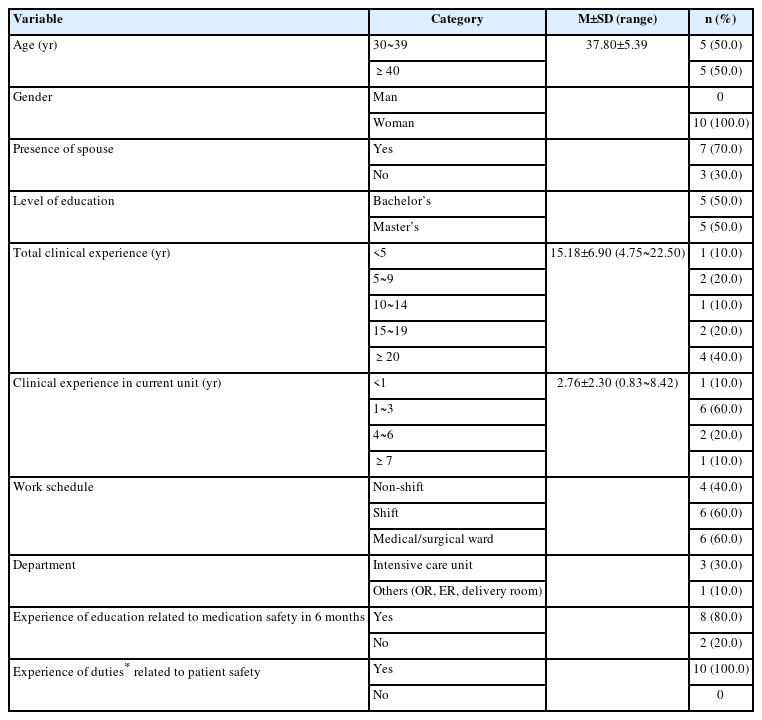
Purpose This qualitative study aimed to explore clinical nurses’ experiences in managing high-alert medications (HAMs) and their educational needs. Methods: Two focus group interviews were conducted with 10 hospital nurses at the proficient level or higher who had experience administering HAMs and managing or encountering related medication errors. Data were analyzed using Graneheim and Lundman’s qualitative content analysis approach. Results: The analysis generated four themes: strengthening competency in HAM management; developing a multilayered education system for HAMs; fostering a supportive patient safety culture; and strengthening system- and organization-based HAM management. Conclusion: HAM safety cannot rely solely on individual vigilance or one-time didactic training. Competency-based nursing education, combined with team-based training and robust organizational safety systems, is needed to reduce medication errors involving HAMs and enhance patient safety in acute care settings.
Purpose This study employs Giorgi's descriptive phenomenological approach to explore the experiences of retired military nurse officers transitioning to civilian hospitals and to identify the essential meanings and underlying structures of this transition.
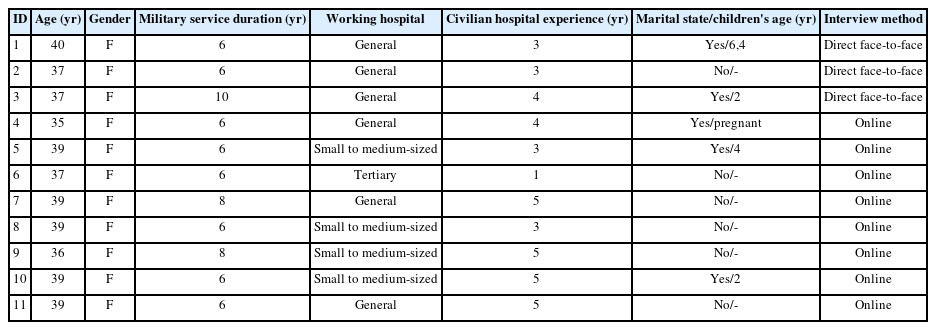
Methods Eleven participants with over two years of military hospital experience, now employed in civilian hospitals, were recruited via snowball sampling. Data were collected through in-depth interviews conducted between December 2023 and March 2024.
Results Analysis using Giorgi’s four-stage method identified 257 meaning units, 37 central meanings, 12 themes, and six general structures: 1) Positive perceptions of the nursing profession, 2) Confusion due to lack of information, 3) Difficulty in adapting due to differences between military and civilian hospitals, 4) Self-blame for a lack of competence, 5) Struggles in finding a position suitable for one’s career, and 6) Satisfaction with freedom and a stable life.
Conclusion These findings emphasize the need for tailored transition programs, including job placement support, skill development, and cultural adaptation training. Socialization and communication programs can further aid integration and contribute to the professional growth. Additionally, a positive perception of nursing significantly influenced the decision to return to the workforce, highlighting the importance of fostering professional identity and confidence among transitioning military nurses.

 First
First Prev
Prev