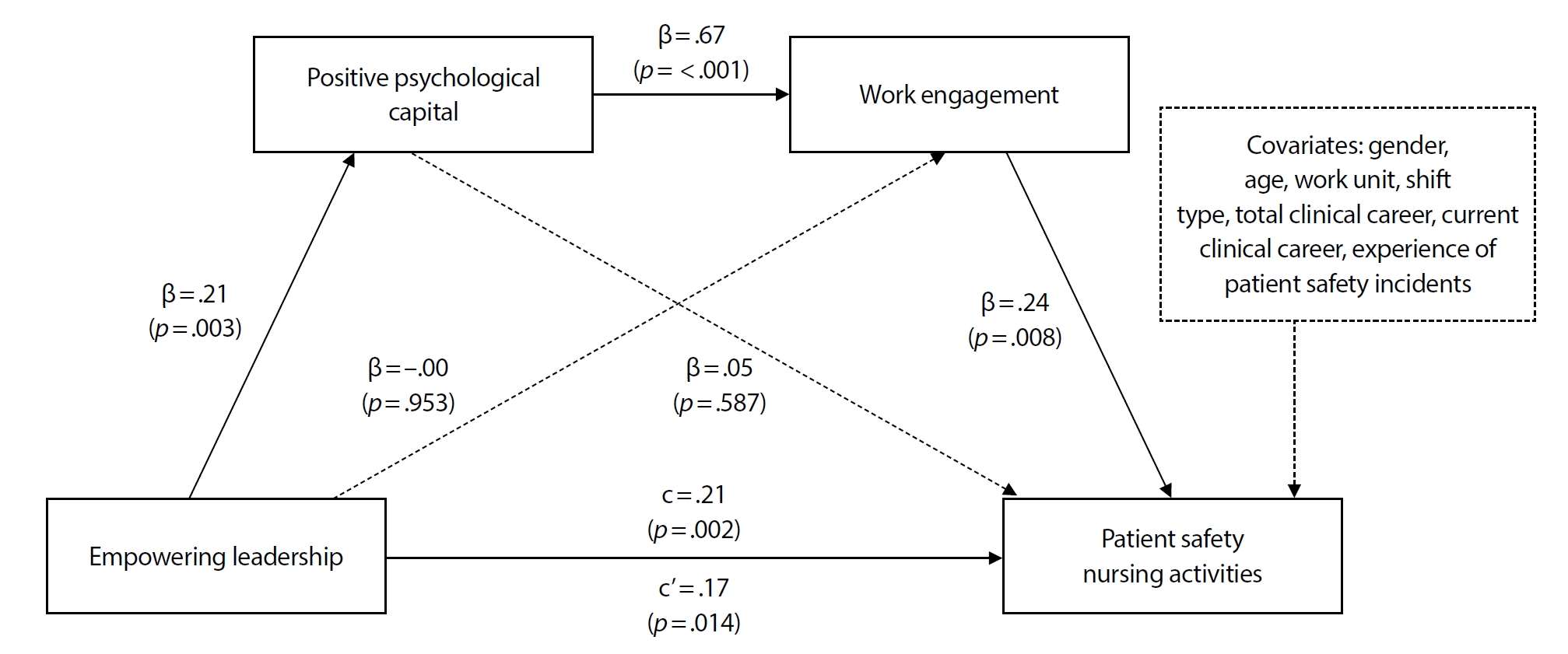
Purpose This study examined the double mediating effects of positive psychological capital and work engagement on the relationship between nurse unit managers’ empowering leadership and nurses’ patient safety nursing activities. Methods: Data were collected from 217 ward nurses employed at a tertiary hospital. Statistical analyses were conducted using SPSS version 29.0. Differences between groups were tested using independent t-tests, one-way analysis of variance, and the Duncan method. When normality assumptions were violated, the Mann–Whitney U and Kruskal–Wallis tests with Bonferroni correction were applied. Pearson correlation coefficients were computed, and mediation analysis was performed using Hayes’ PROCESS macro model 6. Results: Empowering leadership among nurse unit managers had a significantly positive effect on ‘nurses’ patient safety nursing activities. Furthermore, positive psychological capital and work engagement demonstrated significant double mediating effects on the relationship between empowering leadership and patient safety nursing activities. Conclusion: Enhancing patient safety nursing activities requires the establishment of a safety culture and institutional framework, the development of leadership training programs, and provision of systematic education.
Purpose This study aimed to identify the mediating effects of self-leadership and resilience on the relationship between preceptors’ clinical teaching behavior and field adaptation of new graduate nurses. Methods Data were collected from 184 new graduate nurses working at two advanced general hospitals. The research model was designed based on PROCESS macro (model 6) proposed by Hayes and analyzed using SPSS 26.0 program. Results The results showed a positive correlation between preceptors’ clinical teaching behavior and self-leadership, resilience, and field adaptation. Preceptors’ clinical teaching behavior (β=.18, p<.001) and resilience (β=.14, p=.030) had a direct effect on the field adaptation of new graduate nurses. Self-leadership and resilience had a serial double mediating effect. Preceptors’ clinical teaching behavior had a significant effect on the field adaptation of new graduate nurses through self-leadership and resilience. Conclusion To improve the field adaptation of new graduate nurses, the government should expand the current education support project to provide sufficient manpower.
Moreover, medical institutions and nursing organizations should develop and apply programs to strengthen preceptor’s clinical teaching behavior.
Citations
Citations to this article as recorded by
Development of a role transition scale for new graduate nurses Eungyung Kim, Eun Jung Kim, Eunha Choi The Journal of Korean Academic Society of Nursing Education.2026; 32(1): 104. CrossRef
The Effect of Newly Graduated Nurses' Perceived Nursing Practice Readiness, Resilience, and Preceptors' Teaching Behavior on Turnover Intention Jinhee Kim, Eunhee Lee Journal of Korean Academy of Nursing Administration.2025; 31(2): 167. CrossRef
The Effect of Communication in Emergency Department Isolation Rooms Using Smart Glasses: A Mixed‐Methods Study Soyoung Park, Hyeongsuk Lee Journal of Clinical Nursing.2025; 34(10): 4340. CrossRef
Leadership of Novice and Advanced Beginner Nurses: A Systematic Review and Meta-Analysis Sunmi Kim, Myoung Hee Seo, Seok Hee Jeong Journal of Korean Academy of Nursing Administration.2025; 31(4): 371. CrossRef
Purpose To examine the characteristics, core variables, and their correlations in articles published in the Journal of Korean Academy of Nursing Administration (JKANA) from 2012-2021 and suggest future directions for nursing management research. Methods A total of 506 articles were analyzed according to study design, participants and setting, statistical methods, keywords, and core concepts and variables. Results Quantitative research accounted for 73.5%, and most participants were staff nurses (66.8%) and nursing students (9.1%). Furthermore, 318 studies (62.8%) conducted surveys, and settings were mainly acute hospitals(81.5%) and nursing schools (9.7%). Statistical methods for data analysis included independent t-test (81.2%), one-way ANOVA (77.2%), Pearson correlation coefficients (77.2%), post-hoc testing (74.3%), and linear regression(65.9%). Among 2,058 keywords, the most frequent were “nurses” (49.2%), “job satisfaction” (10.7%), and “personnel turnover” (9.1%). The most frequently core concepts were job satisfaction (10.5%), turnover intention(9.5%), organizational commitment (8.5%), and job stress (7.5%). The most frequently variables with significant correlations were turnover intention, work environment, job satisfaction, job stress, burnout, and emotional labor. Conclusion Most JKANA studies examined nursing-related outcomes and performance. Future research should examine the effects of nursing practice and policy on patient outcomes.
Citations
Citations to this article as recorded by
A descriptive and bibliometric trend analysis of biological nursing research in the Journal of Korean Biological Nursing Science (2011–2025) Hohyun Seong, Sungwon Lim, Jae Sim Jeong, Gyeong Ju An, Youn-Jung Kim Journal of Korean Biological Nursing Science.2026; 28(2): 217. CrossRef
Purpose This study investigated the effects of nursing unit managers' authentic, transformational, and transactional leadership styles on positive psychological capital and turnover intention in advanced beginner-stage nurses (ABNs). Methods The study included 157 nurses with clinical experience ranging form more than one year to less than 3 years in three general hospitals. Data analysis was conducted using the SPSS/WINdows software version 26.0. Results Authentic, transformational, and transactional leadership styles of nursing unit managers increased the positive psychological capital of ABNs, thereby lowering their turnover intention. Additionally, the turnover intention of ABNs was negatively correlated with the authentic, transformational, and transactional leadership styles of a nursing unit manager and positive psychological capital. Positive psychological capital showed a mediating effect in the relationship between authentic, transformational, and transactional leadership styles of nursing unit manager and turnover intention of ABNs. Conclusion To reduce ABNs turnover, medical institutions and nursing organizations should focus on enhancing nursing unit managers’ transformational and authentic leadership styles. Moreover, as transactional leadership has been found to decrease the turnover intention among ABNs, nursing unit managers should carefully consider their responsibilities and resources allocation to provide conditional compensation support to nurses.
Purpose This study aimed to identify the mediating effects of team trust on the relationship between the authentic leadership of the nursing unit manager as perceived by the nurses and the nurses’ organizational citizenship behavior (OCB).
Methods: Data were collected from 276 nurses working over six months at a university hospital. The research model was designed based on the PROCESS Macro model 4 and analyzed using the SPSS 26.0 program.
Results: The results show that authentic leadership and team trust had strong correlations with nurses’ organizational citizenship behavior. Nursing unit managers’ authentic leadership had a direct effect on team trust and organizational citizenship behavior. Team trust had a direct effect on organizational citizenship behavior. There was a mediation effect of team trust between authentic leadership and the organizational citizenship behavior of nurses.
Conclusion: To increase team trust in nursing units, the institution should provide systematic support such as education and training program to enhance the authentic leadership of nursing unit managers.
Citations
Citations to this article as recorded by
Factors Influencing Burnout of Nurses in Comprehensive Nursing Care Service Wards: Focusing on Positive Psychological Capital, Role Conflict, and Authentic Leadership Jung Wha Park, Kyoung Ja Kim, Ji Young Im, Ji Young Kim Journal of Korean Academy of Nursing Administration.2025; 31(4): 345. CrossRef
Influence of Self-leadership, Managers’ Authentic Leadership, and Nurses' Organizational Culture Relationships on Hospital Nurses’ Organizational Silence: A Mixed Method Study Hyun-Ju Lee, So-Young Kang Journal of Korean Academy of Nursing Administration.2024; 30(4): 404. CrossRef
Purpose This study aims to determine nursing students’ orientation toward patient-centered care (PCC) and identify its influencing factors: their personality traits, empathy, and psychological capital (PsyCap). A mediating model was used to test the role of PsyCap in the association between empathy and PCC.
Methods: This cross-sectional study included 300 nursing students from seven universities in South Korea. Their orientation toward PCC was measured using the Patient-Practitioner Orientation Scale (PPOS). Moreover, we analyzed the data using independent t-tests, ANOVA, Pearson's r, and SPSS PROCESS macro.
Results: The overall mean score on the PPOS was 3.82±0.43, with the Caring and Sharing subscales accounting for 3.95±0.68 and 3.69±0.50, respectively. Nursing students’ satisfaction with their majors, practicums, and motivation for choosing this profession was significantly related to Caring-not Sharing. Nevertheless, PsyCap positively influenced both Caring (β=.24, p<.001) and Sharing (β=.18, p=.002). While empathy failed to significantly impact both Caring (β=.12, p=.087) and Sharing (β=.01, p=.931). PsyCap mediated the association of empathy with Caring (β=.20, p=.004); however, the same was not true for Sharing (β=.07, p=.366).
Conclusion: The findings indicate that the orientation of Korean nursing students toward PCC is not high. Therefore, to improve the PPOS Caring subscale, nurse educators should formulate better strategies to enhance nursing students’ satisfaction with their major and practicums, empathy, and PsyCap. The importance of sharing health-related information with patients and family caregivers should be emphasized in the nursing curriculum.
Citations
Citations to this article as recorded by
Psychological capital among undergraduate nursing students: A systematic review and meta-analysis of levels and correlates Yilin Wang, Chong Chin Che, Li Yoong Tang Nurse Education Today.2027; 168: 107356. CrossRef
Assessing Needs for Practical Training in Intensive Care Unit to Enhance Nursing Education: A Focus Group Interview Sunah Park, Bokyoung Kim Journal of Korean Critical Care Nursing.2024; 17(2): 55. CrossRef
Contemporary contexts of higher medical education development: Patient-centred care in medical students’ understanding T. D. Podkladova, L. G. Smyshliaeva, A. O. Okorokov, I. I. Soshenko The Education and science journal.2023; 25(9): 44. CrossRef
Purpose This study aimed to identify the effects of preceptors' teaching behavior, resilience, and organizational socialization on new graduate nurses' intention to stay.
Methods: Data were collected from 167 new graduate nurses working at a university hospital for a period of three months to one year and analyzed using SPSS 24.0, PROCESS Macro ver. 3.5.
Results: The results show that preceptors' teaching behavior, resilience, and organizational socialization had strong correlations with new graduate nurses' intention to stay. Preceptors' teaching behavior directly affected new graduate nurses' resilience and intention to stay. However, the results showed that preceptors' teaching behavior did not affect organizational socialization. Resilience directly affected organizational socialization and intention to stay, and had a simple mediation effect between preceptors' teaching behavior and intention to stay.
Moreover, resilience and organizational socialization were found to be significant mediators between preceptors' teaching behavior and intention to stay.
Conclusion: The results suggest that preceptors' teaching behavior is a key factor that strengthens new graduate nurses' intention to stay, as it promotes successful organizational socialization by improving their resilience and helping them overcome transition shock.
Citations
Citations to this article as recorded by
Factors Associated With Newly Graduated Nurses' Work Engagement: Systematic Review of Quantitative Studies Hanna Ojala, Heli‐Maria Kuivila, Kristina Mikkonen, Erika Jarva, Jonna Juntunen Journal of Advanced Nursing.2026; 82(3): 1947. CrossRef
Factors Associated With Nursing Profession Self‐Efficacy Among Newly Graduated Nurses: A Cross‐Sectional Study Yujeong Kim, Eunhee Nam, Myojeong Kim, Dokyung Kim, Heejin Sim Nursing Open.2026;[Epub] CrossRef
Personal and Workplace Characteristics as Predictors of Intent‐To‐Stay Among Registered Nurses: An Exploratory Quantitative Multicentre Study Ming Marcus Chua, Wei How Darryl Ang, An Ling Siew, Hui‐Chen Chen Journal of Advanced Nursing.2025; 81(6): 3045. CrossRef
Factors influencing preceptor nurses' clinical teaching behavior: A cross-sectional study Kyeong Hye Kim, Sujin Shin Nurse Education Today.2025; 146: 106555. CrossRef
The Effect of Newly Graduated Nurses' Perceived Nursing Practice Readiness, Resilience, and Preceptors' Teaching Behavior on Turnover Intention Jinhee Kim, Eunhee Lee Journal of Korean Academy of Nursing Administration.2025; 31(2): 167. CrossRef
Exploring the Knowledge Structure of Research for Nurse Preceptor Training Programs Using Text Network Analysis and Topic Modeling Sun Hee Seon, Hye Won Jeong, Ja Yun Choi CIN: Computers, Informatics, Nursing.2025;[Epub] CrossRef
Evaluating approaches to enhance transition and retention in newly qualified nurses: An updated rapid evidence assessment Mariarosaria Gammone, Michela Calzolari, Andrea Moro, Jane Wray, Roger Watson, Giuseppe Aleo, Gianluca Catania, Milko Zanini, Loredana Sasso, Annamaria Bagnasco Nurse Education in Practice.2025; 87: 104484. CrossRef
Analysis of clinical nurse educators’ mentoring feedback on new nurse journals at a tertiary hospital in South Korea: utilizing text network analysis Shinhye Ahn, Hye Won Jeong BMC Nursing.2025;[Epub] CrossRef
Evaluating Burnout and Resiliency in New Graduate Nurses Bryce Catarelli, Patrick Nobles, Michael Aull, Fan Yi JONA: The Journal of Nursing Administration.2023; 53(5): 259. CrossRef
Effects of Preceptors’ Clinical Teaching Behavior on the Field Adaptation of New Graduate Nurses: Mediating Effects of Self-Leadership and Resilience Eunjung Kim, Eungyung Kim Journal of Korean Academy of Nursing Administration.2023; 29(5): 577. CrossRef
Effects of Nursing Unit Managers’ Authentic Leadership, Transformational Leadership, and Transactional Leadership on Turnover Intention in Advanced Beginner Nurses: Mediation Effects of Positive Psychological Capital Eun Jeong Kim, Eungyung Kim, Son Ja Lee Journal of Korean Academy of Nursing Administration.2023; 29(4): 409. CrossRef
Development and Preliminary Evaluation of the Effects of a Preceptor Reflective Practice Program: A Mixed-Method Research Heui-Seon Kim, Hye-Won Jeong, Deok Ju, Jung-A Lee, Shin-Hye Ahn International Journal of Environmental Research and Public Health.2022; 19(21): 13755. CrossRef


 First
First Prev
Prev