Purpose This study aimed to identify position-specific career competency development needs among clinical nurses in general hospitals. Methods: This descriptive survey included 184 nurses, comprising 98 staff nurses and 86 nurse managers. Participants rated the perceived importance of, and their self-rated performance in, each career competency. Data were analyzed using descriptive statistics, the independent t-test, importance–performance analysis, Borich’s needs assessment model, and the Locus for Focus model. Results: Seven core career competencies—including balance check/adjustment, career experience, relationship formation, new goals challenge, and external exploration—were highly prioritized by both staff nurses and nurse managers. Staff nurses and nurse managers both assigned high priority to seven competency areas: balance checking and adjustment, participation in career-related experiences, internal and external relationship formation, pursuit of new goals, and external career exploration. Staff nurses placed additional emphasis on self-reflection and internal career opportunities, whereas nurse managers emphasized accurate goal planning and ongoing review of career development. Conclusion: This study identified position-specific differences in nurses’ career competency development needs. These findings may inform the selection of educational priorities and the development of differentiated, position-specific programs to strengthen career competencies among nurses in general hospitals.
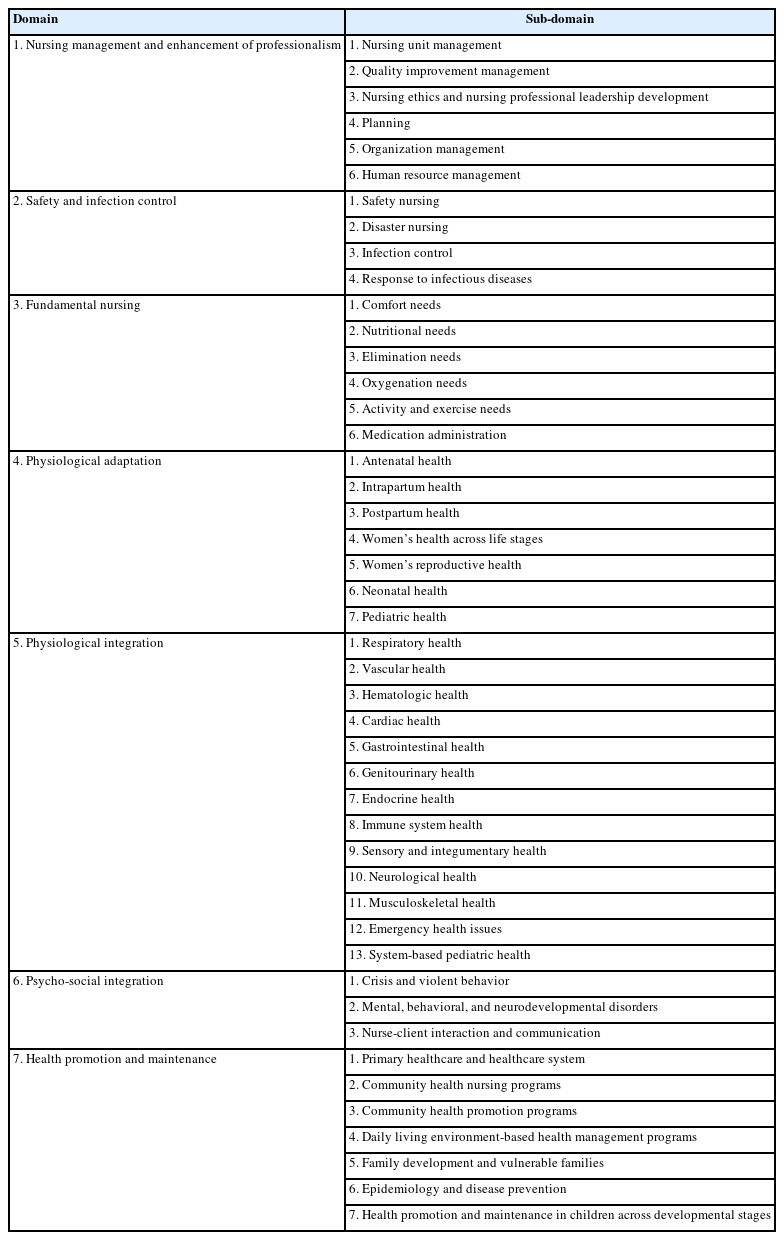
Purpose This study aimed to propose directions for innovation in nursing management education by reviewing reforms to the Nurse Licensure Examination, analyzing the relevance of Nursing Management to the job roles of newly graduated nurses, and examining perceptions of Nursing Management courses. Methods: A narrative review was conducted using research reports, policy reports, laws and regulations, and press releases from the government and the Korea Health Personnel Licensing Examination Institute. Peer-reviewed articles were also reviewed using keywords related to “newly graduated nurses,” “nursing job,” and “managerial or administrative competency.” Results: The Nurse Licensure Examination is expected to shift from knowledge-based assessment to job-based assessment by integrating the existing eight subjects into General Nursing and Health-Related Laws and Regulations. Nursing Management is included in the domain of “nursing management and professional development,” which comprises seven subdomains. The subject is relevant to newly graduated nurses’ job roles in multiple areas. However, managerial and administrative competencies are often perceived as competencies required only by managers, despite being essential for all nurses to strengthen professionalism. This perception affects both students’ understanding of nursing management and policies related to the Nurse Licensure Examination. Conclusion: Nursing management education should be prepared for future changes by reframing perceptions of the field and improving its alignment with the job roles of newly graduated nurses.
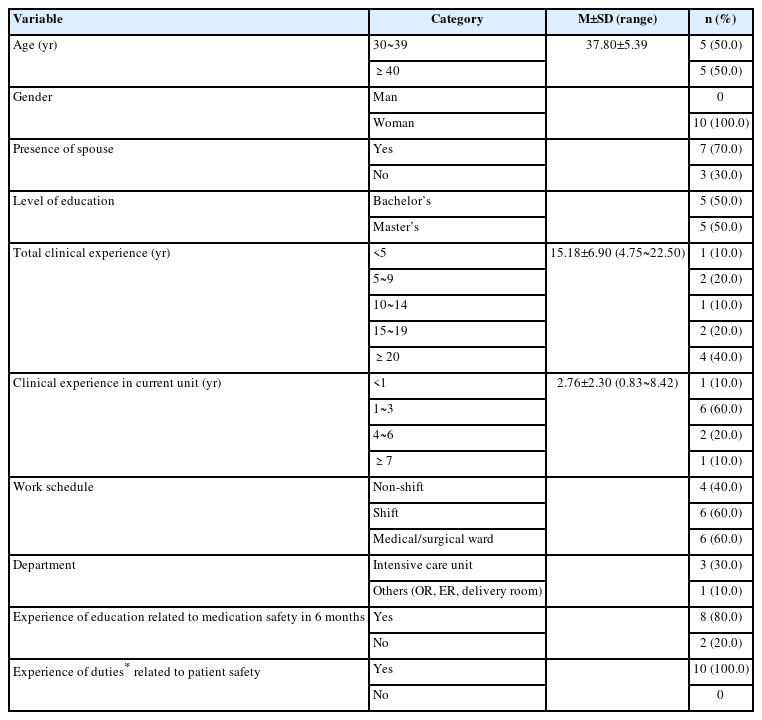
Purpose This qualitative study aimed to explore clinical nurses’ experiences in managing high-alert medications (HAMs) and their educational needs. Methods: Two focus group interviews were conducted with 10 hospital nurses at the proficient level or higher who had experience administering HAMs and managing or encountering related medication errors. Data were analyzed using Graneheim and Lundman’s qualitative content analysis approach. Results: The analysis generated four themes: strengthening competency in HAM management; developing a multilayered education system for HAMs; fostering a supportive patient safety culture; and strengthening system- and organization-based HAM management. Conclusion: HAM safety cannot rely solely on individual vigilance or one-time didactic training. Competency-based nursing education, combined with team-based training and robust organizational safety systems, is needed to reduce medication errors involving HAMs and enhance patient safety in acute care settings.
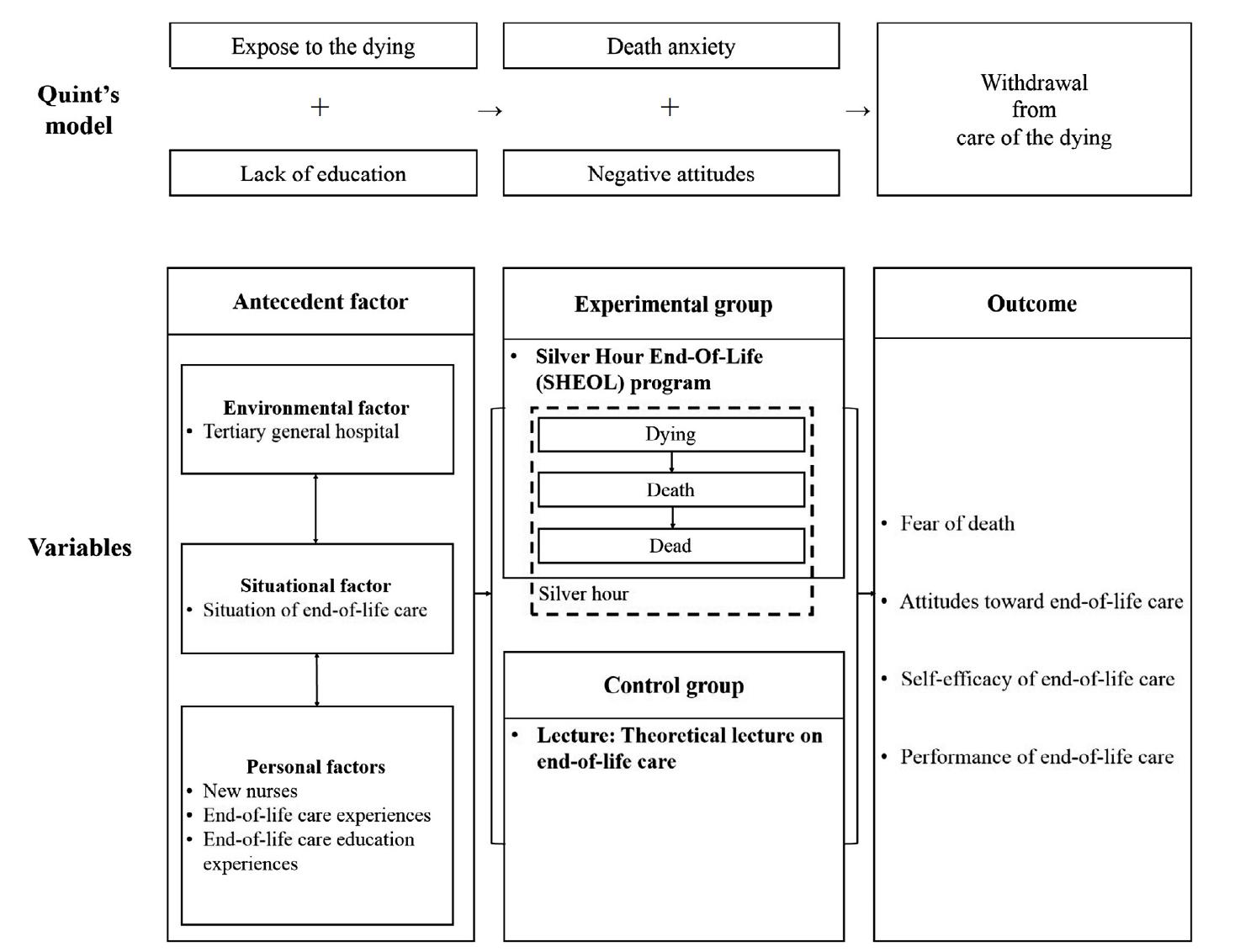
Purpose To evaluate the effectiveness of a Silver Hour End-Of-Life (SHEOL) program in enhancing end-of-life care performance among new nurses. Methods: A nonequivalent control group pre-post test design was adopted. A total of 34 new nurses working at a tertiary general hospital participated in the study. The experimental group (n=17) participated in the SHEOL program, which was delivered through hybrid simulation (180 minutes), while the control group (n=17) received a theoretical lecture on end-of-life care (90 minutes). The intervention and data collection were conducted from August 8 to September 30, 2024. Results: Compared to the control group, the experimental group showed a significant reduction in fear of death (χ2=11.69, p=.003) and significant improvements in attitudes toward end-of-life care (χ2=6.99, p=.030), self-efficacy of end-of-life care (χ2=6.51, p=.039), and performance of end-of-life care (χ2=20.07, p<.001) both immediately and 4 weeks after the intervention. Conclusion: These findings suggest that the SHEOL program can be effectively used to alleviate fear of death, improve attitudes and self-efficacy regarding end-of-life care, and enhance end-of-life care performance among new nurses.
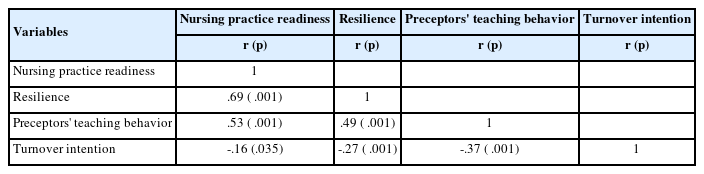
Purpose This study investigated the effects of newly graduated nurses’ perceived readiness for nursing practice, resilience, and preceptors’ teaching behaviors on turnover intention.
Methods A survey was conducted among 168 newly graduated nurses between August 7 and 31, 2023. The data were analyzed using descriptive statistics, t-tests, one-way ANOVA, Pearson's correlation, and hierarchical multiple regression analysis.
Results The factors that significantly affected turnover intention included preceptors' teaching behavior (β=-.29, p=.001) and resilience (β=-.21, p=.026). This model explained 32.0% of the variance.
Conclusion Newly graduated nurses’ resilience and their initial training environment are key factors influencing turnover intention. Therefore, nursing managers should develop strategies to enhance the resilience of newly graduated nurses and improve training systems. Additionally, efforts should be made to promote positive teaching behaviors among the educators responsible for training newly graduated nurses.
Citations
Citations to this article as recorded by
Experiences of work performance among physician assistant nurses during the period of healthcare disruption in South Korea: a qualitative content analysis Juyoung Ha, Minji Kim Journal of Korean Academy of Nursing.2026; 56(1): 98. CrossRef
Educational Innovation in Nursing Management after Reforms in the National Nurse Licensure Examination: A Narrative Review Yoomi Jung Journal of Korean Academy of Nursing Administration.2026; 32(3): 137. CrossRef
Factors Associated With Nursing Profession Self‐Efficacy Among Newly Graduated Nurses: A Cross‐Sectional Study Yujeong Kim, Eunhee Nam, Myojeong Kim, Dokyung Kim, Heejin Sim Nursing Open.2026;[Epub] CrossRef
Perceptions on Fixed Night Shift System and Turnover Intention of General Hospital Nurses Mi-Aie Lee, Hye-Jin Cho, Sung-Hee Ahn, Hyo-Ju Kim Journal of Korean Academy of Nursing Administration.2015; 21(5): 519. CrossRef
PURPOSE The purpose of this study was to examine the effects of perceptions of patient rounding, self-leadership and nursing organization culture on intentional rounding performance. METHODS The participants for this study were 210 nurses who had the experience of patient rounding care in general hospitals in B and Y cities. Data were collected from February 5th to 22nd, 2018. Collected data were analyzed using descriptive statistics, χ² test, and independent t-test. Logistic regression analysis was performed to identify factors influencing intentional rounding performance. RESULTS It was found that intentional rounding performance was carried out by 20.0% of the day shift nurses, 18.1% of the evening shift nurses, and 19.5% of the night shift nurses. The significant factors influencing intentional rounding performance were the recommended rounding time interval in wards and the use of rounding protocol in the wards (p < .050). CONCLUSION It is expected that nurses will be able to provide more advanced and efficient patient rounding by promising a systematic patient rounding time for intentional rounding and developing appropriate protocols for each ward.
Citations
Citations to this article as recorded by
Introducing and applying an intentional rounding program for nursing students in adult nursing practicum: Process and outcomes Heejung Choi, Jong Sun Ok, Eun-Young Noh, Young Hye Song, Jin Yi Choi The Journal of Korean Academic Society of Nursing Education.2025; 31(3): 223. CrossRef
Associations of perceptions of patient safety culture, job crafting, and perceptions of patient rounding with patient safety management activities among tertiary hospital nurses Saet-Byeol Kim, Yun-Hee Kim Journal of Korean Biological Nursing Science.2024; 26(3): 259. CrossRef
Development of an intentional rounding protocol for nursing undergraduates to apply in clinical practice Sueun Kim, Jong Sun Ok, Jin Yi Choi, Heejung Choi The Journal of Korean Academic Society of Nursing Education.2023; 29(4): 381. CrossRef
Improving Patients’ Perception of the Quality of Nursing Services and Nurses’ Perception of Nursing Rounds through Purposeful and Timely Nursing Rounds Yun Sook Kim, Dong Yeon Kim, Na Young Kim, Jinsuk Kim, Young Eun Yang, Youmin Jeong, Hee Young Choi, Eun Oh Journal of Korean Academy of Nursing Administration.2023; 29(1): 12. CrossRef
A Study on the Implementation and Improvement Strategies of the Optometrists’ Code of Ethics Ki-Hun Ye, Min-Jae Lee Journal of Korean Ophthalmic Optics Society.2025; 30(4): 295. CrossRef
A Study on the Need for Continuing Professional Ethics Education for Optometrists Se-Eun Ju, Ji-Hee Jang, Hyun-Sung Leem, Mi-A Jung The Korean Journal of Vision Science.2024; 26(3): 177. CrossRef



 First
First Prev
Prev