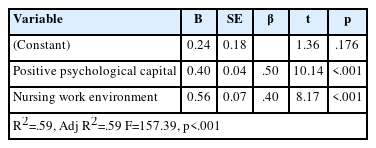
Purpose This study aimed to investigate the factors influencing job embeddedness among advanced beginner nurses, with particular emphasis on the roles of positive psychological capital and the nursing work environment. Methods: This cross-sectional study included 216 advanced beginner nurses from two university-affiliated hospitals. Data were obtained using standardized questionnaires and analyzed with descriptive statistics, the independent t-test, one-way analysis of variance, Pearson correlation coefficients, and multiple regression analysis. Results: The average score for job embeddedness was 3.34±0.54, for positive psychological capital was 4.00±0.67, and for the nursing work environment was 2.67±0.39. Multiple regression analysis showed that positive psychological capital and the nursing work environment significantly predicted job embeddedness, accounting for 59.3% of its variance. Conclusion: The findings suggest that enhancing positive psychological capital and improving the nursing work environment are essential for promoting job embeddedness among advanced beginner nurses. These results provide empirical support for the development of targeted interventions that facilitate their transition toward becoming competent nurses.
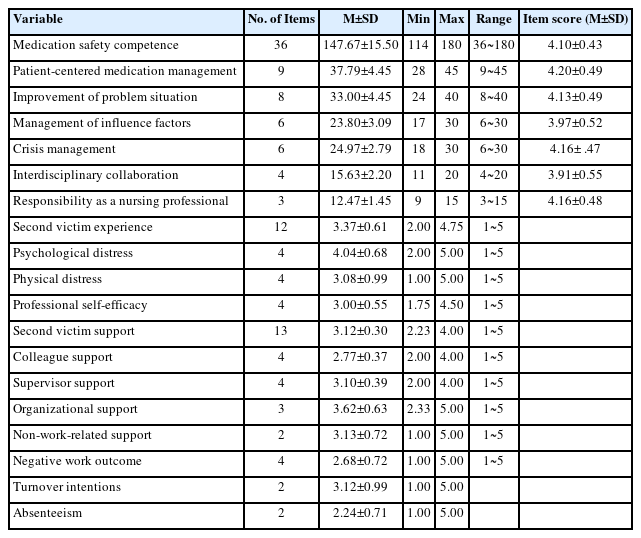
Purpose This study aimed to identify clinical nurses’levels of medication safety competence, second victim experience, second victim support, and negative work outcomes, and to examine the interrelationships among these variables. Methods: A cross-sectional study was conducted with 142 nurses working in university or general hospitals in Gyeonggi-do, South Korea, using self-administered questionnaires collected between June 10 and July 5, 2024. Data were analyzed with IBM SPSS statistics 29.0 using descriptive statistics and Pearson correlation analysis. Results: The mean scores were as follows: medication safety competence (4.10±0.43), second victim experience (3.37±0.61), second victim support (3.12±0.30), and negative work outcomes (2.68±0.72). Medication safety competence was negatively correlated with negative work outcomes (r=-.17, p=.047) and positively correlated with psychological distress, a subdomain of second victim experience (r=.21, p=.013). Second victim experience was positively correlated with both second victim support (r=.53, p<.001) and negative work outcomes (r=.56, p<.001). Conclusion: This study demonstrated that nurses with greater medication safety competence experienced fewer negative work-related outcomes but higher levels of psychological distress. Strengthening medication safety competence may improve patient safety and occupational performance; however, the associated psychological burden must not be overlooked. Initiatives to enhance competence should therefore be accompanied by strategies designed to mitigate psychological distress.
Citations
Citations to this article as recorded by
Knowledge of Medication Management and Therapeutic Care Practices Among Nurses Caring for Older Adults: A Cross-Sectional Study Naila Anjum, Sadia Mukarram, Nimra Rehman Al-Najam Journal of Medical and Life Sciences.2026; 1(2): 19. CrossRef
Purpose This study examines the current status of a second-degree Bachelor of Science in Nursing (BSN) program in South Korea, identifies its advantages and limitations, and provides future directions for improving the program. Methods A mixed-methods, sequential explanatory design was employed. A cross-sectional survey (n=28 faculty members, 122 enrolled students, 20 graduates) was conducted, followed by focus group interviews (n=six faculty members, 13 enrolled students, six graduates). Results Among the 28 nursing colleges, 19 had a second-degree BSN program enrollment capacity of less than 10% of their total student capacity, whereas six colleges had a capacity ranging from 20% to 30%. The advantages of the program included producing nurses with diverse backgrounds, demonstrating a strong aspiration for the nursing profession, diligent attitude, and mature interpersonal skills among the second-degree BSN students. The limitations included inadequate support and resources for program operations, difficulties in ensuring the quality of classes and clinical practice, and limited opportunities for interaction with other students. Conclusion This study highlights the importance of establishing clear policies and guidelines for such programs and developing standardized curricula to ensure high-quality nursing education while accommodating an increasing number of students.



 First
First Prev
Prev