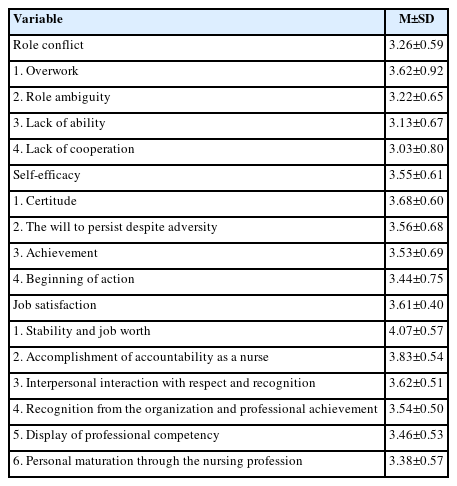
Purpose This study examined factors associated with job satisfaction among physician assistant nurses working across diverse tasks and clinical settings. Methods: From March 18 to April 2, 2025, we surveyed physician assistant nurses at a tertiary hospital in Daegu and data from 141 participants were analyzed. Analyses included descriptive statistics, the independent t-test, one-way analysis of variance, Pearson correlation coefficients, and hierarchical multiple regression. Results: Self-efficacy (β=.47, p<.001) and role conflict (β=-.19, p=.008) were significantly associated with job satisfaction, and the final model explained 32.2% of the variance. Conclusion: Strategies to improve job satisfaction should reduce role conflict and strengthen self-efficacy through education and competency-development programs. Clearer work regulations and legal and institutional safeguards may also support physician assistant nurses.
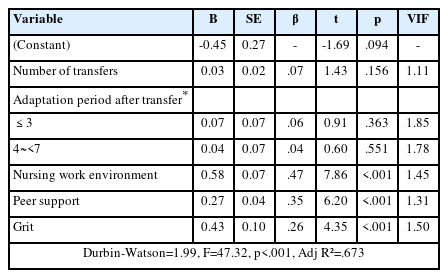
Purpose This study examined the associations of the nursing work environment, peer support, and grit with job satisfaction among nurses who had experienced department transfers. Methods: This cross-sectional descriptive study included 136 nurses from two tertiary hospitals who had experienced at least one department transfer within the previous three years. Data were collected from June 15 to August 15, 2025, using a structured online questionnaire. The data were analyzed using descriptive statistics, the t-test, analysis of variance, Pearson correlation coefficients, and multiple linear regression in IBM SPSS version 26.0. Results: Job satisfaction was significantly correlated with the nursing work environment (r=.69, p<.001), peer support (r=.58, p<.001), and grit (r=.63, p<.001). In the multiple linear regression analysis, the nursing work environment (β=.47, p<.001), peer support (β=.35, p<.001), and grit (β=.26, p<.001) were significant factors associated with job satisfaction. Conclusion: The nursing work environment showed the strongest association with job satisfaction, followed by peer support and grit. Supportive work environments, peer-support systems, and organizational strategies that strengthen nurses’ grit may help improve job satisfaction and support adaptation after department transfer.
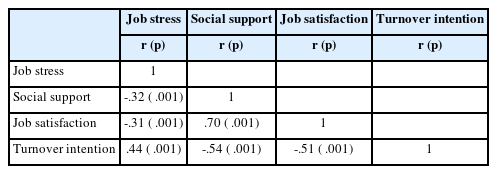
Purpose Hemodialysis units require a highly specialized nursing workforce, and frequent nurse turnover may compromise continuity of care and patient safety. This study aimed to identify factors associated with turnover intention among hemodialysis nurses using Price’s causal model of turnover. Methods: A model-testing design was used. Data were collected from 180 hemodialysis nurses in three metropolitan cities using structured questionnaires that measured job stress, social support, job satisfaction, and turnover intention. Descriptive statistics were analyzed using IBM SPSS version 27.0, and path analysis was conducted using IBM SPSS AMOS version 26.0. Results: Turnover intention was significantly lower among nurses aged 40 years or older, those with at least 20 years of clinical experience, those with at least 10 years of hemodialysis-unit experience, and those with an adaptation period longer than 90 days. Job stress showed a significant direct path to turnover intention (β=.38, p<.001). Social support showed significant direct paths to job satisfaction (β=.64, p<.001) and turnover intention (β=–.42, p<.001), as well as a significant indirect path to turnover intention through job satisfaction (β=–.19, p=.028). The model explained 39.7% of the variance in turnover intention. Conclusion: Strategies to reduce job stress and strengthen social support may help reduce turnover intention and support the retention of experienced hemodialysis nurses.
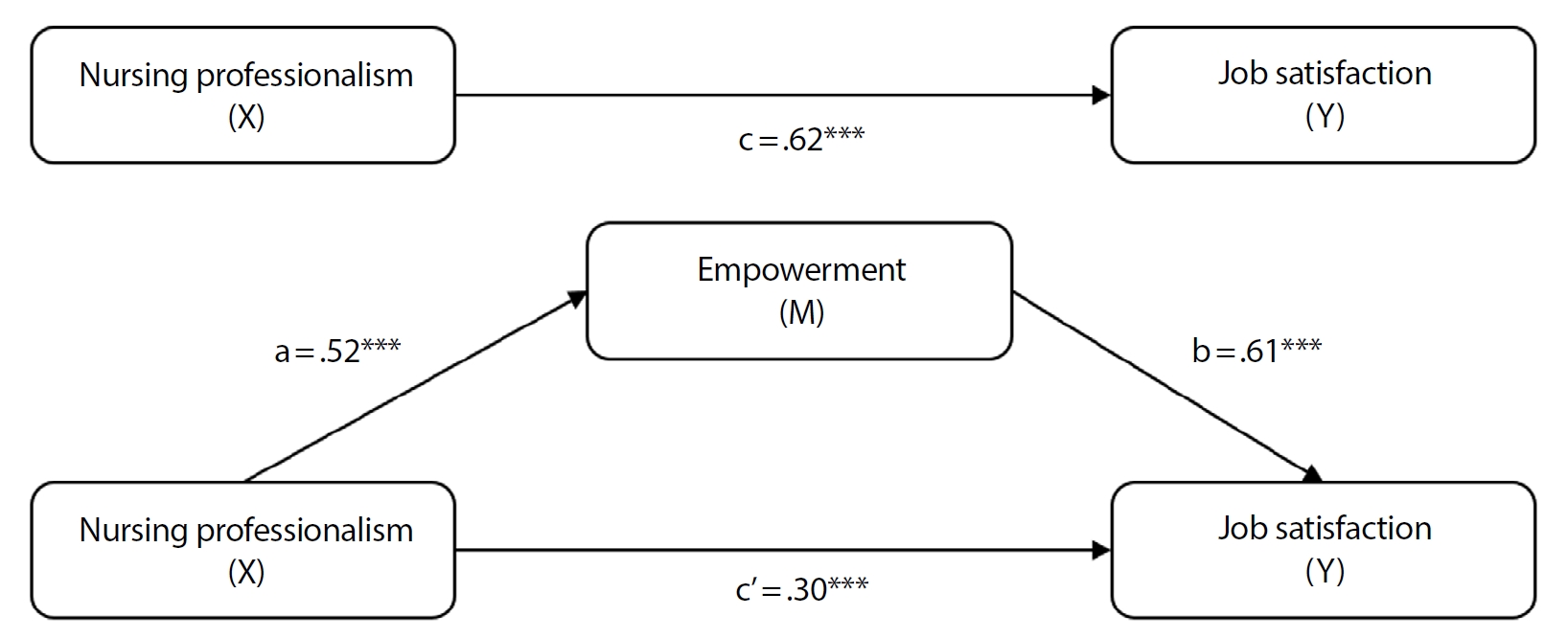
Purpose This study examined the mediating effect of empowerment on the relationship between nursing professionalism and job satisfaction, with the goal of informing strategies to enhance job satisfaction among insurance review nurses. Methods: A total of 165 insurance review nurses with more than 1 year of work experience in 12 general hospitals (≥500 beds) participated in this study. Data were analyzed using descriptive statistics, t-tests, analysis of variance, Pearson correlation analysis, and multiple regression analysis. The mediating effect was tested using the PROCESS Macro (model 4) in SPSS version 26.0 with 10,000bootstrap samples. Results: The mean scores for nursing professionalism, empowerment, and job satisfaction were 100.37 (standard deviation [SD], 17.03), 86.24 (SD, 17.70), and 45.44 (SD, 9.17), respectively. Significant positive correlations were observed between nursing professionalism and job satisfaction (r=.64, p<.001), empowerment and job satisfaction (r=.77, p<.001), and nursing professionalism and empowerment. Empowerment was found to partially mediate the relationship between nursing professionalism and job satisfaction (95% CI, .20–.44). Conclusion: Enhancing empowerment and strengthening nursing professionalism are essential for improving job satisfaction among insurance review nurses. Institutional interventions that promote professional identity and provide structural empowerment may increase job satisfaction and support retention within this specialized nursing workforce.
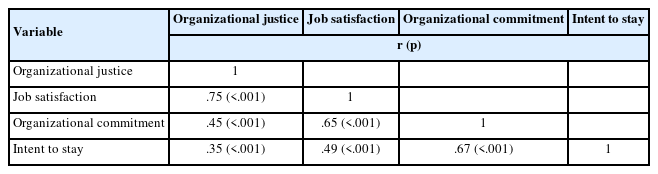
Purpose This study investigated the influence of organizational justice on junior nursing officers’ intent to stay in their positions and explored the mediating roles of job satisfaction and organizational commitment. Methods: A descriptive correlational design was employed, and data were analyzed using SPSS 29.0 software. Statistical analyses included descriptive statistics, the t-test, one-way analysis of variance, Pearson’s correlation coefficients, and multiple linear regression. The mediating effects of job satisfaction and organizational commitment were evaluated following Baron and Kenny’s three-step mediation procedure, and significance was confirmed through the bootstrapping method. Results: Organizational justice, job satisfaction, organizational commitment, and intent to stay were all significantly positively correlated. The mediating effects of job satisfaction and organizational commitment on the relationship between organizational justice and intent to stay were confirmed. Conclusion: Based on the findings of this study, job satisfaction and organizational commitment were found to fully mediate the relationship between organizational justice and intent to stay. Therefore, to enhance the intent to stay among junior nursing officers, it is considered necessary to develop supportive measures and establish systems within the military and nursing corps that strengthen organizational justice for junior nursing officers.
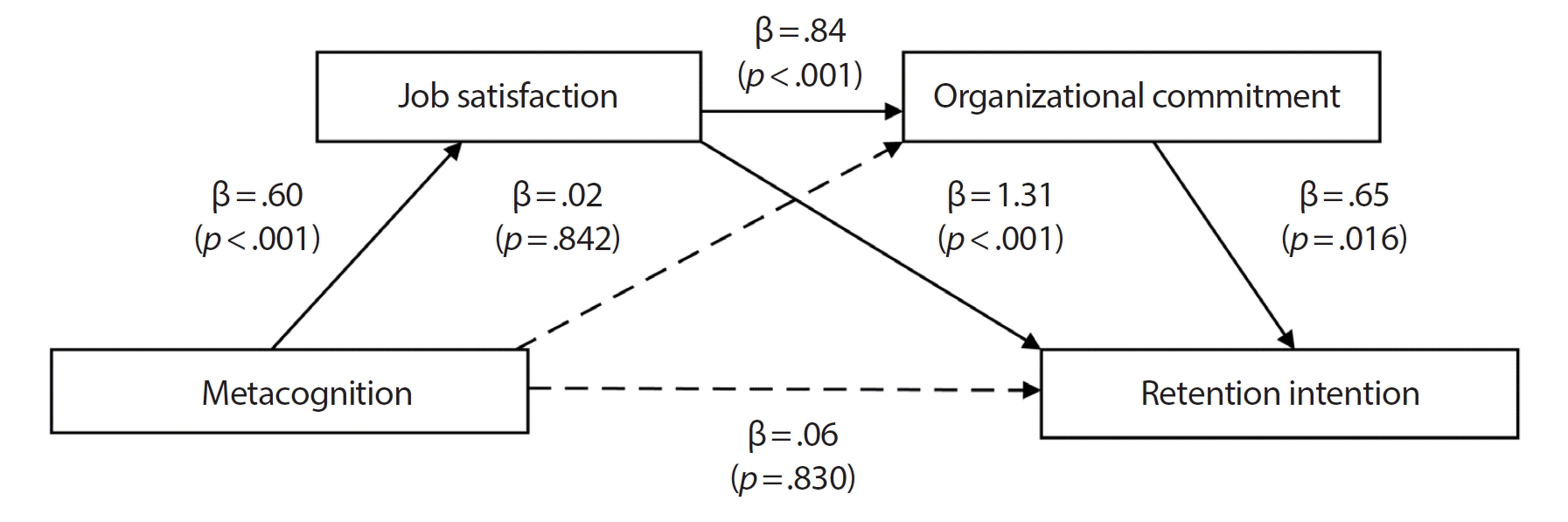
Purpose This study investigated the effect of new nurses' metacognition on their retention intention and the dual mediating effect of job satisfaction and organizational commitment in the relationship between those two variables. Methods: Participants included 154 new nurses with 12 months or less of clinical experience working in general hospitals in Seoul. Using a structured questionnaire, data were collected from September 30 to October 29, 2024 and analyzed using IBM SPSS version 29.0 and the Process Macro 4.2 program. Results: Metacognition had a positive effect on job satisfaction (B=0.60, p<.001). Job satisfaction had significant positive effects on organizational commitment (B=0.84, p<.001) and retention intention (B=1.31, p<.001), while organizational commitment had a significant positive effect on retention intention (B=0.65, p=.016). The sequential mediating effect of job satisfaction and organizational commitment was confirmed within the relationship between metacognition and retention intention in new nurses (effect=0.33, 95% confidence interval: 0.03-0.71). Conclusion: The results of this study suggest the presence of a causal structure in which higher metacognition is associated with greater job satisfaction in new nurses; this leads them to commit to the organization, eventually increasing their retention intention.
Purpose To examine the impact of reading the text of the Nightingale Pledge aloud at the beginning of the shift on nursing workplace spirituality, organizational commitment, and job satisfaction among hospital nurses.
Methods We used a non-randomized controlled trial design. Forty-four nurses from four wards with similar work environments at M General Hospital in B City were enrolled. The data were analyzed using a x2 test, t-test, and generalized estimating equations.
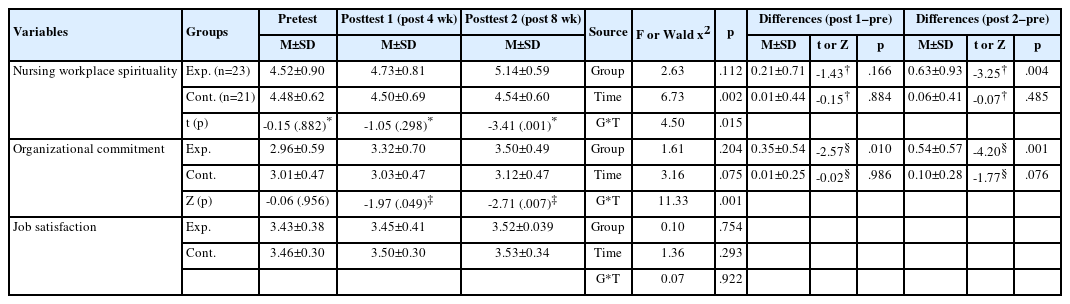
Results In both groups, we observed a significant group and time interaction effect for nursing workplace spirituality (Wald x2=4.50, p=.015) and organizational commitment (Wald x2=11.33, p=.001). Nursing workplace spirituality was significantly higher in the experimental group than in the control group at eight weeks after the intervention (t=-3.41, p=.001). Likewise, organizational commitment was significantly higher in the experimental group than in the control group at four and eight weeks after the intervention (Z=-1.97, p=.049; Z=-2.71, p=.007, respectively). Job satisfaction did not significantly before and after the intervention.
Conclusion Despite the short time commitment, reading aloud the text of the Nightingale Pledge at the beginning of shift had positive effects on hospital nurses’ nursing workplace spirituality and organizational commitment.


 First
First Prev
Prev