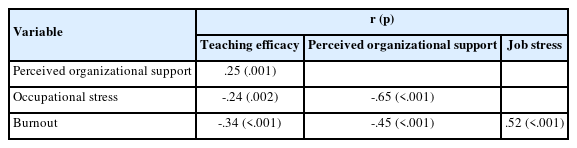
Purpose This study aimed to investigate the effects of teaching efficacy, perceived organizational support, and occupational stress on burnout among preceptor nurses. Methods: Participants included 156 nurses who had at least one month of preceptor experience within the past year. Data were collected using a structured self-report questionnaire and analyzed with SPSS version 27.0. Descriptive statistics, independent sample t-tests, one-way analysis of variance with Scheffé post-hoc tests, Pearson’s correlation analysis, and multiple regression analysis were performed. Results: Occupational stress (β=.36, p<.001) and teaching efficacy (β=-.17, p=.017) were significant predictors of burnout among preceptor nurses, jointly explaining 36.0% of the variance. Conclusion: Occupational stress and teaching efficacy were identified as key determinants of burnout in preceptor nurses. Effective burnout prevention strategies should focus on reducing occupational stress through workload management and strengthening teaching efficacy via continuous training and organizational support.
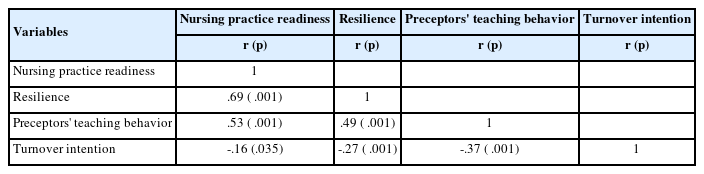
Purpose This study investigated the effects of newly graduated nurses’ perceived readiness for nursing practice, resilience, and preceptors’ teaching behaviors on turnover intention.
Methods A survey was conducted among 168 newly graduated nurses between August 7 and 31, 2023. The data were analyzed using descriptive statistics, t-tests, one-way ANOVA, Pearson's correlation, and hierarchical multiple regression analysis.
Results The factors that significantly affected turnover intention included preceptors' teaching behavior (β=-.29, p=.001) and resilience (β=-.21, p=.026). This model explained 32.0% of the variance.
Conclusion Newly graduated nurses’ resilience and their initial training environment are key factors influencing turnover intention. Therefore, nursing managers should develop strategies to enhance the resilience of newly graduated nurses and improve training systems. Additionally, efforts should be made to promote positive teaching behaviors among the educators responsible for training newly graduated nurses.
Citations
Citations to this article as recorded by
Experiences of work performance among physician assistant nurses during the period of healthcare disruption in South Korea: a qualitative content analysis Juyoung Ha, Minji Kim Journal of Korean Academy of Nursing.2026; 56(1): 98. CrossRef
Educational Innovation in Nursing Management after Reforms in the National Nurse Licensure Examination: A Narrative Review Yoomi Jung Journal of Korean Academy of Nursing Administration.2026; 32(3): 137. CrossRef
Factors Associated With Nursing Profession Self‐Efficacy Among Newly Graduated Nurses: A Cross‐Sectional Study Yujeong Kim, Eunhee Nam, Myojeong Kim, Dokyung Kim, Heejin Sim Nursing Open.2026;[Epub] CrossRef
Perceptions on Fixed Night Shift System and Turnover Intention of General Hospital Nurses Mi-Aie Lee, Hye-Jin Cho, Sung-Hee Ahn, Hyo-Ju Kim Journal of Korean Academy of Nursing Administration.2015; 21(5): 519. CrossRef
Purpose This descriptive study aimed to identify the effects of purposeful and timely nursing rounds on patients' perception of the quality of nursing services and nurses' perception of nursing rounds. Methods Intentional nursing rounds were conducted by communicating patients’ questions on pain, position, pump, potty, and possessions. A total of 144 nurses and 149 patients participated, and data were collected using self-report questionnaires. The independent t-test, x 2 test, and Wilcoxon’s rank-sum test were used to analyze the data with SPSS version 24.0. Results Although intentional nursing rounds improved the nurses’ perception of nursing rounds, there was no significant difference. The nurses’ benefit had the lowest score (3.36), and the benefit of communication with patients had the highest score (3.79).
Intentional nursing rounds significantly improved the patients’ perception of the quality of nursing services in the intervention group. Among the factors of empathy (Z=4.98, p<.001) related to the quality of nursing services as perceived by the patient, assurance (Z=5.50, p<.001), reliability (Z=4.43, p<.001), and responsiveness (Z=5.02, p<.001) significantly increased. Conclusion Intentional nursing rounds positively affected patients’ perception of the quality of nursing service. It is important to improve intentional nursing rounds to enhance nurses’ perceptions of them.
Citations
Citations to this article as recorded by
Associations of perceptions of patient safety culture, job crafting, and perceptions of patient rounding with patient safety management activities among tertiary hospital nurses Saet-Byeol Kim, Yun-Hee Kim Journal of Korean Biological Nursing Science.2024; 26(3): 259. CrossRef
PURPOSE The purpose of this study was to examine the effects of perceptions of patient rounding, self-leadership and nursing organization culture on intentional rounding performance. METHODS The participants for this study were 210 nurses who had the experience of patient rounding care in general hospitals in B and Y cities. Data were collected from February 5th to 22nd, 2018. Collected data were analyzed using descriptive statistics, χ² test, and independent t-test. Logistic regression analysis was performed to identify factors influencing intentional rounding performance. RESULTS It was found that intentional rounding performance was carried out by 20.0% of the day shift nurses, 18.1% of the evening shift nurses, and 19.5% of the night shift nurses. The significant factors influencing intentional rounding performance were the recommended rounding time interval in wards and the use of rounding protocol in the wards (p < .050). CONCLUSION It is expected that nurses will be able to provide more advanced and efficient patient rounding by promising a systematic patient rounding time for intentional rounding and developing appropriate protocols for each ward.
Citations
Citations to this article as recorded by
Introducing and applying an intentional rounding program for nursing students in adult nursing practicum: Process and outcomes Heejung Choi, Jong Sun Ok, Eun-Young Noh, Young Hye Song, Jin Yi Choi The Journal of Korean Academic Society of Nursing Education.2025; 31(3): 223. CrossRef
Associations of perceptions of patient safety culture, job crafting, and perceptions of patient rounding with patient safety management activities among tertiary hospital nurses Saet-Byeol Kim, Yun-Hee Kim Journal of Korean Biological Nursing Science.2024; 26(3): 259. CrossRef
Development of an intentional rounding protocol for nursing undergraduates to apply in clinical practice Sueun Kim, Jong Sun Ok, Jin Yi Choi, Heejung Choi The Journal of Korean Academic Society of Nursing Education.2023; 29(4): 381. CrossRef
Improving Patients’ Perception of the Quality of Nursing Services and Nurses’ Perception of Nursing Rounds through Purposeful and Timely Nursing Rounds Yun Sook Kim, Dong Yeon Kim, Na Young Kim, Jinsuk Kim, Young Eun Yang, Youmin Jeong, Hee Young Choi, Eun Oh Journal of Korean Academy of Nursing Administration.2023; 29(1): 12. CrossRef
PURPOSE The purpose of this study was to identify effects of action learning approaches on learning outcomes of students taking nursing management courses. METHODS The questionnaire surveys were completed between March 2011 and June 2012 by 109 undergraduate seniors in the nursing department of C University. Survey data were obtained 3 times: before, in and after the study of nursing management. The course consisted of lectures and clinical practices. Learning outcomes were measured through problem solving skills, team efficacy, and class satisfaction. Collected data were analyzed using repeated measures ANOVA with the SPSS 20.0 program. RESULTS Scores for problem solving skills (F=13.67, p<.001) and team efficacy (F=4.49, p=.012) showed statistically significant increases after the course. The scores also increased significantly after the lectures for 5 of 9 problem solving skill subscales: analysis skill, divergent thinking, decision making, assessment, feedback, and after the clinical practices for 2 subscales: divergent thinking, and execution and risk taking. Class satisfaction score also increased after both the lectures and the clinical practices. CONCLUSION The findings from this study suggest that an action learning approaches for nursing management courses would be a useful teaching and learning method to achieve learning outcomes.
Citations
Citations to this article as recorded by
Impact of problem-based learning on the development of nursing care management skills Luis Angel Benítez-Chavira, Rosa Amarilis Zárate-Grajales, María Guadalupe Moreno-Monsiváis Teaching and Learning in Nursing.2026; 21(1): e70. CrossRef
The effects of action learning-based education of nursing students on the perception of child abuse Nam Hye Ri, Sun Jung Park International Journal of ADVANCED AND APPLIED SCIENCES.2023; 10(11): 14. CrossRef
Efecto del Aprendizaje Basado en Problemas en habilidades de Gestión del Cuidado: Estudio cuasiexperimental Luis Angel Benítez-Chavira, Rosa Amarilis Zárate-Grajales, María Guadalupe Moreno-Monsiváis, Cecilia Xochitl Vite-Rodríguez, Carlota Mercedes Hernández-Rosales, Carlos Emmanuel Brito-Carbajal Revista Latino-Americana de Enfermagem.2023;[Epub] CrossRef
O efeito da Aprendizagem Baseada em Problemas nas habilidades de Gestão do Cuidado: Estudo quase-experimental Luis Angel Benítez-Chavira, Rosa Amarilis Zárate-Grajales, María Guadalupe Moreno-Monsiváis, Cecilia Xochitl Vite-Rodríguez, Carlota Mercedes Hernández-Rosales, Carlos Emmanuel Brito-Carbajal Revista Latino-Americana de Enfermagem.2023;[Epub] CrossRef
The effect of Problem-Based Learning on Care Management skills: A quasi-experimental study Luis Angel Benítez-Chavira, Rosa Amarilis Zárate-Grajales, María Guadalupe Moreno-Monsiváis, Cecilia Xochitl Vite-Rodríguez, Carlota Mercedes Hernández-Rosales, Carlos Emmanuel Brito-Carbajal Revista Latino-Americana de Enfermagem.2023;[Epub] CrossRef
Clinical Practice Experience of Nursing Students in the Context of the COVID-19 Pandemic Hyeon-Young Kim, Eun-Hye Lee Journal of Korean Academy of Fundamentals of Nursing.2022; 29(1): 45. CrossRef
Nursing Students’ Experience of Action Learning in Clinical Practice of Nursing Management Yong Sook EO, Hae Ok KIM JOURNAL OF FISHRIES AND MARINE SCIENCES EDUCATION.2021; 33(5): 1114. CrossRef
Factors Affecting the Academic Achievement of Nursing College Students in a Flipped Learning Simulation Practice Minkyung Gu, Sohyune Sok International Journal of Environmental Research and Public Health.2021; 18(11): 5970. CrossRef
Experience of Nursing Management Practice in Graduate Nurses Kwang-Ok Park, Jong Kyung Kim Journal of Korean Academy of Nursing Administration.2019; 25(4): 259. CrossRef
Effects of Action Learning Based Health Assessment Class on Nursing Students' Self-confidence and Knowledge of Health Assessment, Critical Thinking Ability, and Class Satisfaction Myo-Gyeong Kim Journal of Korean Academy of Fundamentals of Nursing.2018; 25(4): 259. CrossRef
A Literature Review of Research on Action Learning-based Nursing Education in South Korea Yun-Hee Kim, Hyo-Youn Kim Journal of Korean Academy of Nursing Administration.2018; 24(1): 73. CrossRef
The Effect of Case-based Learning (CBL) on Critical Thinking Disposition, Communication Ability, Problem Solving Ability and Self-directed Learning Ability of Nursing Students in Pathophysiology Course Min Hee Lee, Myung Sook Park Journal of Korean Biological Nursing Science.2016; 18(3): 176. CrossRef
The Effects of Lessons using Action Learning on Nursing Students So-Myeong Kim, Sang-Youn Park The Journal of Korean Academic Society of Nursing Education.2016; 22(1): 42. CrossRef
Analysis of Students Experience related of Nursing Management Clinical Practice: Text Network Analysis Method Kyeong Hwa Kang, Soyoung Yu Journal of Korean Academy of Nursing Administration.2016; 22(1): 80. CrossRef
Effects of Learning Activities on Application of Learning Portfolio in Nursing Management Course So Eun Choi, Eun A Kim Journal of Korean Academy of Nursing.2016; 46(1): 90. CrossRef
The Effects of a gerontological nursing clinical practice course using action learning on undergraduate nursing students Sang Min Kwon, Mal-Suk Kwon, Jee-Yeon Park Journal of the Korea Academia-Industrial cooperation Society.2016; 17(5): 421. CrossRef
Comparative Study on Self-leadership, Team Efficacy, Problem Solving Process and Task Satisfaction of Nursing Students in Response to Clinical Training Jung Hyo Kim, Mi Kyung Park The Journal of Korean Academic Society of Nursing Education.2014; 20(4): 482. CrossRef
The Effect of the Cultural Competence in Multicultural Nursing Education by Action Learning Yeon-Soon Kim, Jin-Young Kim Journal of the Korea Academia-Industrial cooperation Society.2014; 15(11): 6527. CrossRef
The Effects of Action Learning on Nurses' Problem Solving, Communication, Emotional Creativity and Innovation Behavior Sook-Ja Lee, Keum-Seong Jang The Korean Journal of Health Service Management.2014; 8(2): 73. CrossRef
PURPOSE In this study, we examined the differences and relationship between teaching style of preceptors, and personality, nursing performance, and organizational socialization of new nurses. METHODS The participants were 118 new nurses. The data collected from March to May 2011 were analyzed using descriptive statistics, ANOVA, and Pearson correlation coefficients. RESULTS Teaching style of preceptors was most frequently judgement-initiative, and personality of new nurses was most frequently extraversion. Nursing performance (3.05+/-.59) and organizational socialization (3.05+/-.59) of new nurses were at an average level. Nursing performance and organizational socialization of new nurses were not significantly different according to teaching style of preceptors. Significant correlations were found between personality and nursing performance, and between personality and organizational socialization. CONCLUSION These findings indicate that changes in perceived teaching style of preceptors and personality of new nurses may be necessary to increase efficiency of preceptorship related to nursing performance and organizational socialization of new nurses. The above-mentioned results should be reflected in the development of effective preceptor training programs.
Citations
Citations to this article as recorded by
Trajectories of Wok Adjustment and Influencing Factors Among Newly Registered Nurses Sunghee Park, Jin-Hee Park, Ju-Eun Song, Sun Hyoung Bae, Kyoungja Kim, Youngjin Lee Asian Nursing Research.2024; 18(1): 36. CrossRef
Effects of Preceptors’ Clinical Teaching Behavior on the Field Adaptation of New Graduate Nurses: Mediating Effects of Self-Leadership and Resilience Eunjung Kim, Eungyung Kim Journal of Korean Academy of Nursing Administration.2023; 29(5): 577. CrossRef
The Relationship between Empathy Ability and Work Consciousness according to the DISC Behavioral Types of Some Dental Hygiene Students Mi-Hae Yun, Eun-Joo Na International Journal of Clinical Preventive Dentistry.2023; 19(4): 77. CrossRef
Development and Preliminary Evaluation of the Effects of a Preceptor Reflective Practice Program: A Mixed-Method Research Heui-Seon Kim, Hye-Won Jeong, Deok Ju, Jung-A Lee, Shin-Hye Ahn International Journal of Environmental Research and Public Health.2022; 19(21): 13755. CrossRef
Effect of Preceptors' Teaching Behavior on New Graduate Nurses' Intention to Stay: The Mediating Effect of Resilience and Organizational Socialization Eungyung Kim, Eunha Choi Journal of Korean Academy of Nursing Administration.2022; 28(1): 57. CrossRef
The development and evaluation of a pediatric nurse education program to improve nursing competency for newly graduated nurses in a children’s hospital Hae-kyung Shin, Hyo-yeong Kim, Hyun-Jung Kim, Min-kyung Kim, Hyun-joo Shin, Hoo-yun Lee, Jee-hee Han, Hye-jung Lee The Journal of Korean Academic Society of Nursing Education.2022; 28(2): 179. CrossRef
Types of Role Perception of Preceptors for New Nurses: A Q Methodology Approach Sukyung Kim, Byoungsook Lee Journal of Korean Academy of Nursing Administration.2021; 27(3): 204. CrossRef
Could social media help in newcomers' socialization? The moderating effect of newcomers’ utilitarian motivation Di Cai, Jia Liu, Haichuan Zhao, Mingyu Li Computers in Human Behavior.2020; 107: 106273. CrossRef
Relationship between Preceptors’ Communication Type and Newly
Employed Nurses’ Organizational Socialization Mi Sun Jang, Jung A Kim Business Communication Research and Practice.2019; 2(1): 22. CrossRef
Validity and Reliability of the Clinical Teaching Behavior Inventory (CTBI) for Nurse Preceptors in Korea Myun Sook Jung, Eun Gyung Kim, Se Young Kim, Jong Kyung Kim, Sun Ju You Journal of Korean Academy of Nursing.2019; 49(5): 526. CrossRef
Mediating Effect of Self-efficacy in the Relationship between Informal Learning, Shared Leadership and Organizational Socialization of Beginner · Advanced Beginner Nurses Nam Yi Kim, Chung Hee Woo Journal of Korean Academy of Nursing Administration.2018; 24(1): 1. CrossRef
Clinical Competence and Organizational Socialization according to Communication Style of Preceptors as Perceived by New Nurses* Young Choon Park, Hyoung Sook Park Journal of Korean Academy of Fundamentals of Nursing.2016; 23(1): 42. CrossRef
Organizational Socialization and Intention to Leave in Operating Room Nurses Working at Secondary General University Hospitals Su Jung Yoon, Hye-Ja Park Journal of Korean Academy of Nursing Administration.2015; 21(1): 88. CrossRef
PURPOSE In this study, differences and relationship between teaching style, personality, job stress, and job satisfaction among preceptors were examined. METHODS The participants were 121 preceptors. Data were collected in November and December 2010 and analyzed using descriptive statistics, ANOVA, Scheffe's test, and Pearson correlation coefficients. RESULTS The most frequent teaching style was judgement-initiative, and personality scores were highest for conscientiousness. Job stress was average (3.05+/-.59), and job satisfaction was below the mid-point level (2.76+/-.39). Job stress and job satisfaction were significantly different according to teaching style. Significant correlations were found between personality and job stress, and personality and job satisfaction. CONCLUSIONS These findings indicate that changes in perceived teaching style, and personality may be necessary to decrease job stress, and to promote job satisfaction among preceptors. The results of this study should be considered in the development of effective preceptor training programs.
Citations
Citations to this article as recorded by
Factors Associated with Job Stress among Hospital Nurses: A Meta-Correlation Analysis Ji-Young Lim, Geun-Myun Kim, Eun-Joo Kim International Journal of Environmental Research and Public Health.2022; 19(10): 5792. CrossRef
Clinical Competence and Organizational Socialization according to Communication Style of Preceptors as Perceived by New Nurses* Young Choon Park, Hyoung Sook Park Journal of Korean Academy of Fundamentals of Nursing.2016; 23(1): 42. CrossRef
Effects of Individual-organization Personality Agreement using Five-factor Model on Hospital Nurses' Job Satisfaction and Organizational Commitment Ok Gum Kim, Ji Young Lim Journal of Korean Academy of Nursing Administration.2015; 21(2): 164. CrossRef
An analysis of research trends related with job stress in nursing Eun-Yeon Lee, Kyung-Hee Shon Journal of the Korea Convergence Society.2015; 6(3): 87. CrossRef
Nurses' Lived Experience of Preceptorship for Newly Graduated Nurses in Hospital Yeon Sil Cho, Sue Kyung Sohn, Mi Young Han, Mi Sook Kim, Boo Kyeong Bang, Kyong Mi Lee Journal of East-West Nursing Research.2014; 20(1): 37. CrossRef
Nursing Performance and Organizational Socialization of New Nurses according to Teaching Style of Preceptors and Personality of New Nurses Jeong Sill Choi, Nam Young Yang Journal of Korean Academy of Nursing Administration.2012; 18(3): 281. CrossRef


 First
First Prev
Prev