Purpose This study examines how the use of generative artificial intelligence (AI) in research may be interpreted and regulated under South Korea’s National Research and Development Innovation Act and its Enforcement Decree. It also evaluates how AI-assisted research practices challenge the conceptual boundaries of the statutory categories of research misconduct. Methods: Through doctrinal legal analysis of Article 31 of the Act and Article 56 of the Enforcement Decree, common AI-assisted practices across the research cycle—design, literature review, data generation and analysis, manuscript writing, and the input of data into AI systems—were mapped to the Act’s misconduct taxonomy and related legal duties. Results: Generative AI may plausibly implicate fabrication, falsification, plagiarism, and improper authorship (Article 31(1)1), as well as improper ownership of research and development outcomes and breaches of security measures (Article 31(1)3–4). The analysis further indicates that AI use destabilizes categorical boundaries, as individual outputs may simultaneously involve invented content, distorted interpretation, and unattributed reproduction. Numerous research-integrity risks arise from failures in research processes, including nondisclosure, inadequate verification, weak provenance tracking, and irreproducible analysis pipelines. Conclusion: Legal and institutional responses should prioritize transparency across the research cycle and the development of auditable workflows, rather than focusing solely on sanctioning problematic outputs. Clear disclosure standards, verification obligations, reproducibility requirements, and stringent data-stewardship rules are necessary to address these emerging risks.
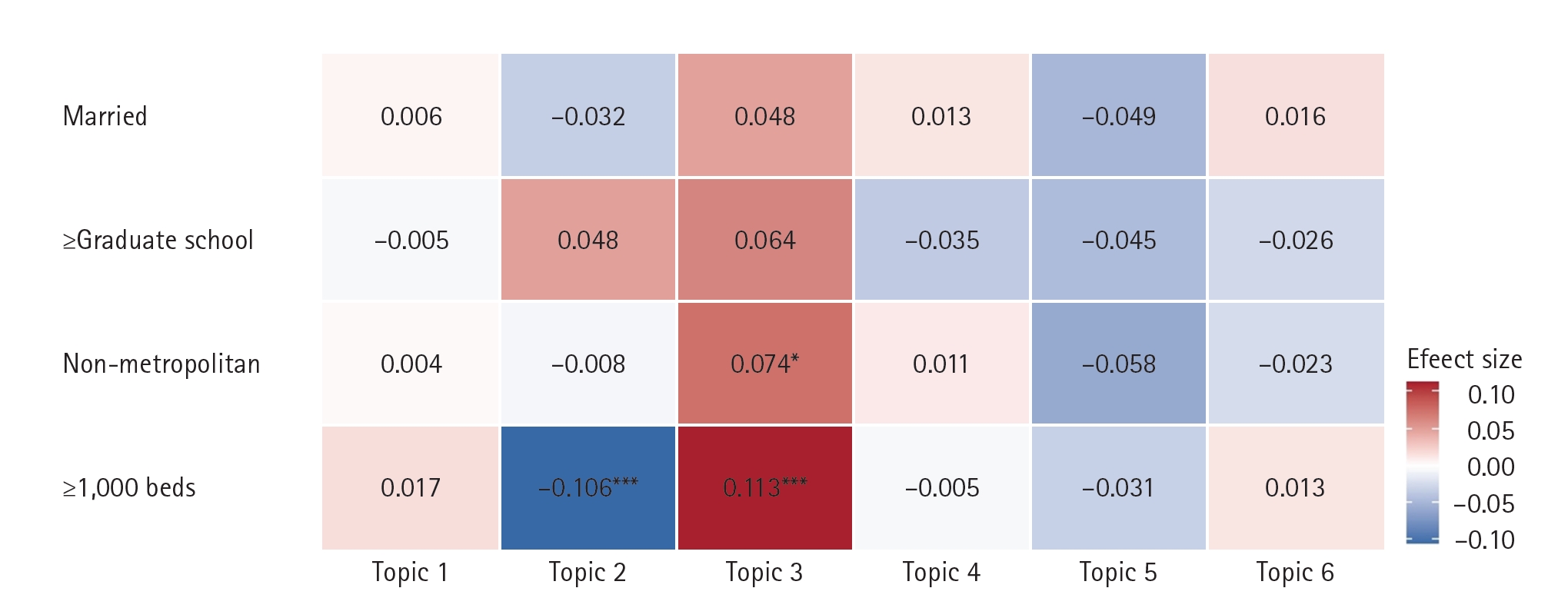
Purpose This study explored nurses’ experiences and perspectives regarding the shift system improvement pilot project, as well as their recommendations for shift work policies, and examined variations according to nurse and hospital characteristics. Methods: Structural topic modeling was applied to open-ended survey responses from 208 nurses. Topic prevalence was examined according to career length, marital status, education, hospital location, and bed capacity. Findings: Six topics emerged: experiences with implementing a pilot project for shift system improvement; shift system improvements for sustainability; physical burden and challenges of fixed night shifts; the impact of shift system improvement on personal life; nurse staffing levels for providing safe nursing care; and nursing workforce expansion and work distribution for quality care. Workforce adequacy showed the highest prevalence and was the dominant theme across all career lengths. The prevalence of system improvement was higher among nurses with ≤3 years and >10 years of experience, whereas nurses with 3–10 years of experience focused more on project participation. Smaller hospitals prioritized system improvements, whereas larger hospitals emphasized the physical burden. Conclusion: Nursing workforce adequacy emerged as nurses’ primary concern, surpassing concerns related to shift system design. Policy should prioritize legally mandated nurse staffing ratios as the foundation for sustainable shift systems, with interventions tailored to organizational capacity and career length.
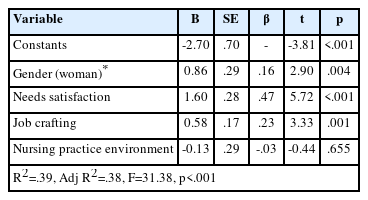
Purpose This study investigated the effects of need satisfaction, job crafting, and the nursing practice environment on retention intention among advanced beginner-stage nurses. Methods: Data were collected from 194 advanced beginner-stage nurses working at one university hospital in Chungcheongnam-do and two general hospitals in Gyeongsangbuk-do. The data were analyzed using descriptive statistics, the t-test, analysis of variance (ANOVA), Pearson’s correlation coefficients, and multiple regression analysis using IBM SPSS version 25.0. Results: The mean score for retention intention among advanced beginner stage nurses was 4.96 out of a possible 8 points. Factors associated with retention intention were need satisfaction (β=.47, p<.001), and job crafting (β=.23, p=.001), and gender (female; β=.16, p=.004). These variables explained 38% of the variance in retention intention in the regression model (F=31.38, p<.001). Conclusion: The findings suggest that improving need satisfaction and enhancing job crafting may increase retention intention among advanced beginner-stage nurses. The development of job-crafting enhancement programs, along with organizational initiatives that support job crafting and establish nursing policies aligned with these efforts, may contribute to improved nurse retention.
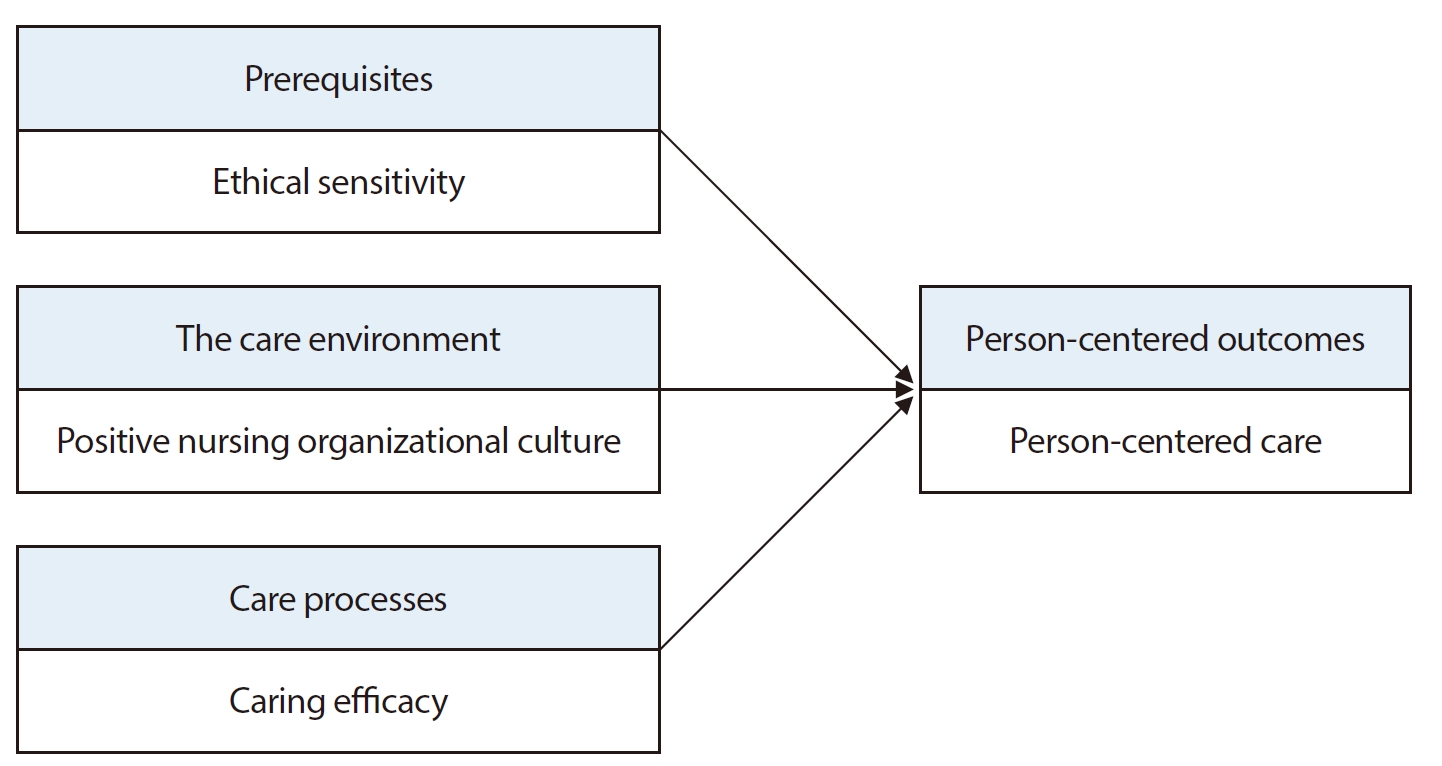
Purpose This study aimed to identify the influence of ethical sensitivity, positive nursing organizational culture, and caring efficacy on person-centered care among clinical nurses in general hospitals. Methods: The participants were 181 clinical nurses working in general hospitals located in Jinju and Changwon cities, Gyeongnam Province, South Korea. Data were collected from December 17, 2024, to January 25, 2025. Data analysis was performed using SPSS Statistics 27.0 and included descriptive statistics, the independent t-test, one-way analysis of variance, Pearson correlation analysis, and multiple regression analysis. Results: The participants’ mean scores were 4.16±0.42 for ethical sensitivity, 3.76±0.64 for positive nursing organizational culture, 4.23±0.67 for caring efficacy, and 3.90±0.50 for person-centered care. Person-centered care showed a significant positive correlation with ethical sensitivity (r=.49, p<.001), positive nursing organizational culture (r=.54, p<.001), and caring efficacy (r=.58, p<.001). Caring efficacy had the most significant effect on person-centered care (β=.41, p<.001), followed by positive nursing organizational culture (β=.30, p<.001) and ethical sensitivity (β=.19, p=.005). These variables accounted for 47.8% of the variance in person-centered care. Conclusion: To improve person-centered care, educational programs aimed at improving ethical sensitivity and caring efficacy, along with the establishment of a nursing organizational culture based on trust and respect, should be implemented.
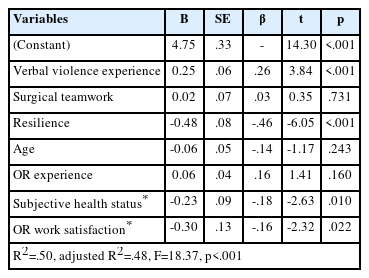
Purpose This study explored the influence of verbal violence experience, surgical teamwork, and resilience on burnout among operating room nurses. Methods: Data were collected from 135 operating room nurses who had worked for more than 6 months in the tertiary and general hospitals in two metropolitan cities. The IBM SPSS Statistics 27.0 program was used for descriptive statistics, independent t-tests, one-way analysis of variance, Pearson correlation coefficients, and stepwise multiple regression. Results: Burnout showed a significant positive correlation with verbal violence experience (r=.38, p<.001) and significant negative correlations with surgical teamwork (r=-.41, p<.001) and resilience (r=-.60, p<.001). Verbal violence experience was negatively correlated with surgical teamwork (r=-.38, p<.001), whereas surgical teamwork was positively correlated with resilience (r=.51, p<.001). Multiple regression analysis revealed that resilience (β=-.46, p<.001), verbal violence experience (β=.26, p<.001), subjective health status (β=-.18, p=.010), and satisfaction with operating room work (β=-.16, p=.022) significantly influenced burnout and explained 50% of the variance. Conclusion: These findings indicate that resilience, verbal violence experience, subjective health status, and work satisfaction are significant factors associated with burnout among operating room nurses. Therefore, targeted interventions focused on strengthening resilience, preventing verbal violence, and enhancing work satisfaction are needed to reduce burnout.
Purpose This study identified themes associated with the clinical adaptation of newly graduated nurses. Methods: We collected 522 interview journals from newly graduated nurses and nurse educators at a tertiary hospital between January 2021 and December 2023. After excluding incomplete data, 407 “promoting enjoyment” entries and 426 “presenting challenges” entries were analyzed using network analysis and topic modeling in NetMiner 4.5.1. Results: Topic modeling identified four themes in each category. For promoting enjoyment, the themes were: “Upon completing my designated responsibilities, I depart from the workplace,” “On my days off, I enjoy indulging in my favorite activities,” “Being recognized by my colleagues makes me feel like I’m contributing my part to the team,” and “The condition of my patient has improved.” For presenting challenges, the themes were: “The numerous responsibilities I must handle make it difficult to complete everything within the designated time frame,” “I struggle with both my tasks and relationships with colleagues,” “I’m anxious about caring for patients on my own,” and “Irregular shift patterns and occupational distress significantly impair my sleep quality.” Conclusion: Educational methodologies need to be developed to facilitate the clinical adaptation of newly graduated nurses. These findings can inform the Ministry of Health and Welfare’s nurse educator policy and future nursing workforce strategies.




 First
First Prev
Prev