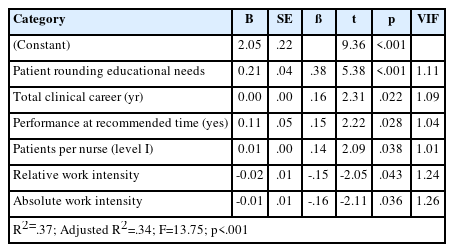
Purpose This study aimed to identify factors associated with nurses’ perceptions of patient rounding. Methods: A descriptive cross-sectional online survey was conducted. A total of 147 nurses working in general hospital wards were recruited online. The survey assessed general characteristics, including demographic, job-related, and work-related characteristics; patient rounding educational needs; and organizational factors, including nursing workload and nursing work intensity. Factors associated with nurses’ perceptions of patient rounding were analyzed using multiple regression analysis. Results: Nurses’ perceptions of patient rounding were positively associated with patient rounding educational needs (β=.38, p < .001), total clinical career (β=.16, p=.022), performance of rounding at recommended times (β=.15, p=.028), and the number of Level I patients assigned during the current shift (β=.14, p=.038). In contrast, relative work intensity (β=−.15, p=.043) and absolute work intensity (β=−.16, p=.036) were negatively associated with nurses’ perceptions of patient rounding. Conclusion: Nurses’ perceptions of patient rounding were associated with both individual and organizational factors. These findings support the need for structured rounding education and organizational strategies that account for nurses’ workload, work intensity, and patient acuity to facilitate patient rounding in clinical practice.
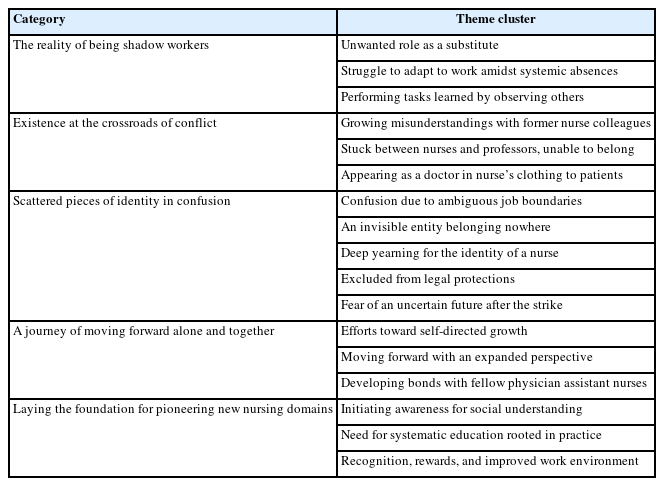
This study explored nurses’ experiences of physician assistant (PA) roles during the 2024 residents’ strike in South Korea, before enactment of the Nursing Act, and aimed to provide foundational evidence for developing PA nursing systems and related policies. Methods: In-depth, one-on-one interviews were conducted with 13 PAs working at an advanced general hospital in A Province between July and August 2024. Data were analyzed using Colaizzi’s phenomenological method. Results: Five categories were identified: “The reality of being shadow workers,” “Existence at the crossroads of conflict,” “Scattered pieces of identity in confusion,” “A journey of moving forward alone and together,” and “Laying the foundation for pioneering new nursing domains.” Conclusion: These findings illuminate the challenges and opportunities experienced by PAs during the 2024 residents’ strike before enactment of the Nursing Act. They also provide foundational evidence for policy development aimed at establishing and expanding PA nursing as a distinct domain in South Korea.
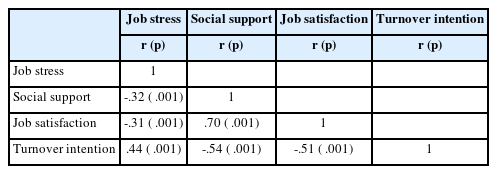
Purpose Hemodialysis units require a highly specialized nursing workforce, and frequent nurse turnover may compromise continuity of care and patient safety. This study aimed to identify factors associated with turnover intention among hemodialysis nurses using Price’s causal model of turnover. Methods: A model-testing design was used. Data were collected from 180 hemodialysis nurses in three metropolitan cities using structured questionnaires that measured job stress, social support, job satisfaction, and turnover intention. Descriptive statistics were analyzed using IBM SPSS version 27.0, and path analysis was conducted using IBM SPSS AMOS version 26.0. Results: Turnover intention was significantly lower among nurses aged 40 years or older, those with at least 20 years of clinical experience, those with at least 10 years of hemodialysis-unit experience, and those with an adaptation period longer than 90 days. Job stress showed a significant direct path to turnover intention (β=.38, p<.001). Social support showed significant direct paths to job satisfaction (β=.64, p<.001) and turnover intention (β=–.42, p<.001), as well as a significant indirect path to turnover intention through job satisfaction (β=–.19, p=.028). The model explained 39.7% of the variance in turnover intention. Conclusion: Strategies to reduce job stress and strengthen social support may help reduce turnover intention and support the retention of experienced hemodialysis nurses.
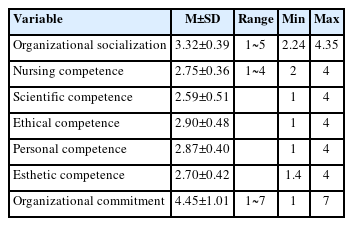
Purpose This study examined the effects of organizational socialization and nursing competence on organizational commitment among clinical nurses. Methods: Data were collected from August 12 to August 31, 2024, from 207 nurses with more than 6 months of clinical experience at five general hospitals in a metropolitan area. Data were analyzed using descriptive statistics, the independent t-test, one-way analysis of variance, Pearson correlation coefficients, and multiple regression in IBM SPSS version 27.0. Results: Organizational commitment was positively correlated with organizational socialization and with scientific, ethical, personal, and aesthetic competence. Multiple regression identified organizational socialization (β=.59, p<.001), aesthetic competence (β=.18, p=.012), ethical competence (β=.15, p=.023), and married status (β=.16, p=.010) as significant factors associated with organizational commitment. These variables explained 57.0% of the variance, and the regression model was significant (F=12.65, p<.001). Conclusion: Healthcare institutions should strengthen organizational socialization and nursing competence through structured education and institutional support to enhance nurses’ organizational commitment.
Purpose This study aimed to identify position-specific career competency development needs among clinical nurses in general hospitals. Methods: This descriptive survey included 184 nurses, comprising 98 staff nurses and 86 nurse managers. Participants rated the perceived importance of, and their self-rated performance in, each career competency. Data were analyzed using descriptive statistics, the independent t-test, importance–performance analysis, Borich’s needs assessment model, and the Locus for Focus model. Results: Seven core career competencies—including balance check/adjustment, career experience, relationship formation, new goals challenge, and external exploration—were highly prioritized by both staff nurses and nurse managers. Staff nurses and nurse managers both assigned high priority to seven competency areas: balance checking and adjustment, participation in career-related experiences, internal and external relationship formation, pursuit of new goals, and external career exploration. Staff nurses placed additional emphasis on self-reflection and internal career opportunities, whereas nurse managers emphasized accurate goal planning and ongoing review of career development. Conclusion: This study identified position-specific differences in nurses’ career competency development needs. These findings may inform the selection of educational priorities and the development of differentiated, position-specific programs to strengthen career competencies among nurses in general hospitals.
Purpose This study aimed to identify leadership development needs among novice and advanced beginner nurses sand provide empirical evidence for developing targeted leadership competency enhancement programs. Methods: Data were collected through a nationwide online survey from January 15 to February 28, 2025, using proportional quota sampling. The sampling quotas reflected hospital region and hospital type. Data from 283 nurses were analyzed. Descriptive statistics, including frequencies, percentages, means, and standard deviations, were calculated using IBM SPSS version 27.0. Results: Participants had a mean age of 27.5 years and a mean clinical experience of 1.75 years. Self-leadership was the leadership type most desired for development (3.97±0.84). The need for leadership programs was high among nurses with 1–3 years of clinical experience, with a mean score of 3.90. The most desired competencies were clinical performance and practical skills (49.1%), stress management (40.3%), and communication (39.2%). Intention to use mobile-based leadership programs was moderate. Short video lectures (70.0%) and self-directed learning (42.8%) were the most preferred content format and learning method, respectively. Conclusion: These findings indicate a need for practical, systematic programs centered on self-leadership that address clinical performance, practical skills, stress management, and communication during the early career stage of nursing.
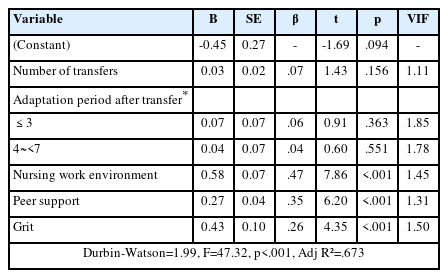
Purpose This study examined the associations of the nursing work environment, peer support, and grit with job satisfaction among nurses who had experienced department transfers. Methods: This cross-sectional descriptive study included 136 nurses from two tertiary hospitals who had experienced at least one department transfer within the previous three years. Data were collected from June 15 to August 15, 2025, using a structured online questionnaire. The data were analyzed using descriptive statistics, the t-test, analysis of variance, Pearson correlation coefficients, and multiple linear regression in IBM SPSS version 26.0. Results: Job satisfaction was significantly correlated with the nursing work environment (r=.69, p<.001), peer support (r=.58, p<.001), and grit (r=.63, p<.001). In the multiple linear regression analysis, the nursing work environment (β=.47, p<.001), peer support (β=.35, p<.001), and grit (β=.26, p<.001) were significant factors associated with job satisfaction. Conclusion: The nursing work environment showed the strongest association with job satisfaction, followed by peer support and grit. Supportive work environments, peer-support systems, and organizational strategies that strengthen nurses’ grit may help improve job satisfaction and support adaptation after department transfer.
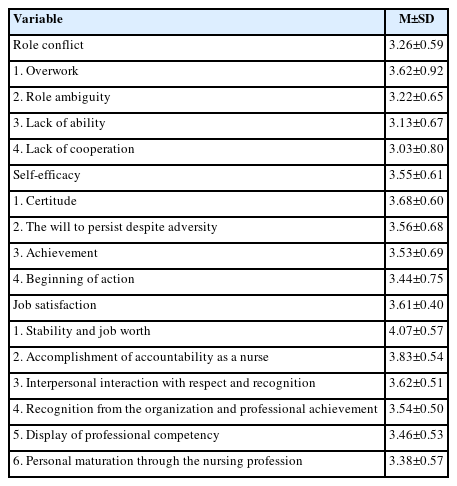
Purpose This study examined factors associated with job satisfaction among physician assistant nurses working across diverse tasks and clinical settings. Methods: From March 18 to April 2, 2025, we surveyed physician assistant nurses at a tertiary hospital in Daegu and data from 141 participants were analyzed. Analyses included descriptive statistics, the independent t-test, one-way analysis of variance, Pearson correlation coefficients, and hierarchical multiple regression. Results: Self-efficacy (β=.47, p<.001) and role conflict (β=-.19, p=.008) were significantly associated with job satisfaction, and the final model explained 32.2% of the variance. Conclusion: Strategies to improve job satisfaction should reduce role conflict and strengthen self-efficacy through education and competency-development programs. Clearer work regulations and legal and institutional safeguards may also support physician assistant nurses.






 First
First Prev
Prev