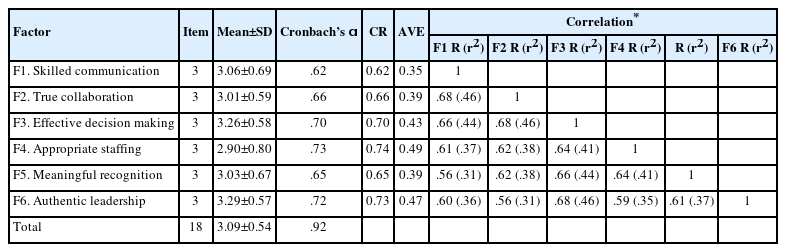
Purpose This study was conducted to evaluate the validity and reliability of the Korean version of the Healthy Work Environment Assessment Tool (K-HWEAT), originally developed by the American Association of Critical-Care Nurses. Methods: The study was conducted among nurses working at three university hospitals located in metropolitan areas between May 29 and October 10, 2019. A total of 543 nurses participated. Data were analyzed using AMOS version 26.0 to assess the construct validity of the K-HWEAT. Results: Confirmatory factor analysis initially failed to meet acceptable model fit indices. Model fit improved after reassigning item 1 from factor 1 to factor 2 and item 12 from factor 4 to factor 6, as well as allowing correlated error terms based on high modification indices. Following these adjustments, standardized root mean square residual remained unchanged (0.05 to 0.05) and root mean square error of approximation decreased from 0.09 to 0.07, whereas goodness of fit index increased from 0.88 to 0.91, adjusted goodness of fit index from 0.83 to 0.86, Normed Fit Index from 0.85 to 0.89, and comparative fit index from 0.88 to 0.92. The K-HWEAT demonstrated a moderate correlation with the Korean version of the Practice Environment Scale of the Nursing Work Index (r=.60, p<.001), supporting criterion validity. The overall Cronbach’s α was .92, with the six factors showing internal consistency coefficients ranging from 0.62 to 0.74. Conclusion: These findings support the reliability and validity of the K-HWEAT. However, further conceptual refinement of individual items may be necessary to enhance construct clarity.
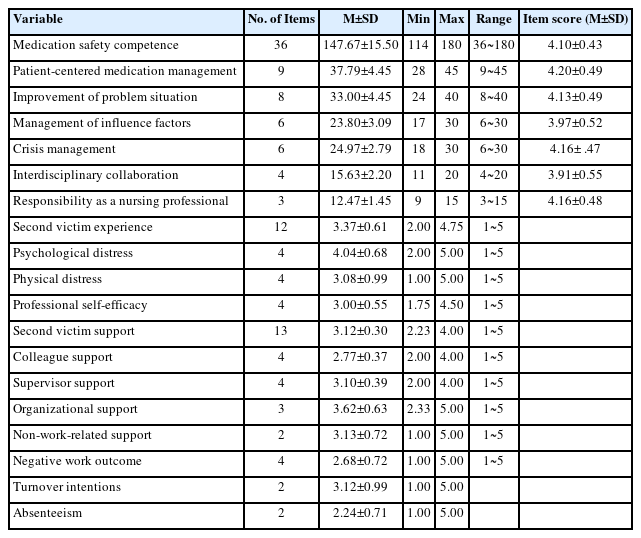
Purpose This study aimed to identify clinical nurses’levels of medication safety competence, second victim experience, second victim support, and negative work outcomes, and to examine the interrelationships among these variables. Methods: A cross-sectional study was conducted with 142 nurses working in university or general hospitals in Gyeonggi-do, South Korea, using self-administered questionnaires collected between June 10 and July 5, 2024. Data were analyzed with IBM SPSS statistics 29.0 using descriptive statistics and Pearson correlation analysis. Results: The mean scores were as follows: medication safety competence (4.10±0.43), second victim experience (3.37±0.61), second victim support (3.12±0.30), and negative work outcomes (2.68±0.72). Medication safety competence was negatively correlated with negative work outcomes (r=-.17, p=.047) and positively correlated with psychological distress, a subdomain of second victim experience (r=.21, p=.013). Second victim experience was positively correlated with both second victim support (r=.53, p<.001) and negative work outcomes (r=.56, p<.001). Conclusion: This study demonstrated that nurses with greater medication safety competence experienced fewer negative work-related outcomes but higher levels of psychological distress. Strengthening medication safety competence may improve patient safety and occupational performance; however, the associated psychological burden must not be overlooked. Initiatives to enhance competence should therefore be accompanied by strategies designed to mitigate psychological distress.
Citations
Citations to this article as recorded by
Knowledge of Medication Management and Therapeutic Care Practices Among Nurses Caring for Older Adults: A Cross-Sectional Study Naila Anjum, Sadia Mukarram, Nimra Rehman Al-Najam Journal of Medical and Life Sciences.2026; 1(2): 19. CrossRef
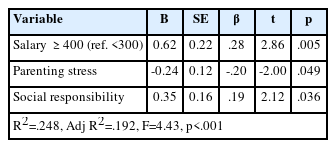
Purpose This study aimed to examine the factors influencing the retention intention of female nurses raising young and school-age children during the COVID-19 pandemic. Methods: In total, 131 female nurses working in hospitals with 30 or more beds who remained employed throughout the pandemic participated in this cross-sectional descriptive study. Data were collected using a structured self-report questionnaire in July 2023 and analyzed using descriptive statistics, correlation analysis, and multiple regression analysis with IBM SPSS 29.0. Results: The mean score for retention intention was 3.98 out of 5. Parenting stress averaged 3.02, family support 4.08, family-friendly policies 1.83 (out of 4), family-friendly organizational culture 2.98, and social responsibility 3.56. Regression analysis identified a monthly salary over 4 million KRW (β=.28, p=.005), parenting stress (β=–.20, p=.049), and social responsibility (β=.19, p=.036) as significant factors influencing retention intention, with an explanatory power of 19.2% (F=4.43, p<.001). Conclusion: Retention intention among nurses with young children during the COVID-19 pandemic was associated with financial stability, reduced parenting stress, and a strong sense of social responsibility. To enhance nurse retention during future public health crises, policies should incorporate practical childcare support and strengthen professional social responsibility.
Citations
Citations to this article as recorded by
Retention Intention of Clinical Nurses Returning from Parental Leave in South Korea: A Structural Equation Modeling Study Jihyun Kim, Mihae Im Healthcare.2026; 14(19): 3219. CrossRef
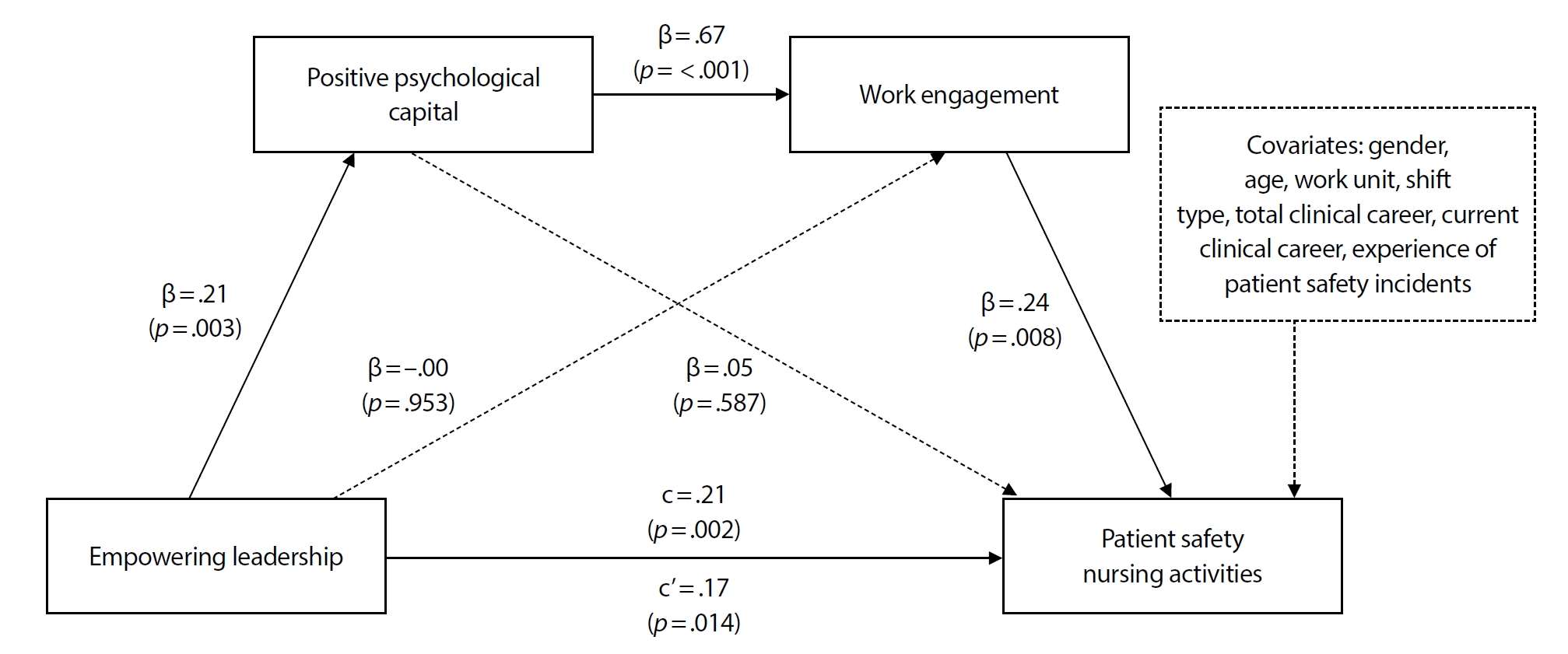
Purpose This study examined the double mediating effects of positive psychological capital and work engagement on the relationship between nurse unit managers’ empowering leadership and nurses’ patient safety nursing activities. Methods: Data were collected from 217 ward nurses employed at a tertiary hospital. Statistical analyses were conducted using SPSS version 29.0. Differences between groups were tested using independent t-tests, one-way analysis of variance, and the Duncan method. When normality assumptions were violated, the Mann–Whitney U and Kruskal–Wallis tests with Bonferroni correction were applied. Pearson correlation coefficients were computed, and mediation analysis was performed using Hayes’ PROCESS macro model 6. Results: Empowering leadership among nurse unit managers had a significantly positive effect on ‘nurses’ patient safety nursing activities. Furthermore, positive psychological capital and work engagement demonstrated significant double mediating effects on the relationship between empowering leadership and patient safety nursing activities. Conclusion: Enhancing patient safety nursing activities requires the establishment of a safety culture and institutional framework, the development of leadership training programs, and provision of systematic education.
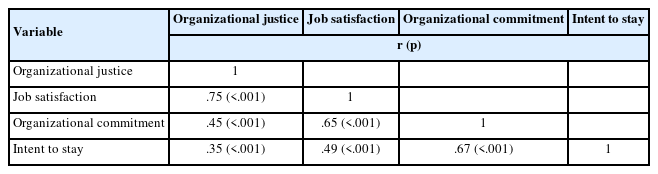
Purpose This study investigated the influence of organizational justice on junior nursing officers’ intent to stay in their positions and explored the mediating roles of job satisfaction and organizational commitment. Methods: A descriptive correlational design was employed, and data were analyzed using SPSS 29.0 software. Statistical analyses included descriptive statistics, the t-test, one-way analysis of variance, Pearson’s correlation coefficients, and multiple linear regression. The mediating effects of job satisfaction and organizational commitment were evaluated following Baron and Kenny’s three-step mediation procedure, and significance was confirmed through the bootstrapping method. Results: Organizational justice, job satisfaction, organizational commitment, and intent to stay were all significantly positively correlated. The mediating effects of job satisfaction and organizational commitment on the relationship between organizational justice and intent to stay were confirmed. Conclusion: Based on the findings of this study, job satisfaction and organizational commitment were found to fully mediate the relationship between organizational justice and intent to stay. Therefore, to enhance the intent to stay among junior nursing officers, it is considered necessary to develop supportive measures and establish systems within the military and nursing corps that strengthen organizational justice for junior nursing officers.
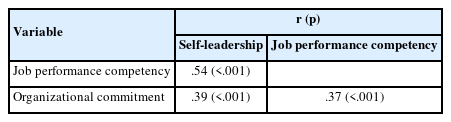
Purpose This study aimed to determine the effects of self-leadership on job performance competency and organizational commitment among insurance review nurses. Methods: A nationwide online survey was conducted using structured questionnaires. Participants included 189 insurance review nurses working in advanced general hospitals and general hospitals in South Korea. Data were collected through self-administered questionnaires between August 19 and September 17, 2021. Data analysis was performed using descriptive statistics, independent t-tests, one-way analysis of variance, Pearson’s correlation coefficients, and hierarchical multiple regression with IBM SPSS version 23.0. Results: The mean score for self-leadership was 3.64±0.43 out of 5, for job performance competency was 3.10±0.68 out of 5, and for organizational commitment was 4.38±1.09 out of 7. Statistically significant positive correlations were observed among self-leadership, job performance competency, and organizational commitment in insurance review nurses. Hierarchical multiple regression analysis showed that self-leadership explained an additional 13.9 percentage points of variance in job performance competency and an additional 5.3 percentage points in organizational commitment. Self-leadership emerged as a statistically significant predictor of both job performance competency and organizational commitment. Conclusion: This study empirically demonstrates that self-leadership has significant effects on job performance competency and organizational commitment among insurance review nurses. These findings provide empirical evidence relevant to human resource management strategies for insurance review nurses.
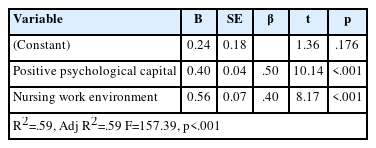
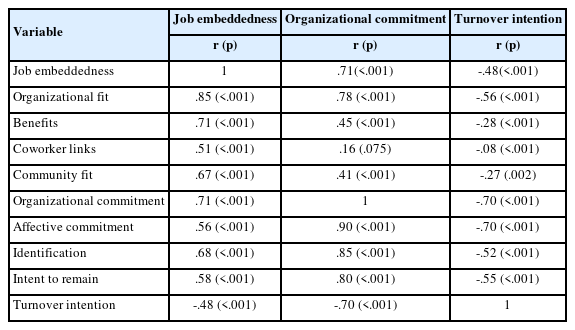
Purpose This study aimed to investigate the factors influencing job embeddedness among advanced beginner nurses, with particular emphasis on the roles of positive psychological capital and the nursing work environment. Methods: This cross-sectional study included 216 advanced beginner nurses from two university-affiliated hospitals. Data were obtained using standardized questionnaires and analyzed with descriptive statistics, the independent t-test, one-way analysis of variance, Pearson correlation coefficients, and multiple regression analysis. Results: The average score for job embeddedness was 3.34±0.54, for positive psychological capital was 4.00±0.67, and for the nursing work environment was 2.67±0.39. Multiple regression analysis showed that positive psychological capital and the nursing work environment significantly predicted job embeddedness, accounting for 59.3% of its variance. Conclusion: The findings suggest that enhancing positive psychological capital and improving the nursing work environment are essential for promoting job embeddedness among advanced beginner nurses. These results provide empirical support for the development of targeted interventions that facilitate their transition toward becoming competent nurses.
Purpose This study examined the effects of dispatch work experience on job embeddedness, organizational commitment, and turnover intention among nurses. Methods: A cross-sectional survey was conducted among 130 nurses working at a tertiary hospital in Seoul. Data were analyzed using IBM SPSS version 28.0 with descriptive statistics, the independent t-test, one-way analysis of variance, Pearson correlation coefficients, and multiple linear regression. Results: Overall, 62.3% of participants reported improved competency following dispatch work experience, whereas 80.7% perceived pre-training as insufficient. Nurses with prior interaction with dispatch unit staff demonstrated significantly higher job embeddedness (F=10.37, p=.002) and organizational commitment (F=5.87, p=.017), along with significantly lower turnover intention (F=4.98, p=.027). Multiple regression analysis showed that job embeddedness was positively associated with prior interaction with dispatch unit staff (β=.170, p=.031) and perceiving dispatch operations as appropriate (β=.297, p<.001). Organizational commitment was significantly influenced by the perception of dispatch operations as appropriate (β=.209, p=.013). No dispatch-related factors were significantly associated with turnover intention. Conclusion: Positive perceptions of dispatch work and prior interaction with dispatch unit staff contribute to job embeddedness and organizational commitment. Improvements such as enhanced pre-interaction opportunities, practice-based training, and consideration of dispatch preferences are needed to optimize dispatch work experiences.
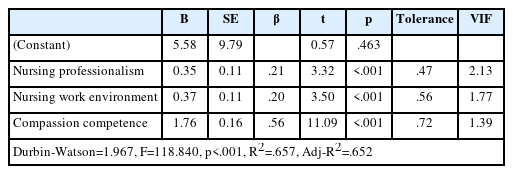
Purpose This study aimed to identify the influence of nursing professionalism, the nursing work environment, and compassion competence on person-centered care among nurses working in comprehensive nursing care units. Methods: An online survey using structured self-report questionnaires was administered to 190 nurses in comprehensive nursing care units at three tertiary general hospitals. The collected data were analyzed using descriptive statistics, the independent t-test, the Mann-Whitney U-test, one-way analysis of variance, Pearson’s correlation coefficient, and multiple linear regression using SPSS version 29.0 program. Results: The average score for person-centered care was 3.70±0.49, nursing professionalism was 3.56±0.51, the nursing work environment was 2.53±0.46, and compassion competence was 4.01±0.47. Person-centered care demonstrated significant positive correlations with nursing professionalism (r=.636, p<.001), the nursing work environment (r=.542, p<.001), and compassion competence (r=.743, p<.001). Factors influencing person-centered care included compassion competence (β=.56, p<.001), nursing professionalism (β=.21, p<.001), and the nursing work environment (β=.20, p<.001), with an explanatory power of 65.2% (F=118.84, p<.001). Conclusion: To improve person-centered care among nurses in comprehensive nursing care units, it is necessary to strengthen nurses’ compassion competence and professionalism, as well as enhance the nursing work environment. The findings of this study may be used as foundational evidence for developing programs to promote person-centered care in comprehensive nursing care units.
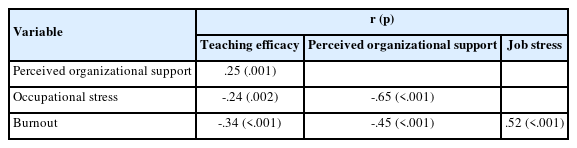
Purpose This study aimed to investigate the effects of teaching efficacy, perceived organizational support, and occupational stress on burnout among preceptor nurses. Methods: Participants included 156 nurses who had at least one month of preceptor experience within the past year. Data were collected using a structured self-report questionnaire and analyzed with SPSS version 27.0. Descriptive statistics, independent sample t-tests, one-way analysis of variance with Scheffé post-hoc tests, Pearson’s correlation analysis, and multiple regression analysis were performed. Results: Occupational stress (β=.36, p<.001) and teaching efficacy (β=-.17, p=.017) were significant predictors of burnout among preceptor nurses, jointly explaining 36.0% of the variance. Conclusion: Occupational stress and teaching efficacy were identified as key determinants of burnout in preceptor nurses. Effective burnout prevention strategies should focus on reducing occupational stress through workload management and strengthening teaching efficacy via continuous training and organizational support.
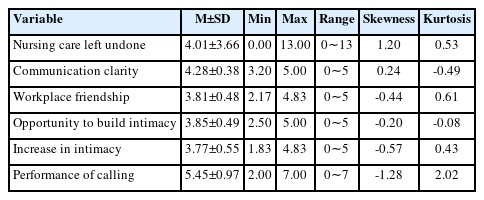
Purpose This study aimed to investigate the effects of communication clarity, workplace friendship, and performance of calling on nursing care left undone among oncology nurses. Methods: Data were collected from 159 oncology nurses with more than one year of experience working in cancer wards between September 11 and September 30, 2024. Statistical analyses included descriptive statistics, the independent t-test, one-way analysis of variance, the Scheffé post hoc test, Pearson’s correlation coefficients, and hierarchical multiple regression analysis, all conducted using IBM SPSS Statistics version 29.0. Results: Communication clarity, workplace friendship, and performance of calling were significantly correlated with nursing care left undone. Hierarchical multiple regression analysis identified communication clarity (β=-.37, p<.001) and being aged 30–39 years (β=-.24, p<.001) as the main factors influencing nursing care left undone, collectively explaining 37% of the total variance. Conclusion: Communication clarity was the most influential factor affecting nursing care left undone in cancer wards. To reduce the incidence of nursing care left undone and ensure high-quality nursing services in oncology units, strategies aimed at enhancing communication clarity are essential. Institutions should consider implementing simulation-based training or ongoing education tailored to their organizational context. Further research is warranted to examine the effects of communication clarity on nursing care left undone.




 First
First Prev
Prev