

• KANAD
  • Contact us
  • E-Submission
ABOUT
BROWSE ARTICLES
EDITORIAL POLICY
FOR CONTRIBUTORS

Page Path

69
results for

"Intention"

Filter

Article category

Keywords

Publication year

Authors

Funded articles

"Intention"

Original Articles
Purpose
This study investigated the effects of newly graduated nurses’ perceived readiness for nursing practice, resilience, and preceptors’ teaching behaviors on turnover intention.
Methods
A survey was conducted among 168 newly graduated nurses between August 7 and 31, 2023. The data were analyzed using descriptive statistics, t-tests, one-way ANOVA, Pearson's correlation, and hierarchical multiple regression analysis.
Results
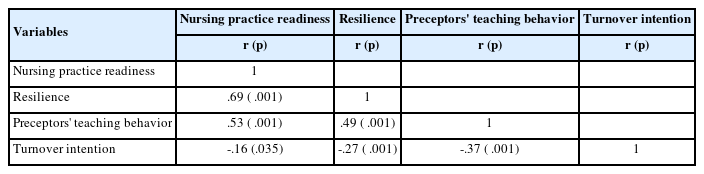
The factors that significantly affected turnover intention included preceptors' teaching behavior (β=-.29, p=.001) and resilience (β=-.21, p=.026). This model explained 32.0% of the variance.
Conclusion
Newly graduated nurses’ resilience and their initial training environment are key factors influencing turnover intention. Therefore, nursing managers should develop strategies to enhance the resilience of newly graduated nurses and improve training systems. Additionally, efforts should be made to promote positive teaching behaviors among the educators responsible for training newly graduated nurses.

Citations

Citations to this article as recorded by  
  • Perceptions on Fixed Night Shift System and Turnover Intention of General Hospital Nurses
    Mi-Aie Lee, Hye-Jin Cho, Sung-Hee Ahn, Hyo-Ju Kim
    Journal of Korean Academy of Nursing Administration.2015; 21(5): 519.     CrossRef
  • 3,207 View
  • 198 Download
  • 1 Crossref
Purpose
This study aimed to investigate the relationship between socio-cognitive mindfulness, job stress, social support, and turnover intention among general hospital nurses and identify the factors influencing nurses’ turnover intention.
Methods
A descriptive survey was conducted among 218 nurses from five general hospitals located in G metropolitan city. The participants completed a questionnaire measuring the study variables, and the data were analyzed using t-tests, ANOVA, Pearson’s correlation coefficient, and hierarchical multiple regression analysis in SPSS/WIN 28.0.
Results
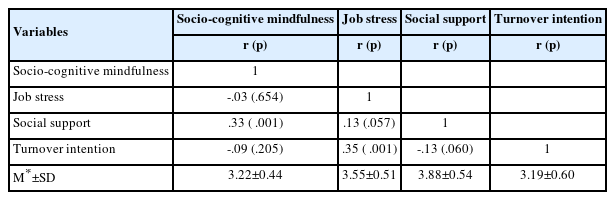
Significant differences were found in turnover intention by gender (t=-2.12, p=.036), family type (t=-3.09, p=.002), work department (F=7.01, p<.001), and work type (t=2.55, p=.011). Socio-cognitive mindfulness was positively related to social support (r=.331, p<.001), and turnover intention was positively related to job stress (r=.347, p<.001). The factors influencing nurses’ turnover intention included job stress (β=.317, p<.001), work department (artificial kidney room: β=-.287, p=.004; emergency room: β=-.219, p=.015), social support (β=-.183, p=.005), and work type (shift work: β=.170, p=.036), respectively. These factors explained 23.4% of the variance.
Conclusion
The findings indicate the need to develop programs to effectively cope with job stress and implement mentoring systems or psychological support programs to reduce turnover intention among nurses at the organizational level.
  • 2,094 View
  • 67 Download
Purpose
This study aimed to confirm the mediating effects of transition shock on the relationships among grit, social support, and retention intention of new graduate nurses.
Methods
A total of 174 new graduate nurses were recruited from a university hospital and a general hospital. The data were collected between November and December 2022 and analyzed using descriptive statistics, independent t-test, one-way analysis of variance, Scheffé test, Pearson’s correlation coefficient, Baron and Kenny’s three-step regression analysis, and the PROCESS Macro Model 4.
Results
Nurses’ retention intention was positively correlated with grit (r=.56, p<.001) and social support (r=.48, p<.001) and negatively correlated with transition shock (r=-.56, p<.001). The mediating analysis revealed that transition shock mediated the relationship between grit and retention intention as well as between social support and retention intention.
Conclusion
Based on the findings, an intervention program should be developed to reduce transition shock in new graduate nurses to increase their intention of retention.
  • 1,800 View
  • 103 Download
Purpose
The study aims to confirm the mediating effect of nursing professional pride in the relationship between nursing practice environment, nursing performance, and retention intention.
Methods
A descriptive cross-sectional survey was conducted from December 13 to 31, 2021, involving 127 nurses. The following statistical analysis was conducted: t-test, ANOVA, Scheffé test, Pearson's correlation coefficient analysis, and Hayes Process Macro Model 4 (to test the mediating effect).
Results
Nursing practice environment showed a significant positive correlation with nursing performance, retention intention, and nursing professional pride. Nursing practice performance showed a positive correlation with retention intention and nursing professional pride, and retention intention showed a significant positive correlation with nursing professional pride. The mediating effect of nursing professional pride was found in the effect of nurses' nursing practice environment on their retention intention. In addition, the mediating effect of nursing professional pride was found in the effect of nurses' nursing practice performance on their retention intention.
Conclusion
Through this study, it was confirmed that nursing professional pride is a major A factor affecting retention intention in the hospital. Therefore, in order to increase nurses' retention intention to remain in Hospital, the basis of basic data was presented for strategy development.

Citations

Citations to this article as recorded by  
  • A Grounded Theory Approach to Understanding Retention among Career Nurses in Clinical Practice
    Su Mi Choi, Ji Won Kim
    The Korean Journal of Health Service Management.2025; 19(2): 57.     CrossRef
  • Retention and Associated Factors among Nurses in Small- and Medium-Sized Hospitals across South Korea
    Eun Mi Kim, Su Jung Choi, mi sug Lee, Hyun Jin Park, Jeong Yun Park
    Journal of Korean Critical Care Nursing.2025; 18(3): 16.     CrossRef
  • 2,824 View
  • 161 Download
  • 2 Crossref
Influence of Nurses' Moral Distress and Ethical Nursing Competence on Retention Intention
Ji-Hyun Choi, Mi-Jin Byun, Thi Ninh Do
J Korean Acad Nurs Adm 2025;31(1):36-44.   Published online January 31, 2025
DOI: https://doi.org/10.11111/jkana.2025.31.1.36
Purpose
This study aimed to ascertain the influence of moral distress and ethical nursing competence on retention intention among nurses.
Methods
Participants included 191 nurses working in general hospitals. Data were collected from July 11 to 18, 2023 and analyzed using SPSS/WIN 23.0.
Results
Factors Influencing retention intention were clinical experience in the present department (β=.22, t=3.20, p=.002), moral distress (β=-.22, t=-3.15, p=.002) and ethical nursing competence (β=.26, t=3.82, p<.001). These variables accounted for 19.7% of nurses' retention intentions.
Conclusion
Based on our findings, it is necessary to identify interventions aimed at alleviating moral distress, and establish and implement systematic programs to improve ethical nursing competence in order to increase the retention intention of nurses.
  • 1,041 View
  • 57 Download
Purpose
This study examined the impact of professional Quality of life (QoL) on turnover intention among general hospital nurses using linear and nonlinear analytical techniques.
Methods
Data were collected from 159 general hospital nurses and analyzed using SPSS, t-test, ANOVA, Pearson's correlation coefficients, multiple linear regression, and nonlinear machine learning models (Bootstrap Forest and Boosted Tree).
Results
Significant correlations were observed between turnover intention and both compassion satisfaction (r=-.26, p<.001) and burnout (r=.27, p=.001). Compassion satisfaction, burnout, and compassion fatigue were identified as the key variables influencing turnover intention. The explanatory power of multiple linear regression analysis was 6.9%, whereas the nonlinear machine learning models demonstrated an explanatory power of 50.5% for Bootstrap Forest and 45.1% for Boosted Tree.
Conclusion
Continuous investment in human resource management, within nursing organizations, is essential to promote the long-term retention of general hospital nurses. This investment should focus on enhancing compassion satisfaction and reducing burnout and compassion fatigue by fostering a sense of vocation and positive job satisfaction.
  • 1,342 View
  • 91 Download
Effect of Clinical Nurses' Political Interest and Nursing Professionalism on the Intention to Political Participation
Yae Lim Shin, Sung Rae Shin
J Korean Acad Nurs Adm 2024;30(5):473-482.   Published online December 31, 2024
DOI: https://doi.org/10.11111/jkana.2024.30.5.473
Purpose
This correlation study was designed to understand clinical nurses' political interest, nursing professionalism, and intention to participate in politics, as well as the impact of political interest and nursing professionalism on intention to political participation.
Method
A total of 187 clinical nurses from a general hospital in Seoul were considered for this study. The collected data were analyzed using SPSS/WIN 24.0, which included descriptive statistics, t-tests, analysis of variance (ANOVA), multiple regression analysis, and Scheffé’s test.
Results
Political interest (β=.46, p<.001), nursing professionalism (β=.17, p=.007), manager or higher (β=.19, p=.018), and age under 24 years of age (β=.14, p=.038) were all statistically significant predictors of political participation. The explanatory power of these factors was 35.6% (R 2 =.39, Adj. R 2 =.36).
Conclusion
This study revealed the relationship between nursing professionalism and intention to participate in politics, which has not been previously investigated in clinical nurses. This study is significant as it suggests the necessity and direction of future nursing professionalism education programs.
  • 709 View
  • 23 Download
The Influences of Teamwork and Grit on Job Adaptation and Intention to Remain among Advanced Beginner Nurses
Seon Kyeong Jeong, Kyoung Ja Kim, Eun Ji Choi
J Korean Acad Nurs Adm 2024;30(4):379-391.   Published online September 30, 2024
DOI: https://doi.org/10.11111/jkana.2024.30.4.379
Purpose
This study aimed to explore the influence of teamwork and grit on job adaptation and intention to remain among advanced beginner nurses.
Methods
A cross-sectional descriptive research design employing a survey method was used. The study involved 203 advanced beginner nurses with 13~36 months of experience working at a tertiary hospital. Collected data were analyzed using descriptive statistics, independent t-tests, one-way ANOVA, Pearson's correlation coefficients, and hierarchical regression analysis.
Results
Job adaptation positively correlated with teamwork (r=.58, p<.001) and grit (r=.65, p<.001). Intention to remain was also positively correlated with teamwork (r=.32, p<.001) and grit (r=.59, p<.001). A hierarchical multiple regression model including control variables, teamwork, and grit accounted for 64% of the factors influencing job adaptation. Another hierarchical multiple regression model, incorporating control variables, teamwork, and grit, explained 44% of the factors influencing the intention to remain. Among the related factors, grit emerged as the most influential in regarding job adaption and intention to remain.
Conclusion
These findings underscore the importance of establishing a support system to bolster grit, enhancing adaptation to the job and fostering intention to remain among advanced beginner nurses.
  • 822 View
  • 53 Download
Purpose
This study aimed to examine the levels of professional autonomy, retention intention, and organizational commitment among public hospital nurses, while also investigating the mediating effect of organizational commitment on the relationship between professional autonomy and intention to remain.
Methods
Data for this study were collected through an online survey conducted from August 5 to August 11, 2022, targeting 230 nurses across three public hospitals within a single region. Data analysis was performed using SPSS/WIN 23.0.
Results
Organizational commitment fully mediated the relationship between professional autonomy and retention intentions among public hospital nurses. Positive correlations were observed between professional autonomy and retention intention (r=.24, p<.001), organizational commitment and intention to remain (r=.72, p<.001), as well as professional autonomy and retention intention (r=.34, p<.001).
Conclusion
; To enhance the retain intention among public hospital nurses, it is imperative to focus on program development and institutional administrative efforts aimed at ensuring professional autonomy and fostering organizational commitment.

Citations

Citations to this article as recorded by  
  • The Effects of Presenteeism, Burnout, and Nursing Performance on Retention Intention among Nurses at an Intensive Care Unit
    Seung-Hee Lee, Na Rin Kim
    Journal of Korean Academy of Nursing Administration.2025; 31(3): 269.     CrossRef
  • Retention and Associated Factors among Nurses in Small- and Medium-Sized Hospitals across South Korea
    Eun Mi Kim, Su Jung Choi, mi sug Lee, Hyun Jin Park, Jeong Yun Park
    Journal of Korean Critical Care Nursing.2025; 18(3): 16.     CrossRef
  • 9,861 View
  • 38 Download
  • 2 Crossref
Purpose
The purpose of this study was to examine the influential factors on retention intention among nurses in small-medium sized hospitals.
Methods
This study was conducted with 185 nurses of 6 small-medium sized general hospitals located in B metropolitan city. Data were collected from July 10 to July 19, 2022 using on-line self-report questionnaires. A descriptive analysis and hierarchical multiple regression were used for data analysis utilizing IBM SPSS Statistics for Windows version 25.0.
Results
The variables influencing the retention intention of the subjects were perceived value of work (β=.36, p<.001), nurse manager ability, leadership, and support of nurses (β=.22, p=.024), positive psychological capital (β=.15, p=.042), and subjective health status (β=.14, p=.035), and the total explanatory power (R2 ) of these variables was 38.0% (F=12.24, p<.001).
Conclusion
Based on the results, in order to increase the retention intention for nurses in small and medium-sized hospitals, it is necessary to create an environment and culture as well as educational strategies for fostering a sense of work value and positive psychological capital. In addition, proactive organizational efforts are required to strengthen nurses’ subjective health and nurse managers’ supporting capabilities and leadership in small-medium sized hospitals.
  • 715 View
  • 15 Download
Purpose
This study used a structural model to identify organizational characteristics, such as work environment, nursing organizational culture, and manager leadership of general hospital nurses, and to examine the effect of organizational characteristics on turnover intention through organizational silence.
Methods
Data were collected from July 1, 2017 to August 30, 2017, using structured questionnaires. Participants were nurses in general hospitals with more than 250 beds and less than 500 beds in Busan City and Gyeongsangnam Province. The collected data were analyzed using IBM SPSS 23.0 and AMOS 23.0.
Results
The nursing work environment, external employment opportunities, relationship-oriented culture, and acquiescent and defensive silence directly impacted turnover intention. Additionally, the nursing work environment and external employment opportunities indirectly affected turnover intention through acquiescent silence.
Conclusion
To lower general hospital nurses’ turnover intention, the external environment should be reviewed and continuously compared to provide a better internal nursing work environment. In addition, it is necessary to find a way to lower the acquiescent silence, which can negatively affect the organization, by creating a relationship-oriented culture that emphasizes the relationship between members.
  • 1,202 View
  • 43 Download
Purpose
Turnover rates among nurses in South Korea are higher than those of other job groups, affecting hospital performance. This study clarified the mediating role of perceived organizational and supervisor support in the relationship between nurses’ organizational citizenship behavior and turnover intention.
Methods
This study involved a descriptive survey of 160 nurses working in two hospitals in S, South Korea. Data were analyzed using the Hayes PROCESS macro (Model 4) program, version 3.4.
Results
Organizational citizenship behavior was positively correlated with perceived organizational support and perceived supervisor support but negatively correlated with turnover intention. Perceived organizational support was positively correlated with perceived supervisor support. Additionally, perceived organizational and supervisor support were negatively correlated with turnover intention. The authors verified the mediating role of perceived organizational support in the relationship between organizational citizenship behavior and turnover intention. However, the mediating role of perceived supervisor support was not confirmed.
Conclusion
The higher a nurse’s organizational citizenship behavior, the higher their perceived organizational support, which reduces turnover intention. High-quality nursing contributes to organizational performance; therefore, the nursing workforce should be carefully preserved.

Citations

Citations to this article as recorded by  
  • Measured nursing perception of the working environment through authentic leadership with technology support and OCB among Chinese public hospitals
    Abid Hussain, Wang Ruowei, Xu Xia, Shahida Kanwel, Shen Chunhong, Arif Jameel
    BMC Nursing.2025;[Epub]     CrossRef
  • Perceived Organisational Support as a Mediator Between Green Organisational Culture and Organisational Commitment: Evidence From Manufacturing Firms in Peru
    Cristian Villar, Ruben Guevara
    SAGE Open.2025;[Epub]     CrossRef
  • Nurse Engagement in Professional and Organisational Citizenship Over the Past Decade: An Integrative Review
    Adrianna Watson, Carmel Bond, Rebecca Jarden, Debra Jackson
    Journal of Advanced Nursing.2025;[Epub]     CrossRef
  • 3,662 View
  • 116 Download
  • 3 Crossref
Purpose
This study was conducted to identify the factors influencing nurses’ intention to stay after coming back from parental leave.
Methods
This was a descriptive cross-sectional study. The participants were 175 female nurses working in hospitals with over 300 beds and returning after three months of parental leave. Data were analyzed using independent t-test, one-way ANOVA, Pearson’s correlation coefficient, and stepwise multiple regression.
Results
There were significant differences in intention to stay by age (t=2.65, p<.001) and position (t=-2.23, p=.027). Intention to stay was positively correlated with social support (r=.24, p<.001) and self-efficacy (r=.42, p<.001), and negatively correlated with work-family balance conflict (r=-.21, p=.004). Factors influencing intention to stay were self-efficacy (β=.94, p<.001) and work-family balance conflict (β=-.49, p=.005), with an explanatory power of 20%.
Conclusion
The findings allow for proposing that increasing nurses’ intention to stay may require self-efficacy improvements to enable nurses to adjust to their work environment, and hospitals should provide nurses with institutional support in order to reduce nurses’ work-family conflicts.

Citations

Citations to this article as recorded by  
  • Parenting Without Penalty: Paid Parental Leave as a Boundary‐Management Strategy for Nursing Workforce Sustainability
    Adrianna Watson
    Journal of Advanced Nursing.2025;[Epub]     CrossRef
  • 1,531 View
  • 27 Download
  • 1 Crossref
Structural Equation Modeling of Advanced Beginner-Stage Nurses' Intention to Continue Employment
Seung-Hee Lee, Hwasoon Kim
J Korean Acad Nurs Adm 2023;29(5):517-528.   Published online December 31, 2023
DOI: https://doi.org/10.11111/jkana.2023.29.5.517
Purpose
The purpose of this study was to establish a structural model explaining the factors affecting advanced beginner-stage nurses' intention to continue employment. This model was designed to provide basic data for improving the intention to continue employment among advanced beginner-stage nurses and to efficiently manage nurses as human resources.
Methods
In order to construct a hypothetical model, latent factors affecting nurses' intention to continue employment were identified through systematic review and meta-analysis. As a result of systematic review, hypothetical model was constructed with nursing professionalism, calling, work environment, positive psychological capital, and job satisfaction. Structural equation modeling was then conducted through SPSS 25.0, AMOS 22.0, and Mplus 6.12 statistics programs.
Results
First, none of the pathways affected by nursing professionalism were statistically significant. Second, the final structural model showed fit very well based on the fit indices RMSEA=.062, SRMR=.052, RMR=.048, CFI=0.95, and TLI=0.94.
Conclusion
This study’s results identified that job satisfaction, calling, work environment, and positive psychological capital affected advanced beginner-stage nurses' intention to continue employment. Among these, job satisfaction was the most powerful variable influencing the decision to continue employment for advanced beginner-stage nurses.

Citations

Citations to this article as recorded by  
  • Retention and Associated Factors among Nurses in Small- and Medium-Sized Hospitals across South Korea
    Eun Mi Kim, Su Jung Choi, mi sug Lee, Hyun Jin Park, Jeong Yun Park
    Journal of Korean Critical Care Nursing.2025; 18(3): 16.     CrossRef
  • The Influences of Teamwork and Grit on Job Adaptation and Intention to Remain among Advanced Beginner Nurses
    Seon Kyeong Jeong, Kyoung Ja Kim, Eun Ji Choi
    Journal of Korean Academy of Nursing Administration.2024; 30(4): 379.     CrossRef
  • 1,028 View
  • 65 Download
  • 2 Crossref
Purpose
This study investigated the effects of nursing unit managers' authentic, transformational, and transactional leadership styles on positive psychological capital and turnover intention in advanced beginner-stage nurses (ABNs).
Methods
The study included 157 nurses with clinical experience ranging form more than one year to less than 3 years in three general hospitals. Data analysis was conducted using the SPSS/WINdows software version 26.0.
Results
Authentic, transformational, and transactional leadership styles of nursing unit managers increased the positive psychological capital of ABNs, thereby lowering their turnover intention. Additionally, the turnover intention of ABNs was negatively correlated with the authentic, transformational, and transactional leadership styles of a nursing unit manager and positive psychological capital. Positive psychological capital showed a mediating effect in the relationship between authentic, transformational, and transactional leadership styles of nursing unit manager and turnover intention of ABNs.
Conclusion
To reduce ABNs turnover, medical institutions and nursing organizations should focus on enhancing nursing unit managers’ transformational and authentic leadership styles. Moreover, as transactional leadership has been found to decrease the turnover intention among ABNs, nursing unit managers should carefully consider their responsibilities and resources allocation to provide conditional compensation support to nurses.
  • 1,788 View
  • 137 Download
Effects of Job Embeddedness, Professional Self-concept, and Work-life Balance on Clinical Nurses’ Intention to Stay
Ae-ri Choi, Jee-In Hwang
J Korean Acad Nurs Adm 2023;29(4):353-362.   Published online September 30, 2023
DOI: https://doi.org/10.11111/jkana.2023.29.4.353
Purpose
This study aimed to assess the influence of job embeddedness, professional self-concept, and work-life balance on clinical nurses’ workplace retention intention.
Methods
A descriptive cross-sectional survey was conducted from July 27 to August 2, 2022, involving 296 nurses at a university hospital in Seoul. The questionnaire-based data collected were analyzed using t-tests, one-way ANOVA, Pearson's correlation coefficients, and multiple regression.
Results
The mean score for intention to stay is 4.92±1.05 out of 8. The mean scores for job embeddedness, professional self-concept, and work-life balance were 2.91±0.48 out of 5, 2.61±0.28 out of 4, and 3.10±0.71 out of 5, respectively. Job embeddedness (β=.17, p=.002) and professional self-concept (β=.42, p<.001) were significantly associated with clinical nurses’ intention to stay in their workplace. Specifically, the “community suitability” subfactor of job embeddedness (β=.16, p=.003) and the “satisfaction” subfactor of professional self-concept (β=.58, p<.001) were significantly related to nurses’ intention to stay. No significant relationship was found between work-life balance and intention to stay.
Conclusion
Nurses’ job embeddedness and professional self-concept significantly affected their intention to stay. Therefore, fostering community bonding outside the organization and increasing professional satisfaction are suggested to increase clinical nurses’ intentions to stay.

Citations

Citations to this article as recorded by  
  • The Influence of Work-Life Balance and Job Embeddedness on Turnover Intention among Nurses Caring for Cancer Patients
    Jin-young Park, Yeunhee Kwak, Jiwoo Jung, Seoung-Wha Lim
    Journal of Korean Critical Care Nursing.2025; 18(3): 28.     CrossRef
  • The effect of dental hygienist work cooperation and compensation satisfaction on job embeddedness: mediating effect of positive psychological capital
    Ju-Eon Kim, Seon-Yeong Kim
    Journal of Korean Society of Dental Hygiene.2024; 24(3): 263.     CrossRef
  • A Study on the Effect of the Quality of the Relationship between Nail Shop Workers and Consumers on the Balance of Work and Life: Focusing on the Mediating Effect of Burnout
    Hyun-Jeong Lee, Hye-Young Kim
    Journal of the Korean Society of Cosmetology.2024; 30(2): 415.     CrossRef
  • 954 View
  • 63 Download
  • 3 Crossref
The Effect of Nurses’ Perceived Leader-Member Exchange on Psychological Ownership, Job Engagement, and Turnover Intention
Eun Ah Cho, Myun Sook Jung, Eun Ju Heo
J Korean Acad Nurs Adm 2023;29(3):298-308.   Published online June 30, 2023
DOI: https://doi.org/10.11111/jkana.2023.29.3.298
Purpose
This study is a hypothetical model of the effect of the leader-member exchange relationship on psychological ownership, job engagement, and turnover intention.
Methods
Data collection was conducted for general nurses who have worked for at least 6 months in a university hospital. The collected data were analyzed using the SPSS/WIN 25.0, and AMOS 18.0 program was used to conduct confirmatory factor analysis as well as goodness of fit verification and hypothesis testing for the hypothetical model.
Results
The leader-member exchange had a significant, static effect on psychological ownership. The leader-member exchange relationship did not have a significant effect on job engagement and psychological ownership had a significant, static effect on job engagement. The leader-member exchange relationship did not have a significant effect on turnover intention and psychological ownership and job engagement had significant, negative effects on turnover intention.
Conclusion
Intervention and the development of programs to increase the psychological ownership and job engagement of members are proposed to improve the leader-member exchange relationship through leadership education and training and reduce the turnover intention of nurses.

Citations

Citations to this article as recorded by  
  • Hospital Nurses’ Professional Quality of Life Model: A Cross‐Sectional Study Based on the Expanded Job Demands‐Resources Model
    Younghee Kim, Mi Yu, Jacopo Fiorini
    Journal of Nursing Management.2025;[Epub]     CrossRef
  • Mediating Effect of Leader-Member Exchange on the Ethical Leadership of Nursing Unit Managers and Turnover Intention of Clinical Nurses: A Nationwide Survey using Proportional Quota Sampling
    Jihun Kim, Sunmi Kim, Nara Han, Seok Hee Jeong
    Journal of Korean Academy of Nursing Administration.2024; 30(1): 42.     CrossRef
  • The Effect of Work Value, Psychological Ownership and Nursing Working Environment on Intention of Retention in Hospital Nurses
    Ji Hey Kim, Yoon Ju Cho, So Eun Jang
    Journal of Korean Critical Care Nursing.2023; 16(3): 62.     CrossRef
  • 952 View
  • 36 Download
  • 3 Crossref
Purpose
This study aims to identify the factors-along the lines of fatigue, nursing professionalism, and the work environment-that affect the nursing of COVID-19 patients by nurses at a designated COVID-19 hospital in Korea.
Methods
Data were collected from March 7 to March 31, 2022 via structured questionnaires submitted by 162 nurses, and analyzed using t-test, ANOVA, Scheffé test, Pearson correlation, and hierarchical regression analysis.
Results
In model 1, the variables among the general characteristics which significantly affect nursing intention are “6 months to less than 1 year of nursing experience for severe COVID-19 patients” (β=.29, p=.001), “having the volition to provide nursing support for future COVID-19 patients” (β=0.28, p<.001), and the “intention according to the hospital situation”(β=.35, p<.001). In model 2, fatigue (β=-.18, p=.007) and nursing professionalism (β=.43, p<.001) affect nursing intention. The total explanatory power of Model 2 is 47.0% (F=16.93, p<.001, R2 =.47).
Conclusion
To increase nursing intention for COVID-19 patients, intervention strategies should reduce nurses’ fatigue and introduce competency-strengthening programs as to improve nursing professionalism.

Citations

Citations to this article as recorded by  
  • Effect of Nursing Professionalism on Turnover Intention among Nurses: The Mediating Effect of Job Embeddedness
    Ja In Kim, Seok Hee Jeong, Hyoung Eun Chang, Sunmi Kim
    Journal of Korean Academy of Nursing Administration.2025; 31(4): 446.     CrossRef
  • Influence of Patient Safety Culture, Ethical Nursing Competence, and Nursing Professionalism on the Perception of Disclosure of Patient Safety Incidents among Nurses in Tertiary Hospitals
    Seulki Kim, Yoonju Lee
    Journal of Korean Academy of Nursing Administration.2024; 30(4): 392.     CrossRef
  • 639 View
  • 3 Download
  • 2 Crossref
Effect of Nurses’ Person-Environment Fit on Positive Psychological Capital, Career Commitment, and Turnover Intention
Hyeon Ju Kim, Myun Sook Jung, Eun Ju Heo
J Korean Acad Nurs Adm 2023;29(2):169-180.   Published online March 31, 2023
DOI: https://doi.org/10.11111/jkana.2023.29.2.169
Purpose
This study aimed to examine the effect of person-environment fit on positive psychological capital, career commitment, and turnover intention among nurses working in university hospitals.
Methods
A survey was administered to 277 nurses working in a university hospital with more than 800 beds in J city. SPSS 25.0 and AMOS 18.0 were used for analysis.
Results
Factors that directly explain turnover intention, person-environment fit, career commitment, and psychological capital exhibited a negative effect. However, while person-job fit did not directly affect turnover intention, it exhibited an indirect effect and total effect via positive psychological capital and career commitment.
Conclusion
Various programs should be developed to enhance nurses’ person-environment fit and person-job fit. Forming a positive attitude and strengthening nurses’ attachment and commitment toward nursing contribute to a lower turnover intention.

Citations

Citations to this article as recorded by  
  • Hospital Nurses’ Professional Quality of Life Model: A Cross‐Sectional Study Based on the Expanded Job Demands‐Resources Model
    Younghee Kim, Mi Yu, Jacopo Fiorini
    Journal of Nursing Management.2025;[Epub]     CrossRef
  • The impact of nurses’ career crafting and career satisfaction on career commitment
    Sujeong Han
    The Journal of Korean Academic Society of Nursing Education.2025; 31(3): 337.     CrossRef
  • Effects of Person-Environment Fit, Career Commitment, and Organizational Silence on Turnover Intention among Shift-Working Nurses
    Gyeong-Hee Bae, Ji-Won Kim
    The Korean Journal of Health Service Management.2025; 19(3): 43.     CrossRef
  • Effects of presenteeism on turnover intention in clinical nurses through the serial mediating roles of missed nursing care and job satisfaction: a cross-sectional predictive correlational study
    Hyeonseon Cheon, Seok Hee Jeong, Hyun Kyung Kim, Hyoung Eun Chang
    Journal of Korean Academy of Nursing.2025; 55(4): 584.     CrossRef
  • Mediating Effect of Leader-Member Exchange on the Ethical Leadership of Nursing Unit Managers and Turnover Intention of Clinical Nurses: A Nationwide Survey using Proportional Quota Sampling
    Jihun Kim, Sunmi Kim, Nara Han, Seok Hee Jeong
    Journal of Korean Academy of Nursing Administration.2024; 30(1): 42.     CrossRef
  • 729 View
  • 33 Download
  • 5 Crossref
The Experiences of Overcoming Turnover Intention among Experienced Nurses
Min Jeong Kwon, Kyung Mi Sung
J Korean Acad Nurs Adm 2023;29(1):32-44.   Published online January 31, 2023
DOI: https://doi.org/10.11111/jkana.2023.29.1.32
Purpose
The purpose of this study was to explore the experiences through which nurses overcame turnover intention when first joining the field. Methods: Study subjects included 10 nurses, each of whom had four to six years of work experience at a general hospital. The experiences of overcoming turnover intentions were analyzed from the perspectives of beginner and experienced nurses, using qualitative contents analysis as a method of deduction. Results: The subjects’ turnover intention was low, with an average score of 2.25±0.35. Five themes and 15 sub-themes were extracted from their experiences. The five themes included: “gaining an understanding of the nursing scene”, “experiencing a support system”, “being satisfied with my job”, “developing into a skilled nurse”, and “overcoming and growing”. Conclusion: Subjects maintained low levels of turnover intention, and they were able handle difficulty and grow into their careers as nurses. These findings may inform the development of programs to overcome turnover intention, specifically in terms of factors affecting norvice nurses’ positive achievement factor.

Citations

Citations to this article as recorded by  
  • Influential factors of moral distress and job satisfaction on turnover intention of long-term care hospital nurses: A cross-sectional descriptive study
    Ningjie Liu, Sun Mi Ha
    Journal of Korean Gerontological Nursing.2025; 27(2): 216.     CrossRef
  • The Experience of turnover to long-term care hospital nurse: A phenomenological qualitative research
    Inhee Choo, Milim Cho, Eunha Kim
    Journal of Korean Gerontological Nursing.2024; 26(4): 392.     CrossRef
  • Influences of Organizational Culture, Nursing Workplace Spirituality, and Nurses’ Perceived Health Status on Quality of Nursing Work Life according to Nursing Clinical Ladder
    Hyun Sook Lee, Ju Hyun Jin, Ju Ri Lee, Hye Jin Kim, Yeon Jae Jung
    Journal of Korean Academy of Nursing Administration.2024; 30(1): 31.     CrossRef
  • Experiences of Career Nurses Balancing Clinical Nursing with Ongoing Studies
    Yunhyung Kim, Yeonsook Joo, Eun Hee Kang, Jeong Hye Kim
    Journal of Korean Association for Qualitative Research.2024; 9(3): 215.     CrossRef
  • Mediating Effect of Leader-Member Exchange on the Ethical Leadership of Nursing Unit Managers and Turnover Intention of Clinical Nurses: A Nationwide Survey using Proportional Quota Sampling
    Jihun Kim, Sunmi Kim, Nara Han, Seok Hee Jeong
    Journal of Korean Academy of Nursing Administration.2024; 30(1): 42.     CrossRef
  • Examining the experiences of mid-career nurses in hospitals: a phenomenological study
    Yukyung Ko, Soyoung Yu, Bohyun Park
    Contemporary Nurse.2024; 60(4): 333.     CrossRef
  • 2,700 View
  • 52 Download
  • 6 Crossref
Improving Patients’ Perception of the Quality of Nursing Services and Nurses’ Perception of Nursing Rounds through Purposeful and Timely Nursing Rounds
Yun Sook Kim, Dong Yeon Kim, Na Young Kim, Jinsuk Kim, Young Eun Yang, Youmin Jeong, Hee Young Choi, Eun Oh
J Korean Acad Nurs Adm 2023;29(1):12-21.   Published online January 31, 2023
DOI: https://doi.org/10.11111/jkana.2023.29.1.12
Purpose
This descriptive study aimed to identify the effects of purposeful and timely nursing rounds on patients' perception of the quality of nursing services and nurses' perception of nursing rounds.
Methods
Intentional nursing rounds were conducted by communicating patients’ questions on pain, position, pump, potty, and possessions. A total of 144 nurses and 149 patients participated, and data were collected using self-report questionnaires. The independent t-test, x 2 test, and Wilcoxon’s rank-sum test were used to analyze the data with SPSS version 24.0.
Results
Although intentional nursing rounds improved the nurses’ perception of nursing rounds, there was no significant difference. The nurses’ benefit had the lowest score (3.36), and the benefit of communication with patients had the highest score (3.79). Intentional nursing rounds significantly improved the patients’ perception of the quality of nursing services in the intervention group. Among the factors of empathy (Z=4.98, p<.001) related to the quality of nursing services as perceived by the patient, assurance (Z=5.50, p<.001), reliability (Z=4.43, p<.001), and responsiveness (Z=5.02, p<.001) significantly increased.
Conclusion
Intentional nursing rounds positively affected patients’ perception of the quality of nursing service. It is important to improve intentional nursing rounds to enhance nurses’ perceptions of them.

Citations

Citations to this article as recorded by  
  • Associations of perceptions of patient safety culture, job crafting, and perceptions of patient rounding with patient safety management activities among tertiary hospital nurses
    Saet-Byeol Kim, Yun-Hee Kim
    Journal of Korean Biological Nursing Science.2024; 26(3): 259.     CrossRef
  • 1,287 View
  • 65 Download
  • 1 Crossref
Relationship of Job Stress to Turnover Intention in Hospital Nurses of Rural Areas: Job Embeddedness as a Mediator
Eun Hee Kang, Im Sun Seo
J Korean Acad Nurs Adm 2022;28(5):534-544.   Published online December 31, 2022
DOI: https://doi.org/10.11111/jkana.2022.28.5.534
Purpose
The purpose of this study was to identify the relationship between job stress and turnover intention and the mediating effect of job embeddedness on the relationship among hospital nurses in rural areas. Methods: This is a descriptive study. A total of 277 registered nurses were enrolled in the study from three hospitals in rural areas of South Korea from April 29 to May 10, 2019. The participants completed self-reporting questionnaires, which measured job stress, turnover intention, and job embeddedness, and collected demographic information. The data were analyzed using IBM SPSS Statistics 25.0, for multiple regression, and a simple mediation model applying the Hayes PROCESS macro with a 95% bias-corrected bootstrap confidence interval (5,000 bootstrap resampling). Results: Job stress had a direct effect (c’=0.35, p<.001) on turnover intention. It was also demonstrated that job embeddedness partially mediated the relationship between job stress and turnover intention among the hospital nurses (a ․ b=-0.40 × -0.58=0.23, 95% Boot C). Conclusion: The job stress and turnover intention of nurses in rural areas are not higher than those in large cities. Nevertheless, hospital administrators need to provide a nursing workforce policy to increase job embeddedness and reduce nurses’ turnover intention.

Citations

Citations to this article as recorded by  
  • Effects of Role Conflict, Work Environment, and Meaning of Work on Job Embeddedness among Physician Assistants
    Kwang Hoon Seo, Tae Yeong Yang, Nam Gyu Park, Jung Eun Park
    Journal of Korean Academy of Nursing Administration.2025; 31(3): 249.     CrossRef
  • Moderating Effect of Job Satisfaction in the Relationship Between Nursing Work Environment and Turnover Intention: A Perspective From Magnet Hospitals in South Korea
    Wonji Lee, Soyoung Yu
    SAGE Open.2025;[Epub]     CrossRef
  • Effect of Nursing Professionalism on Turnover Intention among Nurses: The Mediating Effect of Job Embeddedness
    Ja In Kim, Seok Hee Jeong, Hyoung Eun Chang, Sunmi Kim
    Journal of Korean Academy of Nursing Administration.2025; 31(4): 446.     CrossRef
  • 957 View
  • 59 Download
  • 3 Crossref
Purpose
This study aimed to identify the mediating effect of organizational commitment on the relationship between nurses’ clinical characters and retention intention in small-and medium-sized hospitals. Methods: This descriptive study included 177 nurses frome three small-and medium-sized hospitals in B metropolitan city. Data were collected from August 27 to September 30, 2020 using self-report questionnaires and were analyzed using IBM SPSS Statistics for Windows version 22.0. Results: The significant predictors of retention intention were organizational commitment (β=.43, p<.001), age (β=.21, p=.001), nurses’ clinical characters (β=.16, p=.011), work satisfaction (β=.15, p=.022), and whether they worked in the desired department (β=.13, p=.025). These variables explained 48% of the variance in retention intentions. Additionally, organizational commitment had a mediating effect on the relationship between nurses’ clinical characters and retention intention. Conclusion: According to the results, institutional efforts should be made to strengthen organizational commitment and develop educational programs to enhance nurses’ clinical characters among small-and medium-sized hospitals to promote retention intention.

Citations

Citations to this article as recorded by  
  • Influence of Nurses' Moral Distress and Ethical Nursing Competence on Retention Intention
    Ji-Hyun Choi, Mi-Jin Byun, Thi Ninh Do
    Journal of Korean Academy of Nursing Administration.2025; 31(1): 36.     CrossRef
  • Factors Affecting Retention Intention Among Married Nurses With Preschool-Aged Children
    Hyeseon Shin, Minjeong Jo
    Advances in Nursing Science.2025; 48(2): 177.     CrossRef
  • The Influence of Positive Psychological Capital, Perceived Value of Work, and Nurse Practice Environment on Retention Intention in Small-Medium Sized Hospital Nurses
    Su Hye Kwon, Miseon Bang, Young Kyoung Kim
    Journal of Korean Academy of Nursing Administration.2024; 30(3): 189.     CrossRef
  • Role of Organizational Commitment in Mediating Relationship between Professional Autonomy and Retention Intention among Public Hospital Nurses
    Maria Choi, Hye Young Cho
    Journal of Korean Academy of Nursing Administration.2024; 30(3): 224.     CrossRef
  • The Effects of Compassion Competence, Clinical Nursing Character, and Nursing Professionalism on Nursing Service Quality of Long-term Care Hospital Nurses
    Young Moon Cho, Hyun O We
    The Korean Journal of Rehabilitation Nursing.2024; 27(1): 11.     CrossRef
  • Influences of Organizational Culture, Nursing Workplace Spirituality, and Nurses’ Perceived Health Status on Quality of Nursing Work Life according to Nursing Clinical Ladder
    Hyun Sook Lee, Ju Hyun Jin, Ju Ri Lee, Hye Jin Kim, Yeon Jae Jung
    Journal of Korean Academy of Nursing Administration.2024; 30(1): 31.     CrossRef
  • The Mediating Effect of Grit on the Relationship between Work Environment and Intention to Stay at Work among Regional Trauma Center Nurses: A Cross-Sectional Study
    Ji Sun Yang, Myung Jin Jang
    Korean Journal of Adult Nursing.2023; 35(2): 107.     CrossRef
  • 702 View
  • 23 Download
  • 7 Crossref
Effects of Positive Psychological Capital, Reward on Retention Intention of Hospital Nurses
Sun-Joo Cho, Su-Jin Lim
J Korean Acad Nurs Adm 2020;26(5):563-573.   Published online December 31, 2020
DOI: https://doi.org/10.11111/jkana.2020.26.5.563
Purpose
This study is conducted in order to identify a positive psychological capital and rewards as variables in relation to the retention intention of hospital nurses. Methods: The participants were consisted of 350 nurses with 6 months or more of total work experience in 1 senior general hospital and 2 general hospitals in Incheon and individual data were collected from July 22 to August 10. 2019. Collected data was analyzed by t-test, ANOVA, Pearson's Correlation Coefficient, and Multiple Regression Analysis using IBM SPSS statistics 24.0. Results: It was confirmed that the factors affecting the retention intention were never had any resignation impulse' in the past year (β=.11,p=.023), positive psychological capital (β=.43, p<.001), privileged rewards (β=.25, p<.001), monetary rewards (β= -.20, p=.001), and job rewards (β=-.15, p=.039) and the explanatory power of the model was 27.8%. Conclusion: Based on the result of this study, it is suggested to develop educational and training programs whose aim is to enhance the positive psychological capital. Moreover, it will be to promote retention intention of nurses and to extend the tenure through the proper reward system that meets the duty and ability, by which nurses realize that they are rewarded.

Citations

Citations to this article as recorded by  
  • The Influence of Positive Psychological Capital, Perceived Value of Work, and Nurse Practice Environment on Retention Intention in Small-Medium Sized Hospital Nurses
    Su Hye Kwon, Miseon Bang, Young Kyoung Kim
    Journal of Korean Academy of Nursing Administration.2024; 30(3): 189.     CrossRef
  • The effect of dental hygienist work cooperation and compensation satisfaction on job embeddedness: mediating effect of positive psychological capital
    Ju-Eon Kim, Seon-Yeong Kim
    Journal of Korean Society of Dental Hygiene.2024; 24(3): 263.     CrossRef
  • Effects of Professional Self-concept and Nursing Organizational Culture on Intention of Retention of Middle-aged Nurses
    Jinju Kim, Yeongmi Ha
    Journal of Korean Academy of Nursing Administration.2024; 30(2): 130.     CrossRef
  • Development of a Reward Scale for Hospital Nurses
    Sun Hee Kim, Eun-Young Kim
    Journal of Korean Academy of Nursing.2023; 53(5): 525.     CrossRef
  • Work Experiences of Korean Nurses at a Specialty Hospital in the United Arab Emirates
    Eunok Kwon, Young Mee Kim
    Journal of Korean Association for Qualitative Research.2023; 8(2): 177.     CrossRef
  • The Influence of Emotional Labor, Positive Psychological, Capital, and Rewards on the Retention Intention among Coronavirus Disease 2019 Ward Nurses in Regional Public Hospitals
    Kyung Jin Jeon, Min Jeong Park
    Journal of Korean Academy of Fundamentals of Nursing.2022; 29(2): 181.     CrossRef
  • Effects of Positive Psychological Capital, Job Crafting and Job Satisfaction on Intention of Retention in Hospital Nurses
    Eun-Ah Lee, Yeongmi Ha
    Journal of Korean Academy of Nursing Administration.2022; 28(5): 586.     CrossRef
  • 565 View
  • 28 Download
  • 7 Crossref
Purpose
This study was done to identify the effect of adversity quotient and reality shock on the turnover intention among new nurses in general hospitals. Methods: Participants were 158 new nurses in general hospitals. A survey was used and data were collected in April 2019. Data were analyzed using the IBM SPSS/WIN 22.0 program. Results:The significant predictors for the turnover intention of new nurses were training status (β=.38), age (β=.19) and reality shock (β=.51). These variables explained 46.3% of the variance in turnover intention of nurses. Also, reality shock had a total mediating effect on the relationship between adversity quotient and turnover intention.
Conclusion
Findings indicate that adversity quotient and reality shock are important factors for turnover intention of new nurses in general hospitals.

Citations

Citations to this article as recorded by  
  • Learners' Experiences With First-Person Perspective Video Debriefing Using Smart Glasses in Nursing Simulation Education
    Jiyoung Kim, Mingyo Seo, Hyunjung Shin
    Clinical Simulation in Nursing.2024; 94: 101590.     CrossRef
  • Influence of Nursing Practice Readiness and Social Support from Clinical Nurse Educators on Reality Shock among Newly Graduated Nurses
    Kyoung Hee Youn, Eun Hee Jang
    Journal of Korean Academy of Nursing Administration.2024; 30(5): 494.     CrossRef
  • Effects of Resilience, Nursing Managers’ Empowering Leadership on Turnover Intention among New Nurses: Mediating role of Transition Shock
    Hyun Jin Jung, Hyun Kyung Kim, Seok Hee Jeong
    Journal of Korean Academy of Nursing Administration.2024; 30(3): 212.     CrossRef
  • 772 View
  • 15 Download
  • 3 Crossref
Purpose
The purpose of this study was to investigate the effects of head nurses’ authentic leadership, job satisfaction and organizational commitment as perceived by newly licensed nurses and to identify related factors influencing turnover intention.
Methods
A descriptive survey study was conducted with survey data collected between September 9 and 27, 2019 from 190 newly licensed nurses. The data was analyzed using statistical methods including descriptive statistics, frequency analysis, independent t-test, Pearson correlation coefficients, and multiple linear regression employing SPSS 24.0.
Results
The analysis results show that the turnover intention had positive correlations with the total work experience and work experience with a head nurse, while negative correlations were found with job satisfaction and organizational commitment. The factors affecting the dependent variable of turnover intention were analyzed as the total work experience (β=23, p=.014) and organizational commitment (β=-.68, p<.001). In addition, the explanation ability of turnover intention of newly licensed nurses was 48% (F=36.06, p<.001).
Conclusion
The results show that even after their preceptee period, there is a need for systematic long-term job-training programs to enhance the work adaptability and organizational commitment of newly licensed nurses.

Citations

Citations to this article as recorded by  
  • The Effect of Metacognition on Retention Intention in New Nurses: The Double Mediation Effect of Job Satisfaction and Organizational Commitment
    Solmi Min, Miyoung Kim
    Journal of Korean Academy of Nursing Administration.2025; 31(3): 322.     CrossRef
  • Relationships between Preferred Leadership Styles, Generational Conflict, and Organizational Commitment among Millennial and Generation Z Nurses
    So Yeon Kim, Soo-Hyun Nam, JungMin Lee
    The Korean Journal of Health Service Management.2025; 19(2): 79.     CrossRef
  • The mediating effect of job embeddedness on the nursing work environment and transition shock among new nurses: A cross-sectional study
    Siqi Zhou, Jun Ma, Sisi Fan, Honghong Wang, Wenhong An, Lu Li, Tao Xiao
    Nurse Education in Practice.2024; 78: 104034.     CrossRef
  • Relationships among basic psychological needs, organizational commitment, perceived authentic leadership and turnover intention in Korean nurses: A cross‐sectional study
    Jina Hwang, Eun Kyeung Song, Sangjin Ko
    Journal of Nursing Management.2022; 30(7): 2176.     CrossRef
  • 839 View
  • 35 Download
  • 4 Crossref
Purpose
This study was done to explore research trends on start-up intention of college students in Korea.
Methods
Articles published from 2014 to 2018 were searched. Search term was “start-up intention.” At the first search, 2,137 articles were extracted from academic databases (DB). One hundred forty six articles were used in the systematic review and 88 articles were used in the meta analysis.
Results
There were 384 variables explored in relation to start-up intention. In the correlation and regression analysis, self efficacy and risk taking showed statistical significance in most research. In the meta analysis, career orientation, start-up preparation behavior, and start-up attitude showed statistical significant effect size.
Conclusion
We propose that structural equation model analysis be conducted to find causal relation among variables affecting start-up intention of college students. This will contribute to development of theoretical models for the activation of nursing entrepreneurship.

Citations

Citations to this article as recorded by  
  • Factors Affecting Entrepreneurial Intention of Clinical Nurses in Korea: A Cross-sectional Study
    Jieon Hong, Yunsoo Kim, Kyu Eun Lee
    Journal of Health Informatics and Statistics.2023; 48(4): 382.     CrossRef
  • 669 View
  • 8 Download
  • 1 Crossref
Factors Influencing Differences in Turnover Intention according to Work Periods for Newly Graduated Nurses
Moon Sook Yoo, Mang Rae Jeong, Kyoungja Kim, Youngjin Lee
J Korean Acad Nurs Adm 2019;25(5):489-498.   Published online December 31, 2019
DOI: https://doi.org/10.11111/jkana.2019.25.5.489
PURPOSE
The purpose of this study was to describe differences in turnover intention according to work period for new nurses and to explore factors influencing differences in turnover intention.
METHODS
A longitudinal survey design was used. A structured questionnaire regarding CC (Clinical competence), MNC (Missed Nursing Care), WE (Work Engagement) and turnover intention was administered twice(at 2 months and 5 months of employment) to 98 new nurses working at a tertiary hospital.
RESULTS
The regression model with each of the differences for MNC, WE, and subjective satisfaction with department against differences of turnover intention was statistically significant (F=11.98, p < .001). This model explained 26% of differences in turnover intention (Adj. R²=.26). Especially, differences in WE (β=-.43, p < .001), and differences in MNC (β=.18 p=.044) were identified as factors influencing differences in turnover intention.
CONCLUSION
The turnover intention of new nurses decreased between the first 2 months and 5 months and this difference was influenced by WE and MNC. Therefore, it is necessary to provide social and institutional supports such as effective adaptation programs with sufficient periods of time for newly graduated nurses.

Citations

Citations to this article as recorded by  
  • The mediating effect of transition shock on the relationship between readiness for practice and turnover intention of new graduate nurses in South Korea: A longitudinal study
    Taewha Lee, Eunkyung Kim, Yoonjung Ji
    Nurse Education Today.2024; 143: 106394.     CrossRef
  • Effect of Transition Shock on Intention to Stay in Newly Graduated Nurses : The Mediating Effect of Positive Psychological Capital
    Hyuna Kam, Chanhee Kim, Yeonok Yoon, Heeyoung Shin, Junghwa Lee, Myoungohk Kim
    Journal of Korean Critical Care Nursing.2024; 17(3): 25.     CrossRef
  • Trajectories of Wok Adjustment and Influencing Factors Among Newly Registered Nurses
    Sunghee Park, Jin-Hee Park, Ju-Eun Song, Sun Hyoung Bae, Kyoungja Kim, Youngjin Lee
    Asian Nursing Research.2024; 18(1): 36.     CrossRef
  • Temporal Exploration of New Nurses’ Field Adaptation Using Text Network Analysis
    Shin Hye Ahn, Hye Won Jeong, Seong Gyeong Yang, Ue Seok Jung, Myoung Lee Choi, Heui Seon Kim
    Journal of Korean Academy of Nursing.2024; 54(3): 358.     CrossRef
  • Examining the experiences of mid-career nurses in hospitals: a phenomenological study
    Yukyung Ko, Soyoung Yu, Bohyun Park
    Contemporary Nurse.2024; 60(4): 333.     CrossRef
  • South Korean Nurse Residency Program for New Graduates: A Posttest Study
    Jihye Song, Kyunghee Kim, Yunjung Jang
    The Journal of Continuing Education in Nursing.2024; 55(8): 393.     CrossRef
  • The Experiences of Overcoming Turnover Intention among Experienced Nurses
    Min Jeong Kwon, Kyung Mi Sung
    Journal of Korean Academy of Nursing Administration.2023; 29(1): 32.     CrossRef
  • Reliability and Validity Analysis of the Korean Version of the Affinity for Technology Interaction Scale
    Taehui Kim, Seyeon Park, Miri Jeong
    Healthcare.2023; 11(13): 1951.     CrossRef
  • A survival analysis approach to determine factors associated with non-retention of newly hired health workers in Iran
    Vahid Ghavami, Seyed Saeed Tabatabaee
    BMC Health Services Research.2023;[Epub]     CrossRef
  • Health-Related Factors Influencing Nurse Turnover by Clinical Career: A Secondary Data Analysis of Clinical Nurses in South Korea
    Jiwon Kang, Youngjin Lee
    International Journal of Environmental Research and Public Health.2022; 19(22): 15222.     CrossRef
  • Verbal violence and turnover intention among new nurses in Korea: A time‐lagged survey
    Ae Kyung Chang, Ah Young Kim
    Journal of Nursing Management.2022; 30(6): 1823.     CrossRef
  • Retention Rates and the Associated Risk Factors of Turnover among Newly Hired Nurses at South Korean Hospitals: A Retrospective Cohort Study
    Yunmi Kim, Hyun-Young Kim
    International Journal of Environmental Research and Public Health.2021; 18(19): 10013.     CrossRef
  • Turnover Rates and Factors Influencing Turnover of Korean Acute Care Hospital Nurses: A Retrospective Study Based on Survival Analysis
    Bohyun Park, Yukyung Ko
    Asian Nursing Research.2020; 14(5): 293.     CrossRef
  • 599 View
  • 24 Download
  • 13 Crossref
Influence of Resilience and Job Embeddedness on Turnover Intention in General Hospital Nurses
Kyoung Ja Ko, Soo Kyoung Lee
J Korean Acad Nurs Adm 2019;25(4):362-372.   Published online September 30, 2019
DOI: https://doi.org/10.11111/jkana.2019.25.4.362
PURPOSE
The purpose of this study was to identify the effect of resilience and job placement on general hospital nurse's intention to relocate, prepare a practical transfer management plan, and provide basic data on effective personnel management.
METHODS
Data were collected from 333 nurses in 2 general hospitals with more than 500 beds in P-city. Data analysis was performed using hierarchical regression with the SPSS/WIN 25.0 program.
RESULTS
The significant factors influencing turnover intention of hospital nurses were sacrifice, fit, link, interpersonal relationship, followed by experience of turnover. Explanatory power was 42% in the regression model.
CONCLUSION
Resilience and job embeddedness have a positive effect on turnover intention in general hospital nurses. Therefore, efforts to improve resilience, job embeddedness, and organizational support are required to decrease turnover intention.

Citations

Citations to this article as recorded by  
  • The influence of tertiary hospital nurses’ ageism, empathy, and work intensity on the performance of geriatric nursing: A cross-sectional study
    Jang mi Park, Jung Suk Park
    Journal of Korean Gerontological Nursing.2025; 27(1): 74.     CrossRef
  • Comparison of Burnout, Accountability, Nursing Competency, and Quality of Nursing Services among Nurses under the Functional Nursing Method and Team Nursing Method
    Sun Kyung Park, Seong-Hi Park
    Journal of Korean Academy of Nursing Administration.2025; 31(4): 385.     CrossRef
  • Nurses’ job embeddedness and turnover intention: A systematic review and meta-analysis
    Xin Wang, Ming Liu, Angela Y.M. Leung, Xiaoyan Jin, Hongxia Dai, Shaomei Shang
    International Journal of Nursing Sciences.2024; 11(5): 563.     CrossRef
  • The Mediating Effects of Perceived Organizational Support and Perceived Supervisor Support in the Relationship between Clinical Nurses’ Organizational Citizenship Behavior and Turnover Intention
    Kyungmi Lee, Hye Suk Jun
    Journal of Korean Academy of Nursing Administration.2024; 30(1): 11.     CrossRef
  • Burnout and Its Influencing Factors among Hospital Nurses: A Cross-Sectional Study
    Kyeoung Ae Lee, Hye-Ja Park
    Journal of Health Informatics and Statistics.2023; 48(2): 157.     CrossRef
  • Impact of Job Rotation Stress on Nursing Work Performance among Clinical Nurses: Mediating Effects of Job Embeddedness and Moderated Mediating Effects of Resilience
    Jeong A Jeong, Seok Hee Jeong, Hyun Kyung Kim, Hee Sun Kim
    Journal of Korean Academy of Nursing Administration.2023; 29(5): 503.     CrossRef
  • Influence of Nursing Practice Readiness and Resilience on the Nursing Performance among New Nurses
    Hae Ok Kim, Mun Hee Nam, Yo Na Kim
    Journal of Korean Academy of Nursing Administration.2022; 28(4): 352.     CrossRef
  • Impact of workplace bullying and resilience on new nurses' turnover intention in tertiary hospitals
    Gyu Li Baek, EunJu Lee
    Nursing & Health Sciences.2022; 24(4): 801.     CrossRef
  • Consequences of abusive supervision on Indian service sector professionals: a PLS-SEM-based approach
    Shalini Srivastava, Sajeet Pradhan, Lata Bajpai Singh, Poornima Madan
    International Journal of Conflict Management.2022; 33(4): 613.     CrossRef
  • Effects of job embeddedness and nursing working environment on turnover intention among trauma centre nurses: A cross‐sectional study
    Hye Ju Lee, Soo‐Kyoung Lee
    Journal of Nursing Management.2022; 30(7): 2915.     CrossRef
  • Effects of Meaning of Work, Job Embeddedness, and Workplace Bullying on Turnover Intention of Nurses in a University Hospital
    Young Suk Sim, Gui Sook Shim, Bong Hi Sim, Joo Hyun Sung
    Journal of Korean Academy of Nursing Administration.2021; 27(4): 227.     CrossRef
  • Linking workplace ostracism to turnover intention: A moderated mediation approach
    Lata Bajpai Singh, Shalini Srivastava
    Journal of Hospitality and Tourism Management.2021; 46: 244.     CrossRef
  • Influence of Job Embeddedness and Resilience on Turnover Intention in Dental Hygienists
    Ji-Min Hwang, Ji-Hyoung Han
    Journal of Dental Hygiene Science.2020; 20(3): 171.     CrossRef
  • Relationship of Workplace Violence to Turnover Intention in Hospital Nurses: Resilience as a Mediator
    Hyun-Jung Kang, Jaeyong Shin, Eun-Hyun Lee
    Journal of Korean Academy of Nursing.2020; 50(5): 728.     CrossRef
  • 911 View
  • 29 Download
  • 14 Crossref
PURPOSE
The study was done to investigate the mediating effects of voice behavior on the relationships between empathy and fairness and intention in helping behavior of nursing students.
METHODS
A structured self-report questionnaire was used to measure empathy, fairness, voice behavior and intention in helping behavior. During November 2018, data were collected from 128 nursing students in D and G cities. Data were analyzed using hierarchical multiple linear regression with the SPSS/WIN 24.0 program.
RESULTS
Empathy, fairness and voice behavior were positively correlated with intention in helping behavior of participants and voice behavior was positively correlated with empathy, fairness and intention in helping behavior of participants respectively. Also, voice behavior had a partial mediating effect on the relationship between empathy, fairness and intention in helping behavior.
CONCLUSION
Findings indicate that empathy and fairness are important factors related to the intention in helping behavior of nursing students. It is also expected that voice behavior can further promote the intention in helping behavior of nursing students.

Citations

Citations to this article as recorded by  
  • Social status mediates the propagation of unfairness
    Hyeran Kang, JuYoung Kim, Daeeun Kim, Hackjin Kim
    Frontiers in Psychology.2024;[Epub]     CrossRef
  • Factors influencing ethnic minority students' helping behavior in cyberbullying: perceived severity of cyberbullying from various perspectives, the online disinhibition effect, and parental online discipline style
    Chiao Ling Huang, Yilihamu Alimu, Shu Ching Yang
    European Journal of Psychology of Education.2024; 39(3): 1889.     CrossRef
  • Empathy and teachers’ fairness behavior: The mediating role of moral obligation and moderating role of social value orientation
    Youjuan Hong, Jingxue Cai, Ruiming Lan, Kaixuan Wang, Rong Lian, Lijun Chen, Sónia Brito-Costa
    PLOS ONE.2022; 17(6): e0268681.     CrossRef
  • Factors affecting adjustment of first-year nursing students to college life: A descriptive correlational study
    Ju Young Park, OiSaeng Hong
    Nurse Education Today.2021; 102: 104911.     CrossRef
  • The Influence of Voice Behavior, Self-esteem and Sexual Knowledge on Sexual Assertiveness of Nursing College Students
    Chung Hee Woo, Ju Young Park
    Journal of Korean Academic Society of Nursing Education.2019; 25(4): 405.     CrossRef
  • 410 View
  • 5 Download
  • 5 Crossref
Factors Influencing Entrepreneurial Intention of Nursing Students Based on Theory of Planned Behavior
Ye Jung Kim, Ji Young Lim
J Korean Acad Nurs Adm 2019;25(3):175-185.   Published online June 30, 2019
DOI: https://doi.org/10.11111/jkana.2019.25.3.175
PURPOSE
Based on the theory of planned behavior, the purpose of this study was to investigate factors influencing entrepreneurial intention in nursing students.
METHODS
Convenience sampling was used to recruit 434 participants from five nursing departments. The investigators used self-report questionnaires. The data were collected from October 25 to November 25, 2018. Data were analyzed using descriptive statistics and three-step hierarchical regression analysis.
RESULTS
Attitude, subjective norm, and perceived behavior control of the theory of planned behavior, and role model showed a significant effect on entrepreneurial intention. The explanatory power of the whole model was 63%.
CONCLUSION
Based on the results of this study, we propose developing a nursing entrepreneurial education model focusing on attitude, subjective norm, and perceived behavior control in the theory of planned behavior.

Citations

Citations to this article as recorded by  
  • Factors Affecting Entrepreneurial Intention of Clinical Nurses in Korea: A Cross-sectional Study
    Jieon Hong, Yunsoo Kim, Kyu Eun Lee
    Journal of Health Informatics and Statistics.2023; 48(4): 382.     CrossRef
  • Entrepreneurship among Undergraduate Nursing Students at a public university
    Rafael Marcelo Soder, Caroline Egger Cordeiro Cechet, Giovana Dorneles Callegaro Higashi, Luiz Anildo Anacleto da Silva, Thayza Mirela Oliveira Amaral, Jouhanna do Carmo Menegaz, Alacoque Lorenzini Erdmann, José Luís Guedes dos Santos
    Revista Brasileira de Enfermagem.2022;[Epub]     CrossRef
  • How curriculum delivery translates into entrepreneurial skills: The mediating role of knowledge of information and communication technology
    Javed Iqbal, Xie Yi, Muhammad Azeem Ashraf, Ruihua Chen, Jin Ning, Shahnaz Perveen, Zahid Imran, Alessandro Margherita
    PLOS ONE.2022; 17(5): e0265880.     CrossRef
  • Predictive Models for Nurses’ Entrepreneurial Intentions Using Comparison of Competing Models
    Ye-Jung Kim, Ji-Young Lim
    International Journal of Environmental Research and Public Health.2022; 19(10): 6027.     CrossRef
  • Entrepreneurial tendency of Nursing students: a comparison between graduating beginners and undergraduate students
    Liana Amorim Corrêa Trotte, José Luís Guedes dos Santos, Caroline Ferreira Neris Sarat, Maria Gefé da Rosa Mesquita, Marluci Andrade Conceição Stipp, Patrícia de Souza, Quézia Guedes de Mello Duarte, Bruno de Campos Gobato, Claudia Feio da Maia Lima
    Revista Latino-Americana de Enfermagem.2021;[Epub]     CrossRef
  • Predictors of Entrepreneurial Intention of Nursing Students Based on Theory of Planned Behavior
    Ji Young Lim, Geun Myun Kim, Eun Joo Kim
    Journal of Multidisciplinary Healthcare.2021; Volume 14: 533.     CrossRef
  • The effects of the Start-Up NurseS program on nursing students using management strategy simulation
    Ji Young Lim, Juhang Kim, Seulki Kim
    Nurse Education Today.2021; 105: 105020.     CrossRef
  • Development of the Nursing Start-up Attitude Scale for Student Nurses
    Ji Young Lim, Geun Myun Kim, Eun Joo Kim
    Journal of Korean Academy of Nursing Administration.2020; 26(4): 388.     CrossRef
  • 586 View
  • 10 Download
  • 8 Crossref
PURPOSE
The study was undertaken to investigate influence of nurses' work environment, organizational commitment, and nursing professionalism on turnover intention of nurses working in long term care hospitals.
METHODS
The study was cross-sectional study. Participants were 199 nurses working in one of 7 long term care hospitals. Data were collected from May 1 to June 30, 2016 and analysed using two stage hierarchial regression analysis with SPSS 22.0.
RESULTS
There was a statistically significant difference in turnover intention according to age (F=6.23, p < .001), present work career (t=−2.11, p=.036), frequency of night duty (t=−3.53, p=.001), and present position (t=−4.07, p < .001). The significant predictors of turnover intention were attachment (β=−0.29, p=.005), nursing professionalism (β=−.21, p=.030), identification (β=−.21, p=.014), continuance (β=−.19, p=.008), collegial nurse-physician relations (β=−.16, p=.039), and originality of nursing (β=.16, p=.014). These factors explained 50.4% of the variance.
CONCLUSION
The results suggest that several points need to be considered in order to reduce turnover intention in long term care hospital nurses. These points include building work environments to improve collegial nurse-physician relations, promoting recognition of nurses' organizational commitment, nursing professionalism and the political efforts of organizations supporting nursing originality.

Citations

Citations to this article as recorded by  
  • Influential factors of moral distress and job satisfaction on turnover intention of long-term care hospital nurses: A cross-sectional descriptive study
    Ningjie Liu, Sun Mi Ha
    Journal of Korean Gerontological Nursing.2025; 27(2): 216.     CrossRef
  • Effects of Grit and Nursing Work Environment on Work Engagement in Clinical Nurses
    Young Ju Kim, Hye Young Cho
    Journal of Korean Academy of Nursing Administration.2025; 31(3): 312.     CrossRef
  • Factors influencing person-centered care among nurses in long-term care hospitals in South Korea: a cross-sectional study
    Suhye Kwon, Hyochol Brian Ahn, Miseon Bang
    Journal of Korean Biological Nursing Science.2025; 27(3): 412.     CrossRef
  • The Experience of turnover to long-term care hospital nurse: A phenomenological qualitative research
    Inhee Choo, Milim Cho, Eunha Kim
    Journal of Korean Gerontological Nursing.2024; 26(4): 392.     CrossRef
  • Effect of Nursing Practice Environment on Intent to Leave in Hospital Nurses: Focused on the Mediating Effect of Reciprocity
    So Young Lee, Mi-Aie Lee
    Journal of Korean Academy of Nursing Administration.2024; 30(3): 201.     CrossRef
  • Factors affecting nurses retention during the COVID‐19 pandemic: a systematic review
    Mansoureh Ashghali Farahani, Shahin Nargesi, Nadia Saniee, Zeinab Dolatshahi, Farshad Heidari Beni, Shabnam Shariatpanahi
    Human Resources for Health.2024;[Epub]     CrossRef
  • Impacts of Ethical Dilemma, Job Stress, and Burnout on Turnover Intention of Long-term Care Hospital Nurses
    Geun-Myun Kim, Ok-Kyun Lee, So-Hyeong Sim
    Journal of Korean Academy of psychiatric and Mental Health Nursing.2024; 33(2): 210.     CrossRef
  • Effects of perceived spiritual management, work engagement, and organizational commitment on job satisfaction among clinical nurses: the mediating role of perceived spiritual management
    Eun-Hye Lee, Hea-Jin Yu
    BMC Nursing.2023;[Epub]     CrossRef
  • Relationships of Self-leadership, Working Environment, and Professionalism among School Health Teachers
    Joohee Kim, Young Ko
    Research in Community and Public Health Nursing.2023; 34: 294.     CrossRef
  • Effects of External Employment Opportunities, Nursing Professionalism, and Nursing Work Environments on Korean Hospital Nurses’ Intent to Stay or Leave
    Mi-Aie Lee, So-Hee Lim
    International Journal of Environmental Research and Public Health.2023; 20(5): 4026.     CrossRef
  • Comparative Study on Work-Life Balance, Nursing Work Environment, Nursing Organizational Culture, and Job Satisfaction before Turnover among Nurses Leaving Hospital: Current Clinical Nurses versus Non-clinical Nurses
    Yejin Seo, Mi Yu
    Journal of Korean Academy of Nursing Administration.2023; 29(4): 385.     CrossRef
  • The effect of nursing work environment on slow nursing among long-term care hospital nurses: A descriptive study
    Hyeon-mi Woo
    Journal of Korean Gerontological Nursing.2023; 25(2): 206.     CrossRef
  • The Effect of Professional Autonomy and Nursing Work Environment on Nurses’ Patient Safety Activities: A Perspective on Magnet Hospitals
    Songyi Yuk, Soyoung Yu, Shawn Yong-Shian Goh
    Journal of Nursing Management.2023; 2023: 1.     CrossRef
  • Effects of job embeddedness and nursing working environment on turnover intention among trauma centre nurses: A cross‐sectional study
    Hye Ju Lee, Soo‐Kyoung Lee
    Journal of Nursing Management.2022; 30(7): 2915.     CrossRef
  • The effects of tertiary hospital nurses' ageism and nursing practice environment on geriatric nursing performance
    Hyemin Kang, Sujin Shin
    Journal of Korean Gerontological Nursing.2022; 24(4): 355.     CrossRef
  • Factors Influencing Retention Intention of Nurses at Long-Term Care Hospitals in Korea
    So Young Shin, Joo Hee Kim
    Journal of Gerontological Nursing.2021; 47(10): 44.     CrossRef
  • Effect of Job Embeddedness on Turnover Intention of Nurses in Long Term Care Hospitals: The Mediating Effect of Nursing Work Environment
    Sun Mi Ha, Yeong Ju Ko
    Journal of Korean Academy of Nursing Administration.2020; 26(5): 439.     CrossRef
  • Effects of recognition of flexible work systems, organizational commitment, and quality of life on turnover intentions of healthcare nurses
    Myoungjin Kwon, Jungsoo Han
    Technology and Health Care.2019; 27(5): 499.     CrossRef
  • Relationship among Nursing Professionalism, Nursing Work Environment, and Patient Safety Nursing Activities in General Hospital Nurses
    Mi-Aie Lee, Sunjoo Kang, Hye Sun Hyun
    Journal of Korean Academy of Nursing Administration.2019; 25(4): 317.     CrossRef
  • Mediating Effect of Nursing Professionalism on the Relationship between Nurses' Character and Organizational Commitment of the Nurse
    Sun Young Jung, Hyun Deuk Lee
    Journal of Korean Academy of Nursing Administration.2019; 25(3): 239.     CrossRef
  • 608 View
  • 15 Download
  • 20 Crossref
Factors Influencing Korean Nurses' Intention to Stay: A Systematic Review and Meta-analysis
Sunhee Park, Taewha Lee
J Korean Acad Nurs Adm 2018;24(2):139-148.   Published online March 31, 2018
DOI: https://doi.org/10.11111/jkana.2018.24.2.139
PURPOSE
To systematically review research articles that examined factors affecting Korean clinical nurses' intention to stay in their jobs.
METHODS
Articles related to Korean clinical nurses and published both in Korean and English languages were retrieved from computerized databases using a manual search. Data extraction, quality assessment, and analysis including meta-analysis were completed.
RESULTS
The review included 15 studies. There was strong evidence for the effects of 19 factors on Korean clinical nurses' intention to stay. Factors were categorized into three major categories; demographic, extrinsic, and intrinsic factors. In the meta-analysis of 10 articles, career experience of more than 6 years was the main factor that led to high intention to stay (OR=−0.5, p < .001). Job performance related factors (28.1%) and nursing work environment or organizational climate for caring (21.9%) were studied as the main extrinsic factors. Job related attitude (28.1%) including job satisfaction and organizational commitment and nursing value (15.6%) were studied as the main intrinsic factors.
CONCLUSION
Expert nurses are more likely to retain their current positions as well as quality workplace environments or psychological capitals. Healthcare organizations must be responsible for improving professional and psychological capital of beginner nurses and affecting change for a warm organizational environment.

Citations

Citations to this article as recorded by  
  • Effects of Grit and Nursing Work Environment on Work Engagement in Clinical Nurses
    Young Ju Kim, Hye Young Cho
    Journal of Korean Academy of Nursing Administration.2025; 31(3): 312.     CrossRef
  • Healthcare Professionals' Job Satisfaction and Its Determinants in Ethiopia: A Systematic Review and Meta‐Analysis
    Diriba Teshome, Metages Hunie, Moges Gelaw, Basazinew Chekol, Wubet Alebachew, Demeke Mesfin Belay, Bekalu Getnet, Dereje Zewdu, Seyoum Hailu, Simegnew Kibret, Efrem Fenta
    Nursing Open.2025;[Epub]     CrossRef
  • Self-Management Interventions for Kidney Transplant Recipients: A Systematic Review
    Hyejin Lee, Chan Mi Kang
    Healthcare.2025; 13(15): 1918.     CrossRef
  • The Effects of Job Stress and Grit on the Retention Intentions of General Hospital Nurses
    Byoung Hee An, Moon Sook Shim
    Journal of Korean Public Health Nursing.2025; 39(2): 235.     CrossRef
  • Effects of Professional Self-concept and Nursing Organizational Culture on Intention of Retention of Middle-aged Nurses
    Jinju Kim, Yeongmi Ha
    Journal of Korean Academy of Nursing Administration.2024; 30(2): 130.     CrossRef
  • The effects of clinical competence and field adaptation on the retention intention of new nurses
    Gyeong Hee Park, Deulle Min
    The Journal of Korean Academic Society of Nursing Education.2024; 30(3): 253.     CrossRef
  • Role of Organizational Commitment in Mediating Relationship between Professional Autonomy and Retention Intention among Public Hospital Nurses
    Maria Choi, Hye Young Cho
    Journal of Korean Academy of Nursing Administration.2024; 30(3): 224.     CrossRef
  • Effects of grit, calling, and resilience on the retention intention of general hospital nurses
    Gi Ran Lee, Imsun Lee, Mihee Chung, Jiyeon Ha
    International Nursing Review.2024; 71(4): 766.     CrossRef
  • Factors Associated with Female Nurses’ Intention to Stay after Returning from Parental Leave in South Korea: A Cross Sectional Study
    Mihae Im, Jihyun Kim
    Journal of Korean Academy of Nursing Administration.2024; 30(1): 1.     CrossRef
  • The Influence of Positive Psychological Capital, Perceived Value of Work, and Nurse Practice Environment on Retention Intention in Small-Medium Sized Hospital Nurses
    Su Hye Kwon, Miseon Bang, Young Kyoung Kim
    Journal of Korean Academy of Nursing Administration.2024; 30(3): 189.     CrossRef
  • Experiences of Career Nurses Balancing Clinical Nursing with Ongoing Studies
    Yunhyung Kim, Yeonsook Joo, Eun Hee Kang, Jeong Hye Kim
    Journal of Korean Association for Qualitative Research.2024; 9(3): 215.     CrossRef
  • Growth Overcoming Obstacles as a Clinical Nurse Educator: A Qualitative Study
    Gi Won Choi, Sun Ju Chang, Kyoung‐eun Lee, Joo Ri Kim, Ha Na Jeong
    Nursing & Health Sciences.2024;[Epub]     CrossRef
  • Exploring nurses' experiences: Abandoning the profession and migrating for improved opportunities
    Paola Galbany-Estragués, Miquel Àngel Giménez-Lajara, Glòria Jodar-Solà, Rocio Casañas, Maria Romeu-Labayen, Encarnación Gomez-Gamboa, Olga Canet-Vélez
    Applied Nursing Research.2024; 77: 151787.     CrossRef
  • Effects of External Employment Opportunities, Nursing Professionalism, and Nursing Work Environments on Korean Hospital Nurses’ Intent to Stay or Leave
    Mi-Aie Lee, So-Hee Lim
    International Journal of Environmental Research and Public Health.2023; 20(5): 4026.     CrossRef
  • Effects of Nursing Work Environment on Intention to Stay of Hospital Nurses: A Two-Mediator Serial Mediation Effect of Career Motivation and Job-Esteem
    Yu Na Lee, Eungyung Kim
    Journal of Korean Academy of Nursing.2023; 53(6): 622.     CrossRef
  • The Effect of Work Value, Psychological Ownership and Nursing Working Environment on Intention of Retention in Hospital Nurses
    Ji Hey Kim, Yoon Ju Cho, So Eun Jang
    Journal of Korean Critical Care Nursing.2023; 16(3): 62.     CrossRef
  • Structural Equation Modeling of Advanced Beginner-Stage Nurses' Intention to Continue Employment
    Seung-Hee Lee, Hwasoon Kim
    Journal of Korean Academy of Nursing Administration.2023; 29(5): 517.     CrossRef
  • Effects of Job Embeddedness, Professional Self-concept, and Work-life Balance on Clinical Nurses’ Intention to Stay
    Ae-ri Choi, Jee-In Hwang
    Journal of Korean Academy of Nursing Administration.2023; 29(4): 353.     CrossRef
  • Factors Affecting Nurse Retention Intention: With a Focus on Shift Nurses in South Korea
    Eun-Young Cho, Hwee Wee
    Healthcare.2023; 11(8): 1167.     CrossRef
  • Factors related to the organizational silence of Korean nurses: A systematic review and meta-analysis
    Kyungja Kang, Jeong-Hee Kim
    The Journal of Korean Academic Society of Nursing Education.2023; 29(3): 302.     CrossRef
  • Influence of Nurses’ General and Job-related Characteristics, Nursing Practice Environment, and Grit on the Intent to Stay among Operating Room Nurses
    Jeongha Lee, Haejung Lee
    Journal of Korean Academy of Nursing Administration.2023; 29(3): 203.     CrossRef
  • The Influence of Leader-Member Exchange Relationship, Perceived Organizational Support, and Work-Life Balance on Tertiary Hospital Nurses’ Retention Intention
    Ji Hoe Yoon, Hyojung Park
    Journal of Korean Academy of Fundamentals of Nursing.2023; 30(1): 13.     CrossRef
  • Factors Influencing RNs' Intention to Stay in Nursing Homes: Multilevel Modeling Approach
    Sunyeob Choi, Jiyeon Lee
    Journal of Gerontological Nursing.2023; 49(7): 40.     CrossRef
  • Factors related to the nurses’ intention to stay in the Iranian context: A multicenter cross-sectional study
    Parisa Mohammadi, Fatemeh Gheiasi, Kourosh Amini
    Journal of Research Development in Nursing and Midwifery.2023; 20(1): 35.     CrossRef
  • Do parenting stress, work-family conflict, and resilience affect retention intention in Korean nurses returning to work after parental leave?: a cross-sectional study
    Young-Eun Jung, Mi-Hae Sung
    Korean Journal of Women Health Nursing.2022; 28(1): 18.     CrossRef
  • Relationship among Post-traumatic Stress Disorder, Resilience, and Retention Intention in Nurses who had Perceived Traumatic Events
    Jin Young Lee, Ja Yun Choi
    Korean Journal of Adult Nursing.2022; 34(4): 403.     CrossRef
  • Effects of Non-Pharmacological Interventions to Improve the Sleep of Korean Elderly: A Systematic Review
    Yunhee Park, Hyun Jung Yun
    Journal of Korean Academy of Fundamentals of Nursing.2022; 29(1): 67.     CrossRef
  • Effects of Leadership Styles of Nursing Managers on Turnover Intention of Hospital Nurses: A Systematic Review and Meta-Analysis
    Yunjeong Cho, Seok Hee Jeong, Hee Sun Kim, Young Man Kim
    Journal of Korean Academy of Nursing.2022; 52(5): 479.     CrossRef
  • Effects of Positive Psychological Capital, Job Crafting and Job Satisfaction on Intention of Retention in Hospital Nurses
    Eun-Ah Lee, Yeongmi Ha
    Journal of Korean Academy of Nursing Administration.2022; 28(5): 586.     CrossRef
  • Job Satisfaction and Associated Factors Among Health Care Professionals Working in Public Health Facilities in Ethiopia: A Systematic Review
    Hailemichael Kindie Abate, Chilot Kassa Mekonnen
    Journal of Multidisciplinary Healthcare.2021; Volume 14: 821.     CrossRef
  • Why Do They Stay? Intention to Stay among Registered Nurses in Nursing Homes
    Ji Yeon Lee, Juh Hyun Shin
    International Journal of Environmental Research and Public Health.2020; 17(22): 8485.     CrossRef
  • Effect of Nursing Organizational Culture, Organizational Health, and Job Crafting on Intent to Stay among Registered Nurses
    Hun Ha Cho, Eun-Young Kim
    Journal of Korean Academy of Nursing Administration.2020; 26(2): 172.     CrossRef
  • Factors associated with the nurses’ intent to stay in China, Japan, and Korea: an integrative review
    Ting Xue, Wen-Bin Jiang, Meng-Di Ma, Jie Zhang, Ming-Hui Lu, Yong-Mei Jiang
    Frontiers of Nursing.2020; 7(3): 269.     CrossRef
  • Development of Ethical Nursing Competence Self-rating Scale for Clinical Nurses
    Borah Kang, Heeyoung Oh
    Korean Journal of Adult Nursing.2020; 32(5): 482.     CrossRef
  • Factors Affecting New Graduate Nurses' Intention on Retention in Hospitals: Focused on Nursing Organizational Culture, Empowering Leadership and Organizational Socialization
    Eun Gyung Kim, Myun Sook Jung, Jong Kyung Kim, Sun Ju You
    Journal of Korean Academy of Nursing Administration.2020; 26(1): 31.     CrossRef
  • Factors influencing career preparation behavior of nursing students: A systemic review and meta-analysis
    Seon Nyeo Kim, Mi Sun Bang, Hae Yoon Shin, Sue-Kyung Sohn
    The Journal of Korean Academic Society of Nursing Education.2020; 26(3): 225.     CrossRef
  • The Influence of Organizational Justice, Organizational Culture and Emotional Intelligence on Intention of Retention in Reemployed Nurses
    Yu Ri Jung, So Young Choi
    Journal of Korean Academy of Nursing Administration.2020; 26(5): 501.     CrossRef
  • Effect of Nursing Professionalism and Organizational Communication on Intent to Stay in Geriatric Hospital Nurses
    Bi-Joo Kim, Mi-Aie Lee
    Journal of Korean Academy of Nursing Administration.2018; 24(5): 455.     CrossRef
  • 1,123 View
  • 29 Download
  • 38 Crossref
Factor Influencing New Graduate Nurses' Turnover Intention according to Length of Service
Eun A Ji, Ji Soo Kim
J Korean Acad Nurs Adm 2018;24(1):51-60.   Published online January 31, 2018
DOI: https://doi.org/10.11111/jkana.2018.24.1.51
PURPOSE
The purpose of the study was to explore factors influencing turnover intention of new graduate nurses according to length of services.
METHODS
From May to July, 2017, a survey was conducted among 220 nurses working in four hospitals. Inclusion criteria were new graduate nurses who had careers of less than 16 months. Data were collected on organizational socialization, support in work place, job stress, and turnover intention.
RESULTS
Satisfaction with current work department, job satisfaction, organizational commitment, and job stress were significant factors influencing turnover intention of new nurses with less than six months experience. However, in case of nurses with seven to 15 months experience, only organizational commitment influenced turnover intention.
CONCLUSIONS
These findings indicate that the factors influencing turnover intention are different according to the length of time the new graduate nurses have worked. To reduce the turnover intention of new nurses, it is necessary to differentiate human resource management approaches according to length of employment. The study results could be useful evidence for developing strategies to reduce turnover in new nurses.

Citations

Citations to this article as recorded by  
  • Factors Influencing Organizational Socialization in New Nurses: A Focus on Job Stress, Resilience, and Nursing Performance
    Kyungok Park, Yeoungsuk Song
    Journal of Korean Academy of Fundamentals of Nursing.2025; 32(1): 118.     CrossRef
  • Professional Role Transition in Nursing: Leveraging Transition Theory to Mitigate the Current Human Resource Crises
    Stella Akomeng Aryeequaye, Kathryn Corneau, Judy E. Duchscher
    Healthcare.2025; 13(6): 671.     CrossRef
  • Factors affecting the turnover intention of newly graduated Generation Z nurses in Korea: multilevel analysis
    Mee Sun Lee, Sujin Shin
    Human Resources for Health.2025;[Epub]     CrossRef
  • A Study on the Perception of Job Satisfaction and Job Turnover Intention of Nurses in Busan
    Hyeon-Kyoo CHOI, Gyun HEO
    THE JOURNAL OF FISHERIES AND MARINE SCIENCES EDUCATION.2025; 37(5): 1146.     CrossRef
  • Factors Affecting the Field Adaptation of Early-Stage Nurses in South Korea
    Eunhee Hwang, Miyeong Kim, Yunkyeong Lee
    Healthcare.2024; 12(14): 1447.     CrossRef
  • Effect of Nursing Practice Environment on Intent to Leave in Hospital Nurses: Focused on the Mediating Effect of Reciprocity
    So Young Lee, Mi-Aie Lee
    Journal of Korean Academy of Nursing Administration.2024; 30(3): 201.     CrossRef
  • South Korean Nurse Residency Program for New Graduates: A Posttest Study
    Jihye Song, Kyunghee Kim, Yunjung Jang
    The Journal of Continuing Education in Nursing.2024; 55(8): 393.     CrossRef
  • Temporal Exploration of New Nurses’ Field Adaptation Using Text Network Analysis
    Shin Hye Ahn, Hye Won Jeong, Seong Gyeong Yang, Ue Seok Jung, Myoung Lee Choi, Heui Seon Kim
    Journal of Korean Academy of Nursing.2024; 54(3): 358.     CrossRef
  • A survival analysis approach to determine factors associated with non-retention of newly hired health workers in Iran
    Vahid Ghavami, Seyed Saeed Tabatabaee
    BMC Health Services Research.2023;[Epub]     CrossRef
  • Development of Competencies for New Nurses and Verification of Content Validity through a Delphi Survey
    Hanna Jung, Yoonjung Lee, Jung Yeon Kim, Minjin Lee, Soo Young Han, Yumie Rhee, Shinki An, Phill Ja Kim
    Korean Medical Education Review.2023; 25(2): 159.     CrossRef
  • Adaptation and Validation of the Readiness for Practice Instrument for Senior Undergraduate Nursing Students in China
    Zhenwei Dai, Jia Wang, Weiguang Ma, Majd T. Mrayyan
    Journal of Nursing Management.2023; 2023: 1.     CrossRef
  • Content Analysis of Feedback Journals for New Nurses From Preceptor Nurses Using Text Network Analysis
    Shin Hye Ahn, Hye Won Jeong
    CIN: Computers, Informatics, Nursing.2023; 41(10): 780.     CrossRef
  • Mediating Influences of the Exchange Relationship with a Preceptor on the Relationship between Burnout and Job Retention Intention among New Nurses in Korea
    Jihyun Kim, Yaki Yang
    Healthcare.2023; 11(18): 2575.     CrossRef
  • Factors associated with difficulty in adapting and intent to leave among new graduate nurses in South Korea
    Sun-young Park, Heejung Kim, Chenjuan Ma
    Health Care Management Review.2022; 47(2): 168.     CrossRef
  • Validity and Reliability of the Korean Version of the Holistic Nursing Competence Scale
    Kawoun Seo, Taejeong Jang, Taehui Kim
    International Journal of Environmental Research and Public Health.2022; 19(12): 7244.     CrossRef
  • Factors Associated with Job Stress among Hospital Nurses: A Meta-Correlation Analysis
    Ji-Young Lim, Geun-Myun Kim, Eun-Joo Kim
    International Journal of Environmental Research and Public Health.2022; 19(10): 5792.     CrossRef
  • The Factors That Affect Turnover Intention According to Clinical Experience: A Focus on Organizational Justice and Nursing Core Competency
    Hanna Choi, Sujin Shin
    International Journal of Environmental Research and Public Health.2022; 19(6): 3515.     CrossRef
  • The Validity and Reliability of the Korean Version of Readiness for Practice Survey for Nursing Students
    Tae Wha Lee, Yoonjung Ji, Yea Seul Yoon
    Journal of Korean Academy of Nursing.2022; 52(6): 564.     CrossRef
  • Factors Influencing Re-Employment of Newly Graduated Nurses: Longitudinal Study
    Yun Kyung Oh, Eun-Young Kim
    Journal of Korean Academy of Nursing.2021; 51(2): 162.     CrossRef
  • Influences of Job Stress and Positive Psychological Capital on Turnover Intention among Novice Nurses
    Soonjeong Kwon, Moonhee Gang
    Journal of Korean Academy of Nursing Administration.2021; 27(3): 159.     CrossRef
  • Retention Rates and the Associated Risk Factors of Turnover among Newly Hired Nurses at South Korean Hospitals: A Retrospective Cohort Study
    Yunmi Kim, Hyun-Young Kim
    International Journal of Environmental Research and Public Health.2021; 18(19): 10013.     CrossRef
  • Development and Evaluation of a Preceptor Education Program Based on the One-Minute Preceptor Model: Participatory Action Research
    Hye Won Jeong, Deok Ju, Myoung Lee Choi, Suhyun Kim
    International Journal of Environmental Research and Public Health.2021; 18(21): 11376.     CrossRef
  • Effect of Self-efficacy, Resilience, and Nursing Work Environment on Intent to Stay among Newly Graduated Nurses in General Hospitals
    Ju Na Jeon, Seung-Hee Lee
    Journal of Korean Academy of Nursing Administration.2021; 27(4): 291.     CrossRef
  • Exploring barriers and facilitators for successful transition in new graduate nurses: A mixed methods study
    Ju Hee Kim, Hye Sook Shin
    Journal of Professional Nursing.2020; 36(6): 560.     CrossRef
  • Factors Affecting New Graduate Nurses' Intention on Retention in Hospitals: Focused on Nursing Organizational Culture, Empowering Leadership and Organizational Socialization
    Eun Gyung Kim, Myun Sook Jung, Jong Kyung Kim, Sun Ju You
    Journal of Korean Academy of Nursing Administration.2020; 26(1): 31.     CrossRef
  • Relationship of Workplace Violence to Turnover Intention in Hospital Nurses: Resilience as a Mediator
    Hyun-Jung Kang, Jaeyong Shin, Eun-Hyun Lee
    Journal of Korean Academy of Nursing.2020; 50(5): 728.     CrossRef
  • Education Programs for Newly Graduated Nurses in Hospitals: A Scoping Review
    Mijung Kim, Sujin Shin, Inyoung Lee
    Korean Journal of Adult Nursing.2020; 32(5): 440.     CrossRef
  • Influence of Secondary Trauma Stress, and Vocation on Turnover Intention of Nurses in Regional Trauma Centers
    Hyun-Gwan Lee, Ji-Soo Kim
    Journal of Korean Academy of Nursing Administration.2020; 26(1): 65.     CrossRef
  • Effects of Head Nurses' Authentic Leadership, Job Satisfaction and Organizational Commitment Perceived by Newly Licenced Nurses on Turnover Intention
    Eun Min An, Ju Young Park
    Journal of Korean Academy of Nursing Administration.2020; 26(4): 428.     CrossRef
  • Effects of Job Embeddedness, Nursing Work Environment, and Nursing Professionalism on Turnover Intention in Nurses Working at Rehabilitation Hospitals
    Kyung Mi Kim, Sook Young Kim, Hyenam Hwang, Hye Min Hwang, Hyoeun Kim, Eun Sun Lim
    The Korean Journal of Rehabilitation Nursing.2019; 22(2): 134.     CrossRef
  • Survey on the Education System for New Graduate Nurses in Hospitals: Focusing on the Preceptorship
    Sujin Shin, Young Woo Park, Mijung Kim, Jeonghyun Kim, Inyoung Lee
    Korean Medical Education Review.2019; 21(2): 112.     CrossRef
  • 1,781 View
  • 53 Download
  • 31 Crossref
PURPOSE
The study aim was to compare nursing service satisfaction, hospital commitment and revisit intention between patients on general care units and comprehensive nursing care units.
METHODS
Participants were 201 hospitalized patients in a WHO tertiary hospital and a general hospital. Data were analyzed using SPSS/WIN 23.0 program.
RESULTS
There was a significant difference in the satisfaction with nursing service between patients on general care units and comprehensive nursing care units (t=14.73, p < .001). There was a significant difference in the hospital commitment between general care units and comprehensive nursing care units (t=7.52, p < .001). There was a significant difference in the revisit intention between patients on general care units and patients on comprehensive nursing care units (t=6.01, p < .001). There were significant relationships among nursing service satisfaction, hospital commitment and revisit intention.
CONCLUSION
The findings reveal that patients on comprehensive nursing care units were more satisfied with the nursing service, hospital commitment, and revisit intention compared to general care unit patients. Nursing service satisfaction and hospital commitment were factors affecting hospital revisit intention. Therefore, these results are important data for complementing and expanding the comprehensive nursing service system to improve satisfied with nursing service and hospital commitment to increase hospital revisit intention.

Citations

Citations to this article as recorded by  
  • Understanding the Association Between Comprehensive Nursing Care Service Policy and Patient Outcomes
    Sung-Heui Bae
    Journal of Nursing Care Quality.2025;[Epub]     CrossRef
  • Factors influencing delirium nursing competency among nurses in integrated nursing care wards in South Korea: a cross-sectional study
    Jeeyoung Yeon, Gisoo Shin
    Journal of Korean Biological Nursing Science.2025; 27(2): 256.     CrossRef
  • Factors Influencing Burnout of Nurses in Comprehensive Nursing Care Service Wards: Focusing on Positive Psychological Capital, Role Conflict, and Authentic Leadership
    Jung Wha Park, Kyoung Ja Kim, Ji Young Im, Ji Young Kim
    Journal of Korean Academy of Nursing Administration.2025; 31(4): 345.     CrossRef
  • Association between Integrated Nursing Care Service Use and Patient Experience, Hospital Recommendation Intention
    Mi Hee Shin, Tae Hyun Kim, Sang Gyu Lee, Suk-Yong Jang
    Health Insurance Review & Assessment Service Research.2025; 5(2): 162.     CrossRef
  • Comparison of Factors Affecting Delirium Nursing Stress between Nurses in Comprehensive Nursing Care Service Wards and General Wards
    Sumin Gwon, Gaeun Kim
    Journal of Korean Academy of Nursing Administration.2024; 30(5): 517.     CrossRef
  • Analysis of Factors Affecting the Inpatient Satisfaction in Integrated Nursing Care Service Wards using a Healthcare Service Survey Database
    Young Shin Cho, Jiwon Hong
    Journal of Korean Critical Care Nursing.2024; 17(3): 76.     CrossRef
  • Differences in Medical Use and Patient Outcomes between Patients Admitted to the Integrated Nursing Care Ward and the General Ward
    Jeong Eun Mun, Bohyun Park
    Journal of Korean Academy of Nursing Administration.2024; 30(5): 439.     CrossRef
  • Influence of Teamwork, Role Conflict, and Delegation Preparedness on Job Satisfaction among Nurses Working in Integrated Nursing Care Wards
    Deokhyun Lee, Yoonju Lee, Haejung Lee, Sunyoung Jung
    Journal of Korean Academy of Nursing Administration.2023; 29(4): 478.     CrossRef
  • Cancer-Oriented Comprehensive Nursing Services in Republic of Korea: Lessons from an Oncologist’s Perspective
    Suk Hun Ha, Moonho Kim, Hyojin Kim, Boram No, Ara Go, Miso Choi, Seol Lee, Yongchel Ahn
    Medicina.2023; 59(1): 144.     CrossRef
  • In-hospital fall prediction using machine learning algorithms and the Morse fall scale in patients with acute stroke: a nested case-control study
    Jun Hwa Choi, Eun Suk Choi, Dougho Park
    BMC Medical Informatics and Decision Making.2023;[Epub]     CrossRef
  • Improving Patients’ Perception of the Quality of Nursing Services and Nurses’ Perception of Nursing Rounds through Purposeful and Timely Nursing Rounds
    Yun Sook Kim, Dong Yeon Kim, Na Young Kim, Jinsuk Kim, Young Eun Yang, Youmin Jeong, Hee Young Choi, Eun Oh
    Journal of Korean Academy of Nursing Administration.2023; 29(1): 12.     CrossRef
  • National Petition Analysis Related to Nursing: Text Network Analysis and Topic Modeling
    HyunJung Ko, Seok Hee Jeong, Eun Jee Lee, Hee Sun Kim
    Journal of Korean Academy of Nursing.2023; 53(6): 635.     CrossRef
  • Factors Influencing Probability and Increase of Patients’ Call Bell Use in Integrated Nursing Care Wards
    Jiyeong Seong, Sung-Hyun Cho
    Journal of Korean Academy of Nursing Administration.2022; 28(3): 273.     CrossRef
  • Comparison Between Comprehensive Nursing Care Ward and Private Care Ward on Functional Recovery in Stroke Patients
    Yang Rok Hur, Woo Sup Song, Kyung Min Kim, Ki Hun Hwang
    Brain & Neurorehabilitation.2022;[Epub]     CrossRef
  • A policy review of the process of the Integrated Nursing Care Service System in South Korea
    NamKyung Han, Taewha Lee
    Journal of Nursing Management.2022; 30(8): 3933.     CrossRef
  • The effect of the reformed nurse staffing policy on employment of nurses in Korea
    Jinhyun Kim, Sungjae Kim, Eunhee Lee, Hyunjeong Kwon, Jayon Lee, Hyunji Bae
    Nursing Open.2021; 8(5): 2850.     CrossRef
  • Exploring the Subjective Frame of Patient Satisfaction among Patients Admitted to the Comprehensive Nursing Care Service: Q Methodology Application
    Ye-Na Lee, Jeehyoung Kim, Geon Go, Purum Kang
    Journal of Korean Academy of Nursing Administration.2021; 27(5): 323.     CrossRef
  • Experience of a COVID-19 outbreak response in a general hospital in Gyeonggi Province, Korea
    Chanhee Kim, Gawon Choi, Shin Young Park, Jieun Kim, Young Joon Park, Kyungnam Kim
    Epidemiology and Health.2021; 43: e2021083.     CrossRef
  • A Concept Analysis of Quality Nursing Care
    I Gede Juanamasta, Yupin Aungsuroch, Joko Gunawan
    Journal of Korean Academy of Nursing.2021; 51(4): 430.     CrossRef
  • Türkiye Sağlık Hizmetleri Sektöründe Hasta Memnuniyetini Ele Alan Lisansüstü Tezlerin Tüketici Davranışları Çerçevesinde İçerik Değerlendirmesi
    Haydar HOŞGÖR, Nurperihan TOSUN
    Atatürk Üniversitesi İktisadi ve İdari Bilimler Dergisi.2020;[Epub]     CrossRef
  • A Comparison of Nursing Work Environment, Role Conflict, and Job Embeddedness of Nurses Working in Comprehensive Nursing Care Service Wards and General Wards in a Tertiary Hospital
    Hye-Eun So, Jee-In Hwang
    Quality Improvement in Health Care.2020; 26(1): 11.     CrossRef
  • Influences of Perceived Patient-centered Care and Nursing Service Satisfaction on Hospital Revisit Intent among Inpatients who Received Comprehensive Nursing Service
    Young Ok Kang, Myung Sook Kim, Kyong Sook Jang
    Journal of Korean Gerontological Nursing.2020; 22(1): 45.     CrossRef
  • Performance management in hospital organizations from the perspective of Principal Component Analysis and Data Envelopment Analysis: the case of Federal University Hospitals in Brazil
    Maria Gabriela Mendonça Peixoto, Marcel Andreotti Musetti, Maria Cristina Angélico de Mendonça
    Computers & Industrial Engineering.2020; 150: 106873.     CrossRef
  • Impact of South Korea’s Comprehensive Nursing Service Policy on Nurse and Patient Outcomes
    Seon Heui Lee, Soyoung Yu, Miok Kim, Hee Sun Kim
    Healthcare.2020; 8(3): 223.     CrossRef
  • The Analysis of Trends in Domestic Nursing Research on Integrated Nursing Care Service
    Hyun Ju Choi
    Journal of Korean Academy of Nursing Administration.2019; 25(5): 510.     CrossRef
  • Work-related Characteristics and Sleep Quality of Nurses in Comprehensive Nursing Care Units of Small-medium Sized Hospitals
    Sujin Shin, Inyoung Lee, Jeonghyun Kim, Sung-Heui Bae
    Journal of Korean Academy of Fundamentals of Nursing.2019; 26(4): 260.     CrossRef
  • Qualitative Study of Cancer Survivors’ Needs Related to Survival Stages
    김다은, 배은영, Eunsil Kang, 김진현, 김혜림, 양동욱
    Health and Social Welfare Review.2019; 39(4): 356.     CrossRef
  • Ethical climate and service behaviours in nurses: The moderating role of employment type
    Na Zhang, Zhen‐Xing Gong, Zhen Xu, Faheem Gul Gilal
    Journal of Advanced Nursing.2019; 75(9): 1868.     CrossRef
  • Video Recording of Nursing Care Activities in Gerontological Nursing to Compare General Units and Comprehensive Nursing Care Units
    Sung-Heui Bae, Jeonghyun Kim, Inyoung Lee, Seung Jin Oh, Sujin Shin
    Journal of Korean Gerontological Nursing.2019; 21(3): 165.     CrossRef
  • Effects of ethical leadership on nurses’ service behaviors
    Na Zhang, Mingfang Li, Zhenxing Gong, Dingxin Xu
    Nursing Ethics.2019; 26(6): 1861.     CrossRef
  • Hospitalization Experience of Patients Admitted to Nursing Care Integrated Service Wards in Small and Medium-size General Hospitals
    Hyun Ju Choi, A Leum Han, Young Mi Park, JI Hyeon Lee, Young Sook Tae
    Journal of Korean Academy of Nursing Administration.2018; 24(5): 396.     CrossRef
  • 692 View
  • 19 Download
  • 31 Crossref
Factors affecting Retention Intention of Male Nurses Working Health Care Institution in Korea
Mi Yu, Kyung Ja Kang, Su Jeong Yu, Myungsook Park
J Korean Acad Nurs Adm 2017;23(3):280-289.   Published online June 30, 2017
DOI: https://doi.org/10.11111/jkana.2017.23.3.280
PURPOSE
The study was done to investigate male nurses' gender discrimination, person-organization fit, organization leader-member exchange, career plateau and retention intention and to identify factors affecting nurses' retention intention for these nurses.
METHODS
A cross-sectional survey was conducted using self-report questionnaires. The participants were 144 male nurses working in hospitals and other health care facilities in Korea. Data were analyzed using hierarchial regression.
RESULTS
The mean score was 5.40±1.61 (out of 8) for retention intention. Factors influencing retention intention were ‘married’ (β=.27, p<.001) and ‘employment career (3~5 yr)’ (β=-.24, p=.003) in model 1, ‘person-organization fit’ (β=.42, p<.001) in model 2, ‘content plateau’ (β=-.19, p=.020) in model 3. Person-organization fit was the most significant factor followed by content plateau, employment career and married state in that order. These factors explained 33.2% of the variance in retention intention (F=17.23, p<.001).
CONCLUSION
Findings indicate that it is necessary to confirm that the male nurses are suitable for their organization and improve career development at 3~5 years of work experience as a retention strategy of male nurses.

Citations

Citations to this article as recorded by  
  • A Validation Study on the Translated Korean Version of Attitudes towards Men in Nursing Questionnaire for Nurses
    Jin Ho Lee, Moon Jeong Kim
    Journal of Korean Academy of Nursing Administration.2025; 31(2): 190.     CrossRef
  • The Mediating Effect of Grit on the Relationship between Work Environment and Intention to Stay at Work among Regional Trauma Center Nurses: A Cross-Sectional Study
    Ji Sun Yang, Myung Jin Jang
    Korean Journal of Adult Nursing.2023; 35(2): 107.     CrossRef
  • Structural Model of Retention Intention of Nurses in Small- and Medium-Sized Hospitals: Based on Herzberg’s Motivation-Hygiene Theory
    Joo Yeon Lee, Mi Hyang Lee
    Healthcare.2022; 10(3): 502.     CrossRef
  • Factors Influencing Male Nursing Students' Adaptation to College Life in Korea
    Hwajin LEE, Nam Young KIM, Mikyoung LEE, Hyunyoung PARK
    Journal of Nursing Research.2022; 30(4): e220.     CrossRef
  • Clinical Work and Life of Mid-Career Male Nurses: A Qualitative Study
    Soo-Yong Shin, Eun-Ju Lim
    International Journal of Environmental Research and Public Health.2021; 18(12): 6224.     CrossRef
  • Male Nurses’ Experiences of Workplace Gender Discrimination and Sexual Harassment in South Korea: A Qualitative Study
    Hyoung Eun Chang, Suyong Jeong
    Asian Nursing Research.2021; 15(5): 303.     CrossRef
  • Analysis of Male and Female Nurses’ Attitudes toward Nurse Uniforms in South Korea: The Functional, Expressive, and Aesthetic (FEA) Framework
    Seon Mi Jang, Sae Eun Lee, Jeong-Ju Yoo
    International Journal of Costume and Fashion.2021; 21(1): 25.     CrossRef
  • Adaptation Experiences of Male Students in Nursing Education Programs: A Meta-synthesis Study
    Haeng Mi Son, Seieun Oh, Hye Young Jang
    Journal of Korean Academic Society of Nursing Education.2018; 24(4): 391.     CrossRef
  • 572 View
  • 19 Download
  • 8 Crossref
Influence of Nurse Manager and Peer Group Caring Behaviors as Perceived by Nurses on Intention to Retention
Moon Yeon Kong, Jeong Hee Kim
J Korean Acad Nurs Adm 2017;23(2):191-200.   Published online March 31, 2017
DOI: https://doi.org/10.11111/jkana.2017.23.2.191
PURPOSE
This study was conducted to identify the influence of nurse manager and peer group caring behaviors as perceived by nurses on intention to retention.
METHODS
The participants for this study were 229 nurses who had worked for over 6 months in general hospitals located in J province. Survey data were analyzed descriptive statistics and t-tests, ANOVAs with Scheffé's post-hoc testing, Pearson's correlation coefficients, and hierarchical regression analysis.
RESULTS
The scores for ‘manager and peer group caring behaviors’ and intention to retention were all at a moderate level, although the subjects perceived ‘peer group caring behaviors’ as higher compared to ‘manager caring behaviors’. There were significant differences in ‘manager caring behaviors’ scores by suitability for present working department and employment status and in ‘peer group caring behaviors’ scores by suitability for present working department. The factors influencing nurses' intention to retention were religion, suitability for present department, clinical experience of over ten years, ‘manager caring behaviors’, and ‘peer group caring behaviors’ CONCLUSION: To improve nurses' intention to retention, it may be necessary to alter the transfer and arrangement strategies of their working environments to better consider nurses' aptitude and competence, and thereby increase both manager and peer group caring behaviors.

Citations

Citations to this article as recorded by  
  • The Influence of Positive Psychological Capital, Perceived Value of Work, and Nurse Practice Environment on Retention Intention in Small-Medium Sized Hospital Nurses
    Su Hye Kwon, Miseon Bang, Young Kyoung Kim
    Journal of Korean Academy of Nursing Administration.2024; 30(3): 189.     CrossRef
  • Hospital organisational health as a mediator between positive nursing organisational culture, caring behaviour, and quality of nursing care
    Bo Ram Ku, Mi Yu
    Humanities and Social Sciences Communications.2024;[Epub]     CrossRef
  • The relationship between nurse manager’s behavior and staff nurses autonomy
    Heba A.E. Ali, Magda A. Elmolla, Sahar H. Aly El Banan
    Egyptian Nursing Journal.2021; 18(2): 58.     CrossRef
  • Influence of Nurse Manager and Peer Group Caring Behaviors as Perceived by Nurses on Organizational Socialization and Nursing Performance
    Na Yeon Shin, Soyoung Yu, Seong Suk Kang, Seung Shin Lee, Min Jeung Park, DaeYeon Lee, Sun Mi Nam
    Journal of Korean Academy of Nursing Administration.2020; 26(2): 110.     CrossRef
  • The Influences of Grit, Emotional Labor and Organizational Intimacy on Nurses' Intention to Stay in Comprehensive Nursing Care Service Units
    Dae Yeon Lee, Sook Young Kim
    The Korean Journal of Rehabilitation Nursing.2020; 23(2): 149.     CrossRef
  • Why Do They Stay? Intention to Stay among Registered Nurses in Nursing Homes
    Ji Yeon Lee, Juh Hyun Shin
    International Journal of Environmental Research and Public Health.2020; 17(22): 8485.     CrossRef
  • Effect of Nursing Organizational Culture, Organizational Health, and Job Crafting on Intent to Stay among Registered Nurses
    Hun Ha Cho, Eun-Young Kim
    Journal of Korean Academy of Nursing Administration.2020; 26(2): 172.     CrossRef
  • Factors Influencing Korean Nurses' Intention to Stay: A Systematic Review and Meta-analysis
    Sunhee Park, Taewha Lee
    Journal of Korean Academy of Nursing Administration.2018; 24(2): 139.     CrossRef
  • 461 View
  • 6 Download
  • 8 Crossref
PURPOSE
This study was done to identify the relationships of perception of JCI (Joint Commission International) hospital accreditation, nursing performance, self-concept and retention intention in nurses.
METHODS
Self-administered questionnaires were used to collect data from 199 JCI-accredited nurses in general hospitals located in Gyeonggi Province. Data collection was done in May 2015 and analyzed using t-test, ANOVA, Scheffé's test, and Pearson correlation coefficients.
RESULTS
The scores for perception, and nursing performance were (on a five-point Likert scale) 3.34, 3.78 respectively, and self-concept and retention intention were (on a eight-point Likert scale) 5.40 and 5.21 respectively. Nurses' perception, nursing performance, self-concept, and retention intention showed significant differences depending on age, marital status, education, department, work experience, position, Korean accreditation, and JCI accreditation. A positive correlation was observed between perception, nursing performance, self-concept, and retention intention.
CONCLUSION
The results of this study indicate that enhancing positive perception and good nursing performance can produce good self-concept and retention intention.

Citations

Citations to this article as recorded by  
  • The Professional Self-Concept and Problem-Solving Ability in Different Career Stages Among Jordanian Registered Nurses
    Tahani R. Al Manaseer, Nidal F. Eshah, Ahmad Rayan, Anas H. Khalifeh
    Hospital Topics.2025; : 1.     CrossRef
  • Effect of a Nursing Practice Environment, Nursing Performance on Retention Intention: Focused on the Mediating Effects of Nursing Professional Pride
    Shin Hee Kim, Mi Sook Oh, Yun Bok Kwak
    Journal of Korean Academy of Nursing Administration.2025; 31(1): 64.     CrossRef
  • Factors Affecting Nurse Retention Intention: With a Focus on Shift Nurses in South Korea
    Eun-Young Cho, Hwee Wee
    Healthcare.2023; 11(8): 1167.     CrossRef
  • Mediating Effect of Organizational Commitment on the Relationship between Nurses’ Clinical Characters and Retention Intention of the Small and Medium-sized Hospital Nurses
    Min Hee Lee, Su Hye Kwon
    Journal of Korean Academy of Nursing Administration.2022; 28(2): 110.     CrossRef
  • Work Experience of Nurses in Charge of Adequacy Evaluation of Small and Medium Sized Hospitals
    Sohee Nam, Jaehee Jeon, Yeon Jeong Heo
    Journal of Korean Critical Care Nursing.2021; 14(3): 99.     CrossRef
  • The Effects of Organizational Trust, Resilience, and Compassion Fatigue on the Performance of Clinical Nurses
    Yu-Hyun JANG, Euna PARK
    JOURNAL OF FISHRIES AND MARINE SCIENCES EDUCATION.2021; 33(3): 597.     CrossRef
  • Factors Influencing Korean Nurses' Intention to Stay: A Systematic Review and Meta-analysis
    Sunhee Park, Taewha Lee
    Journal of Korean Academy of Nursing Administration.2018; 24(2): 139.     CrossRef
  • 432 View
  • 1 Download
  • 7 Crossref
Effects of Nursing Professionalism and Job Involvement on Turnover Intention among New Graduate Nurses
Hye Yun Jeoung, Se Young Kim
J Korean Acad Nurs Adm 2016;22(5):531-539.   Published online December 31, 2016
DOI: https://doi.org/10.11111/jkana.2016.22.5.531
PURPOSE
This study was done to investigate new graduate nurses' perceptions of nursing professionalism, job involvement and turnover intention and to identify factors influencing turnover intention in new graduate nurses.
METHODS
Participants were 179 new graduate nurses working in general hospitals and small and medium-sized hospitals in Gyungnam province. Data were collected from August 10 to September 16, 2015 through a survey with self-report questionnaires. Data were analyzed using descriptive statistics, t-test, ANOVA, Scheffé test, Pearson correlation coefficients, and multiple regression analysis.
RESULTS
Mean scores were; for nursing professionalism, 3.62±0.73, for job commitment, 3.22±0.89. and for turnover intention, 3.25±0.95. There were significant correlations between nursing professionalism and job involvement (r=.47, p<.001), nursing professionalism and turnover intention (r=-.36, p<.001), job involvement and turnover intention (r=-.46, p<.001). For turnover intention of new graduates 25.1% of the variance was explained by nursing professionalism (β=-.16, p=.034), job involvement (β=-.36, p<.001), and frequency of night shifts (β=.03, p=.022).
CONCLUSION
Findings indicate that nursing professionalism and job involvement of new graduate nurses had significant influence on their turnover intention. Therefore, to reduce turnover intention of new graduate nurses, it is necessary to enhance their nursing professionalism and job involvement with organizational supports.

Citations

Citations to this article as recorded by  
  • Effect of a Nursing Practice Environment, Nursing Performance on Retention Intention: Focused on the Mediating Effects of Nursing Professional Pride
    Shin Hee Kim, Mi Sook Oh, Yun Bok Kwak
    Journal of Korean Academy of Nursing Administration.2025; 31(1): 64.     CrossRef
  • Factors influencing nursing professionalism among nursing students in South Korea: a descriptive study
    Bokyoung Kim, Jiyoon Park, Seon Woo Ko, Na Yeon Kim, Jiyeon Park, Gain Seo
    Child Health Nursing Research.2024; 30(4): 321.     CrossRef
  • Factors Influencing Perineal Injury in Women Giving Birth in Natural Childbirth Hospitals
    Sun Hee Lee
    Journal of The Korean Society of Maternal and Child Health.2023; 27(3): 173.     CrossRef
  • Factors Job Commitment of Preceptor Nurse
    Seo Yeon Lee, Kuem Sun Han
    Journal of Korean Academy of psychiatric and Mental Health Nursing.2022; 31(2): 192.     CrossRef
  • Effect of compassion competence on cultural competence in student nurses: Mediating effect of professional nursing values
    Jumi Lee, Won Hee Jun
    Journal of Professional Nursing.2022; 41: 134.     CrossRef
  • Factors influencing the dementia care behavior of long-term care hospital nurses
    Kyung-Ae Jeon, Seung-Hee Yang
    International Journal of ADVANCED AND APPLIED SCIENCES.2022; 9(4): 80.     CrossRef
  • Research trend analysis of Korean new graduate nurses using topic modeling
    Seungmi Park, Jung Lim Lee
    The Journal of Korean Academic Society of Nursing Education.2021; 27(3): 240.     CrossRef
  • Analysis of the effect of dental technicians’ job satisfaction factor on turnover intention
    Eun-Ja Kwon, Esther Choi, Min-Soo Han
    Journal of Korean Acedemy of Dental Technology.2020; 42(3): 272.     CrossRef
  • Development of an Instrument to Assess the Nursing Professional Pride
    JaeHee Jeon, EunHee Lee, EunJoo Kim
    Journal of Korean Academy of Nursing.2020; 50(2): 228.     CrossRef
  • The Effect of Basic Psychological Needs, Quality of Life on College Living Satisfaction of First Grade Nursing Students in a College
    Jee Yoon Kim
    Journal of Health Informatics and Statistics.2019; 44(3): 301.     CrossRef
  • Effects of Job Embeddedness, Nursing Work Environment, and Nursing Professionalism on Turnover Intention in Nurses Working at Rehabilitation Hospitals
    Kyung Mi Kim, Sook Young Kim, Hyenam Hwang, Hye Min Hwang, Hyoeun Kim, Eun Sun Lim
    The Korean Journal of Rehabilitation Nursing.2019; 22(2): 134.     CrossRef
  • Factor Influencing New Graduate Nurses' Turnover Intention according to Length of Service
    Eun A Ji, Ji Soo Kim
    Journal of Korean Academy of Nursing Administration.2018; 24(1): 51.     CrossRef
  • 619 View
  • 14 Download
  • 12 Crossref
Factors Influencing Intention of Vietnamese to Use Korean Medical Tourism
Young Hee Yom, Myoung Ae Kim
J Korean Acad Nurs Adm 2016;22(4):332-343.   Published online September 30, 2016
DOI: https://doi.org/10.11111/jkana.2016.22.4.332
PURPOSE
The purpose of this study was to identify factors related to Vietnamese customers who use Korean medical and tourism services. The study was based on the Anderson Models METHODS: Participants were 173 Vietnamese who were living in Ho Chi Minh and Hanoi in Vietnam. Data were analyzed using descriptive statistics, χ², t-test and Multiple Logistic Regression.
RESULTS
Research necessary factors had the most significant effect among the preceding factors, possible factors and necessary factors. Human service and outstanding natural beauty of necessary factors had significant influence on customer intention to use. According to the result of the stepwise logistic regression analysis, the most important item in medical services was human service OR=1.89 (p=.014), and for tour services, outstanding natural beauty OR=4.30 (p=.033). The explained variance for customer intention to use was 91.9%.
CONCLUSION
These results suggest the need to improve the human service and outstanding natural beauty to retain customers' intention to use.
  • 314 View
  • 1 Download
Relationships among Nursing Work Environment, Job Embeddedness, and Turnover Intention in Nurses
Hae Jin Ko, Jeong Hee Kim
J Korean Acad Nurs Adm 2016;22(3):279-291.   Published online June 30, 2016
DOI: https://doi.org/10.11111/jkana.2016.22.3.279
PURPOSE
The purpose of this study was to investigate the relationship among nursing work environment, job embeddedness, and turnover intention in order to provide basic data for efficient management of human resources in nursing organizations.
METHODS
A cross-sectional, descriptive study design was conducted with 177 nurses who had worked for more than 6 months in five general hospitals on Jeju Island. A self-report questionnaire was used for data collection.
RESULTS
About 88% of the participants reported that they were considering a turnover plan because of overload in their jobs and poor salaries. Nursing work environment was significantly related to job embeddedness and turnover intention. Job embeddedness was significantly related to turnover intention. Hierarchical multiple regression analysis showed that factors affecting turnover intention were the organizational embeddedness factors of organization fit and organization sacrifice.
CONCLUSION
The results indicate that nurses' turnover intention is associated with nursing work environment and job embeddedness. To reduce nurses' turnover intention and improve nurses' retention, nurse managers should improve the nursing work environment and consider job embeddedness, particularly in relation to the organization fit and sacrifice.

Citations

Citations to this article as recorded by  
  • The relationship between implicit absenteeism and grit and compassion fatigue in female neonatal nurses
    Xushu Chen, Xiaowen Li, Shulin Hou, Ru Yang, Zeyao Shi
    Frontiers in Public Health.2025;[Epub]     CrossRef
  • The impact of grit and job crafting on organizational commitment and job satisfaction among hospital nurses in Korea
    Mi-Suk Hyun
    Medicine.2025; 104(45): e45890.     CrossRef
  • The Influence of Work-Life Balance and Job Embeddedness on Turnover Intention among Nurses Caring for Cancer Patients
    Jin-young Park, Yeunhee Kwak, Jiwoo Jung, Seoung-Wha Lim
    Journal of Korean Critical Care Nursing.2025; 18(3): 28.     CrossRef
  • The Influences of Teamwork and Grit on Job Adaptation and Intention to Remain among Advanced Beginner Nurses
    Seon Kyeong Jeong, Kyoung Ja Kim, Eun Ji Choi
    Journal of Korean Academy of Nursing Administration.2024; 30(4): 379.     CrossRef
  • Nurses’ job embeddedness and turnover intention: A systematic review and meta-analysis
    Xin Wang, Ming Liu, Angela Y.M. Leung, Xiaoyan Jin, Hongxia Dai, Shaomei Shang
    International Journal of Nursing Sciences.2024; 11(5): 563.     CrossRef
  • Effect of Work-Family Conflict on Turnover Intention among Married Female Nurses: The Mediating Effect of Nursing Work Environment
    Min Gyeong Jeong, So Young Choi
    Journal of Korean Academy of Nursing Administration.2024; 30(5): 451.     CrossRef
  • Effect of Nursing Practice Environment on Intent to Leave in Hospital Nurses: Focused on the Mediating Effect of Reciprocity
    So Young Lee, Mi-Aie Lee
    Journal of Korean Academy of Nursing Administration.2024; 30(3): 201.     CrossRef
  • Factors Impacting on Nurse Unit Managers’ Knowledge and Ability Importance of Managerial Competencies
    Jihae Lee, Miyoung Kim
    Journal of Korean Academy of Nursing Administration.2024; 30(4): 428.     CrossRef
  • Effects of Fatigue, Nursing Professionalism, and Nursing Work Environment on Nursing Intention for COVID-19 Patients among Nurses in a Designated COVID-19 Hospital
    Hyeon Jeong Park, Mi Yu
    Journal of Korean Academy of Nursing Administration.2023; 29(3): 223.     CrossRef
  • Impact of Role Conflict, Nursing Organizational Culture, and Nurse-Physician Collaboration on Job Embeddedness of Intensive Care Unit Nurses
    Young Eun Jin, Yun Mi Lee, Hyo Jin Park
    Journal of Korean Critical Care Nursing.2023; 16(1): 15.     CrossRef
  • Effects of job embeddedness and nursing working environment on turnover intention among trauma centre nurses: A cross‐sectional study
    Hye Ju Lee, Soo‐Kyoung Lee
    Journal of Nursing Management.2022; 30(7): 2915.     CrossRef
  • Effects of Meaning of Work, Job Embeddedness, and Workplace Bullying on Turnover Intention of Nurses in a University Hospital
    Young Suk Sim, Gui Sook Shim, Bong Hi Sim, Joo Hyun Sung
    Journal of Korean Academy of Nursing Administration.2021; 27(4): 227.     CrossRef
  • Influence of Ethical Leadership of Nursing Unit Managers on Job Embeddedness of Staff Nurses: Focusing on Mediating Effect of Trust in Supervisor
    Sunmi Kim, Seohee Jeong, Seok Hee Jeong, Myung Ha Lee
    Journal of Korean Academy of Nursing Administration.2021; 27(1): 21.     CrossRef
  • The moderating effect of resilience in the relationship between traumatic event experience and turnover intention of nurses in intensive care units
    Da Woon Jeong, Soukyoung Kim
    The Journal of Korean Academic Society of Nursing Education.2021; 27(4): 447.     CrossRef
  • Predicting manufacturing employee turnover intentions
    Angie R. Skelton, Deborah Nattress, Rocky J. Dwyer
    Journal of Economics, Finance and Administrative Science.2020; 25(49): 101.     CrossRef
  • Effect of Job Embeddedness on Turnover Intention of Nurses in Long Term Care Hospitals: The Mediating Effect of Nursing Work Environment
    Sun Mi Ha, Yeong Ju Ko
    Journal of Korean Academy of Nursing Administration.2020; 26(5): 439.     CrossRef
  • Effects of Job Embeddedness, Nursing Work Environment, and Nursing Professionalism on Turnover Intention in Nurses Working at Rehabilitation Hospitals
    Kyung Mi Kim, Sook Young Kim, Hyenam Hwang, Hye Min Hwang, Hyoeun Kim, Eun Sun Lim
    The Korean Journal of Rehabilitation Nursing.2019; 22(2): 134.     CrossRef
  • Influence of Nurse Manager and Peer Group Caring Behaviors as Perceived by Nurses on Intention to Retention
    Moon Yeon Kong, Jeong-Hee Kim
    Journal of Korean Academy of Nursing Administration.2017; 23(2): 191.     CrossRef
  • Influences of Fatigue, Emotional Labor and Job Embeddedness on Nurses Turnover Intention
    Yo-Na Kim
    The Korean Journal of Health Service Management.2017; 11(1): 67.     CrossRef
  • 930 View
  • 19 Download
  • 19 Crossref
Influence of Job Embeddedness Factors on Turnover Intention of Nurses in Small and Medium Sized General Hospitals
Yun Sook Kim, Seang Ryu
J Korean Acad Nurs Adm 2016;22(2):158-166.   Published online March 31, 2016
DOI: https://doi.org/10.11111/jkana.2016.22.2.158
PURPOSE
This study was done to investigate the influence of organization and community job embeddedness on turnover intention of nurses in small and medium sized general hospitals.
METHODS
The participants, 333 nurses, were recruited from small and medium sized general hospitals in Korea. Data were collected by self-report questionnaires on job-embeddedness and turnover intention and were analyzed using descriptive statistics, Independent t-test, One-way ANOVA and Scheffé', Pearson correlation coefficient, and multiple linear regression analysis with the SPSS 18.0 program.
RESULTS
The score for job embeddedness and it's 6 factors, and turnover intention were above 3 on a 5 point scale with the exception of organizational sacrifice. There was a significant difference in turnover intention according to age, marital status, salary, and position. There were significant negative correlations between the 6 factors of job embeddedness and turnover intention. Variables entered in multiple regression showed that organizational sacrifice, organizational fit and age were significant contributing factors to turnover intention.
CONCLUSION
The findings suggest that there is a need for strategies to enhance job embeddedness, especially organization sacrifice and organization fit. These factors should be developed and used to decrease turnover intention of nurses in small and medium sized general hospitals.

Citations

Citations to this article as recorded by  
  • Effect of Nursing Professionalism on Turnover Intention among Nurses: The Mediating Effect of Job Embeddedness
    Ja In Kim, Seok Hee Jeong, Hyoung Eun Chang, Sunmi Kim
    Journal of Korean Academy of Nursing Administration.2025; 31(4): 446.     CrossRef
  • Nurses’ job embeddedness and turnover intention: A systematic review and meta-analysis
    Xin Wang, Ming Liu, Angela Y.M. Leung, Xiaoyan Jin, Hongxia Dai, Shaomei Shang
    International Journal of Nursing Sciences.2024; 11(5): 563.     CrossRef
  • An Exploratory Study of Psychological Distress, Professional Quality of Life, Effort-Reward Imbalance, and Turnover Intention of Hospital Nurses during the COVID-19 Pandemic
    Suk-Jung Han, Soon-Youl Lee, Sie-Eun Kim
    Healthcare.2023; 11(19): 2695.     CrossRef
  • Effects of nursing professionalism and self-efficacy on job embeddedness in nurses
    Hee-jeong Kim, Dahye Park
    Heliyon.2023; 9(6): e16991.     CrossRef
  • Effects of job embeddedness and nursing working environment on turnover intention among trauma centre nurses: A cross‐sectional study
    Hye Ju Lee, Soo‐Kyoung Lee
    Journal of Nursing Management.2022; 30(7): 2915.     CrossRef
  • Relationship of Job Stress to Turnover Intention in Hospital Nurses of Rural Areas: Job Embeddedness as a Mediator
    Eun Hee Kang, Im Sun Seo
    Journal of Korean Academy of Nursing Administration.2022; 28(5): 534.     CrossRef
  • Influence of Ethical Leadership of Nursing Unit Managers on Job Embeddedness of Staff Nurses: Focusing on Mediating Effect of Trust in Supervisor
    Sunmi Kim, Seohee Jeong, Seok Hee Jeong, Myung Ha Lee
    Journal of Korean Academy of Nursing Administration.2021; 27(1): 21.     CrossRef
  • Effects of Meaning of Work, Job Embeddedness, and Workplace Bullying on Turnover Intention of Nurses in a University Hospital
    Young Suk Sim, Gui Sook Shim, Bong Hi Sim, Joo Hyun Sung
    Journal of Korean Academy of Nursing Administration.2021; 27(4): 227.     CrossRef
  • Influence of Job Embeddedness and Resilience on Turnover Intention in Dental Hygienists
    Ji-Min Hwang, Ji-Hyoung Han
    Journal of Dental Hygiene Science.2020; 20(3): 171.     CrossRef
  • Effects of Job Embeddedness and Emotional Intelligence on Performance of Nurses in Medium and Small sized Hospital
    Sung-Bok Kwon, Mee-Jeong Park, Hyeong-Mi Song, Ji-Seon Moon
    The Korean Journal of Health Service Management.2017; 11(1): 55.     CrossRef
  • Influences of Customer Orientation, Emotional Labor, Unit Manager-nurse Exchange and Relational Bonds on Nurses' Turnover Intension
    Young-Soon Kim, Kyung-Yeon Park
    Journal of Korean Academy of Nursing Administration.2016; 22(4): 396.     CrossRef
  • 460 View
  • 3 Download
  • 11 Crossref
PURPOSE
This study was designed to examine effects of sense of calling, job satisfaction and organizational commitment on retention intention in nurses who are at the advanced beginner-stage.
METHODS
Participants were 199 nurses with 13 to 36 months' clinical career at hospital located in Busan, Korea. Data were analyzed using descriptive statistics, independent t-test, one-way ANOVA, Scheffé test, Pearson correlation, and Multiple regression.
RESULTS
Retention intention correlated positively with sense of calling (r=.43, p<.001), job satisfaction (r=.31, p<.001) and organizational commitment (r=.31, p<.001). Factors affecting the participants' retention intention were found to be statistically significant (F=21.96, p<.001). Total factor score accounted for 24.1% of retention intention. Out of the related factors, the most influential factor was 'goals/meaning', belonging to the sub-areas of the sense of calling and explaining 18.2% of retention intention, followed by organizational commitment and average monthly income in that order.
CONCLUSION
The results of this study suggest a need to develop a management program that helps promote retention intention for nurses at the advanced beginner-stage by both improving their monthly income and outside conditions and, more importantly, raising their sense of calling, especially in association with the goals/meaning of their life.

Citations

Citations to this article as recorded by  
  • The Moderating Effect of Calling in the Relationship between Post-Traumatic Stress and Turnover Intention of Nurses Who Cared for COVID-19 Patients
    Min Ju Woo, Bu Kyung Park
    Journal of Korean Academy of Nursing Administration.2025; 31(1): 75.     CrossRef
  • Correlation of Beauty Shop Workers’ Work Environment, Calling and Job Embeddedness
    Ji-Hyun Ryu, Eun-Jun Park
    Journal of the Korean Society of Cosmetology.2025; 31(2): 279.     CrossRef
  • Linking workplace incivility to turnover outcomes in nursing
    Ifeyimika O. Ajaiyeoba, Matthew J. Aplin-Houtz
    Journal of Health Organization and Management.2025; 39(6): 1195.     CrossRef
  • Effects of social support on organizational commitment among experienced nurses experiencing department rotation: the mediating effect of organizational socialization
    Young Jun Jang, Jeong A Jeong, Yu Seung Ban, Seon Hwa Park, Eun Jee Lee
    Journal of Korean Academy of Nursing.2025; 55(3): 364.     CrossRef
  • The Influences of Teamwork and Grit on Job Adaptation and Intention to Remain among Advanced Beginner Nurses
    Seon Kyeong Jeong, Kyoung Ja Kim, Eun Ji Choi
    Journal of Korean Academy of Nursing Administration.2024; 30(4): 379.     CrossRef
  • ÖRGÜT KÜLTÜRÜ, YETENEK YÖNETİMİ VE İŞ TATMİNİ ARASINDAKİ İLİŞKİ
    Zeynep KIZILTAN, Yahya FİDAN
    Uluslararası İktisadi ve İdari İncelemeler Dergisi.2023; (40): 49.     CrossRef
  • Structural Equation Modeling of Advanced Beginner-Stage Nurses' Intention to Continue Employment
    Seung-Hee Lee, Hwasoon Kim
    Journal of Korean Academy of Nursing Administration.2023; 29(5): 517.     CrossRef
  • Mediating Influences of the Exchange Relationship with a Preceptor on the Relationship between Burnout and Job Retention Intention among New Nurses in Korea
    Jihyun Kim, Yaki Yang
    Healthcare.2023; 11(18): 2575.     CrossRef
  • The Moderating Effects of Self-Care on the Relationships between Perceived Stress, Job Burnout and Retention Intention in Clinical Nurses
    Seung-Hee Lee, Min-Ho Joo
    Healthcare.2023; 11(13): 1870.     CrossRef
  • Structural Model of Retention Intention of Nurses in Small- and Medium-Sized Hospitals: Based on Herzberg’s Motivation-Hygiene Theory
    Joo Yeon Lee, Mi Hyang Lee
    Healthcare.2022; 10(3): 502.     CrossRef
  • Effect of Anxiety and Calling on Professional Quality of Life in COVID-19 Dedicated Nurses in Korea
    Minjung Moon, Kyoungsan Seo
    Healthcare.2022; 10(9): 1797.     CrossRef
  • Reasons Behind Generation Z Nursing Students’ Intentions to Leave their Profession: A Cross-Sectional Study
    Jaseon Kim, Duckhee Chae, Jae Yong Yoo
    INQUIRY: The Journal of Health Care Organization, Provision, and Financing.2021;[Epub]     CrossRef
  • Influencing Factors on Performance of Person-Centered Care among Intensive Care Unit Nurses: An Ecological Perspective
    Yein Lee, Yunhee Kim
    Korean Journal of Adult Nursing.2021; 33(5): 522.     CrossRef
  • The Relationship between Calling and Posttraumatic Growth of the Air Force Pilot
    A Ram Lee, Young Woo Sohn, Jeong Hoon Seol
    Journal of the Korean Society for Aviation and Aeronautics.2021; 29(3): 1.     CrossRef
  • The Influence of Organizational Justice, Organizational Culture and Emotional Intelligence on Intention of Retention in Reemployed Nurses
    Yu Ri Jung, So Young Choi
    Journal of Korean Academy of Nursing Administration.2020; 26(5): 501.     CrossRef
  • Effects of Positive Psychological Capital, Social Support and Head Nurses' Authentic Leadership on Organizational Commitment of Nurses at the Advanced Beginner Stage
    Hye Sook Kwon, Yeongmi Ha
    Journal of Korean Academy of Nursing Administration.2020; 26(3): 284.     CrossRef
  • Influence of Secondary Trauma Stress, and Vocation on Turnover Intention of Nurses in Regional Trauma Centers
    Hyun-Gwan Lee, Ji-Soo Kim
    Journal of Korean Academy of Nursing Administration.2020; 26(1): 65.     CrossRef
  • Development of an Instrument to Assess the Nursing Professional Pride
    JaeHee Jeon, EunHee Lee, EunJoo Kim
    Journal of Korean Academy of Nursing.2020; 50(2): 228.     CrossRef
  • Factors Affecting New Graduate Nurses' Intention on Retention in Hospitals: Focused on Nursing Organizational Culture, Empowering Leadership and Organizational Socialization
    Eun Gyung Kim, Myun Sook Jung, Jong Kyung Kim, Sun Ju You
    Journal of Korean Academy of Nursing Administration.2020; 26(1): 31.     CrossRef
  • Influence of Nurse Manager and Peer Group Caring Behaviors as Perceived by Nurses on Organizational Socialization and Nursing Performance
    Na Yeon Shin, Soyoung Yu, Seong Suk Kang, Seung Shin Lee, Min Jeung Park, DaeYeon Lee, Sun Mi Nam
    Journal of Korean Academy of Nursing Administration.2020; 26(2): 110.     CrossRef
  • Prediction Model for Nursing Work Outcome of Nurses: Focused on Positive Psychological Capital
    Soon Neum Lee, Jung A Kim
    Journal of Korean Academy of Nursing.2020; 50(1): 1.     CrossRef
  • Work performance and calling as factors influencing job satisfaction among nurse midwives working in the delivery room
    Geum Ah Jung, Moon Jeong Kim
    Korean Journal of Women Health Nursing.2020; 26(1): 10.     CrossRef
  • Mediating Effects of Self-efficacy between Calling and Nursing Professionalism for Nurses in General Hospitals
    Hyewon Kim, Sujeong Han
    Journal of Korean Academy of Nursing Administration.2019; 25(3): 220.     CrossRef
  • Design of Services for Improving the Quality of Care of Hospitalized Children with Acute Diseases
    Hyun Young Koo, Kyungmin Yi, Young Eun Gu
    Child Health Nursing Research.2019; 25(4): 528.     CrossRef
  • Occupational values of nurses who succeeded their mothers in nursing
    Kyoung Ju Lee, Miyoung Kim
    Journal of Advanced Nursing.2019; 75(7): 1493.     CrossRef
  • Importance and Performance Analysis of Competency for Advanced Beginner-stage Nurses of Ward
    Inhee Hwang, Soyoung Yu
    Journal of Health Informatics and Statistics.2019; 44(3): 292.     CrossRef
  • The Effect of Perceiving a Calling on Pakistani Nurses’ Organizational Commitment, Organizational Citizenship Behavior, and Job Stress
    Bilal Afsar, Asad Shahjehan, Sadia Cheema, Farheen Javed
    Journal of Transcultural Nursing.2018; 29(6): 540.     CrossRef
  • Mediating Effect of Self-efficacy in the Relationship between Informal Learning, Shared Leadership and Organizational Socialization of Beginner · Advanced Beginner Nurses
    Nam Yi Kim, Chung Hee Woo
    Journal of Korean Academy of Nursing Administration.2018; 24(1): 1.     CrossRef
  • Mediating Effects of Person-environment Fit between Calling and Job Satisfaction of Nurses in Small and Medium Size General Hospitals
    Jaewoo Oh, Sujeong Han
    Journal of Korean Academy of Nursing Administration.2018; 24(5): 365.     CrossRef
  • Factors Influencing Korean Nurses' Intention to Stay: A Systematic Review and Meta-analysis
    Sunhee Park, Taewha Lee
    Journal of Korean Academy of Nursing Administration.2018; 24(2): 139.     CrossRef
  • Factors affecting Retention Intention of Male Nurses Working Health Care Institution in Korea
    Mi Yu, Kyung Ja Kang, Su Jeong Yu, Myungsook Park
    Journal of Korean Academy of Nursing Administration.2017; 23(3): 280.     CrossRef
  • Influence of Nurse Manager and Peer Group Caring Behaviors as Perceived by Nurses on Intention to Retention
    Moon Yeon Kong, Jeong-Hee Kim
    Journal of Korean Academy of Nursing Administration.2017; 23(2): 191.     CrossRef
  • Influences of Customer Orientation, Emotional Labor, Unit Manager-nurse Exchange and Relational Bonds on Nurses' Turnover Intension
    Young-Soon Kim, Kyung-Yeon Park
    Journal of Korean Academy of Nursing Administration.2016; 22(4): 396.     CrossRef
  • Impact of Self-leadership and Organizational Commitment on the Intention of Psychiatric Mental Health Nurses to Remain in the Profession
    Hyun Sook Park
    Journal of Korean Academy of Psychiatric and Mental Health Nursing.2016; 25(4): 409.     CrossRef
  • The Influence of Job Stress and Calling on the Organizational Commitment of Nurses: Focused on Clinical Nurses at University Hospitals in Busan
    Moon-Jeong Kim, Yu-Mi Lee
    The Korean Journal of Health Service Management.2016; 10(3): 27.     CrossRef
  • 840 View
  • 17 Download
  • 35 Crossref
PURPOSE
This study was designed to construct a structural equation model and identify the effects and relationships of self-efficacy, career plateau, job embeddedness, organizational commitment and intent to turnover for nurses. Also, an attempt was made to derive a hypothetical model from these factors and to verify whether the model has validity as a means of explaining and anticipating turnover intention of nurses.
METHODS
Data were collected from six randomly selected hospitals: a university hospital located in J city, Kyungnam and five general hospitals located in two cities (cities B and C), each having 400 to 720 beds. Also, 318 nurses were surveyed. Data were analyzed using SPSS 21.0 and AMOS 18.0 program.
RESULTS
Job embeddedness and organizational commitment were identified as the most likely paths to turn over intention. Also, organizational commitment had the highest direct effect on turnover intention followed by job embeddedness and then self-efficacy, but career plateau had an indirectly effected turnover intention.
CONCLUSION
As turnover intention was found to be greatly affected by organizational commitment and job embeddedness, methods to improve organizational commitment and job embeddedness should be actively developed to reduce turnover intention among nurses.

Citations

Citations to this article as recorded by  
  • Clinical Nurses’ Job Embeddedness and Its Relationship to Professional Identity, Organizational Climate, and Compassion Fatigue: A Structural Equation Model
    Shuqi Zhai, Congcong Dai, Qinqin Liu, Yifan Lu, Chaoran Chen, Haibo Xu
    Journal of Nursing Management.2025;[Epub]     CrossRef
  • Nurses’ job embeddedness and turnover intention: A systematic review and meta-analysis
    Xin Wang, Ming Liu, Angela Y.M. Leung, Xiaoyan Jin, Hongxia Dai, Shaomei Shang
    International Journal of Nursing Sciences.2024; 11(5): 563.     CrossRef
  • The impact of nurse’s sense of calling, organizational commitment, job stress, and nursing work environment on patient safety management activities in comprehensive nursing care service units during the covid-19 pandemic
    YeJi Lee, Won Ju Hwang
    BMC Nursing.2024;[Epub]     CrossRef
  • Perception of Clinical Ladder System, Professional Self-Concept, Self-Efficacy, and Organizational Commitment by the Level of Clinical ladder among Intensive Care Unit Nurses
    Ji Hyun Lee, Su Jung Choi
    Journal of Korean Critical Care Nursing.2022; 15(3): 51.     CrossRef
  • Psychometric Properties of the Korean Version of the Nursing Profession Self-Efficacy Scale
    Seon Mi KIM, Ju Hee KIM, Jung Min KWAK
    Journal of Nursing Research.2022; 30(2): e197.     CrossRef
  • The critical role of job embeddedness: The impact of psychological empowerment and learning orientation on organizational commitment
    Dong-Yeol Yoon, Caleb Seung-Hyun Han, Soo-Kyoung Lee, Jun Cho, Moonju Sung, Soo Jeoung Han
    Frontiers in Psychology.2022;[Epub]     CrossRef
  • Effects of job embeddedness and nursing working environment on turnover intention among trauma centre nurses: A cross‐sectional study
    Hye Ju Lee, Soo‐Kyoung Lee
    Journal of Nursing Management.2022; 30(7): 2915.     CrossRef
  • Effects of Meaning of Work, Job Embeddedness, and Workplace Bullying on Turnover Intention of Nurses in a University Hospital
    Young Suk Sim, Gui Sook Shim, Bong Hi Sim, Joo Hyun Sung
    Journal of Korean Academy of Nursing Administration.2021; 27(4): 227.     CrossRef
  • Assessing the Presence of Post-Traumatic Stress and Turnover Intention Among Nurses Post–Middle East Respiratory Syndrome Outbreak: The Importance of Supervisor Support
    Heeja Jung, Sun Young Jung, Mi Hyang Lee, Mi Sun Kim
    Workplace Health & Safety.2020; 68(7): 337.     CrossRef
  • Effects of Nurses' Positive Psychological Capital, Self-Leadership, and Relational Bonds on Organizational Commitment
    Shi Nae Kwon, Hyo Jung Park
    Journal of Korean Academy of Nursing Administration.2020; 26(3): 241.     CrossRef
  • The Impact of Organizational Commitment and Positive Psychological Capital on Job Embeddedness of Nurses in Trauma Centers
    Eun Ji Choi, Eun Nam Lee, Moon Ja Kim
    Journal of Korean Academy of Nursing Administration.2019; 25(4): 292.     CrossRef
  • Effects of Job Embeddedness, Nursing Work Environment, and Nursing Professionalism on Turnover Intention in Nurses Working at Rehabilitation Hospitals
    Kyung Mi Kim, Sook Young Kim, Hyenam Hwang, Hye Min Hwang, Hyoeun Kim, Eun Sun Lim
    The Korean Journal of Rehabilitation Nursing.2019; 22(2): 134.     CrossRef
  • Impact of self‐efficacy on the self‐leadership of nursing preceptors: The mediating effect of job embeddedness
    Hyunju Kim, Kisook Kim
    Journal of Nursing Management.2019; 27(8): 1756.     CrossRef
  • Influence of Resilience and Job Embeddedness on Turnover Intention in General Hospital Nurses
    Kyoung Ja Ko, Soo-Kyoung Lee
    Journal of Korean Academy of Nursing Administration.2019; 25(4): 362.     CrossRef
  • Effects of Relational Bonds and Professional Authority in the Organizational Commitment of Intensive Care Unit Nurses
    Naeyoung Lee, Young Soon Kim
    Journal of Korean Academy of Nursing Administration.2017; 23(2): 151.     CrossRef
  • Factors affecting Retention Intention of Male Nurses Working Health Care Institution in Korea
    Mi Yu, Kyung Ja Kang, Su Jeong Yu, Myungsook Park
    Journal of Korean Academy of Nursing Administration.2017; 23(3): 280.     CrossRef
  • Impact of Nursing Organizational Culture Types on Innovative Behavior and Job Embeddedness Perceived by Nurses
    Mi Yeong Mun, Seon Young Hwang
    Journal of Korean Academy of Nursing Administration.2016; 22(4): 313.     CrossRef
  • Impact of Self-leadership and Organizational Commitment on the Intention of Psychiatric Mental Health Nurses to Remain in the Profession
    Hyun Sook Park
    Journal of Korean Academy of Psychiatric and Mental Health Nursing.2016; 25(4): 409.     CrossRef
  • 915 View
  • 17 Download
  • 18 Crossref
Perceptions on Fixed Night Shift System and Turnover Intention of General Hospital Nurses
Mi Aie Lee, Hye Jin Cho, Sung Hee Ahn, Hyo Ju Kim
J Korean Acad Nurs Adm 2015;21(5):519-529.   Published online December 31, 2015
DOI: https://doi.org/10.11111/jkana.2015.21.5.519
PURPOSE
This study was performed to identify perceptions on fixed night shift system and turnover intention of general hospital nurses and to explore a desirable application plan for a fixed night shift system.
METHODS
This study was a cross-sectional survey. Participants were 300 nurses working at one general hospital in GyeongGi-Do, Korea. Data were collected from November 3 to 7, 2014, with a structured questionnaires and analyzed using SPSS/PC ver 20.0 programs.
RESULTS
Of the participants 73.5% had thought about turnover because of night shifts and the preconditions for desirable fixed night shift system were a payment plan differentiated according to work conditions and an adequate number of nursing staff. Economic and administrative supports like 'raising extra-pay for night shift' and 'increasing the number of paid holidays' were very important for a desirable fixed night shift system.
CONCLUSION
The results indicate that the most important factor for a desirable fixed night shift system to decrease nurses' turnover intention is economic and administrative support according to the needs of the nurses. So nursing managers need to find a desirable fixed night shift system considering nurses' demographic characteristics and organizational characteristics.

Citations

Citations to this article as recorded by  
  • The impact of psychological violence in the workplace on turnover intention of clinical nurses: the mediating role of job satisfaction
    Yanyan Luo, Minli Zhang, Shuliang Yu, Xiubi Guan, Ting Zhong, Qingcai Wu, Yuanfang Li
    BMC Nursing.2024;[Epub]     CrossRef
  • Characteristics of Nursing-related Patient Safety Incidents and Qualitative Content Analysis: Secondary data Analysis of Medical Litigation Judgment (2014~ 2018)
    Min-Ji Kim, Won Lee, Sang-Hee Kim, So-Yoon Kim
    Quality Improvement in Health Care.2023; 29(2): 15.     CrossRef
  • Impact of Psychological Resources on Employee Engagement: The Mediating Role of Positive Affect and Ego-Resilience
    Rahman Khan, Jean-Pierre Neveu, Ghulam Murtaza, Kashif Ullah Khan
    Sage Open.2022;[Epub]     CrossRef
  • Intention to leave among newly graduated nurses: A descriptive, multicenter study
    Zhen Li, Jing Cao, Xinjuan Wu, Fangfang Li, Chen Zhu
    Journal of Advanced Nursing.2020; 76(12): 3429.     CrossRef
  • 401 View
  • 0 Download
  • 4 Crossref
PURPOSE
The purpose of this study was to identify moderating effects of work-family conflict in the relationship between job, organizational, career characteristics and turnover intention among nurses working in small and medium-sized hospitals.
METHODS
A self report questionnaire survey was completed by 286 nurses working in five small or medium-sized hospitals in P city. Data were gathered during October, 2014 and analyzed using the SPSS 21.0 program.
RESULTS
Work-family conflict had significant moderating effects between job, organizational, career characteristics and turnover intention of nurses working in small or medium-sized hospitals. Career commitment was the biggest factor in reducing turnover intention.
CONCLUSION
The results of the study indicate that work-family conflict and career commitment are important factors in turnover intention among nurses working in small and medium-sized hospitals. Therefore, to understand job and organizational career characteristics of nurses in small and medium hospitals, consideration must be given to the role of conflict in the nurses' workplace and homes. Support from the organization focusing on career development, and provision of an innovative system for the environment of small hospitals are needed.

Citations

Citations to this article as recorded by  
  • Effect of Work-Family Conflict on Turnover Intention among Married Female Nurses: The Mediating Effect of Nursing Work Environment
    Min Gyeong Jeong, So Young Choi
    Journal of Korean Academy of Nursing Administration.2024; 30(5): 451.     CrossRef
  • Can Decent Work Explain Employee-Level Outcomes? The Roles of Work–Family and Family–Work Conflict
    Meryem Aybas, Gaye Özçelik, Cavide Uyargil
    Sustainability.2022; 14(18): 11488.     CrossRef
  • The Effects of Work Characteristics Related to Work–Life Imbalance on Presenteeism among Female Workers in the Health and Social Work Sectors: Mediation Analysis of Psychological and Physical Health Problems
    Jee-Hyun Hwang, Hye-Sun Jung
    International Journal of Environmental Research and Public Health.2021; 18(12): 6218.     CrossRef
  • Trends in Turnover Research on Korean Nurses: Based on 8 Journals Published by Member Societies under the Korean Academy of Nursing Science, 2006-2015
    Hyo Geun Geun
    The Open Nursing Journal.2019; 13(1): 92.     CrossRef
  • The Influence of Stress and Role Conflict on Quality of Life among Graduate Students in Nursing
    Yu-Jin Jeong, Eun Kyung Kim
    STRESS.2019; 27(4): 365.     CrossRef
  • 504 View
  • 6 Download
  • 5 Crossref
PURPOSE
This was a correlational study to identify effects of perception of clinical ladder system on job satisfaction and intention to leave in perioperative nurses.
METHODS
Participants were 154 of perioperative nurses from larger general hospitals in Seoul. Data were collected from April, 16 to 22, 2013 using self-report questionnaires which included items on perception of clinical ladder system, job satisfaction, and intention to leave. Data were analyzed using frequency, t-test, ANOVA, Scheffe? test, Pearson correlation coefficients, and multiple stepwise regression.
RESULTS
The average mean score for perception of clinical ladder system was midline at 2.69 point out of 4 point. Perception of clinical ladder system correlated positively with job satisfaction (r=.38, p<.01) and negatively with intention to leave (r=-.88, p<.01). Perception of clinical ladder system was the factor which most influenced job satisfaction explaining 17.1% of the variance, also perception of clinical ladder system was the factor which most influenced intention to leave, explaining 12.7% of the variance.
CONCLUSION
Results of this study suggest that there is a need to enhance the perception of the clinical ladder system and to find ways to fulfill the expected effects for improving perioperative nurses' job satisfaction and reducing the intention to leave.

Citations

Citations to this article as recorded by  
  • Clinical nurses’ experience of participating in a career ladder system: A qualitative study using focus group interviews
    Myoung-sook Kim, Ae-ju Noh, Young-sun Jung, Hye-jin Lee, Kyoung-eun Lee
    The Journal of Korean Academic Society of Nursing Education.2025; 31(1): 53.     CrossRef
  • Effect of a Nursing Practice Environment, Nursing Performance on Retention Intention: Focused on the Mediating Effects of Nursing Professional Pride
    Shin Hee Kim, Mi Sook Oh, Yun Bok Kwak
    Journal of Korean Academy of Nursing Administration.2025; 31(1): 64.     CrossRef
  • The Impact of Clinical Competence and Perception of Clinical Ladder System on Organizational Commitment among Nurses at a General Tertiary Hospital
    Yeon Hee Shin, Mi Ra Lee, Sung Nam Kim, Min Jung Kim, Ae Jin Kim, Hyun Ja Kim, Ji Yoon Kang
    Journal of Korean Academy of Nursing Administration.2025; 31(1): 120.     CrossRef
  • Experience of Nurses Promoted to Clinical Nurse III through the Career Ladder System
    Bo Kyung Kim, Yeon Hee Kim, Jeong Hye Kim
    Journal of Korean Association for Qualitative Research.2024; 9(3): 227.     CrossRef
  • Legal and Practical Solutions for the Expanding the Roles of Medical Support Staff Nurses
    Su Jung Choi, Min Young Kim
    Journal of Korean Academy of Nursing.2024; 54(3): 300.     CrossRef
  • Nurses' perceptions of career ladder systems, job satisfaction and turnover intention: A cross‐sectional study
    Young Seon Ahn, Jeong Sil Choi
    Nursing Open.2023; 10(1): 195.     CrossRef
  • Effect of the Nursing Work Environment on Turnover Intention: Serial Mediation Effects of Career Motivation and Job Satisfaction
    Young Deok Park, Sun Ju You
    Journal of Korean Academy of Nursing Administration.2023; 29(5): 529.     CrossRef
  • Perception of Clinical Ladder System, Professional Self-Concept, Self-Efficacy, and Organizational Commitment by the Level of Clinical ladder among Intensive Care Unit Nurses
    Ji Hyun Lee, Su Jung Choi
    Journal of Korean Critical Care Nursing.2022; 15(3): 51.     CrossRef
  • Effect of Verbal Violence on the Turnover Intention among Operating Room Nurses: Focusing on the Moderating Effects of Social Support and Coping
    Ae-Sook Kim, Eun Hee Jang
    Journal of Korean Academy of Nursing Administration.2021; 27(5): 433.     CrossRef
  • THE RELATIONSHIP BETWEEN CAREER LADDER AND NURSES JOB SATISFACTION AT A HOSPITAL
    Ekawati Saputri, Syahrir A Pasinringi, Julianus Ake
    Jurnal Administrasi Kesehatan Indonesia.2021; 9(1): 55.     CrossRef
  • Influences of Workplace Bullying and Job Satisfaction on Happiness among Perioperative Nurses
    Song I Park, Key Ha Kim
    Journal of Korean Academy of Nursing Administration.2021; 27(1): 54.     CrossRef
  • A Hierarchical Model of Occupational Burnout in Nurses Associated With Job-Induced Stress, Self-Concept, and Work Environment
    Ru-Wen LIAO, Mei-Ling YEH, Kuan-Chia LIN, Kwua-Yun WANG
    Journal of Nursing Research.2020; 28(2): e79.     CrossRef
  • The Impact of Nurse Scheduling Management on Nurses’ Job Satisfaction in Army Hospital: A Cross-Sectional Research
    Ichsan Rizany, Rr. Tutik Sri Hariyati, Efy Afifah, Rusdiyansyah
    Sage Open.2019;[Epub]     CrossRef
  • Trends in Turnover Research on Korean Nurses: Based on 8 Journals Published by Member Societies under the Korean Academy of Nursing Science, 2006-2015
    Hyo Geun Geun
    The Open Nursing Journal.2019; 13(1): 92.     CrossRef
  • The impacts of career ladder system for nurses in hospital
    Bela Pertiwi, Rr. Tutik Sri Hariyati
    Enfermería Clínica.2019; 29: 106.     CrossRef
  • Nurses’ understanding and perception of career ladder system are related to work motivation: A multicenter cross-sectional study in Aceh, Indonesia
    Mela Filani, Enie Novieastari, Tuti Nuraini
    Enfermería Clínica.2019; 29: 434.     CrossRef
  • Factors Affecting on Turnover Intentions among Operating Room Nurses
    Yeo-Jin Kim, Keum-Sook Park, Eun-Ja Yang
    Journal of the Korea Academia-Industrial cooperation Society.2016; 17(12): 352.     CrossRef
  • Effect of Career Development and Career Plateau on Career Satisfaction of Nurses
    Yo Na Kim
    Journal of Korean Public Health Nursing.2016; 30(1): 83.     CrossRef
  • 680 View
  • 8 Download
  • 18 Crossref
Job Satisfaction, Organizational Commitment and Turnover Intention among Male Nurses
Min Kweon Ahn, Myung Ha Lee, Hyun Kyung Kim, Seok Hee Jeong
J Korean Acad Nurs Adm 2015;21(2):203-211.   Published online March 31, 2015
DOI: https://doi.org/10.11111/jkana.2015.21.2.203
PURPOSE
This study aimed to investigate job satisfaction, organizational commitment and turnover intention among male nurses in South Korea.
METHODS
Data were collected in May, 2013 and a total of 150 male hospital nurses participated in this study. Job satisfaction, organizational commitment and turnover intention were measured using a structured questionnaire. Collected data were analyzed using SPSS/WIN 20.0 for windows.
RESULTS
There were statistically significant correlations between job satisfaction and organizational commitment (r=.74, p<.001), job satisfaction and turnover intention (r=-.56, p<.001), and organizational commitment and turnover intention (r=-.69, p< .001). There was a statistically significant difference in job satisfaction of participants according to education, work unit, and salary. Organizational commitment showed significant difference according to age, education, work unit, and salary. Turnover intention was significantly different according to duration of employment in the hospital, and salary. The most influential factor for turnover intention was organizational commitment (beta=-.69, p<.001). This factor accounted for 47.8% of the variance in turnover intention.
CONCLUSION
The results of this study indicate that to reduce turnover intention for men in nursing, it is necessary to increase job satisfaction, and organizational commitment.

Citations

Citations to this article as recorded by  
  • Organizational Commitment of Korean American Nurses: A Cross-Sectional Study
    Myunghee Jun, Hye-Kyung Kim, Sungsu Kim, Michael Wreen, Yeon Hee Kim, Christine Vandenhouten, Soo Il Shin
    Western Journal of Nursing Research.2025; 47(5): 338.     CrossRef
  • TOPLAM KALİTE YÖNETİMİ UYGULAMALARI İLE HASTANE ÇALIŞANLARININ İŞ TATMİNİ, İŞ YAŞAM KALİTESİ VE İŞTEN AYRILMA NİYETİ ARASINDAKİ İLİŞKİ
    Tuğçe Nur DURSUN TEMİZ, Derya SİVUK
    Verimlilik Dergisi.2022; (1): 120.     CrossRef
  • Factors Influencing Turnover Intention among Male Nurses in Korea
    Su Ol Kim, Sun-Hee Moon
    International Journal of Environmental Research and Public Health.2021; 18(18): 9862.     CrossRef
  • Mediating effect of job satisfaction on the organizational commitment of civil engineers and architects
    Gözde (Tantekin) Çelik, Emel (Laptalı) Oral
    International Journal of Construction Management.2021; 21(10): 969.     CrossRef
  • Clinical Work and Life of Mid-Career Male Nurses: A Qualitative Study
    Soo-Yong Shin, Eun-Ju Lim
    International Journal of Environmental Research and Public Health.2021; 18(12): 6224.     CrossRef
  • Factors Influencing Patient-Centered Care by Nursing Staff in Nursing Homes
    Eun Mee Kim, Juh Hyun Shin
    Journal of Korean Gerontological Nursing.2020; 22(1): 10.     CrossRef
  • Identifying the factors influencing Saudi Arabian nurses' turnover
    Abdullah Ghaleb Alshareef, Darren Wraith, Kaeleen Dingle, Jennifer Mays
    Journal of Nursing Management.2020; 28(5): 1030.     CrossRef
  • The Effect of Career Decision Making Self-efficacy and Military Duty Planning on Career Preparation Behavior among Male Nursing Students
    MinKweon Ahn
    Journal of Korean Academic Society of Nursing Education.2019; 25(1): 93.     CrossRef
  • The Effects of Work Performance, Perceived Organizational Support and Personal Coping Resources on Job Satisfaction among Infusion Nurses in Korea
    Young Soon Cho, Young Im Kim
    Journal of Korean Academic Society of Nursing Education.2019; 25(1): 148.     CrossRef
  • Factors affecting Retention Intention of Male Nurses Working Health Care Institution in Korea
    Mi Yu, Kyung Ja Kang, Su Jeong Yu, Myungsook Park
    Journal of Korean Academy of Nursing Administration.2017; 23(3): 280.     CrossRef
  • Effects of Relational Bonds and Professional Authority in the Organizational Commitment of Intensive Care Unit Nurses
    Naeyoung Lee, Young Soon Kim
    Journal of Korean Academy of Nursing Administration.2017; 23(2): 151.     CrossRef
  • Relationship of Gender Role Conflict and Job Satisfaction to Turnover Intention for Men in Nursing
    Ha-Man Hwang, Myung Ja Kim
    Journal of Korean Academy of Nursing Administration.2017; 23(1): 32.     CrossRef
  • The Influence of Job Stress and Job Satisfaction on Turnover Intention for Male Dental Hygienists
    Young-ki Kim, Ho-Jang Kwon
    Journal of dental hygiene science.2016; 16(2): 142.     CrossRef
  • A Convergence Study on the Relationship among Job Rotation, Verbal Abuse and Organizational Commitment of Perioperative Nurses
    Ke-Sook Yoon
    Journal of the Korea Convergence Society.2016; 7(3): 131.     CrossRef
  • The Effect of Career Barrier, Satisfaction and Career Decision Making Pattern on Career Search Behavior in Male Nursing Students
    Eun Young Choi, Mi Jung Choi, Sang Bin Park
    The Journal of Korean Academic Society of Nursing Education.2016; 22(3): 334.     CrossRef
  • A Prediction Model on the Male Nurses' Turnover Intention
    Su Ol Kim, Younhee Kang
    Korean Journal of Adult Nursing.2016; 28(5): 585.     CrossRef
  • The Relationship among Practice Environment, Organizational Justice, and Job Satisfaction of Male Nurses
    Mi-Kyoung Cho, Chul-Gyu Kim
    Korean Journal of Occupational Health Nursing.2016; 25(3): 177.     CrossRef
  • Nursing Jobs and Gender in our age of convergence: Research on Male Nurses
    Ja Hyun Shin, Myoung Hee Seo, Myung In Lee
    Journal of Digital Convergence.2016; 14(3): 287.     CrossRef
  • An Adaptation Experience of Male Nurses at General Nursing Unit
    Ji Hye Kim, Kwang Ok Park, Jong Kyung Kim, Ha Jeong Yun, Jin hee Lee, Eun Kyung Cho, Soon Hee Kim, Yeon Hee Kim
    Journal of Korean Academy of Nursing Administration.2016; 22(5): 496.     CrossRef
  • Influence of Interpersonal relation and Job Stress on Nursing Performance of Male Nurses
    Mi-Kyoung Cho, Chul-Gyu Kim, Hyeong-Jung Mo
    Journal of muscle and joint health.2015; 22(3): 195.     CrossRef
  • 775 View
  • 10 Download
  • 20 Crossref
PURPOSE
To evaluate the relationship between organizational socialization and intention to leave, and to identify factors affecting on intention to leave in operating room nurses.
METHODS
This study used a descriptive design. Seventy operating room nurses recruited from three hospitals under the same management style, in-service educational system, and working conditions agreed to participate in this study, and completed self-administered questionnaires of the organizational socialization and the intention to leave questionnaire. Respondents were classified by career as advanced beginner, competent practitioner, proficient practitioner and expert practitioner by Benner's stages of nursing proficiency. Data were analyzed with t-test, ANOVA with multiple comparisons, Spearman correlation, and multiple regression analysis.
RESULTS
Nurses unsatisfied with the current in-service continuous education had lower organizational socialization and higher intention to leave. In advanced beginners, job performance was lowest and organizational commitment was highest. In expert practitioners, intention to leave was highest. Organizational commitment, interpersonal relationship, identity and burnout were associated with intention to leave. Mutual trust, burnout, and interpersonal relationship were predictors of intention to leave explained 20.8% of variance.
CONCLUSION
The career ladder program to enhance nurses' organizational socialization and intention to stay should be established and expanded for well-experienced operating room nurses.

Citations

Citations to this article as recorded by  
  • Relationship between organizational trust perception and emotional burnout level in operating room nurses
    Neslihan Özcanarslan, Aysel Doğan
    Cukurova Medical Journal.2025; 50(1): 200.     CrossRef
  • Nurses' Work-Life Balance on Organizational Socialization: Mediating Effect of Self-Leadership and Shared Leadership
    Nam Yi Kim, Jung Hee Park
    Journal of Korean Academy of Nursing Administration.2021; 27(2): 118.     CrossRef
  • Influence of Nurse Manager and Peer Group Caring Behaviors as Perceived by Nurses on Organizational Socialization and Nursing Performance
    Na Yeon Shin, Soyoung Yu, Seong Suk Kang, Seung Shin Lee, Min Jeung Park, DaeYeon Lee, Sun Mi Nam
    Journal of Korean Academy of Nursing Administration.2020; 26(2): 110.     CrossRef
  • Factors Influencing Resilience in Long-term Care Hospital Nurses
    Ju Hui Moon, Sook Hee Yoon
    Journal of Korean Academy of Nursing Administration.2019; 25(5): 373.     CrossRef
  • Relationship between Preceptors’ Communication Type and Newly Employed Nurses’ Organizational Socialization
    Mi Sun Jang, Jung A Kim
    Business Communication Research and Practice.2019; 2(1): 22.     CrossRef
  • Effects of Emotional Labor and Organizational Justice on Organizational Socialization of Emergency Room Nurses
    Sung Ran Joe, Eun Kyung Lee
    Journal of Korean Academy of Nursing Administration.2017; 23(4): 397.     CrossRef
  • Factors Affecting on Turnover Intentions among Operating Room Nurses
    Yeo-Jin Kim, Keum-Sook Park, Eun-Ja Yang
    Journal of the Korea Academia-Industrial cooperation Society.2016; 17(12): 352.     CrossRef
  • 1,435 View
  • 1 Download
  • 7 Crossref
Structural Relationships among Job Embeddedness, Emotional Intelligence, Social Support and Turnover Intention of Nurses
So Jung Lee, Hye Jong Woo
J Korean Acad Nurs Adm 2015;21(1):32-42.   Published online January 31, 2015
DOI: https://doi.org/10.11111/jkana.2015.21.1.32
PURPOSE
This study was done to elicit basic data for effective human resource management by identifying the relationships among job embeddedness, emotional intelligence, social support, and the turnover intention of Nurses.
METHODS
Research design was to build a hypothetical causal model between variables and to verify its fitness. The sample for this study was 283 nurses with careers of more than 6 months in one hospital of more than 800 beds located in Seoul. They agreed in writing and this study was approved by the Institutional Review Board. Data were analyzed using SPSS 18.0 and AMOS 18.0 program.
RESULTS
Differences in general characteristics for the variables were significant for age, marital status, education, work experience, job title, income, and department. Job embeddedness, emotional intelligence and social support were significantly correlated to turnover intention. Job embeddedness to emotional intelligence and social support showed positive effects and a negative effect to turnover intention. Emotional intelligence to turnover intention showed a positive effect, but social support was not significant.
CONCLUSION
Organizations should provide ways to minimize voluntary turnover of a competent workforce and demonstrate their competency. Also it should develop training and management programs to effectively utilize emotional intelligence.

Citations

Citations to this article as recorded by  
  • Impact of Informal Organizational Support on Female Employee Turnover Intention: An Empirical Study in Yemen
    Ghamdan Abdulkader, Rakesh Krishnan M, Maeen Hamam
    South Asian Journal of Management.2025; 31(4): 31.     CrossRef
  • The Influence of Socio-Cognitive Mindfulness, Job Stress and Social Support on Turnover Intention in General Hospital Nurses
    Chun Ha Kim, Mikyoung Lee
    Journal of Korean Academy of Nursing Administration.2025; 31(2): 155.     CrossRef
  • Workload, Teamwork, Compassion Competence, and Person-centered Critical Care Nursing among Critical Care Nurses
    Hyun A Lee, Myung Sun Hyun, Jin-Hee Park, Eun Ji Seo
    Journal of Korean Critical Care Nursing.2025; 18(2): 14.     CrossRef
  • Importance and Performance of Evidence-based Clinical Practice Guidelines for Prevention of Venous Thromboembolism Among Orthopedic Hospital Nurses
    Dain Jeong, Young Eun, Chang Park
    Asian Nursing Research.2025; 19(3): 227.     CrossRef
  • Development and Effectiveness of the Silver Hour End-Of-Life Program for New Nurses: Based on Quint’s Model of Nursing Care for the Dying
    Se Yeong Park, Jin Hwa Choi, Seung Ah Hong, Hyang Ok Choi, Sunyoung Moon
    Journal of Korean Academy of Nursing Administration.2025; 31(4): 421.     CrossRef
  • Effect of Nursing Professionalism on Turnover Intention among Nurses: The Mediating Effect of Job Embeddedness
    Ja In Kim, Seok Hee Jeong, Hyoung Eun Chang, Sunmi Kim
    Journal of Korean Academy of Nursing Administration.2025; 31(4): 446.     CrossRef
  • Nurses’ job embeddedness and turnover intention: A systematic review and meta-analysis
    Xin Wang, Ming Liu, Angela Y.M. Leung, Xiaoyan Jin, Hongxia Dai, Shaomei Shang
    International Journal of Nursing Sciences.2024; 11(5): 563.     CrossRef
  • Effects of nursing professionalism and self-efficacy on job embeddedness in nurses
    Hee-jeong Kim, Dahye Park
    Heliyon.2023; 9(6): e16991.     CrossRef
  • Impact of Job Rotation Stress on Nursing Work Performance among Clinical Nurses: Mediating Effects of Job Embeddedness and Moderated Mediating Effects of Resilience
    Jeong A Jeong, Seok Hee Jeong, Hyun Kyung Kim, Hee Sun Kim
    Journal of Korean Academy of Nursing Administration.2023; 29(5): 503.     CrossRef
  • Factors Influencing End-of-Life Care Stress in Nurses
    Ri Na Kim, So-Young Choi
    Asian Oncology Nursing.2023; 23(4): 207.     CrossRef
  • A Meta-Analysis of the Relationships Between Emotional Intelligence and Employee Outcomes
    Çaǧlar Doǧru
    Frontiers in Psychology.2022;[Epub]     CrossRef
  • Validity and Reliability of the Korean version of the Wong and Law Emotional Intelligence Scale for Nurses
    Hye-Ja Park, Soyoung Yu
    Sage Open.2021;[Epub]     CrossRef
  • The Influence of Organizational Justice, Organizational Culture and Emotional Intelligence on Intention of Retention in Reemployed Nurses
    Yu Ri Jung, So Young Choi
    Journal of Korean Academy of Nursing Administration.2020; 26(5): 501.     CrossRef
  • Emotional intelligence and intent to stay among nurses employed in Jordanian hospitals
    Zaid M. Al‐Hamdan, Anas Muhsen, Mohammad Alhamdan, Ahmad Rayan, Khaled Banyhamdan, Hala Bawadi
    Journal of Nursing Management.2020; 28(2): 351.     CrossRef
  • Influence of Job Embeddedness and Resilience on Turnover Intention in Dental Hygienists
    Ji-Min Hwang, Ji-Hyoung Han
    Journal of Dental Hygiene Science.2020; 20(3): 171.     CrossRef
  • Influence of Resilience and Job Embeddedness on Turnover Intention in General Hospital Nurses
    Kyoung Ja Ko, Soo-Kyoung Lee
    Journal of Korean Academy of Nursing Administration.2019; 25(4): 362.     CrossRef
  • Work-family conflict and female employees’ turnover intentions
    Mamoona Rasheed, Salman Iqbal, Faisal Mustafa
    Gender in Management: An International Journal.2018; 33(8): 636.     CrossRef
  • Relationship among Emotional Labor, Burnout, Social Support and Turnover Intention of Nurse Practitioners in terms of Interdisciplinary Perspectives
    Ji-Young Kim
    Journal of Digital Convergence.2016; 14(8): 331.     CrossRef
  • The Influences of Workplace Spirituality and Emotional Intelligence on the Organizational Citizenship Behavior for Clinical Nurses
    Myung-Sook Yoo
    The Korean Journal of Health Service Management.2016; 10(2): 59.     CrossRef
  • Influence of Emotional Intelligence and Empathy on the Facilitative Communication Ability of Psychiatric Nurses
    Eun-jung Oh, Myung Ha Lee, Sung Hee Ko
    Journal of Korean Academy of Psychiatric and Mental Health Nursing.2016; 25(4): 283.     CrossRef
  • Influence of Job Embeddedness Factors on Turnover Intention of Nurses in Small and Medium Sized General Hospitals
    Yun-Sook Kim, Seang Ryu
    Journal of Korean Academy of Nursing Administration.2016; 22(2): 158.     CrossRef
  • Influence of the Emotional Intelligence, Communication Competence and Stress coping on Turnover Intention in Psychiatric Nurses
    Hye-Seung Kang, Yoon-Young Kim
    Journal of the Korea Academia-Industrial cooperation Society.2016; 17(1): 141.     CrossRef
  • 577 View
  • 5 Download
  • 22 Crossref
TOP