
• KANAD
  • Contact us
  • E-Submission
ABOUT
BROWSE ARTICLES
EDITORIAL POLICY
FOR CONTRIBUTORS

Page Path

64
results for

"Patient safet"

Filter

Article category

Keywords

Publication year

Authors

Funded articles

"Patient safet"

Original Articles
The Influence of Clinical Practice Nurses' Self-Leadership, Role Conflict, and Practice Environment on Patient Safety Competency
Jeong Hwa Heo, Ji Hyun Sung
J Korean Acad Nurs Adm 2025;31(4):458-468.   Published online September 30, 2025
DOI: https://doi.org/10.11111/jkana.2025.0018
Purpose
This study aimed to examine the relationships among self-leadership, role conflict, practice environment, and patient safety competency, and to identify factors influencing patient safety competency in clinical practice nurses. Methods: A total of 152 clinical practice nurses from four university hospitals participated in this cross-sectional study. Data were collected using a structured questionnaire and analyzed to identify key predictors of patient safety competency. Results: Patient safety competency was positively associated with self-leadership, the practice environment, and the presence of regular educational programs tailored for clinical practice nurses. Self-leadership and the practice environment were identified as significant predictors, explaining 30% of the variance in patient safety competency. Conclusion: The findings underscore the importance of fostering self-leadership and enhancing the practice environment to improve patient safety competency among clinical practice nurses. Tailored education and training programs aimed at strengthening self-leadership skills should be developed. Additionally, organizational efforts to optimize the clinical practice environment are essential to support safe and effective nursing practice.
  • 985 View
  • 54 Download
Predictors of Nurses' Reporting Level by the Types of Patient Safety Incidents
Ju-Hee Kang, Yeojin Yi
J Korean Acad Nurs Adm 2025;31(4):434-445.   Published online September 30, 2025
DOI: https://doi.org/10.11111/jkana.2025.0008
Purpose
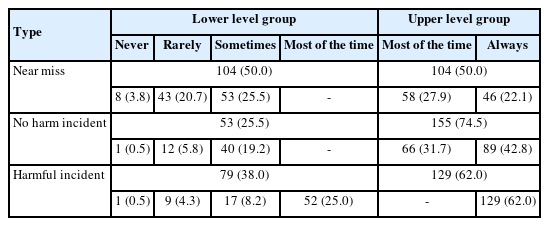
This study aimed to examine the predictors of nurses’ incident reporting by dividing the level of patient safety incident (near miss, no harm, harmful incident) reporting into upper and lower level groups. Methods: Data were collected from 208 nurses working in a hospital from March 29 to April 6, 2022. Logistic regression analysis was used to determine the predictors of nurses’ reporting level. Results: Predictors of the upper level group of near miss reporting were belief in improvement (odds ratio [OR], 2.40; 95% confidence interval [CI], 1.27-4.53), reporting intention (OR, 2.00; 95% CI, 1.15-3.47), patient safety knowledge (OR, 2.16; 95% CI, 1.16-4.01). Predictors of the upper level group no harm incidents reporting were reporting training (OR, 1.38; 95% CI, 1.01-1.90), belief in improvement (OR, 2.00; 95% CI, 1.01-3.95), patient safety knowledge (OR, 2.41; 95% CI, 1.17-4.98). In the case of harmful incident reporting, the predictor was patient safety attitude (OR, 9.32; 95% CI, 2.77-31.38). Conclusion: The reporting level varies depending on the type of patient safety incidents. Managing nurses' individual characteristics, such as their beliefs in improvement, patient safety knowledge, and attitude is a key strategy for enhancing incident reporting level. Nursing managers should be aware that not all harmful incidents are being reported.
  • 741 View
  • 53 Download
Purpose
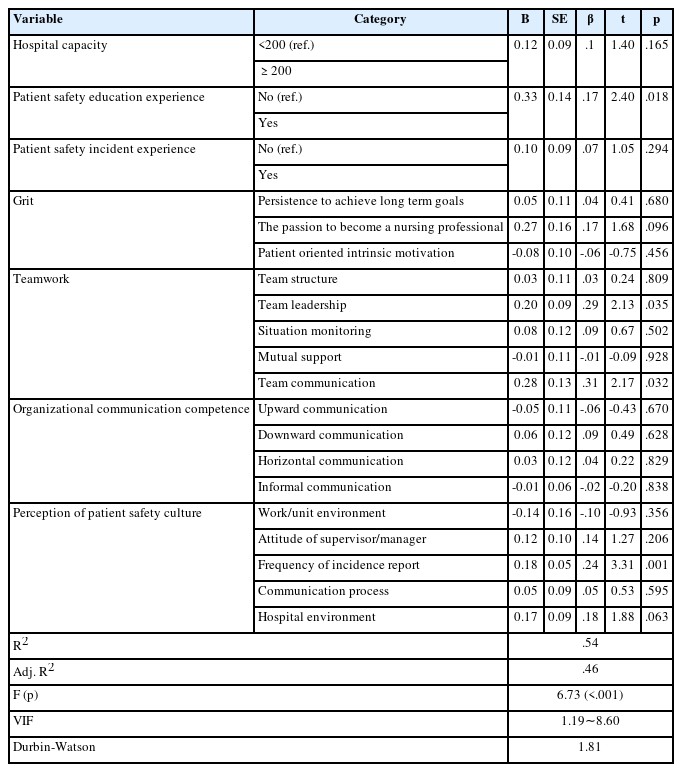
This study examined factors influencing patient safety nursing activities in integrated nursing care units. Methods: A survey was conducted with 134 nurses from hospitals (100~300 beds) in Busan using self-administered questionnaires (August 17–September 15, 2024). Data were analyzed using descriptive statistics, Pearson correlation, and multiple regression analysis. Results: The mean score for patient safety nursing activities was 4.31±0.55. Positive correlations were found with grit, teamwork, communication, and patient safety culture awareness. The predictor variables explained 46.0% of the variance in patient safety nursing activities. Significant factors included communication (β=.31, p=.032) and leadership (β=.29, p=.035) within teamwork, incident reporting frequency (β=.24, p<.001) within patient safety culture awareness, and experience in patient safety education (β=.17, p=.018). Conclusion: The findings of this study highlight the importance of enhancing teamwork, particularly in leadership and communication, and creating a safety culture that promotes incident reporting and education to strengthen patient safety nursing practices. Improving patient safety training, developing systematic evaluation and feedback mechanisms, and establishing structured support systems through campaigns and workshops will boost staff involvement and elevate the quality of patient safety practices.
  • 1,933 View
  • 169 Download
Purpose
This study aimed to examine the mediating role of nursing professionalism in the relationship between critical thinking disposition and medication safety competency among peri-anesthesia nurses.
Methods
Data were collected from 128 peri-anesthesia nurses with at least six months of experience in recovery-related departments across medical institutions nationwide. The analysis was conducted using IBM SPSS Statistics for Windows, version 24.0, including descriptive statistics, t-tests, one-way ANOVA, Scheffé tests, Pearson’s correlation coefficients, stepwise multiple regression, and the SPSS Process Macro.
Results
Medication safety competency showed a significant positive correlation with critical thinking disposition (r=.79, p<.001) and nursing professionalism (r=.80, p<.001). Similarly, critical thinking disposition was positively correlated with nursing professionalism (r=.78, p<.001). Nursing professionalism was identified as a partial mediator in the relationship between critical thinking disposition and medication safety competency, with a 95% confidence interval of .11 to .63.
Conclusion
Critical thinking disposition significantly enhances medication safety competency, with nursing professionalism serving as a partial mediator. These findings underscore the importance of developing targeted educational programs to foster critical thinking skills and nursing professionalism, ultimately improving medication safety competency among peri-anesthesia nurses.
  • 1,631 View
  • 65 Download
Purpose
This study aimed to explore the mediating role of organizational silence in the effect of leader-member exchange on patient safety culture among perioperative nurses.
Methods
This descriptive study surveyed 201 perioperative nurses from five university hospitals. Data were collected via online questionnaires from November 8, 2022, to February 6, 2023, measuring demographics, work-related factors, leader-member exchange, organizational silence, and patient safety culture. The Data were analyzed using SPSS 26.0 and PROCESS Macro model 4.
Results
Leader-member exchange showed a significant direct effect on patient safety culture (β=.44, p<.001). The indirect effect of leader-member exchange on patient safety culture through acquiescent silence was also significant (β=.05, 95% CI: 0.02 to 0.13). The total effect of leader-member exchange on patient safety culture (β=.52, p<.001) was larger than its direct effect, indicating that acquiescent silence partially mediated the relationship between leader-member exchange and patient safety culture.
Conclusion
To improve perioperative nurses perception of patient safety culture, healthcare organizations should enhance leader-member exchange by promoting strong emotional connections and open communication between nurse managers and staff nurses. Additionally, encouraging autonomous decision-making and reducing acquiescent silence are essential to facilitate the active expression of patient safety concerns.
  • 994 View
  • 48 Download
Purpose
This study aimed to identify the factors influencing nurses’ perceptions of the disclosure of patient safety incidents in tertiary hospitals.
Methods
As a descriptive study, data were collected from 315 nurses working in two tertiary hospitals in Busan via structured self-report questionnaires from June 28 to September 3, 2023, through an online survey. Data were analyzed using descriptive statistics, t-test, one-way ANOVA, Pearson’s correlation coefficients, and hierarchical regression analysis with SPSS/WIN 27.0.
Results
Analysis was conducted by controlling for the characteristics of the study participants, which revealed significant differences in their perceptions of the disclosure of patient safety incidents. Ethical nursing competence (β=.30, p<.001) and patient safety culture (β=.15, p=.012) were significant influencing factors on the perception of such disclosure, and the explanatory power of the regression model was 21.0% (F=14.63, p<.001).
Conclusion
To enhance the aforementioned perception among nurses in tertiary hospitals, healthcare institutions should provide learning opportunities to improve their ethical nursing competence. Fostering an organizational culture that promotes and encourages open disclosure of patient safety incidents is also essential.

Citations

Citations to this article as recorded by  
  • Impact of Nursing Professionalism, Ethical Sensitivity, and the Clinical Learning Environment on Nursing Students' Intention to Report Near Misses and Adverse Events
    Sookhee Yoon, Ha-Young Park
    Journal of Korean Academy of Fundamentals of Nursing.2025; 32(2): 209.     CrossRef
  • Factors Influencing End-of-life Care Competency in Nursing Students
    Jinryung Park, Minjeong Seo
    Korean Journal of Medical Ethics.2024; 27(4): 267.     CrossRef
  • 3,328 View
  • 101 Download
  • 2 Crossref
Purpose
This study examined the influence of patient safety management systems, leadership, and communication types on nurses’ patient safety management activities.
Methods
Participants were 237 nurses who has been working in medical institutes for over 6 months. Online self-report questionnaires were conducted. Measures included patient safety management systems, transformational leadership, authentic leadership, communication types, and patient safety management activities. Data were analyzed using descriptive statistics, t-test, ANOVA, Pearson’s correlation coefficients, and multiple regression with SPSS/WIN 24.0.
Results
According to the general characteristics, patient safety management activities were higher among nurses who were female (t=4.27, p<.001), charge nurses (t=-2.41, p=.016), had healthcare accreditation experience (t=4.36, p<.001), and worked in nursing units implementing a team nursing method (F=6.26, p=.002) with more than 30 nurses (F=6.28, p=.043). Female nurses (β=.16, p=.015) with high authentic leadership (β=.21, p=.002), low informal communication (β=-.21, p=.004), and high downward communication (β=.19, p=.009) showed higher patient safety management activities. The models' explanatory power was 21.0%.
Conclusion
Based on the results of this study, further research is needed to investigate the differences in patient safety management activities according to gender, the number of nurses per ward, and the nursing delivery system. Lowering informal communication and strengthening authentic leadership and downward communication may improve nurses’ patient safety management activities.
  • 3,367 View
  • 222 Download
Effects of Nurse-Nurse Collaboration and Nurse-Physician Collaboration on Nursing Performance in Nurses: The Mediating Effect of Patient Safety Management Activities
JaHyun Kim, Seok Hee Jeong, Hee Sun Kim, Sunmi Kim
J Korean Acad Nurs Adm 2024;30(4):343-356.   Published online September 30, 2024
DOI: https://doi.org/10.11111/jkana.2024.30.4.343
Purpose
This study investigated the mediating effects of patient safety management activities on the relationship between nurse-nurse collaboration, nurse-physician collaboration, and nursing performance of clinical nurses.
Methods
Online survey was performed from February 18 to February 28, 2023 using structured questionnaires. The participants were 212 clinical nurses working in tertiary general hospitals in South Korea. The participants completed self-reporting questionnaires, that measured nurse-nurse collaboration, nurse-physician collaboration, nursing performance, and patient safety management activities. Data were analyzed using SPSS 29.0 program, for multiple regression and a simple mediation model, applying the PROCESS macro with a 95% bias-corrected bootstrap confidence interval.
Results
Nurses' patient safety management activities had a mediating effect on the relationship between nurse-nurse collaboration and nursing performance (B=0.24, Boot 95% CI=0.16∼0.34). In addition, patient safety management activities showed a mediating effect on the relationship between nurse-physician collaboration and nursing performance (B=0.10, Boot 95% CI=0.07∼0.15).
Conclusion
The levels of nurse-nurse collaboration, nurse-physician collaboration, and patient safety management activities must be considered when developing strategies to improve nurses’ performance in nursing practice settings.

Citations

Citations to this article as recorded by  
  • Nurses’s Experience with Department Transfer Following Sudden Ward Closure after a Collective Resignation of Residents
    Yeon Hee Kim, Jeong Min Jo, Hye Mi Kim, Gyu Ri An, Na Yeon Lee, Hee Suk Ha
    Journal of Korean Association for Qualitative Research.2025; 10(1): 14.     CrossRef
  • 6,696 View
  • 408 Download
  • 1 Crossref
Improving Handover Efficiency for Emergency Nurses
Seungeun Lee, Heeje Yun, Yukyung Lee, Minji Kang, Eunbi Jo, Sunjong Yoo, I Gyeong Jo, Jung Hwan Heo, Min Jin Choi
J Korean Acad Nurs Adm 2024;30(3):294-305.   Published online June 30, 2024
DOI: https://doi.org/10.11111/jkana.2024.30.3.294
Purpose
Patient handovers are critical for patient safety. Studies have shown that nurses are often interrupted during handovers, and standardized guidelines are lacking. This study aimed to develop and evaluate the effectiveness of a new handover method for emergency nurses.
Methods
This quasi-experimental study implemented a new handover method from August 1, 2022, at the emergency department of a university hospital. Pre- (34 responses) and post-(16 responses, six months later) surveys and post-interviews (six participants) were conducted. In the pre-survey, data were collected regarding handover-related characteristics, cause of handover error, handover perception and handover error experience. Data regarding handover perception and handover error experience were obtained again at the post-survey. Wilcoxon’s signed rank test was used to compare handover perception and handover error experience. The interview results were analyzed using inductive content analysis.
Results
There were no significant differences in information quality or interaction and support, but the new handover method was more efficient, and handover errors decreased. Four themes were identified from interview responses.
Conclusion
By providing a quiet place and allowing emergency nurses to independently review patient records during handovers, we expect to maintain nursing continuity, increase efficiency, and ultimately ensure patient safety and nurses’ job satisfaction.
  • 1,366 View
  • 85 Download
Purpose
Nursing care activities for patient safety are important to prevent accidents. This study aimed to examine the association between nurses’ perception of patient safety culture, willingness to report near misses, critical thinking disposition, and nursing care activities for patient safety.
Methods
In this cross-sectional study, data were obtained from online surveys conducted with 201 ward nurses. An independent t-test, one-way ANOVA, Pearson’s correlation coefficient test, and multiple linear regression analysis were performed using IBM SPSS/WIN 21.0.
Results
Perceptions of patient safety culture, willingness to report near misses, critical thinking disposition, and nursing activities for patient safety were all correlated with each other. According to the regression model, significant factors influencing nursing care activities for patient safety were medical ward (β=-.28, p=.010), critical thinking disposition (β=.27, p<.001), willingness to report near misses (β=.19, p=.004), perceptions of patient safety culture (β=.19, p=.007), and work experience (β=-.18, p=.016).
Conclusion
Improving nurses’ perceptions of patient safety culture, promoting the reporting of near misses, and strengthening nurses' critical thinking dispositions can foster patient-safety nursing care activities. Additionally, a tailored patient safety education program that considers nursing work experience may be appropriate for patient-safety nursing care activities.

Citations

Citations to this article as recorded by  
  • Impact of Grit, Teamwork, Organizational Communication Competence, Perception of Patient Safety Culture on Patient Safety Nursing Activities in Integrated Nursing Care Units
    Jeeseon Kim, Haejung Lee
    Journal of Korean Academy of Nursing Administration.2025; 31(3): 237.     CrossRef
  • 3,045 View
  • 147 Download
  • 1 Crossref
Relationships among Nursing Skill Mix, Missed Nursing Care, and Adverse Events in Small and Medium-Sized Hospital Comprehensive Nursing Care Wards
Yoon Sook Cho, Hyoung Eun Chang, Hyunjung Lee
J Korean Acad Nurs Adm 2024;30(2):163-174.   Published online March 31, 2024
DOI: https://doi.org/10.11111/jkana.2024.30.2.163
Purpose
This study aimed to investigate the relationships among nursing skill mix, missed nursing care, and adverse events according to the nursing skill mix and the factors influencing.
Methods
This study is a descriptive survey that used survey data were collected from 158 nurses working in comprehensive nursing care wards in small and medium-sized hospitals. The data were analyzed using the t-test, analysis of variance, and multiple regression analysis.
Results
The average age of the study participants was 37.9 years, and they had over 10 years of experience. The average mean ratio of nursing skill mix 1 was 69.98. For nursing skill mix 2, the average mean ratio was 68.44%. The mean score for missed nursing care was 1.33, and the mean score for adverse events was 1.90 points. The factors affecting adverse events experience were missed nursing care, total work experience of >3 years, number of beds between ≥200 and <300.
Conclusion
Our findings suggest that patient safety and management education should consider the nurses’ age and total work experience. Furthermore, nursing workforce management, particularly focusing on nursing assistants in small- and medium-sized hospitals, is essential for fostering a safer healthcare environment.
  • 639 View
  • 31 Download
Purpose
This study examined the effect of missed nursing care on nursing sensitive indicators.
Methods
A nationwide cross-sectional survey was conducted using structured questionnaires. Data of 174 clinical nurses employed in general or tertiary hospitals were collected through proportional quota sampling; the quota used was the location of a working hospital in South Korea. Data were collected through an online survey and snowball sampling from July 16 to July 20, 2022. The collected data were analyzed using IBM SPSS 26.0.
Results
Missed nursing care had statistically significant negative correlations with patient safety management activity and job satisfaction, and significant positive correlation with turnover intention. Significant correlation was not found between missed nursing care and adverse event experiences. Hierarchical multiple regression analysis revealed that missed nursing care explained an additional 21%p of patient safety management activity, 14%p of job satisfaction, and 3%p of turnover intention. Thus, missed nursing care was found to be a statistically significant predictor of patient safety management activity, job satisfaction, and turnover intention.
Conclusion
Missed nursing care significantly affects nursing sensitive indicators. To improve positive outcomes and decrease negative outcomes, nurses and nursing managers must make efforts to minimize missed nursing care.

Citations

Citations to this article as recorded by  
  • Effect of Nursing Professionalism on Turnover Intention among Nurses: The Mediating Effect of Job Embeddedness
    Ja In Kim, Seok Hee Jeong, Hyoung Eun Chang, Sunmi Kim
    Journal of Korean Academy of Nursing Administration.2025; 31(4): 446.     CrossRef
  • Effects of presenteeism on turnover intention in clinical nurses through the serial mediating roles of missed nursing care and job satisfaction: a cross-sectional predictive correlational study
    Hyeonseon Cheon, Seok Hee Jeong, Hyun Kyung Kim, Hyoung Eun Chang
    Journal of Korean Academy of Nursing.2025; 55(4): 584.     CrossRef
  • Role of Hi-Tech Call Center Employees’ ESG Activity Recognition in Increasing Corporate Performance via Organizational Identification and Job Satisfaction
    So Ra Park
    Journal of Digital Contents Society.2024; 25(2): 503.     CrossRef
  • Impact of Emotional Labor and Positive Psychological Capital on the Turnover Intention of Nurses Caring for Patients with COVID-19: A Descriptive Survey Study
    Mira Kwon, Yeoungsuk Song, Majd T. Mrayyan
    Journal of Nursing Management.2024; 2024: 1.     CrossRef
  • 1,730 View
  • 81 Download
  • 4 Crossref
Purpose
This study aimed to verify the effect of patient safety environment (PSE) and health literacy (HL) on patient safety participation (PSP) and the mediating effect of HL.
Methods
We recruited patients who were hospitalized at a tertiary general hospital in “D” city. A total of 230 people responded to a questionnaire survey we conducted from March 15 to July 10, 2020. The collected data were analyzed using descriptive statistics, independent t-test, One-way ANOVA, Scheffé test, Pearson’s correlation coefficient analysis, and hierarchical regression using SPSS/WIN 26.0.
Results
PSP was found to be significantly associated with PSE (r=.29, p<.001) and HL (r=.44, p<.001). PSE and HL were found to have a significant effect on PSP (power: 23%). HL was found to have a partial mediating effect (indirect effect: 0.09, 95% CI: 0.04~0.14) between PSE and PSP.
Conclusion
The findings from this study can contribute to developing interventions for patient participation in the PSE and providing directions for offering safe and high-quality medical care to patients.

Citations

Citations to this article as recorded by  
  • What Factors Influence Patient Measures of Safety Among Adults?
    Yujeong Kim, Eunhee Nam
    Risk Management and Healthcare Policy.2025; Volume 18: 353.     CrossRef
  • Factors Influencing the Willingness of Hospitalized Children’s Parents to Engage in Patient Safety: A Cross-Sectional Study
    Yujeong Kim, Mingi Chang
    Risk Management and Healthcare Policy.2025; Volume 18: 53.     CrossRef
  • The Influence of Patient Safety Perception and Knowledge on Patient Participation among Inpatients in Comprehensive Nursing Care Service Ward
    Kyung Suk Baek, Chul-Gyu Kim
    Quality Improvement in Health Care.2025; 31(1): 2.     CrossRef
  • Mediating effects of patient safety perception and willingness to participate in patient safety on the relationship between health literacy and patient participation behavior among inpatients
    Mi Hwa Won, Sun-Hwa Shin
    Frontiers in Public Health.2024;[Epub]     CrossRef
  • Influence of patient safety perception and attitude on inpatients’ willingness to participate in patient safety: An observation study
    Mi Hwa Won, In Suk Hwang, Sun-Hwa Shin
    Medicine.2024; 103(29): e39033.     CrossRef
  • 1,341 View
  • 41 Download
  • 5 Crossref
Purpose
This study’s purpose is to examine the effects of nurses' incident reporting attitudes, their perceptions of importance of patient safety management, and patient safety culture on reporting patient safety events.
Methods
We used a cross-sectional design with a convenience sample of 192 nurses with more than three months clinical experience from five provincial hospitals. The data were collected through an online structured self-report questionnaire from September 25 to October 15, 2022. Data were analyzed using descriptive statistics, t-test, ANOVA, Pearson correlation coefficients, and stepwise multiple regression.
Results
The most important influencing factors for the level of patient safety event reporting were perceptions of the importance of patient safety management (β=.24, p=.005), followed by patient safety culture (β=.23, p=.019), incident reporting attitude (β=.18, p=.016), and near miss reporting experience (β=.14, p=.022). The explanatory power of the model was 33%.
Conclusion
To increase the level of patient safety incident reporting, differentiated education and standardized work procedures are needed. Also, it is necessary to prepare policies that revitalize patient safety reporting systems at medical institutions as measures to prevent patient safety accidents and recurrences.

Citations

Citations to this article as recorded by  
  • Patient safety management activities and perceived workload of shift‐work nurses, moderated by the perceived importance of patient safety management
    Kyung Jin Hong
    International Nursing Review.2025;[Epub]     CrossRef
  • Predictors of Nurses' Reporting Level by the Types of Patient Safety Incidents
    Ju-Hee Kang, Yeojin Yi
    Journal of Korean Academy of Nursing Administration.2025; 31(4): 434.     CrossRef
  • Relationship between nurses’ critical thinking disposition and patient safety incident reporting: The mediating role of patient safety culture in a comprehensive nursing service ward
    Nam-Yi Kim, Sung-Jung Kwak, Ayman Mohamed El-Ashry
    PLOS ONE.2024; 19(12): e0315679.     CrossRef
  • Impacts of Just Culture on Perioperative Nurses' Attitudes and Behaviors With Regard to Patient Safety Incident Reporting: Cross-Sectional Nationwide Survey
    Nara Han, Seok Hee Jeong, Myung Ha Lee, Hee Sun Kim
    Asian Nursing Research.2024; 18(4): 323.     CrossRef
  • Associations of perceptions of patient safety culture, job crafting, and perceptions of patient rounding with patient safety management activities among tertiary hospital nurses
    Saet-Byeol Kim, Yun-Hee Kim
    Journal of Korean Biological Nursing Science.2024; 26(3): 259.     CrossRef
  • 2,154 View
  • 106 Download
  • 5 Crossref
A Systematic Content Analysis of the Closed Nursing Malpractice Claims Related to Patients’ Safety
Hea Kung Hur, Ki Kyong Kim, Ji Soo Jung
J Korean Acad Nurs Adm 2023;29(2):99-108.   Published online March 31, 2023
DOI: https://doi.org/10.11111/jkana.2023.29.2.99
Purpose
The study aimed to classify patient safety accident and nursing malpractice types through a content analysis of litigation cases in which nurses were found guilty.
Methods
Data on malpractice cases were collected from the official website of the Korean judiciary. This analysis was conducted in stages according to the systematic content analysis method. A total of 46 cases consisting of 14 criminal cases and 32 civil cases were selected for analysis, and classified based on the types of safety accident and nursing malpractice.
Results
Eleven categories and 14 subcategories of accidents were extracted from 71 significant statements. The 11 categories of accidents consisted of falls, medication, burns, treatment, diet, medical equipment, delivery, exams, surgery, infection, and suicide. Five categories and 14 subcategories of nursing malpractice were extracted from 71 significant statements. The five categories of malpractice were as follows: failure to take affirmative action to prevent accidents, monitor, follow guidelines, use equipment properly, and reports.
Conclusion
These findings highlight the importance of nurses’ independent roles as patients’ safety managers. It can be used as primary data to develop organizational and educational support for nurses seeking to perform their professional roles in ensuring patient safety.

Citations

Citations to this article as recorded by  
  • Effects of Discussion-Based Legality-Focused Nursing Record Education on Nursing Students’ Knowledge, Self-Confidence, and Nursing Record Performance
    Dohye Kim, Kyoungrim Kang, Jeongyeong Jeon
    Journal of Korean Academy of Fundamentals of Nursing.2025; 32(1): 14.     CrossRef
  • Influencing Factors of Coping Strategies in Mothers of High‐Risk Newborns: Perceived Stress and Nursing Support
    Jung‐A Kim, Hye‐Young Jang
    International Journal of Nursing Practice.2025;[Epub]     CrossRef
  • Development of Guidelines for the Delegation of Nursing Tasks in Integrated Nursing Care Service
    Yeojin Yi, Haena Lim, Ji-Mee Kim, Jung-Hee Song
    Journal of Korean Academy of Nursing Administration.2024; 30(2): 114.     CrossRef
  • Characteristics of Nursing-related Patient Safety Incidents and Qualitative Content Analysis: Secondary data Analysis of Medical Litigation Judgment (2014~ 2018)
    Min-Ji Kim, Won Lee, Sang-Hee Kim, So-Yoon Kim
    Quality Improvement in Health Care.2023; 29(2): 15.     CrossRef
  • 2,887 View
  • 142 Download
  • 4 Crossref
Factors Influencing Patient Safety Management Activities among General Hospital Operating Room Nurses
Seon Mi Kim, Su Hye Kwon
J Korean Acad Nurs Adm 2023;29(2):89-98.   Published online March 31, 2023
DOI: https://doi.org/10.11111/jkana.2023.29.2.89
Purpose
This study was to examine the influential factors on patient safety management activities of operating room nurses in general hospitals.
Methods
The subject of this study were 133 operating room nurses of seven general hospitals in B metropolitan city. Data were collected from July 23 to August 14, 2020 using self-report questionnaires. For data analysis, a descriptive analysis and stepwise multiple regression were utilized with IBM SPSS Statistics for Windows version 22.0.
Results
The significant predictors of patient safety management activities were perception of patient safety culture (β=.73, p<.001) and physical burden (β=-.13, p=.025). These variables were found to contribute 56.3% to the outcomes of patient safety management activities.
Conclusion
Based on the research results, to promote patient safety management activities of operating room nurses, it is required to establish active and multifaceted strategies and systems at the hospital level to enhance awareness of patient safety culture and reduce physical burden.

Citations

Citations to this article as recorded by  
  • Study of Patient Safety Culture Awareness of Radiological Technologists in Magnetic Resonance Imaging Laboratories
    Min-Seo Park, Dong-Ha Lee, Hyun-Jin Jo, Hea-Youn Cho, Yeong-Cheol Heo
    Journal of the Korean Society of MR Technology.2024; 34(1): 9.     CrossRef
  • The Effects of a Simulation-Based Patient Safety Education Program on Compliance with Patient Safety, Perception of Patient Safety Culture, and Educational Satisfaction of Operating Room Nurses
    OkBun Park, MiYang Jeon, MiSeon Kim, ByeolAh Kim, HyeonCheol Jeong
    Healthcare.2023; 11(21): 2824.     CrossRef
  • 982 View
  • 40 Download
  • 2 Crossref
Influences of Teamwork and Job Burnout on Patient Safety Management Activities among Operating Room Nurses
Ayoung Kim, Haein Lee
J Korean Acad Nurs Adm 2022;28(5):605-615.   Published online December 31, 2022
DOI: https://doi.org/10.11111/jkana.2022.28.5.605
Purpose
This study aimed to investigate the influences of teamwork and job burnout on patient safety management activities (PSMA) among operating room nurses. Methods: We collected cross-sectional data from 144 operating room nurses with at least 1 year of clinical experience. Teamwork had five subscales (team structure, leadership, situation monitoring, mutual support, and communication) and burnout had two subscales (exhaustion and disengagement). We used descriptive statistics, t-tests, analysis of variance, Pearson’s correlation coefficients, and multiple linear regression. Results: PSMA had significant positive correlations with all subscales of teamwork and had a significant negative correlation with disengagement. Multiple regression analysis revealed that gender, clinical career in operating room, number of patient safety education, accreditation evaluation experience, team structure, and situation monitoring were associated with PSMA. Specifically, we found significant positive associations of team structure (β=.31, p<.001) and situation monitoring (β=.23, p=.039) with PSMA. Disengagement was not associated with PSMA after adjusting for confounders despite a significant correlation. Conclusion: To improve operating room nurses’ PSMA, it is important to improve their awareness of the team structure and their ability to monitor the operating room situation.

Citations

Citations to this article as recorded by  
  • Putting Patients at Risk: The Effect of Health Care Provider Burnout on Patient Care in the Operating Room—A Narrative Review
    Juan Antonio Hueto Madrid, Judith Hargreaves, Beata Buchelt
    Journal of Patient Safety.2025; 21(6): 424.     CrossRef
  • The Effects of Presenteeism, Burnout, and Nursing Performance on Retention Intention among Nurses at an Intensive Care Unit
    Seung-Hee Lee, Na Rin Kim
    Journal of Korean Academy of Nursing Administration.2025; 31(3): 269.     CrossRef
  • THE PERCEIVED INFLUENCE OF BURNOUT ON QUALITY OF PERIOPERATIVE CARE AMONG SURGICAL TEAM IN TEACHING HOSPITALS IN A PERI-URBAN CITY IN SOUTHWESTERN NIGERIA
    Rafiat Omotayo ISHOLA, Olufemi Oyebanji OYEDIRAN, Iyanuoluwa Oreofe OJO, Johnson Adewale AKINOSO, Emmanuel Olufemi AYANDIRAN
    Perioperative Care and Operating Room Management.2025; : 100567.     CrossRef
  • Importance-Performance Analysis of Patient-Safety Nursing in the Operating Room: A Cross-Sectional Study
    Jieun Shin, Nam-Yi Kim
    Risk Management and Healthcare Policy.2024; Volume 17: 715.     CrossRef
  • Effects of Nurse-Nurse Collaboration and Nurse-Physician Collaboration on Nursing Performance in Nurses: The Mediating Effect of Patient Safety Management Activities
    JaHyun Kim, Seok Hee Jeong, Hee Sun Kim, Sunmi Kim
    Journal of Korean Academy of Nursing Administration.2024; 30(4): 343.     CrossRef
  • The Effects of a Simulation-Based Patient Safety Education Program on Compliance with Patient Safety, Perception of Patient Safety Culture, and Educational Satisfaction of Operating Room Nurses
    OkBun Park, MiYang Jeon, MiSeon Kim, ByeolAh Kim, HyeonCheol Jeong
    Healthcare.2023; 11(21): 2824.     CrossRef
  • 1,712 View
  • 90 Download
  • 6 Crossref
Purpose
This study aimed to examine the association of job crafting and perception of patient safety culture with patient safety management activities among hospital nurses. Methods: This study used a questionnaire that contained the scales of Job Crafting, Patient Safety Culture, and Patient Safety Management Activities. The participants were 211 nurses from two hospitals. Data were analyzed using descriptive statistics, correlations and simultaneous multiple regression. Results: The mean scores of the variables were as follows: job crafting, 3.42 out of 5; perception of patient safety culture, 3.77 out of 5; and patient safety management activities, 4.30 out of 5. The items ‘using professional autonomy’ of job crafting and ‘patient safety knowledge/attitude’ and ‘teamwork’ of patient safety culture were associated with the patient safety management activities among nurses. Conclusion: Nurses’ patient safety knowledge and attitude of striving for patient safety influenced nurses’ patient safety management activities. To enhance nurses’ patient safety knowledge and attitude, hospitals should develop continuously provide education programs. Nurse managers need to strive for supportive teamwork and encourage adherence to patient safety rules. For nurses’ patient safety management activities, nurse education should highlight nursing as a profession that entails autonomous nursing care, which includes responsibility for patient safety.

Citations

Citations to this article as recorded by  
  • Associations of perceptions of patient safety culture, job crafting, and perceptions of patient rounding with patient safety management activities among tertiary hospital nurses
    Saet-Byeol Kim, Yun-Hee Kim
    Journal of Korean Biological Nursing Science.2024; 26(3): 259.     CrossRef
  • Importance-Performance Analysis of Patient-Safety Nursing in the Operating Room: A Cross-Sectional Study
    Jieun Shin, Nam-Yi Kim
    Risk Management and Healthcare Policy.2024; Volume 17: 715.     CrossRef
  • Effects of Nurse-Nurse Collaboration and Nurse-Physician Collaboration on Nursing Performance in Nurses: The Mediating Effect of Patient Safety Management Activities
    JaHyun Kim, Seok Hee Jeong, Hee Sun Kim, Sunmi Kim
    Journal of Korean Academy of Nursing Administration.2024; 30(4): 343.     CrossRef
  • Effects of Patient Safety Management System, Leadership, and Communication Types on Nurse’ Patient Safety Management Activities
    Eunji Lee, Haejung Lee
    Journal of Korean Academy of Nursing Administration.2024; 30(4): 367.     CrossRef
  • 743 View
  • 25 Download
  • 4 Crossref
Influence of Clinical Nurses’ Second-Victim Experience and Second-Victim Support in Relation to Patient Safety Incidents on Their Work-Related Outcomes
Su Jin Jung, Youngjin Lee, Sun Hyoung Bae
J Korean Acad Nurs Adm 2022;28(4):331-341.   Published online September 30, 2022
DOI: https://doi.org/10.11111/jkana.2022.28.4.331
Purpose
This study aims to determine the influence of clinical nurses’ second-victim experience and second-victim support on their negative work-related outcomes. Methods: We used a cross-sectional design with a convenience sample of 179 clinical nurses from two Korean tertiary hospitals. The data were collected through a structured self-questionnaire survey and analyzed via descriptive analysis, independent t-tests, one-way ANOVA (analysis of variance), Pearson correlation coefficients, and hierarchical multiple regression. Results: Second-victim experience revealed a significant negative correlation with second-victim support and a significant positive correlation with negative work-related outcomes. The second-victim experience was found to be a significant predictor of negative work-related outcomes. These factors explained 46.3% of the negative work-related outcomes in the regression model. Conclusion: It is necessary to determine the degree of second-victim experience among clinical nurses and provide second-victim support to prevent future occurrences of negative work-related outcomes.

Citations

Citations to this article as recorded by  
  • How does just culture reduce negative work outcomes through second victim distress and demand for support in clinical nurses? A path analysis
    Seohee Jeong, Sunmi Kim, Hyoung Eun Chang, Seok Hee Jeong
    BMC Nursing.2025;[Epub]     CrossRef
  • Factors influencing negative outcomes for nurses who experience patient safety incidents: An integrative review
    Hanseulgi Lee, Nam‐Ju Lee, Nari Kim
    International Nursing Review.2025;[Epub]     CrossRef
  • Clinical nurses’ work-life balance prediction due to patient safety incidents using classification and regression tree analysis: a secondary data analysis
    Jiwon Kang, Soon-Sun Kwon, Youngjin Lee
    BMC Nursing.2024;[Epub]     CrossRef
  • Development of a Patient Safety Simulation Program for New Nurses in the Intensive Care Unit
    Su Jin Jung, Jin-Hee Park
    Journal of Korean Academy of Fundamentals of Nursing.2024; 31(1): 100.     CrossRef
  • Simulation-based training program on patient safety management: A quasi-experimental study among new intensive care unit nurses
    Su Jin Jung, Ju-Eun Song, Sun Hyoung Bae, Youngjin Lee, Seok Hyun Gwon, Jin-Hee Park
    Nurse Education Today.2023; 126: 105823.     CrossRef
  • 906 View
  • 14 Download
  • 5 Crossref
Purpose
This study is a descriptive research study conducted for the perioperative nurses of operating room to strengthen their capacity for patient safety and use them as basic data for sustainable surgical nursing practice education. Methods: This study adopted a cross-sectional survey design using a self-report questionnaire. Data were collected from January 25 to February 15, 2019 from 142 nurses in the operating rooms of four university hospitals in Seoul and Gyeonggi Province. For data analysis, mean, standard deviation, frequency, percentage, independent t-test, one-way ANOVA, Pearson's Correlation Coefficient, and hierarchical multiple regression analysis were used using SPSS version 24.0. Results: The variables affecting the patient safety management activities of the subjects were operating room safety management education experience (once or more in 3 months) (β=.15, p=.034), perception of patient safety atmosphere (β=.23, p=.022), and safety control (β=.46, p<.001), and the total explanatory power of these variables was 39% (Adjusted R 2 =.39, F=6.41, p<.001). Conclusion: It was found that for positive patient safety management activities of perioperative nurses, it is necessary to develop and apply an operating room safety management education program that includes patient safety atmosphere awareness and safety control as components.

Citations

Citations to this article as recorded by  
  • The Impact of the Nursing Professionalism and Triage Competency of Emergency Department Nurses on Disaster Nursing Competency
    Hyo Jin Im, Ju Young Ha
    Journal of Korean Public Health Nursing.2025; 39(1): 19.     CrossRef
  • Factors affecting pediatric nurses’ development of partnerships with parents of hospitalized children: An evaluation based on the stress-coping adaptation model
    In Young Cho, So Hyoung Hong, Ji Yeong Yun
    Journal of Child Health Care.2025; 29(1): 53.     CrossRef
  • Acuquisition of Professional Nursing Intuition: A Grounded Theory Approach
    Hwa-Young Ahn, Sung-Bok Kwon
    Journal of Korean Academy of Nursing Administration.2025; 31(1): 1.     CrossRef
  • Factors Influencing the Safety Nursing Activities of Emergency Department Nurses
    Hyo Seon Pae, Eun Ji Seo
    Journal of Korean Critical Care Nursing.2025; 18(2): 54.     CrossRef
  • Development and Evaluation of a “Speak-Up” Program for Patient Safety: A Virtual Reality-Based Intervention for Nursing Students
    Jeong Hee Jeong, Mi Jin Kim
    Healthcare.2025; 13(22): 2860.     CrossRef
  • The Safety Climate and Patient Safety Activities in Mental Health Nurses: The Mediating Effect of Safety Control
    Jiyeong No, Kyoungsook Lee
    Healthcare.2024; 12(12): 1181.     CrossRef
  • Effects of Patient Safety Management System, Leadership, and Communication Types on Nurse’ Patient Safety Management Activities
    Eunji Lee, Haejung Lee
    Journal of Korean Academy of Nursing Administration.2024; 30(4): 367.     CrossRef
  • Effect of Counting Error Prevention Training on Operating Room Nurses’ Counting Error Prevention Awareness and Perceptions of Patient Safety
    Myung Jin JANG, Mi Kyung HONG, Mi Jeong LEE, Kyung A LEE, Yang Ok KIM, Jin A JEON, Hana KO
    Korean Journal of Health Promotion.2024; 24(1): 20.     CrossRef
  • Factors Related to the Severity of Patient Safety Incidents in Operating Rooms in South Korea
    Minjung Ryu, Jun Su Park, Bomgyeol Kim, Suk-Yong Jang, Sang Gyu Lee, Tae Hyun Kim
    Health Insurance Review & Assessment Service Research.2024; 4(2): 149.     CrossRef
  • Importance-Performance Analysis of Patient-Safety Nursing in the Operating Room: A Cross-Sectional Study
    Jieun Shin, Nam-Yi Kim
    Risk Management and Healthcare Policy.2024; Volume 17: 715.     CrossRef
  • Effect of Leader-Member Exchange on Patient Safety Culture in Perioperative Nurses: The Mediating Role of Organizational Silence
    Nayeop Lee, Yoonju Lee
    Journal of Korean Academy of Nursing Administration.2024; 30(5): 462.     CrossRef
  • Effects of Grit, Patient Safety Competence, and Patient Safety Culture on the Patient Safety Nursing Activities of Nurses in Comprehensive Nursing Service Wards
    Ji Hyun Kim, Haena Jang
    Journal of Korean Critical Care Nursing.2024; 17(3): 62.     CrossRef
  • The Effects of Patient Safety Culture Perception and Safety Control on the Patient Safety Management Activities of Psychiatric Ward Nurses
    Dea-Gyu Park, Hyo-Ja An
    Journal of Korean Academy of psychiatric and Mental Health Nursing.2023; 32(2): 138.     CrossRef
  • Effects of Self-leadership, Professional Self-concept, Emotional Labor on Professional Quality of Life in Hospital Nurses
    Yu-Yeong Kyun, Mi-Aie Lee
    Journal of Korean Academy of Nursing Administration.2020; 26(5): 447.     CrossRef
  • Specialty satisfaction, positive psychological capital, and nursing professional values in nursing students: A cross-sectional survey
    Chung Hee Woo, Ju Young Park
    Nurse Education Today.2017; 57: 24.     CrossRef
  • Effects of a Refresher Program for Inactive Nurses on Nursing Professionalism and Nursing Clinical Self-Efficacy
    Mi Ra Han, Smi Choi-Kwon
    Journal of Korean Academy of Nursing Administration.2011; 17(1): 44.     CrossRef
  • An international comparison of Korean and Chinese nursing students with nursing curricula and educational outcomes
    Hyang-Yeon Lee, YoonHee Kim, HyunSook Kang, Xiuzhen Fan, Min Ling, Qiuhuan Yuan, Jia Lee
    Nurse Education Today.2011; 31(5): 450.     CrossRef
  • 954 View
  • 68 Download
  • 17 Crossref
The Relationship between Nurse-Perceived Patient Safety Culture and Patient Safety
Hyunju Ji, Seung Eun Lee
J Korean Acad Nurs Adm 2022;28(3):190-199.   Published online June 30, 2022
DOI: https://doi.org/10.11111/jkana.2022.28.3.190
Purpose
To examine the relationship between nurse-perceived patient safety culture and patient safety grade in healthcare organizations. Methods: A cross-sectional, correlational study design was used. An online survey was conducted with nurses in three tertiary hospitals in Korea who provided direct care to patients. Data were analyzed using Pearson correlation coefficients and ordinal logistic regression. Results: A total of 526 nurses completed the questionnaire. Among patient safety culture dimensions, staffing and work pace, reporting patient safety events, hospital management support for patient safety, handoffs and information exchange, organizational learningcontinuous improvement, and unit manager support for patient safety were significant predictors for patient safety grade. Conclusion: Efforts should be made to create and enhance patient safety culture in healthcare organizations. This study showed that staffing and work pace were the strongest predictors of patient safety grade, indicating that adequate nurse staffing is important to handle workloads and improve patient safety. Our study also demonstrated the importance of hospital management and unit manager support for patient safety. Therefore, we suggest developing a leadership program for hospital administrators and unit managers, to help them develop the necessary leadership skills for creating a culture of safety in healthcare organizations.

Citations

Citations to this article as recorded by  
  • Development and Evaluation of a Multifaceted Intervention Program for Preventing Medication Administration Errors by Nurses
    Won Hee Sim
    Journal of Patient Safety.2025; 21(4): 226.     CrossRef
  • The influencing factors of pediatric nurses’ perception of patient safety culture and partnership with patients’ parents on patient safety nursing activities in South Korea: a descriptive study
    Seo Jin Lee, Young Ran Han
    Child Health Nursing Research.2024; 30(4): 255.     CrossRef
  • Effect of Leader-Member Exchange on Patient Safety Culture in Perioperative Nurses: The Mediating Role of Organizational Silence
    Nayeop Lee, Yoonju Lee
    Journal of Korean Academy of Nursing Administration.2024; 30(5): 462.     CrossRef
  • A Survey on the Perception of Psychiatric Hospital Nurses on Patient Safety
    Sunah Kim, Wongyeong Lee, Chaehyeon Kang
    Journal of Korean Academy of psychiatric and Mental Health Nursing.2022; 31(4): 448.     CrossRef
  • 2,397 View
  • 96 Download
  • 4 Crossref
Purpose
The purpose of this study was to examine the influences of nursing workplace spirituality, organizational citizenship behavior, and perception of patient safety management on patient safety nursing activities of nurses at a tertiary hospital. Methods: The subjects were 136 nurses who had more than a year of clinical experience and were currently working in tertiary hospitals in D city. Data was collected from October 2 to October 13, 2020 using self-report questionnaires. The collected data were analyzed with descriptive statistics, t-test, one-way ANOVA, Scheffe test, Pearson’s correlation coefficient and hierarchical regression analysis using the IBM SPSS 25.0 program. Results: There was statistically significant correlation among nursing workplace spirituality, organizational citizenship behavior, perception of patient safety management, and patient safety nursing activities. The most significant predictor that affected patient safety nursing activities of nurses was nurses’ perception of patient safety management. This model showed a 42.0% explanation of patient safety nursing activities. Conclusion: In order to improve the patient safety nursing activities of nurses, an organizational approach to enhancing perception of patient safety management and application of patient safety education programs are required.

Citations

Citations to this article as recorded by  
  • Influence of Perception of Patient Safety Culture, Job Stress, and Nursing Work Environment on Patient Safety Nursing Activities by Emergency Room Nurses
    Eon Mi Lee, Jeong Hyun Cho, Seung Gyeong Jang
    Journal of Korean Academy of Fundamentals of Nursing.2025; 32(2): 264.     CrossRef
  • Influences of Organizational Culture, Nursing Workplace Spirituality, and Nurses’ Perceived Health Status on Quality of Nursing Work Life according to Nursing Clinical Ladder
    Hyun Sook Lee, Ju Hyun Jin, Ju Ri Lee, Hye Jin Kim, Yeon Jae Jung
    Journal of Korean Academy of Nursing Administration.2024; 30(1): 31.     CrossRef
  • Effects of Grit, Patient Safety Competence, and Patient Safety Culture on the Patient Safety Nursing Activities of Nurses in Comprehensive Nursing Service Wards
    Ji Hyun Kim, Haena Jang
    Journal of Korean Critical Care Nursing.2024; 17(3): 62.     CrossRef
  • 742 View
  • 16 Download
  • 3 Crossref
Influence of the Patient Safety Culture and Nursing Work Environment on Fall Prevention Activities of Hospital Nurses
Se-Young Jung, Eun-Young Kim
J Korean Acad Nurs Adm 2022;28(2):78-87.   Published online March 31, 2022
DOI: https://doi.org/10.11111/jkana.2022.28.2.78
Purpose
This study was conducted to identify the influence of patient safety culture and nursing work environment on fall prevention activities among hospital nurses. Methods: The participants were 177 nurses working at eight hospitals including clinics, general hospitals, and tertiary care hospitals located in B city. Data were collected using self-report questionnaires and analyzed using descriptive statistics, independent t-test, one-way ANOVA, Scheffé test. Pearson’s correlation coefficients, and hierarchical multiple regression with SPSS/WIN 26.0. Results: Fall prevention activities were positively correlated with nursing work environment (r=.25, p=.001) and patient safety culture (r=.49, p<.001). Fall prevention activities were found to be significantly affected by patient safety culture (β=.47, p<.001) and being a training hospital (β=.21, p=.006). Conclusion: The findings from this study suggest that patient safety culture is associated with fall prevention activities. In order to raise fall prevention activities, it is important to improve patient safety culture. Additionally, the health care organization should develop programs to raise fall prevention activities.

Citations

Citations to this article as recorded by  
  • Predictors of Nurses' Reporting Level by the Types of Patient Safety Incidents
    Ju-Hee Kang, Yeojin Yi
    Journal of Korean Academy of Nursing Administration.2025; 31(4): 434.     CrossRef
  • Associations of perceptions of patient safety culture, job crafting, and perceptions of patient rounding with patient safety management activities among tertiary hospital nurses
    Saet-Byeol Kim, Yun-Hee Kim
    Journal of Korean Biological Nursing Science.2024; 26(3): 259.     CrossRef
  • Development and validation of a patient-centered communication scale for nurses
    Youngshin Joo, Yeonsoo Jang, Chang Gi Park, You Lee Yang
    BMC Nursing.2024;[Epub]     CrossRef
  • Effects of Clinical Nurses Critical Reflection Competency, Professional Pride, and Person-Centered Care Practice on Patient Safety Management Activities
    Subin Lee, Sujin Shin
    Journal of Korean Critical Care Nursing.2023; 16(3): 87.     CrossRef
  • Falls in Patients of Medical Institutions in South Korea: A Literature Review
    Jongwon Choi, Woochol Joseph Choi
    Physical Therapy Korea.2023; 30(1): 1.     CrossRef
  • The Effect of Work Value, Psychological Ownership and Nursing Working Environment on Intention of Retention in Hospital Nurses
    Ji Hey Kim, Yoon Ju Cho, So Eun Jang
    Journal of Korean Critical Care Nursing.2023; 16(3): 62.     CrossRef
  • 1,938 View
  • 96 Download
  • 6 Crossref
Factors Influencing Safety Nursing Activities of Nurses at a Nationally Designated Infectious Disease Hospital
Sung Ae Choi, Ju Young Park
J Korean Acad Nurs Adm 2022;28(1):20-30.   Published online January 31, 2022
DOI: https://doi.org/10.11111/jkana.2022.28.1.20
Purpose
This study investigated patient safety culture, safety knowledge, incident reporting attitude, and safety nursing activities, and determined the factors influencing nurses’ safety nursing activities at a nationally designated infectious disease hospital. Methods: A cross-sectional descriptive survey was conducted with 169 nurses. Data analysis, including descriptive statistics, independent t-tests, one-way ANOVA, Pearson’s correlations, and hierarchical multiple regression analysis, were performed using SPSS 26.0. Results: Factors influencing safety nursing activities included patient safety culture (β=.26, t=2.39, p=.018), safety knowledge (β=.25, t=2.67, p=.009), and mild severity (β=.17, t=2.52, p=.013). These variables explained 31.0% of the safety nursing activities. Conclusion: Therefore, it is necessary to establish an organizational culture that emphasizes patient safety by establishing safety management regulations for quarantined patients and provision of education on patient safety for employees to empower them to respond to emerging infectious diseases. Additionally, it is essential to operate given the patient’s severity and to increase knowledge about patient safety through regular education based on quarantine facilities and environmental management regulations.

Citations

Citations to this article as recorded by  
  • Predictors of Nurses' Reporting Level by the Types of Patient Safety Incidents
    Ju-Hee Kang, Yeojin Yi
    Journal of Korean Academy of Nursing Administration.2025; 31(4): 434.     CrossRef
  • Exploring research trends in nursing organizational culture using topic modeling
    Eun-Jun Park, Chan Sook Park
    The Journal of Korean Academic Society of Nursing Education.2024; 30(4): 371.     CrossRef
  • Risk Factors for Falls or Fractures in Stroke Patients: An Analysis of 2020 Patient Sample Data
    Miso Lee, Mikyung Moon
    The Korean Journal of Rehabilitation Nursing.2024; 27(1): 58.     CrossRef
  • 649 View
  • 14 Download
  • 3 Crossref
Factors Affecting the Degree of Harm from Fall Incidents in Hospitals
Shinae Ahn, Da Eun Kim
J Korean Acad Nurs Adm 2021;27(5):334-343.   Published online December 31, 2021
DOI: https://doi.org/10.11111/jkana.2021.27.5.334
Purpose
This study aimed to examine the factors influencing the degree of harm caused by fall incidents in hospitals.
Methods
This cross-sectional descriptive study used secondary data from the “Korean Patient Safety Incident Report 2019” and was based on the International Classification for Patient Safety conceptual framework. We analyzed a total of 4,176 fall incidents between January 1 and December 31, 2019, in Korea. Multinomial logistic regression analyses were conducted to identify the factors that influence the degree of harm from these incidents.
Results
Among the fall incidents, 443 (10.6%) were sentinel events, 2,514 (60.2%) were adverse events, and 1,219 (29.2%) were near misses. The factors associated with sentinel events were old age (≥60 years), gender, patient diagnosis, medical department, early detection after falls, long-term care hospital, and reporters. Adverse events were significantly associated with diagnosis, medical department, nurses’ night shift time, large bed size, location (i.e., operating room, recovery room, and intensive care unit), and reporters.
Conclusion
Both patient and incident characteristics are significantly associated with the degree of harm in hospitals. Therefore, multiple factors should be considered to establish healthcare policies and thus prevent fall risks and minimize damage following falls in hospitals.

Citations

Citations to this article as recorded by  
  • Factors Affecting Fall Incidents at Long-term Care Hospitals: Using Data from the Korea Patient Safety Reporting and Learning System
    Soojin Chung, Jeongim Lee
    Journal of Health Informatics and Statistics.2025; 50(1): 96.     CrossRef
  • Determinants of Harm in Fall Incidents in Hospital Settings With 200 or More Beds in Korea
    Youngmi Kang, Eunyoung Hong
    Journal of Patient Safety.2025; 21(7): 480.     CrossRef
  • Predictors of Nurses' Reporting Level by the Types of Patient Safety Incidents
    Ju-Hee Kang, Yeojin Yi
    Journal of Korean Academy of Nursing Administration.2025; 31(4): 434.     CrossRef
  • Content Analysis of Patient Safety Incident Reports Using Text Mining: A Secondary Data Analysis
    On-Jeon Baek, Ho Jin Moon, Hyosun Kim, Sun-Hwa Shin
    Korean Journal of Adult Nursing.2024; 36(4): 298.     CrossRef
  • Falls in Patients of Medical Institutions in South Korea: A Literature Review
    Jongwon Choi, Woochol Joseph Choi
    Physical Therapy Korea.2023; 30(1): 1.     CrossRef
  • Predication of Falls in Hospitalized Cancer Patients
    Jun-Nyun Kim, Sun-Hwa Beak, Bo-Seop Lee, Mi-Ra Han
    Asian Oncology Nursing.2023; 23(2): 56.     CrossRef
  • Trends in infection-related patient safety incident reporting before and during the COVID-19 pandemic in Korea
    Eun-Jin Kim, Yeon-Hwan Park
    Journal of Korean Biological Nursing Science.2023; 25(2): 95.     CrossRef
  • Factors Associated with Patient Safety Incidents in Long-Term Care Hospitals: A Secondary Data Analysis
    Sookhee Yoon, Myungsuk Kang
    Korean Journal of Adult Nursing.2022; 34(3): 295.     CrossRef
  • 1,425 View
  • 47 Download
  • 8 Crossref
Purpose
This study was conducted to identify the influence of communication self-efficacy and perception of the patient safety culture on the experience of nursing errors among operating room nurses. Methods: A cross-sectional design was used, with a convenience sample of 184 operation room nurses from 16 hospitals in Korea. Data were collected through a structured self-administered survey. The questionnaires included Communication, Self Efficacy, Safety Attitude Questionnaire, and experiences of nursing errors in operation room. Data were analyzed using descriptive analysis, Shapiro-Wilk test, Mann-Whitney U test, Kruskal-Wallis test, Pearson correlation coefficients and multiple linear regression. Results: The experience of nursing errors had significant negative correlations with communication self-efficacy (r=-.39, p<.001) and perception of the patient safety culture (r=-.36, p<.001). Factors significantly influencing the experiences of nursing errors included communication self-efficacy (β=-.25, p=.002), and perception of patient safety culture (β=-.21, p=.009). The overall explanatory power was 19% (F=14.85, p<.001). Conclusion: It is necessary to develop continuous education and programs improving communication self efficacy and perception of patient safety culture to reduce risk of nursing errors in the operating room.

Citations

Citations to this article as recorded by  
  • Development of a communication self-efficacy scale for nurses: a psychometric validation study
    Kuem Sun Han, Jihye Shin, Soo Yeon Lee
    Journal of Korean Academy of Nursing.2025; 55(2): 269.     CrossRef
  • Lived Experiences of Nurses in Delivering Peri-Operative Care
    Emilyn Fajardo, Romeo Tuazon, Ariel Bongco
    Psychology and Education: A Multidisciplinary Journal.2025; 38(8): 861.     CrossRef
  • The relationship between clinical decision-making levels and self-efficacy levels of operating room nurses
    Sedat Kaya, Gizem Kubat Bakir
    Perioperative Care and Operating Room Management.2024; 37: 100416.     CrossRef
  • Efficacy of an error reporting-based education program on nursing students’ skill confidence, immersion, and satisfaction
    Youngsook Lim, Sunae Kim, Ohsoon Yoon, SunJung Park
    International Journal of ADVANCED AND APPLIED SCIENCES.2023; 10(10): 200.     CrossRef
  • The Relationship between Nurse-Perceived Patient Safety Culture and Patient Safety
    Hyunju Ji, Seung Eun Lee
    Journal of Korean Academy of Nursing Administration.2022; 28(3): 190.     CrossRef
  • 1,421 View
  • 61 Download
  • 5 Crossref
A Study on Factors Affecting Near Misses by Nurses in Small-Medium Sized Hospitals
San-Na Lee, Seon-Ha Kim
J Korean Acad Nurs Adm 2021;27(2):75-83.   Published online March 31, 2021
DOI: https://doi.org/10.11111/jkana.2021.27.2.75
Purpose
The purpose of this study was to investigate the status of the near miss by nurses in small-medium hospitals and to identify the factors that affect the near miss. Methods: Data were collected using a structured questionnaire for small-medium sized hospital nurses who had worked for more than one year. A total of 243 questionnaires were used for analysis. The difference in the characteristics of the nurses according to the near miss experience was analyzed by the x 2 test, and the influence factor of the near miss was analyzed by logistic regression. Results: Overall, 155 nurses (63.8%) experienced near misses during the previous 1 year. Among those who experienced a near miss, the medication-related error was the highest at 58.3%. As a result of the stepwise logistic regression analysis, the odds ratio over time work of over 3 hours increased near misses 2.48 (95% CI: 1.21~5.08) compared to the group without overtime. Conclusion: Overtime work seems to be a significant factor in the near miss experience for small-medium hospital nurses.

Citations

Citations to this article as recorded by  
  • Predictors of Nurses' Reporting Level by the Types of Patient Safety Incidents
    Ju-Hee Kang, Yeojin Yi
    Journal of Korean Academy of Nursing Administration.2025; 31(4): 434.     CrossRef
  • Association between Nurses’ Perceptions of Patient Safety Culture, Willingness to Report Near Misses, Critical Thinking Disposition, and Nursing Care Activities for Patient Safety
    Da Eun Lee, Bo Gyeong Lee
    Journal of Korean Academy of Nursing Administration.2024; 30(3): 283.     CrossRef
  • Influence of Nursing Manager's Ethical Leadership Perceived by Nurses in Patient-Engaged Nursing Services: Mediating Effect of Patient Participation Culture
    Yea Seul Yoon, Yoonjung Ji, Tae Wha Lee
    Journal of Korean Academy of Nursing Administration.2023; 29(4): 397.     CrossRef
  • A Survey on the Perception of Psychiatric Hospital Nurses on Patient Safety
    Sunah Kim, Wongyeong Lee, Chaehyeon Kang
    Journal of Korean Academy of psychiatric and Mental Health Nursing.2022; 31(4): 448.     CrossRef
  • Effects of Perceived Safety Culture, Nursing Work Environment, and Professional Self-concept on Patient Safety Care Activity of Nurses in Small-medium Sized Hospitals
    Young Ok Cho, Myoung Soo Kim
    Journal of Health Informatics and Statistics.2022; 47(1): 66.     CrossRef
  • 1,882 View
  • 51 Download
  • 5 Crossref
Development of a Simulation Program related to Patient Safety: Focusing on Medication Error
Mi Yu, Eun-Young Kim, Jong Kyung Kim, Youngjin Lee
J Korean Acad Nurs Adm 2021;27(2):107-117.   Published online March 31, 2021
DOI: https://doi.org/10.11111/jkana.2021.27.2.107
Purpose
Ensuring patient safety is an essential professional competency that is conceptualized and developed during undergraduate nursing education. To reduce the incidence of preventable medication errors, it is critical to learn how errors are made and the importance of collaboration with healthcare workers. This study was done to develop a simulation program related to the medication process and improving patient safety in nursing students.
Methods
This methodological study was designed to develop a simulation program on teaching preventable medication errors and communication among nurses, doctors, pharmacists and nurse managers in the nursing management curriculum of colleges of nursing. The design included creation of two scenarios. Guideline-based scenarios were verified by nursing experts using the three-round Delphi method.
Results
The two scenarios using high-fidelity patient simulators or standard patients address ‘resolving medication errors related to patients’ identification and history, and reporting safety incidents’ and ‘resolving medication errors related to medication prescription and dispensing, and reporting safety incidents’.
Conclusion
This simulation program supports practical education for nursing students in the nursing management course and novice nurses in patient safety-related education.

Citations

Citations to this article as recorded by  
  • Effectiveness of room-of-error interventions for healthcare providers: a systematic review
    Su Jin Jung, Jiwon Kang, Youngjin Lee
    BMC Nursing.2025;[Epub]     CrossRef
  • Mediating effect of grit on the influence of nurses’ silence behavior on medication safety competence: a cross-sectional study
    Haengsuk Kim, Wanju Park
    Journal of Korean Academy of Nursing.2025; 55(1): 81.     CrossRef
  • Development and Effectiveness of Progressive Simulation Education Program on Medication Safety for Nursing Students
    Se-Young Jung, Eun-Young Kim
    Journal of Korean Academy of Nursing.2024; 54(4): 563.     CrossRef
  • The effects of flipped learning and gamification on nursing students’ patient safety education: A mixed method study
    Soo Jung Chang, Geun Myun Kim, Jeong Ah Kim
    Heliyon.2024; 10(8): e29538.     CrossRef
  • Patient safety interprofessional education program using medical error scenarios for undergraduate nursing and medical students in Korea
    Hea Kung Hur, Ki Kyong Kim, Young Mi Lim, Junghee Kim, Kyung Hye Park, Yon Chul Park
    Journal of Interprofessional Care.2023; 37(6): 944.     CrossRef
  • Efficacy of an error reporting-based education program on nursing students’ skill confidence, immersion, and satisfaction
    Youngsook Lim, Sunae Kim, Ohsoon Yoon, SunJung Park
    International Journal of ADVANCED AND APPLIED SCIENCES.2023; 10(10): 200.     CrossRef
  • Capturing New Nurses' Experiences and Supporting Critical Thinking
    Sun Hee Seon, Hye Won Jeong, Deok Ju, Jung A. Lee, Shin Hye Ahn
    CIN: Computers, Informatics, Nursing.2023; 41(6): 434.     CrossRef
  • Patient Safety Error Reporting Education for Undergraduate Nursing Students: A Scoping Review
    Mi Ok Song, So Young Yun, Aeri Jang
    Journal of Nursing Education.2023; 62(9): 489.     CrossRef
  • Effects of “Room of Errors” Simulation Education for Nursing Students on Patient Safety Management Behavior Intention and Confidence in Performance
    Sun-Young Jung, Hee-Jung Kim, Eun-Kyung Lee, Ji-Hyun Park
    Journal of Korea Society for Simulation in Nursing.2023; 11(2): 107.     CrossRef
  • Content Analysis of Feedback Journals for New Nurses From Preceptor Nurses Using Text Network Analysis
    Shin Hye Ahn, Hye Won Jeong
    CIN: Computers, Informatics, Nursing.2023; 41(10): 780.     CrossRef
  • 1,771 View
  • 150 Download
  • 10 Crossref
Factors Affecting Patient Safety Culture of Clinical Nurses: Focusing on Authentic Leadership and Team effectiveness
Tae Wha Lee, Phill Ja Kim, Hye Young Lee, Hae Kyung Shin, Hyun Sim Lee, Yoona Choi
J Korean Acad Nurs Adm 2021;27(1):34-42.   Published online January 31, 2021
DOI: https://doi.org/10.11111/jkana.2021.27.1.34
Purpose
This study was conducted to test a structural model for patient safety culture of clinical nurses focusing on organizational policy and interpersonal factors. Methods: A descriptive structural equation model design was used. Participates in this study were 385 clinical nurses. The variables of safety management system, authentic leadership, team effectiveness, and patient safety culture were measured to test the hypothetical model. SPSS 25.0 and AMOS 21.0 were used to analyze descriptive statistics and path analysis. Results: The final model fit satisfied goodness-of-fit and all path were significant. Authentic leadership (β=.54, p=<.001) was reported as the most influencing factor, followed by team effectiveness (β=.24, p<.001) and safety management system (β=.21, p<.001). Safety management system (β=.38, p=.002) and authentic leadership (β=.12, p=.002) had indirect effects on patient safety culture as well. Conclusion: The findings of this study show the importance of authentic leadership, team effectiveness, and safety management system to develop patient safety culture. The health care organization should develop the programs to increase these influencing factors.

Citations

Citations to this article as recorded by  
  • Influence of perceptions of reporting nurses’ medical errors and patient safety culture on patient safety nursing practices in Korea: a cross-sectional study
    Young Hee Kim, Mi Young Kim
    Journal of Korean Biological Nursing Science.2025; 27(1): 104.     CrossRef
  • Predictors of Nurses' Reporting Level by the Types of Patient Safety Incidents
    Ju-Hee Kang, Yeojin Yi
    Journal of Korean Academy of Nursing Administration.2025; 31(4): 434.     CrossRef
  • Effects of Patient Safety Management System, Leadership, and Communication Types on Nurse’ Patient Safety Management Activities
    Eunji Lee, Haejung Lee
    Journal of Korean Academy of Nursing Administration.2024; 30(4): 367.     CrossRef
  • Patient Safety Culture: Nurses’ Perspective in the Hospital Setting
    Maria José Reyes Ramos, Silvia Costa Abós
    Healthcare.2024; 12(10): 1010.     CrossRef
  • Effect of Leader-Member Exchange on Patient Safety Culture in Perioperative Nurses: The Mediating Role of Organizational Silence
    Nayeop Lee, Yoonju Lee
    Journal of Korean Academy of Nursing Administration.2024; 30(5): 462.     CrossRef
  • Concept Analysis of Social Intelligence of Nurses Using Hybrid Model
    Kyung Ran Lee, Na Kyoung Lee, Hee Oh, Kyoung Ae Park
    Journal of Korean Academy of Nursing.2024; 54(3): 459.     CrossRef
  • Nursing leadership style and error management culture: a scoping review
    Eleonora Moraca, Francesco Zaghini, Jacopo Fiorini, Alessandro Sili
    Leadership in Health Services.2024; 37(4): 526.     CrossRef
  • The Effect of Work Interruption on Workload and Perception of Patient Safety Culture in Ward Nurses
    Doo-Nam Oh, Ye-Won Lee
    Quality Improvement in Health Care.2022; 28(2): 2.     CrossRef
  • Validity and Reliability of a Korean Version of the ConCom Safety Management Scale
    Mi Young Kwon, Nam Yi Kim
    International Journal of Environmental Research and Public Health.2021; 18(23): 12514.     CrossRef
  • 1,212 View
  • 54 Download
  • 9 Crossref
Purpose
The purpose of this study is to identify the effects of the organizational factors and nursing competency of novice and advanced beginner nurses on patient safety management activities, and to confirm the mediating effect of informal learning. Methods Responses to questionnaires from 169 novice and advanced beginner nurses in South Korea were analyzed. For model fit and hypothesis, maximum likelihood method and covariance structure modeling were used, and bootstrapping was used for significance level. Organizational factors and nursing competencies were independent variables. Informal learning and patient safety management activities were mediator and dependent variables, respectively. Results Informal learning exhibited a partial mediating effect on the relationship between nursing competency and patient safety management activities and completely mediated the relationship between organizational factors and patient safety management activities. Conclusion In order to improve the patient safety management activities of novice and advanced nurses, there is a need for interventions that can improve organizational changes and individual nursing competency. Based on this, it will be possible to increase patient safety management activities by developing educational programs including informal learning and improving patient safety culture.

Citations

Citations to this article as recorded by  
  • Importance-Performance Analysis of Patient-Safety Nursing in the Operating Room: A Cross-Sectional Study
    Jieun Shin, Nam-Yi Kim
    Risk Management and Healthcare Policy.2024; Volume 17: 715.     CrossRef
  • Nursing Students’ Informal Learning of Patient Safety Management Activities
    Nam-Yi Kim
    Healthcare.2021; 9(12): 1635.     CrossRef
  • 800 View
  • 7 Download
  • 2 Crossref
Development and Evaluation of an Informatics System for Nursing Faculty to Improve Patient Safety Teaching Competency
Nam-Ju Lee, Shinae Ahn, Miseon Lee, Haena Jang
J Korean Acad Nurs Adm 2020;26(5):488-500.   Published online December 31, 2020
DOI: https://doi.org/10.11111/jkana.2020.26.5.488
Purpose
This study aimed to develop an educational informatics system for nursing faculty to improve their competencies in teaching patient safety and to evaluate the effectiveness of the system. Methods: We developed a system called, ‘Resource to Enhance Safety Competency and Utilize for Education’ (RESCUE) based on the World Health Organization Multi-professional Patient Safety Curriculum Guide, and it was implemented with full-time nursing faculty in 4-year nursing schools. A one-group pretest-posttest design was used for evaluation. A total of 46 nursing faculty members used the system during a 3-month period. The effects of the RESCUE were measured using a survey including patient safety teaching competency, system usability and user satisfaction. Data were analyzed using descriptive statistics and the Wilcoxon signed-rank test. Results: After using the RESCUE, participants showed a significant increase in self-confidence in teaching patient safety during lectures (Z=-3.61, p<.001) and practica (Z=-3.14, p=.002). Conclusion: The developed informatics system was shown to be effective in improving the self-confidence of nursing faculty in teaching patient safety. To effectively integrate patient safety topics into the curriculum, it can be helpful to utilize the educational materials provided in this study with various clinical cases.

Citations

Citations to this article as recorded by  
  • The effects of flipped learning and gamification on nursing students’ patient safety education: A mixed method study
    Soo Jung Chang, Geun Myun Kim, Jeong Ah Kim
    Heliyon.2024; 10(8): e29538.     CrossRef
  • The Effects of Outpatients’ Experiences of Patient Participation on Patient Satisfaction in Korea
    Shinae Ahn
    Journal of Korean Academy of Nursing Administration.2022; 28(2): 88.     CrossRef
  • 999 View
  • 27 Download
  • 2 Crossref
Factors Affecting the Patient Safety Management Activity of Nursing Students: A Quantile Regression Approach
Myungsuk Kang, Yeonsoo Jang, Ui Rim Song
J Korean Acad Nurs Adm 2020;26(3):230-240.   Published online June 30, 2020
DOI: https://doi.org/10.11111/jkana.2020.26.3.230
Purpose
The purpose of this study was to identify factors affecting the Patient Safety Management Activity (PSMA) of nursing students according to levels of PSMA based on the Theory of Planned Behavior (TPB).
Methods
A descriptive study was used. The participants were 135 nursing students from universities in Korea. Data were collected with self-reported questionnaires through online survey. The questionnaire consisted of PSMA scale and modified version of the TBP-based questionnaire. Data were analyzed using multiple linear regression and quantile regression.
Results
The average score of PSMA was 4.09±0.44 out of 5 points. In the multiple linear regression, patient safety education, subjective norm, perceived behavioral control and intention were significant factors. In the quantile regression, place of clinical practice (in 75%), patient safety education (in 50% and 90%), subjective norm (in 75%), perceived behavioral control (in 50% and 75%) and intention (in 50%) were significant factors.
Conclusion
We confirmed the dynamic influences of all factors according to the levels of PSMA. It is proposed that the affecting factors according to the levels of PSMA should be considered in designing effective programs to enhance PSMA among nursing students.

Citations

Citations to this article as recorded by  
  • Effects of “Room of Errors” Simulation Education for Nursing Students on Patient Safety Management Behavior Intention and Confidence in Performance
    Sun-Young Jung, Hee-Jung Kim, Eun-Kyung Lee, Ji-Hyun Park
    Journal of Korea Society for Simulation in Nursing.2023; 11(2): 107.     CrossRef
  • Development and Evaluation of Patient Safety Education Program for Undergraduate Nursing Students
    Hyun Ju Kim, Young Soon Jung, Yu Kyung Park
    The Korean Journal of Rehabilitation Nursing.2023; 26(1): 39.     CrossRef
  • Development and psychometric evaluation of Clinical Practice Self-Efficacy Scale for nursing students
    Heejung Choi, Sueun Kim, Harim Jeong
    The Journal of Korean Academic Society of Nursing Education.2022; 28(3): 236.     CrossRef
  • 817 View
  • 28 Download
  • 3 Crossref
Purpose
This study was done to identify effects of nurses' nursing service quality, importance of patient safety management and patient safety culture on patient safety management activities.
Methods
The participants were 246 nurses in tertiary hospitals. Data were analyzed using descriptive statistics, t-test, Mann-Whitney U test, ANOVA, Pearson correlation coefficients, multiple regression with SPSS/WIN 24.0.
Results
A mean score of 4.43±0.44 out of 5 was found for patient safety management activities and a mean score of 3.29±0.27 out of 4 for nursing service quality. A mean score of 3.89±0.48 out of 5 was found for importance of patient safety management and a mean score of 3.28±0.25 out of 5 for patient safety culture. Patient safety management activities were positively correlated with importance of safety management, and with patient safety culture. The results show that importance of patient safety management, patient safety culture, and length in workplace were predictive of patient safety management activities (R2=.25, p<.001).
Conclusion
These results suggest that importance of patient safety management and patient safety culture are associated with patient safety management activities. Intervention programs to improve patient safety management activities are needed to promote the importance of patient safety management as well as patient safety culture.

Citations

Citations to this article as recorded by  
  • Patient safety management activities and perceived workload of shift‐work nurses, moderated by the perceived importance of patient safety management
    Kyung Jin Hong
    International Nursing Review.2025;[Epub]     CrossRef
  • The Patient Safety Management Activities of Hospital Nurses: An Importance and Performance Analysis
    Eunha RYOO, Hyunbong PARK, Na Yeon SHIN, Soyoung YU
    Journal of Nursing Research.2025; 33(3): e396.     CrossRef
  • Impact of Grit, Teamwork, Organizational Communication Competence, Perception of Patient Safety Culture on Patient Safety Nursing Activities in Integrated Nursing Care Units
    Jeeseon Kim, Haejung Lee
    Journal of Korean Academy of Nursing Administration.2025; 31(3): 237.     CrossRef
  • Factors Influencing the Safety Nursing Activities of Emergency Department Nurses
    Hyo Seon Pae, Eun Ji Seo
    Journal of Korean Critical Care Nursing.2025; 18(2): 54.     CrossRef
  • Effects of Patient Safety Management System, Leadership, and Communication Types on Nurse’ Patient Safety Management Activities
    Eunji Lee, Haejung Lee
    Journal of Korean Academy of Nursing Administration.2024; 30(4): 367.     CrossRef
  • Patient Safety Personnel's Task analysis using Importance and Performance Analysis
    EunJung Shin, JeongYun Park
    Quality Improvement in Health Care.2024; 30(1): 44.     CrossRef
  • Influence of patient safety perception and attitude on inpatients’ willingness to participate in patient safety: An observation study
    Mi Hwa Won, In Suk Hwang, Sun-Hwa Shin
    Medicine.2024; 103(29): e39033.     CrossRef
  • Influence of Patient Safety Culture, Ethical Nursing Competence, and Nursing Professionalism on the Perception of Disclosure of Patient Safety Incidents among Nurses in Tertiary Hospitals
    Seulki Kim, Yoonju Lee
    Journal of Korean Academy of Nursing Administration.2024; 30(4): 392.     CrossRef
  • Exploring influential factors on patient safety culture in delirium nursing care within long-term care facilities: a cross-sectional survey
    Se Hee Kim, Kyoung Ja Moon
    BMC Health Services Research.2023;[Epub]     CrossRef
  • The Influence of Attitude toward Job Rotation, Professional Self-concept and Organizational Commitment on Patient Safety Nursing Activities: A Cross-Sectional Study
    Minji Park, Hyojung Park
    Journal of Korean Academy of Fundamentals of Nursing.2023; 30(3): 303.     CrossRef
  • The Influence of Relational Bonds, Followership, and Occupational Stress on Nurses' Organizational Commitment
    Gipeum Choi, Hyojung Park
    Journal of Korean Academy of Fundamentals of Nursing.2023; 30(1): 56.     CrossRef
  • Effects of Clinical Nurses Critical Reflection Competency, Professional Pride, and Person-Centered Care Practice on Patient Safety Management Activities
    Subin Lee, Sujin Shin
    Journal of Korean Critical Care Nursing.2023; 16(3): 87.     CrossRef
  • Influence of the Patient Safety Culture and Nursing Work Environment on Fall Prevention Activities of Hospital Nurses
    Se-Young Jung, Eun-Young Kim
    Journal of Korean Academy of Nursing Administration.2022; 28(2): 78.     CrossRef
  • Analysis of Nursing Task in Integrated Nursing Care Wards by Hospital Type
    Yeojin Yi, Haena Lim, Ji-Mee Kim, Jung-Hee Song
    Journal of Korean Academy of Nursing Administration.2022; 28(2): 131.     CrossRef
  • The Effect of Work Interruption on Workload and Perception of Patient Safety Culture in Ward Nurses
    Doo-Nam Oh, Ye-Won Lee
    Quality Improvement in Health Care.2022; 28(2): 2.     CrossRef
  • Patient Safety Management Activities of Korean Nurses: A Meta-Analytic Path Analysis
    Seohee Jeong, Seok Hee Jeong
    Journal of Korean Academy of Nursing.2022; 52(4): 363.     CrossRef
  • The Relationship between Nurse-Perceived Patient Safety Culture and Patient Safety
    Hyunju Ji, Seung Eun Lee
    Journal of Korean Academy of Nursing Administration.2022; 28(3): 190.     CrossRef
  • Influences of Nursing Workplace Spirituality, Organizational Citizenship Behavior, and Perception of Patient Safety Management on the Patient Safety Nursing Activities among a Tertiary Hospital Nurses
    Hye Jin Kim, Hee Jung Kim
    Journal of Korean Academy of Nursing Administration.2022; 28(3): 179.     CrossRef
  • Association of Job Crafting and Perception of Patient Safety Culture with Patient Safety Management Activities among Hospital Nurses
    Jung Sook Kim, Ji-Soo Kim
    Journal of Korean Academy of Nursing Administration.2022; 28(4): 382.     CrossRef
  • Effects of Job Crafting on the Quality of Nursing Services among Clinical Nurses: The Mediating Effect of Work Engagement
    Hyesun Kim
    Journal of Korean Academy of Nursing Administration.2021; 27(5): 423.     CrossRef
  • 1,763 View
  • 137 Download
  • 20 Crossref
Analysis of Patient Safety Incident in Korea
Nam Yi Kim
J Korean Acad Nurs Adm 2020;26(2):151-159.   Published online March 31, 2020
DOI: https://doi.org/10.11111/jkana.2020.26.2.151
Purpose
The purpose of this study was to analyze factors related to patient safety incidents by analyzing '2018 patient safety report data' for Korea, and to prepare a plan for preventing patient safety incidents.
Methods
Analysis was done for 2018 patient safety report data’published in 2019. In 2018, 9,250 patient safety incidents were reported, and for this study data (3,757) from hospitals with more than 500 beds were analyzed. SPSS 25.0 was used for the crosstabulation analysis and multinominal logistic regression.
Results
There were no factors affecting the sentinel event. The main factors of adverse events were age, patient room, treatment room, day duty of nurses, falls, transfusions, and medication.
Conclusion
In order to prevent patient safety incidents, elderly patients should receive verbal and nonverbal communication that will help them understand the complexity of the disease. Finding ways to reduce nurse overtime and reduce human error by computerizing patient monitoring systems, fall prevention activities, and patient safety regulations and procedures are necessary.

Citations

Citations to this article as recorded by  
  • Influence of perceptions of reporting nurses’ medical errors and patient safety culture on patient safety nursing practices in Korea: a cross-sectional study
    Young Hee Kim, Mi Young Kim
    Journal of Korean Biological Nursing Science.2025; 27(1): 104.     CrossRef
  • Factors associated with harm in reported patient safety incidents and characteristics during health screenings in Korea: a secondary data analysis
    Jeongin Choe, Kyungmi Woo
    International Journal for Quality in Health Care.2025;[Epub]     CrossRef
  • The Influence of Patient Safety Perception and Knowledge on Patient Participation among Inpatients in Comprehensive Nursing Care Service Ward
    Kyung Suk Baek, Chul-Gyu Kim
    Quality Improvement in Health Care.2025; 31(1): 2.     CrossRef
  • Effects of high-fidelity simulation and e-learning methods on nursing students’ self-efficacy in patient safety: a quasi-experimental study
    Kevser Ozata, Leyla Dinc
    BMC Nursing.2025;[Epub]     CrossRef
  • Response to Patient Safety Incidents Involving Older Adult Patients: Focusing on the Disclosure of Patient Safety Incidents
    Won Lee
    Korean Journal of Geriatrics & Gerontology.2025; 26(2): 59.     CrossRef
  • Patient Safety Incidents in Operating Rooms Reported in the Past Five Years (2017-2021) in Korea
    Nam-Yi Kim, Hyonshik Ryu, Sungjung Kwak
    Risk Management and Healthcare Policy.2024; Volume 17: 1639.     CrossRef
  • Factors Related to the Severity of Patient Safety Incidents in Operating Rooms in South Korea
    Minjung Ryu, Jun Su Park, Bomgyeol Kim, Suk-Yong Jang, Sang Gyu Lee, Tae Hyun Kim
    Health Insurance Review & Assessment Service Research.2024; 4(2): 149.     CrossRef
  • Content Analysis of Patient Safety Incident Reports Using Text Mining: A Secondary Data Analysis
    On-Jeon Baek, Ho Jin Moon, Hyosun Kim, Sun-Hwa Shin
    Korean Journal of Adult Nursing.2024; 36(4): 298.     CrossRef
  • The Mediating Effect of Nursing Professionalism in the Relationship between Critical Thinking Disposition and Medication Safety Competency of Peri-Anesthesia Nurses
    Won Mi Son, Jung Suk Park
    Journal of Korean Academy of Nursing Administration.2024; 30(5): 543.     CrossRef
  • Case Report of a Fire Accident When Using a Radiofrequency Absorber (Accusorb MRI) during an MRI Examination
    Eun-Ji Gim, Min-Gu Kim, Bon-Chul Ha, Hyeon-Ho Kim
    Journal of the Korean Society of MR Technology.2024; 34(2): 15.     CrossRef
  • Associations of perceptions of patient safety culture, job crafting, and perceptions of patient rounding with patient safety management activities among tertiary hospital nurses
    Saet-Byeol Kim, Yun-Hee Kim
    Journal of Korean Biological Nursing Science.2024; 26(3): 259.     CrossRef
  • Analysis of Factors Related to Domestic Patient Safety Incidents Using Decision Tree Technique
    Jieun Shin, Ji-Hoon Lee, Nam-Yi Kim
    Risk Management and Healthcare Policy.2023; Volume 16: 1467.     CrossRef
  • Trends in infection-related patient safety incident reporting before and during the COVID-19 pandemic in Korea
    Eun-Jin Kim, Yeon-Hwan Park
    Journal of Korean Biological Nursing Science.2023; 25(2): 95.     CrossRef
  • Effects of Nurses' Incident Reporting Attitude, Perception of Importance on Patient Safety Management, and Patient Safety Culture on the Reporting of Patient Safety Events
    Eun Suk Ko, Kyung Ja Kang
    Journal of Korean Academy of Nursing Administration.2023; 29(3): 309.     CrossRef
  • Association of Job Crafting and Perception of Patient Safety Culture with Patient Safety Management Activities among Hospital Nurses
    Jung Sook Kim, Ji-Soo Kim
    Journal of Korean Academy of Nursing Administration.2022; 28(4): 382.     CrossRef
  • Factors Associated with Patient Safety Incidents in Long-Term Care Hospitals: A Secondary Data Analysis
    Sookhee Yoon, Myungsuk Kang
    Korean Journal of Adult Nursing.2022; 34(3): 295.     CrossRef
  • Effects of Self-Education on Patient Safety via Smartphone Application for Self-Efficacy and Safety Behaviors of Inpatients in Korea
    Sumi Cho, Eunjoo Lee
    Healthcare Informatics Research.2021; 27(1): 48.     CrossRef
  • Trend Analysis of Patient Safety Incidents and Their Associated Factors in Korea Using National Patient Safety Report Data (2017~2019)
    Sunhwa Shin, Mihwa Won
    International Journal of Environmental Research and Public Health.2021; 18(16): 8482.     CrossRef
  • Transportation, the pathogen vector to rule them all: Evidence from the recent coronavirus pandemic
    Peter J. Stavroulakis, Vasiliki A. Tzora, Elena Riza, Stratos Papadimitriou
    Journal of Transport & Health.2021; 22: 101087.     CrossRef
  • Nursing Students’ Informal Learning of Patient Safety Management Activities
    Nam-Yi Kim
    Healthcare.2021; 9(12): 1635.     CrossRef
  • 4,985 View
  • 179 Download
  • 20 Crossref
Influence of Hospital Ethical Climate and Nursing Professionalism on Patient Safety Management Activity by Nurses
Mi Yeong Mun, Mi Yeon Kim
J Korean Acad Nurs Adm 2019;25(5):458-466.   Published online December 31, 2019
DOI: https://doi.org/10.11111/jkana.2019.25.5.458
PURPOSE
The purpose of this study was to investigate the influence of hospital ethical climate and nursing professionalism on patient safety management activity by nurses.
METHODS
A cross-sectional correlation study design was used. Participants included 142 nurses from two tertiary hospitals in Seoul and Gyunggi-do, South Korea. Data were collected in April and May 2019 using self-report questionnaires and analyzed using descriptive statistics, t-test, ANOVA, Pearson correlation coefficients and multiple liner regression analysis with SPSS/WIN 21.0.
RESULTS
The patient safety management activity correlated positively with hospital ethical climate (r=.32, p < .001) and nursing professionalism (r=.40, p < .001). The patient safety management activity was the factor that most influenced nursing professionalism and position, explaining 21% of the variance (F=12.06, p < .001).
CONCLUSION
It is necessary to provide education on professionalism. It is necessary to continuously provide job education and training to nurture competence and quality in professional nurses.

Citations

Citations to this article as recorded by  
  • Patient‐Centred Communication as a Mediator of Nurses' Safety‐Care Activities
    Dongsoon Shin, Yeonjeong Lee, Eunsuk Song, Jin Kim, Rhayun Song
    Scandinavian Journal of Caring Sciences.2025;[Epub]     CrossRef
  • Effect of Nursing Professionalism on Turnover Intention among Nurses: The Mediating Effect of Job Embeddedness
    Ja In Kim, Seok Hee Jeong, Hyoung Eun Chang, Sunmi Kim
    Journal of Korean Academy of Nursing Administration.2025; 31(4): 446.     CrossRef
  • The Effects of Compassion Competence, Clinical Nursing Character, and Nursing Professionalism on Nursing Service Quality of Long-term Care Hospital Nurses
    Young Moon Cho, Hyun O We
    The Korean Journal of Rehabilitation Nursing.2024; 27(1): 11.     CrossRef
  • Associations of perceptions of patient safety culture, job crafting, and perceptions of patient rounding with patient safety management activities among tertiary hospital nurses
    Saet-Byeol Kim, Yun-Hee Kim
    Journal of Korean Biological Nursing Science.2024; 26(3): 259.     CrossRef
  • Influence of Patient Safety Culture, Ethical Nursing Competence, and Nursing Professionalism on the Perception of Disclosure of Patient Safety Incidents among Nurses in Tertiary Hospitals
    Seulki Kim, Yoonju Lee
    Journal of Korean Academy of Nursing Administration.2024; 30(4): 392.     CrossRef
  • The Association of Job Stress, Quality of Sleep, and the Experience of Near-Miss Errors among Nurses in General Hospitals
    Seong-Kyeong Kwak, Jin-Soo Ahn, Yeon-Ha Kim
    Healthcare.2024; 12(6): 699.     CrossRef
  • Effects of Clinical Nurses Critical Reflection Competency, Professional Pride, and Person-Centered Care Practice on Patient Safety Management Activities
    Subin Lee, Sujin Shin
    Journal of Korean Critical Care Nursing.2023; 16(3): 87.     CrossRef
  • Factors influencing public health nurses’ ethical sensitivity during the pandemic
    Hyeji Seo, Kisook Kim
    Nursing Ethics.2022; 29(4): 858.     CrossRef
  • Relationship between Ethical Climate and Missed Nursing Care from the Point of View of Patients with Cancer and Nurses Working in Oncology Wards of Zanjan and Rasht Cities
    K Amini, L Khani Lehdarboni, N Hanifi
    Journal of Health and Care.2022; 24(2): 95.     CrossRef
  • 619 View
  • 19 Download
  • 9 Crossref
Patient Safety Management Activities of Clinical Nurse: A Modified Theory of Planned Behavior
Nam Yi Kim, Sun Young Jeong
J Korean Acad Nurs Adm 2019;25(5):384-392.   Published online December 31, 2019
DOI: https://doi.org/10.11111/jkana.2019.25.5.384
PURPOSE
The purpose of this study was to develop a structural model for patient safety management activities and to identify the influencing factors of organizational and individual dimensions that promote patient safety management activities and to suggest effective intervention plans.
METHODS
A structured self-report questionnaire was used to measure organizational factor, attitude, subjective norm, perceived behavior control, and patient safety management activities. The questionnaires were distributed to 300 nurses and 275 were included in the analysis. SPSS 25.0 and AMOS 21.0 were used to analyze the model fitness, indirect effect, and direct effect of the model.
RESULTS
The hypothetical model for patient safety management activities was appropriate. Among the 8 pathways, 6 direct pathways were significant. Organizational factor affected individual attitudes, subjective norms, and perceived behavior control. Perceived behavior control, and subjective norm affected behavioral intention. Behavioral intention affected patient safety management activities. Perceived behavior control did not affect patient safety management activities.
CONCLUSION
Organizations and individuals must change together to promote patient safety management activities. The organization should establish practical education and training, systems and regulations. Individuals should increase behavioral intention by strengthening perceived behavioral control and subjective norm.

Citations

Citations to this article as recorded by  
  • Consumer attitude and health care delivery as perceived by patients and nurses
    Anna Barbara Krakowiak-Burdzy, Anna Fąfara
    Pielegniarstwo XXI wieku / Nursing in the 21st Century.2025; 24(2): 110.     CrossRef
  • Assessing the application of adapted theory of planned behaviour in predicting postpartum family planning intentions in a pragmatic randomized control trial in Western Kenya
    Morris Senghor Shisanya, Mary Kipmerewo, Everlyne Morema, Collins Ouma, Mohammad Asghari Jafarabadi
    PLOS ONE.2025; 20(2): e0315029.     CrossRef
  • Determinants of Nurses’ Safety Incident Reporting
    Hyeonju Lim, Youngmi Kang
    Advances in Nursing Science.2025;[Epub]     CrossRef
  • Factors associated with intention to use care robots among people with physical disabilities
    Sang H. Jung, Yong Soon Shin
    Nursing Outlook.2024; 72(3): 102145.     CrossRef
  • Factors Affecting Radiation Protective Behaviors in Perioperative Nurses Applying the Theory of Planned Behavior: Path Analysis
    Se Young Jang, Hee Sun Kim, Seok Hee Jeong, Young Man Kim
    Journal of Korean Academy of Nursing.2023; 53(2): 222.     CrossRef
  • The Effects of Professional Autonomy, Job Satisfaction, and Perceived Patient-Safety Culture on Nurses' Patient-Safety Management Activities: A Cross-Sectional Study
    Bokja Koak, Junglim Seo, Eunji Song, Haneul Shin, Jaehee Jeon
    Korean Journal of Adult Nursing.2023; 35(2): 117.     CrossRef
  • Effects of “Room of Errors” Simulation Education for Nursing Students on Patient Safety Management Behavior Intention and Confidence in Performance
    Sun-Young Jung, Hee-Jung Kim, Eun-Kyung Lee, Ji-Hyun Park
    Journal of Korea Society for Simulation in Nursing.2023; 11(2): 107.     CrossRef
  • Structural Model of Hospital Nurses’ Compliance with Antineoplastic Drugs Safety Management Guidelines Based on Theory of Planned Behavior
    Min Roh, Oksoo Kim
    Korean Journal of Adult Nursing.2022; 34(5): 466.     CrossRef
  • Nursing Students’ Informal Learning of Patient Safety Management Activities
    Nam-Yi Kim
    Healthcare.2021; 9(12): 1635.     CrossRef
  • Perioperative patient safety management activities: A modified theory of planned behavior
    Nam Yi Kim, Sun Young Jeong, Camelia Delcea
    PLOS ONE.2021; 16(6): e0252648.     CrossRef
  • Patient safety attitude and associated factors among nurses at Mansoura University Hospital: A cross sectional study
    Shahenda A. Salih, Fadia A. Abdelkader Reshia, Wafa Abdein Humza Bashir, Ayat M. Omar, Shereen Ahmed Elwasefy
    International Journal of Africa Nursing Sciences.2021; 14: 100287.     CrossRef
  • Novice and Advanced Beginner Nurses' Patient Safety Management Activities: Mediating Effects of Informal Learning
    Nam Yi Kim
    Journal of Korean Academy of Nursing Administration.2020; 26(5): 542.     CrossRef
  • 1,008 View
  • 32 Download
  • 12 Crossref
PURPOSE
The objective of this study was to explore the causal relationships among staff nurses' job stress factors, patient safety culture perception, and patient safety nursing activities through path analysis.
METHODS
The participants, 275 staff nurses with over a year of exp rience working at a university hospital in Seoul, completed structured questionnaires. The data were collected from January 5 to February 28, 2018. The data analysis included descriptive statistics, t-test, ANOVA, Scheffé test and Pearson correlation coefficients using the SPSS/WIN 24.0 program, and path analysis & bootstrapping using AMOS 24.0 program.
RESULTS
The path analyses of the hypothesized causal model showed a considerable explanatory power for each of the endogenous variables. About 45 percent of organizational culture was explained by work overload, lack of knowledge/skill, inadequate reward, work environment, and communication. The finding in this study confirmed the mediating effect of patient safety culture perception on the relationships between job stress factors and patient safety nursing activities.
CONCLUSION
The proper arrangement of nursing staff, proper treatment and rewards, positive work environment, organizational culture, and smooth communication are needed to promote patient safety nursing activities.

Citations

Citations to this article as recorded by  
  • The relationship between job stress and the perception of patient safety culture among Palestinian hospital nurses
    Loai M. Zabin, Jamal Qaddumi, Sajed Faisal Ghawadra
    BMC Nursing.2025;[Epub]     CrossRef
  • The Effects of Infection Control Perception, Job Stress, and Organizational Culture on Standard Precautions Compliance among Clinical Nurses
    Ji-Young Park, Tae-Hi Ha
    Journal of Korean Public Health Nursing.2025; 39(2): 221.     CrossRef
  • Associations of perceptions of patient safety culture, job crafting, and perceptions of patient rounding with patient safety management activities among tertiary hospital nurses
    Saet-Byeol Kim, Yun-Hee Kim
    Journal of Korean Biological Nursing Science.2024; 26(3): 259.     CrossRef
  • Patient Safety Culture among Nurses in Pediatric Clinical Settings
    Manal F. Alharbi, Salwa I. Bishi, Nawal Alsulanni
    Pediatric Nursing.2024; 50(1): 7.     CrossRef
  • Influence of Work Environment, Missed Nursing Care, and Non-Nursing Tasks of Hospital Nurses on Job Stress
    Ji Yeong Park, Kyoung Ja Kim
    Journal of Korean Academy of Nursing Administration.2024; 30(3): 246.     CrossRef
  • The Influence of Attitude toward Job Rotation, Professional Self-concept and Organizational Commitment on Patient Safety Nursing Activities: A Cross-Sectional Study
    Minji Park, Hyojung Park
    Journal of Korean Academy of Fundamentals of Nursing.2023; 30(3): 303.     CrossRef
  • Factors Affecting Nursing Surveillance Activity among Clinical Nurses
    Se Young Kim, Mi-Kyoung Cho
    Healthcare.2023; 11(9): 1273.     CrossRef
  • Moderated moderation effect of empathy and resilience on the relationship between geriatric care-related stress and geriatric nursing practice among secondary hospital nurses: A cross-sectional study
    Young Suk Choe, Yang Gyeong Yoo
    Journal of Korean Gerontological Nursing.2023; 25(1): 89.     CrossRef
  • Study on Educational Needs of Patient Safety Nursing Activities in Intensive Care Units: Utilizing Importance-Performance Analysis
    Seung Hee Lee, Nam Hee Park
    Journal of Korean Critical Care Nursing.2022; 15(3): 1.     CrossRef
  • Factors Influencing Safety Nursing Activities of Nurses at a Nationally Designated Infectious Disease Hospital
    Sung Ae Choi, Ju Young Park
    Journal of Korean Academy of Nursing Administration.2022; 28(1): 20.     CrossRef
  • The Effect of Work Interruption on Workload and Perception of Patient Safety Culture in Ward Nurses
    Doo-Nam Oh, Ye-Won Lee
    Quality Improvement in Health Care.2022; 28(2): 2.     CrossRef
  • Factors Influencing Patient Safety Nursing Activities of Intensive Care Unit Nurses
    Jae Eun Kim, Ju Eun Song, Jeong Ah Ahn, Sunjoo Boo
    Journal of Korean Critical Care Nursing.2021; 14(2): 12.     CrossRef
  • The Influence of Burnout on Patient Safety Management Activities of Shift Nurses: The Mediating Effect of Compassion Satisfaction
    I Seul Ryu, JaeLan Shim
    International Journal of Environmental Research and Public Health.2021; 18(22): 12210.     CrossRef
  • 541 View
  • 18 Download
  • 13 Crossref
Experience of Communication for Patient Safety by Perioperative Nurses
Shinae Ahn, Nam Ju Lee
J Korean Acad Nurs Adm 2019;25(4):329-339.   Published online September 30, 2019
DOI: https://doi.org/10.11111/jkana.2019.25.4.329
PURPOSE
The purpose of this study was to explore perioperative nurses' communication experience within the surgical team with regard to patient safety.
METHODS
Data were collected from December 2015 to September 2016, through in-depth individual interviews with 14 perioperative nurses. Individual interviews, once or twice, lasted from 40 minutes to one hour for each session. The main interview question was “How do you describe your communication experience with surgical team members as a perioperative nurse?” Collected data were analyzed using a conventional content analysis.
RESULTS
Two categories of the perioperative nurses' experience of communication were identified: communication contributing to patient safety, communication hindering patient safety. Communication in the surgical team reflected on the unique features of the operating room, such as urgency and a hierarchical organizational culture. However, the nurses recognized ineffective communication could impact on patient safety, and endeavored to overcome communication failures.
CONCLUSION
The results indicate that sharing responsibility, open communication, assertiveness on safety issues, and interprofessional collaboration in the operating room are necessary to ensure effective communication. Thus, respectful culture and an open communication climate based on interprofessional understanding are required to improve communication. Training programs to enhance communication skills should be implemented.

Citations

Citations to this article as recorded by  
  • Experiences of Nurses Speaking Up in Healthcare Settings: A Qualitative Metasynthesis
    Eunhee Lee, Jennie C. De Gagne, Paige S. Randall, Brandi Tuttle, Hyunjeong Kwon
    Journal of Advanced Nursing.2025; 81(11): 7464.     CrossRef
  • A survey on factors distracting operating theatre staff during surgery in Korea
    Jeomin Kang, Songyi Lee, Jueun Jung, Yiseul Sim, Yoojin Lee, Boyoung Park, Kyungja Kim
    Journal of Perioperative Practice.2025;[Epub]     CrossRef
  • Effect of Counting Error Prevention Training on Operating Room Nurses’ Counting Error Prevention Awareness and Perceptions of Patient Safety
    Myung Jin JANG, Mi Kyung HONG, Mi Jeong LEE, Kyung A LEE, Yang Ok KIM, Jin A JEON, Hana KO
    Korean Journal of Health Promotion.2024; 24(1): 20.     CrossRef
  • Effects of Verbal Abuse Experience and Communication Competence on Burnout among Operating Room Nurses
    Yesol Byon, Yoon Goo Noh
    Journal of Health Informatics and Statistics.2024; 49(2): 117.     CrossRef
  • Adaptation and validation of a Korean version of the speaking up about patient safety questionnaire (KSUPS-Q)
    Shinae Ahn, Da Eun Kim
    BMC Nursing.2024;[Epub]     CrossRef
  • Factors Related to the Severity of Patient Safety Incidents in Operating Rooms in South Korea
    Minjung Ryu, Jun Su Park, Bomgyeol Kim, Suk-Yong Jang, Sang Gyu Lee, Tae Hyun Kim
    Health Insurance Review & Assessment Service Research.2024; 4(2): 149.     CrossRef
  • Cluster of Speaking‐Up Behavior in Clinical Nurses and Its Association With Nursing Organizational Culture, Teamwork, and Working Condition: A Cross‐Sectional Study
    Eunhee Lee, Hyunjeong Kwon, Miyuki Takase
    Journal of Nursing Management.2024;[Epub]     CrossRef
  • Effect of Leader-Member Exchange on Patient Safety Culture in Perioperative Nurses: The Mediating Role of Organizational Silence
    Nayeop Lee, Yoonju Lee
    Journal of Korean Academy of Nursing Administration.2024; 30(5): 462.     CrossRef
  • Perceived Professionalism among Student Nurses: What They Learning and Encountering in the Operating Room?
    Yuha SHON, Heejung JEON, Sanghee KIM
    Korean Journal of Medical Ethics.2023; 26(3): 209.     CrossRef
  • Quality of anesthetist communication with surgical patients in the perioperative setting: a survey at an academic tertiary referral hospital in Ethiopia
    Yophtahe Woldegerima Berhe, Temesgen Agegnehu, Mulualem Endeshaw, Nurhusen Riskey, Getasew Kassaw
    Patient Safety in Surgery.2023;[Epub]     CrossRef
  • Moderating Effect of Nursing Organizational Culture on the Relationship between Verbal Violence and Burnout in Operating Room Nurses
    Sojeong Lim, Sujin Shin
    Korean Journal of Adult Nursing.2022; 34(2): 196.     CrossRef
  • Influences of Teamwork and Job Burnout on Patient Safety Management Activities among Operating Room Nurses
    Ayoung Kim, Haein Lee
    Journal of Korean Academy of Nursing Administration.2022; 28(5): 605.     CrossRef
  • A Systematic Review of Communication Programs for Nurses Working in Hospitals
    Yeseul Jeon, Heeseung Choi
    Korean Journal of Stress Research.2021; 29(2): 69.     CrossRef
  • Influence of Communication Self-efficacy and Perception of Patient Safety Culture on Experience of Nursing Errors among Operating Room Nurses
    Jiin Seo, Yujeong Kim
    Journal of Korean Academy of Nursing Administration.2021; 27(3): 181.     CrossRef
  • Influences of Workplace Bullying and Job Satisfaction on Happiness among Perioperative Nurses
    Song I Park, Key Ha Kim
    Journal of Korean Academy of Nursing Administration.2021; 27(1): 54.     CrossRef
  • Cyberincivility Experience of Korean Clinical Nurses in the Workplace: A Qualitative Content Analysis
    Sang Suk Kim, Ho Jeong Song, Jung Jae Lee
    International Journal of Environmental Research and Public Health.2020; 17(23): 9052.     CrossRef
  • 1,280 View
  • 44 Download
  • 16 Crossref
Relationship among Nursing Professionalism, Nursing Work Environment, and Patient Safety Nursing Activities in General Hospital Nurses
Mi Aie Lee, Sunjoo Kang, Hye Sun Hyun
J Korean Acad Nurs Adm 2019;25(4):317-328.   Published online September 30, 2019
DOI: https://doi.org/10.11111/jkana.2019.25.4.317
PURPOSE
This study was done to identify the relationships among nursing professionalism, nursing work environment, and patient safety activities, and to analyze the factors influencing nurses' patient safety nursing activities.
METHODS
This descriptive study included 270 nurses from six general hospitals. Questionnaires were used to collect data between August 20 and September 21, 2018, using questionnaires. Analyses included descriptive statistics, t-test, analysis of variance, Pearson correlation coefficient, and stepwise multiple regression, conducted using IBM SPSS/WIN 21.0.
RESULTS
Mean scores on nursing professionalism, nursing work environment, and patient safety nursing activities were 3.51±0.41, 2.44±0.45, and 4.39±0.50, respectively. The patient safety nursing activities score was positively correlated with subscales of nursing professionalism variable: professional self-concept (r=.15, p=.019), social recognition (r=.10, p=.036), professional identity in nursing (r=.24, p<.001), role of nursing practice (r=.16, p=.012), nursing foundation for quality of care (r=.19, p=.003), and nurse manager's ability (r=.14, p=.031). Patient safety nursing activities were influenced by professional identity in nursing (β=.22, p=.001) and nursing foundation for quality of care (β=.15, p=.001), which explained 8.0% of the variance.
CONCLUSION
These results suggest that nurse managers should focus on creating an appropriate nursing environment and facilitating nursing professionalism to enhance hospital nurses' patient safety nursing activities.

Citations

Citations to this article as recorded by  
  • Navigating Disparities: An In-depth Analysis of Perceived Competency Importance and Training Discrepancies in Clinical Placements Among Students and Clinical Nurses
    Su Hyun Kim, Dayeong Kim, Sunyoung Lee, Sojeong Lee, Hyunjee Lee, Hyewon Jeon, Geun-Hee Kim
    Asian Nursing Research.2025; 19(2): 136.     CrossRef
  • Nursing professionalism and associated factors in Ethiopia: a systematic review and meta-analysis
    Moges Tadesse Abebe, Agerie Mengistie Zeleke, Yeshiwas Ayale Ferede, Yosef Aragaw Gonete, Worku Chekol Tassew
    BMC Nursing.2025;[Epub]     CrossRef
  • Impact of Nursing Professionalism, Ethical Sensitivity, and the Clinical Learning Environment on Nursing Students' Intention to Report Near Misses and Adverse Events
    Sookhee Yoon, Ha-Young Park
    Journal of Korean Academy of Fundamentals of Nursing.2025; 32(2): 209.     CrossRef
  • Factors Influencing the Safety Nursing Activities of Emergency Department Nurses
    Hyo Seon Pae, Eun Ji Seo
    Journal of Korean Critical Care Nursing.2025; 18(2): 54.     CrossRef
  • The Effect of Patient Safety Simulation Education on Nursing Professionalism, Attitude of Patient Safety, Confidence in Performance of Patient Safety and Confidence in Performance of Multidrug-Resistant Bacterial Infection Control
    Yeon-I Jung
    Journal of Korea Society for Simulation in Nursing.2025; 13(1): 1.     CrossRef
  • Public and Simulated Patient voice in the assessment of professionalism on healthcare degree programmes
    Jonathan D. T. Ward, Jose W. Jr. S. Cortezano, Jacob H. Chizzo, Katharine Heathcock, Katharine Weetman, Connie M. Wiskin
    MedEdPublish.2025; 15: 206.     CrossRef
  • Effects of perceptions of the importance of patient safety management and patient safety competency on patient safety management activities among nurses at unaccredited general hospitals
    Ji-Yeong Park, Hanna Choi
    Journal of Korean Biological Nursing Science.2024; 26(1): 60.     CrossRef
  • Predictors of Nursing Performance for Patient Safety among Nurses in Regional Hospitals: A Cross-sectional Study
    Siriporn Sangsrijan, Thitinut Akkadechanunt, Bunpitcha Chitpakdee, Kulwadee Abhicharttibutra
    Pacific Rim International Journal of Nursing Research.2024; 28(2): 252.     CrossRef
  • The Association Between Intensive Care Unit Nurses’ Perception of Nursing Professional Autonomy and Nursing Professionalism: A Descriptive Correlational Design
    Alaa Mefleh Al-sbehat, Nidal Fareed Eshah, Ahmad Hussien Rayan, Ahmad H. Abu Raddaha, Omar Al Omari, Fadwa Alhalaiqa
    SAGE Open Nursing.2024;[Epub]     CrossRef
  • The mediating effect of patient safety culture on the relationship between professionalism, self-leadership, and compliance with infection prevention activity against emerging respiratory infectious disease among nurses working in geriatric long-term care
    Sun Young Jeong, Min Sun Song, Heeja Jung
    Journal of Korean Gerontological Nursing.2024; 26(4): 360.     CrossRef
  • Improving Willingness to Care and Training Needs for PLWHA from the Perspective of Student Nurses in China: A Qualitative Study
    Chunhong Shi, Jerome V. Cleofas
    Healthcare.2024; 12(16): 1646.     CrossRef
  • Association between Nurses’ Perceptions of Patient Safety Culture, Willingness to Report Near Misses, Critical Thinking Disposition, and Nursing Care Activities for Patient Safety
    Da Eun Lee, Bo Gyeong Lee
    Journal of Korean Academy of Nursing Administration.2024; 30(3): 283.     CrossRef
  • Exploring the influence of nurses’ demographics and hospital work environment on medical error reporting practices in Jordan: a cross-sectional study
    Ala’a Dalky, Islam Ali Oweidat, Sajeda Ramadan Abuzaid, Anas Husam Khalifeh, Mohammed AlBashtawy
    BMJ Open.2024; 14(11): e087057.     CrossRef
  • The influencing factors of pediatric nurses’ perception of patient safety culture and partnership with patients’ parents on patient safety nursing activities in South Korea: a descriptive study
    Seo Jin Lee, Young Ran Han
    Child Health Nursing Research.2024; 30(4): 255.     CrossRef
  • Effects of Clinical Nurses Critical Reflection Competency, Professional Pride, and Person-Centered Care Practice on Patient Safety Management Activities
    Subin Lee, Sujin Shin
    Journal of Korean Critical Care Nursing.2023; 16(3): 87.     CrossRef
  • Moderating Role of Communication Competence in the Association between Professionalism and Job Satisfaction in Korean Millennial and Generation Z Nurses: A Cross-Sectional Study
    Young Jin Lee, Hyunjin Lee, Eun-Hi Choi
    Healthcare.2023; 11(18): 2547.     CrossRef
  • The effects of tertiary hospital nurses' ageism and nursing practice environment on geriatric nursing performance
    Hyemin Kang, Sujin Shin
    Journal of Korean Gerontological Nursing.2022; 24(4): 355.     CrossRef
  • Factors influencing nurses’ intention to care for patients with COVID-19: Focusing on positive psychological capital and nursing professionalism
    Sun-a Jeong, Jinhee Kim, César Leal-Costa
    PLOS ONE.2022; 17(1): e0262786.     CrossRef
  • Factors Influencing Nursing Professionalism on the Nursing Performance in Intensive Care Unit Nurses
    Sunyoung Jung, Hyojung Park
    Journal of Korean Academy of Fundamentals of Nursing.2022; 29(4): 451.     CrossRef
  • The effects of nursing work environment on patient safety in Saudi Arabian hospitals
    Reem N. AL-Dossary
    Frontiers in Medicine.2022;[Epub]     CrossRef
  • Effects of Perceived Safety Culture, Nursing Work Environment, and Professional Self-concept on Patient Safety Care Activity of Nurses in Small-medium Sized Hospitals
    Young Ok Cho, Myoung Soo Kim
    Journal of Health Informatics and Statistics.2022; 47(1): 66.     CrossRef
  • Influences of Nursing Workplace Spirituality, Organizational Citizenship Behavior, and Perception of Patient Safety Management on the Patient Safety Nursing Activities among a Tertiary Hospital Nurses
    Hye Jin Kim, Hee Jung Kim
    Journal of Korean Academy of Nursing Administration.2022; 28(3): 179.     CrossRef
  • The association of professionalism and systems thinking on patient safety competency: A structural equation model
    Edris Kakemam, Masoud Ghafari, Mahtab Rouzbahani, Hamideh Zahedi, Young Sook Roh
    Journal of Nursing Management.2022; 30(3): 817.     CrossRef
  • Effects of Compassionate Competence, Communication Skills, and Nursing Work Environment on Person-centered Care in General Hospital Nurses who Care for Cancer Patients
    Mi Jin Han, Seonho Kim
    The Korean Journal of Rehabilitation Nursing.2022; 25(1): 11.     CrossRef
  • Factors Associated with Person-Centered Care among Hospice Nurses
    Sinyoung Kwon, Kyoung Hee Kim
    The Korean Journal of Hospice and Palliative Care.2022; 25(2): 66.     CrossRef
  • Study on Educational Needs of Patient Safety Nursing Activities in Intensive Care Units: Utilizing Importance-Performance Analysis
    Seung Hee Lee, Nam Hee Park
    Journal of Korean Critical Care Nursing.2022; 15(3): 1.     CrossRef
  • Combination Relationship between Features of Person-Centered Care and Patient Safety Activities of Nurses Working in Small–Medium-Sized Hospitals: A Cross-Sectional Study
    Myoung Soo Kim, Young Ok Cho, Jiwon Park
    Nursing Reports.2022; 12(4): 861.     CrossRef
  • Nursing degree students’ clinical placement experiences in Australia: A survey design
    Elise Luders, Simon Cooper, Robyn Cant, Donna Waters, Marion Tower, Amanda Henderson, Kerry Hood, Georgina Willetts, Colleen Ryan, Kerry Reid-Searl
    Nurse Education in Practice.2021; 54: 103112.     CrossRef
  • Effects of Nursing Professionalism and Job Stress on the Problem Solving Ability of Community Health Practitioners
    Min Sun Song, Nam Young Yang, Jin Hak Kim
    Journal of Korean Academy of Nursing Administration.2020; 26(3): 274.     CrossRef
  • Development of Job-Esteem Scale for Korean Nurses
    Hyun Ju Choi, Kwuy Im Jung
    Journal of Korean Academy of Nursing.2020; 50(3): 444.     CrossRef
  • 1,133 View
  • 59 Download
  • 30 Crossref
Mediating Effects of Burnout between Time Pressure and Safety Care Activities of Nurses
Jungim Yun, Hyun mi Son
J Korean Acad Nurs Adm 2019;25(3):248-257.   Published online June 30, 2019
DOI: https://doi.org/10.11111/jkana.2019.25.3.248
PURPOSE
This study was done to identify the effects of nurses' time pressure on their safety care activities through the mediation of burnout.
METHODS
Participants, 147 nurses with at least one year of work experience in two university hospitals were enrolled in this study. Data were collected using a self-reported questionnaire from July 31, to August 31, 2017 and analyzed with t-test, ANOVA, and Pearson's correlation coefficients. SPSS 23.0 was used for analysis. Mediating effects were examined with stepwise simple and complex regression, and statistical significance was verified with the Sobel test.
RESULTS
Time pressure and burnout were significantly negatively correlated with safety care activities, and there was a positive correlation between time pressure and burnout. Regarding the mediating effects of burnout in the relationship between time pressure and safety care activity, time pressure had a significant effect on safety care activity both directly and indirectly through burnout, confirming a partial mediation effect of burnout.
CONCLUSION
Strategies for enhancing work efficiency to reduce nurses' time pressure are needed to promote safety care activities. Furthermore, because burnout facilitated by time pressure among nurses influences their patient care activities, interventions for burnout management must also be implemented simultaneously.

Citations

Citations to this article as recorded by  
  • Predictors of Adverse Drug Reaction Monitoring Practices Among Hospital Nurses
    Anyeong Kim, Duckhee Chae
    JONA: The Journal of Nursing Administration.2025; 55(5): 267.     CrossRef
  • The Mediating Effects of Psychological Flexibility on Infection Control Nurses’ Mental Well-being in the Post-Pandemic Era
    Jina Kim, Chung Hee Woo
    Journal of Korean Academy of Fundamentals of Nursing.2025; 32(2): 253.     CrossRef
  • Analysis of the Adequacy of Nurse Staffing Level through the Estimation of Nursing Activity Hours and Implementation of Focus Group Interviews in a Tertiary Hospital: Using a Mixed-Method Design
    Hyun-Joo Kim, Sun-Hee Lee, Jai-Jung Lee, Sun-Suk Seong, Hee Yang, Hyang-Yuol Lee
    Journal of Korean Academy of Nursing.2024; 54(2): 237.     CrossRef
  • The associations of psychological burnout and time factors on medication errors in rotating shift nurses in Korea: A cross sectional descriptive study
    Cheongin Im, Suyoung Song, Kyoungja Kim
    Nursing Open.2023; 10(8): 5550.     CrossRef
  • Effects of Clinical Nurses Critical Reflection Competency, Professional Pride, and Person-Centered Care Practice on Patient Safety Management Activities
    Subin Lee, Sujin Shin
    Journal of Korean Critical Care Nursing.2023; 16(3): 87.     CrossRef
  • The Influence of Attitude toward Job Rotation, Professional Self-concept and Organizational Commitment on Patient Safety Nursing Activities: A Cross-Sectional Study
    Minji Park, Hyojung Park
    Journal of Korean Academy of Fundamentals of Nursing.2023; 30(3): 303.     CrossRef
  • Factors Affecting the Infection Control Practices of Nurses at University Hospitals
    Mi Hyang Lee, Sun Hwa Jun
    Healthcare.2022; 10(8): 1517.     CrossRef
  • Influences of Teamwork and Job Burnout on Patient Safety Management Activities among Operating Room Nurses
    Ayoung Kim, Haein Lee
    Journal of Korean Academy of Nursing Administration.2022; 28(5): 605.     CrossRef
  • Validity and Reliability of the Korean Version of the Climate, Health, and Nursing Tool
    Da Woon Jeong, Gwang Suk Kim, Min Kyung Park
    Journal of Korean Academy of Nursing.2022; 52(2): 173.     CrossRef
  • The Influence of Burnout on Patient Safety Management Activities of Shift Nurses: The Mediating Effect of Compassion Satisfaction
    I Seul Ryu, JaeLan Shim
    International Journal of Environmental Research and Public Health.2021; 18(22): 12210.     CrossRef
  • Relationships among Non-Nursing Tasks, Nursing Care Left Undone, Nurse Outcomes and Medical Errors in Integrated Nursing Care Wards in Small and Medium-Sized General Hospitals
    Ju-Young Park, Jee-In Hwang
    Journal of Korean Academy of Nursing.2021; 51(1): 27.     CrossRef
  • 1,144 View
  • 45 Download
  • 11 Crossref
A Structural Equation Model of Nurses' Patient Safety Management Activities
Hyeon Hee Park, Soukyoung Kim
J Korean Acad Nurs Adm 2019;25(2):63-72.   Published online March 31, 2019
DOI: https://doi.org/10.11111/jkana.2019.25.2.63
PURPOSE
The purpose of this study was to build and test a model outlining the factors related to nurses' patient safety management activities. The exogenous variables were personal factor, job factor and organizational support. The endogenous factors were safety-related recognition, patient safety culture and patient safety management activities.
METHODS
A survey using a structured questionnaire was conducted among 500 nurses in Korea. The collected data were analyzed using PASW Statistics 18.0 and AMOS 20.0 programs.
RESULTS
Personal factors, job factors, safety-related recognition, and patient safety culture significantly affected nurses' patient safety management activities.
CONCLUSION
These results suggest that patient safety accidents can be prevented by increasing the safety culture and safety related recognition. To improve the safety culture and safety related recognition, measures should be taken to reduce the turnover rate of career nurses and provide sufficient manpower allocation, education and policies.

Citations

Citations to this article as recorded by  
  • Factors Influencing the Performance of Safe Injection Practices among Nurses in General Hospitals
    Oh Yeon Cho, Eunyoung Hong
    Journal of Korean Academy of Fundamentals of Nursing.2025; 32(1): 94.     CrossRef
  • The impact of nurse’s sense of calling, organizational commitment, job stress, and nursing work environment on patient safety management activities in comprehensive nursing care service units during the covid-19 pandemic
    YeJi Lee, Won Ju Hwang
    BMC Nursing.2024;[Epub]     CrossRef
  • Effects of Patient Safety Management System, Leadership, and Communication Types on Nurse’ Patient Safety Management Activities
    Eunji Lee, Haejung Lee
    Journal of Korean Academy of Nursing Administration.2024; 30(4): 367.     CrossRef
  • Effects of Nurse-Nurse Collaboration and Nurse-Physician Collaboration on Nursing Performance in Nurses: The Mediating Effect of Patient Safety Management Activities
    JaHyun Kim, Seok Hee Jeong, Hee Sun Kim, Sunmi Kim
    Journal of Korean Academy of Nursing Administration.2024; 30(4): 343.     CrossRef
  • Factors Affecting the Preparedness to Care for Patients with Highly Infectious Diseases among Nursing Staff in Long-term Care Hospitals: A Cross-Sectional Descriptive Study
    Ye Seul Lee, Min Hye Lee
    Korean Journal of Adult Nursing.2023; 35(1): 35.     CrossRef
  • The Effects of Professional Autonomy, Job Satisfaction, and Perceived Patient-Safety Culture on Nurses' Patient-Safety Management Activities: A Cross-Sectional Study
    Bokja Koak, Junglim Seo, Eunji Song, Haneul Shin, Jaehee Jeon
    Korean Journal of Adult Nursing.2023; 35(2): 117.     CrossRef
  • The Effect of Missed Nursing Care on Adverse Event Experiences, Patient Safety Management Activity, Job Satisfaction and Turnover Intention in Nurses: A Nationwide Survey using Proportional Quota Sampling
    Myung Jin Choi, Seok Hee Jeong
    Journal of Korean Academy of Nursing Administration.2023; 29(4): 490.     CrossRef
  • Klinik Yönetişim İklimi ve Hasta Güvenliği Kültürü Üzerindeki Sosyo-demografik Özelliklerin Belirleyiciliği: Türkiye Perspektifi
    Nuran ERASLAN, Osman HAYRAN
    Journal of Biotechnology and Strategic Health Research.2023; 7(1): 54.     CrossRef
  • The Intra-Hospital Medical Dispute Burden and Capacities: A Nationwide Survey in Taiwan
    Wen-Chun Chia, Li-Sheng Chen, Sen-Te Wang
    Healthcare.2023; 11(15): 2121.     CrossRef
  • Influence of the Patient Safety Culture and Nursing Work Environment on Fall Prevention Activities of Hospital Nurses
    Se-Young Jung, Eun-Young Kim
    Journal of Korean Academy of Nursing Administration.2022; 28(2): 78.     CrossRef
  • Factors Influencing on Performance for Infection Control of Nurses Working in Comprehensive Nursing Care Service Ward under COVID-19 Pandemic
    Mi Jin Kwon, Yeojin Yi
    Journal of Korean Academy of Nursing Administration.2022; 28(2): 121.     CrossRef
  • Patient Safety Management Activities of Korean Nurses: A Meta-Analytic Path Analysis
    Seohee Jeong, Seok Hee Jeong
    Journal of Korean Academy of Nursing.2022; 52(4): 363.     CrossRef
  • Patient safety awareness, knowledge and attitude about fire risk assessment during time‐out among perioperative nurses in Korea
    Ok‐Hee Cho, Dayun Lee, Kyung‐Hye Hwang
    Nursing Open.2022; 9(2): 1353.     CrossRef
  • Association of Job Crafting and Perception of Patient Safety Culture with Patient Safety Management Activities among Hospital Nurses
    Jung Sook Kim, Ji-Soo Kim
    Journal of Korean Academy of Nursing Administration.2022; 28(4): 382.     CrossRef
  • Combination Relationship between Features of Person-Centered Care and Patient Safety Activities of Nurses Working in Small–Medium-Sized Hospitals: A Cross-Sectional Study
    Myoung Soo Kim, Young Ok Cho, Jiwon Park
    Nursing Reports.2022; 12(4): 861.     CrossRef
  • Organizational Culture for Infection Control and Practice of Standard Precaution in Veterans Hospital Nurses: The Mediating Effect of Self-Efficacy
    Yunghye Kim, Yeoungsuk Song
    Journal of Health Informatics and Statistics.2021; 46(1): 124.     CrossRef
  • Effects of Nurses' Patient Safety Management Importance, Patient Safety Culture and Nursing Service Quality on Patient Safety Management Activities in Tertiary Hospitals
    Jung Ha Park
    Journal of Korean Academy of Nursing Administration.2020; 26(3): 181.     CrossRef
  • 2,115 View
  • 62 Download
  • 17 Crossref
Effects of Nursing Workplace Spirituality and Self-efficacy on the Patient Safety Management Activities of Nurses
Ki Yeon Kown, Pok Ja Oh
J Korean Acad Nurs Adm 2019;25(2):106-114.   Published online March 31, 2019
DOI: https://doi.org/10.11111/jkana.2019.25.2.106
PURPOSE
The purpose of this study was to examine the effects of nursing workplace spirituality and self-efficacy on patient safety management activities of nurses.
METHODS
A purposive sample of 212 nurses from two general hospitals was recruited for the cross-sectional survey design. During March and April, 2017, data were collected through structured self-administered questionnaires. The assessment tools were Patient Safety Management Activities Scale, Nursing Workplace Spirituality Scale and Self-efficacy Scale. Data were analyzed using descriptive statistics, t-test, one way ANOVA, Pearson correlation coefficients, and hierachical multiple regression analyses with SPSS 22.0 and AMOS 22.0 programs.
RESULTS
The mean score for patient safety management activities by nurses was 4.29. A mean score of 4.49 was found for nursing workplace spirituality and a mean of 3.43 for the degree of self-efficacy. The results of the hierarchical multiple analysis revealed that self-efficacy (β=.31, p<.001) and nursing workplace spirituality (β=.27, p<.001) were predictive of patient safety management activities (R2=.18, p<.001).
CONCLUSION
These results suggest that self-efficacy and nursing workplace spirituality are highly associated with patient safety management activities by nurses. Intervention programs are needed to promote self-efficacy as well as nursing workplace spirituality.

Citations

Citations to this article as recorded by  
  • Factors Influencing the Performance of Safe Injection Practices among Nurses in General Hospitals
    Oh Yeon Cho, Eunyoung Hong
    Journal of Korean Academy of Fundamentals of Nursing.2025; 32(1): 94.     CrossRef
  • The mediating role of self-efficacy in the relationship between spirituality and burnout among intensive care unit nurses: a pathway analysis
    Fatin Lailatul Badriyah, Mundakir Mundakir, Tita Rohita, Bih-O Lee, Santo Imanuel Tonapa
    Applied Nursing Research.2025; 86: 152005.     CrossRef
  • Effects of Patient Safety Management System, Leadership, and Communication Types on Nurse’ Patient Safety Management Activities
    Eunji Lee, Haejung Lee
    Journal of Korean Academy of Nursing Administration.2024; 30(4): 367.     CrossRef
  • Effects of perceptions of the importance of patient safety management and patient safety competency on patient safety management activities among nurses at unaccredited general hospitals
    Ji-Yeong Park, Hanna Choi
    Journal of Korean Biological Nursing Science.2024; 26(1): 60.     CrossRef
  • Influences of Organizational Culture, Nursing Workplace Spirituality, and Nurses’ Perceived Health Status on Quality of Nursing Work Life according to Nursing Clinical Ladder
    Hyun Sook Lee, Ju Hyun Jin, Ju Ri Lee, Hye Jin Kim, Yeon Jae Jung
    Journal of Korean Academy of Nursing Administration.2024; 30(1): 31.     CrossRef
  • Emotional Touch Nursing Competencies Model of the Fourth Industrial Revolution: Instrument Validation Study
    Sun-Young Jung, Ji-Hyeon Lee
    Asian/Pacific Island Nursing Journal.2024; 8: e67928.     CrossRef
  • Workplace Spirituality and Employee Job Attitude: Direct Test Effect: An Empirical Check Among Nursing Community
    B. Baskar, R. Indradevi
    Vision: The Journal of Business Perspective.2023; 27(5): 628.     CrossRef
  • Association Among Workplace Spirituality, Spiritual Well-Being, and Spiritual Care in Practice With Multiple Mediators for Clinical Nurses
    Kyunghwa Rhyu, Gyungjoo Lee, Heechong Baek
    The Journal of Continuing Education in Nursing.2023; 54(2): 89.     CrossRef
  • Workplace spirituality and organizational justice in turnover intention of mental health professionals at small‐sized centres
    Eunmi Hwang, Yeojin Yi
    Journal of Nursing Management.2022; 30(1): 328.     CrossRef
  • Influences of Nursing Workplace Spirituality, Organizational Citizenship Behavior, and Perception of Patient Safety Management on the Patient Safety Nursing Activities among a Tertiary Hospital Nurses
    Hye Jin Kim, Hee Jung Kim
    Journal of Korean Academy of Nursing Administration.2022; 28(3): 179.     CrossRef
  • Patient Safety Management Activities of Korean Nurses: A Meta-Analytic Path Analysis
    Seohee Jeong, Seok Hee Jeong
    Journal of Korean Academy of Nursing.2022; 52(4): 363.     CrossRef
  • Association of Job Crafting and Perception of Patient Safety Culture with Patient Safety Management Activities among Hospital Nurses
    Jung Sook Kim, Ji-Soo Kim
    Journal of Korean Academy of Nursing Administration.2022; 28(4): 382.     CrossRef
  • Effects of Awareness of Patient Safety Culture, Emotional Labor and Job Stress on Patient Safety Nursing Activities by Comprehensive Nursing Care Medical Service Ward Nurses
    Hyo Jeong Choi, Yun Mi Lee, Hyo Jin Park
    Journal of Korean Critical Care Nursing.2021; 14(3): 87.     CrossRef
  • Impact of Job Engagement on the Quality of Nursing Services: The Effect of Person-Centered Nursing in South Korean Nurses
    Hyesun Kim, Kawoun Seo
    Healthcare.2021; 9(7): 826.     CrossRef
  • Intentions of frontline nurses regarding COVID‐19 patient care: A cross‐sectional study in Korea
    Yu‐Mi Heo, Miyoung Lee, Sun Joo Jang
    Journal of Nursing Management.2021; 29(6): 1880.     CrossRef
  • Factors Influencing Emergency Department Nurses’ Compliance with Standard Precautions Using Multilevel Analysis
    Su Jung Kim, Eun Ju Lee
    International Journal of Environmental Research and Public Health.2021; 18(11): 6149.     CrossRef
  • Factors Affecting the Patient Safety Management Activity of Nursing Students: A Quantile Regression Approach
    Myungsuk Kang, Yeonsoo Jang, Ui Rim Song
    Journal of Korean Academy of Nursing Administration.2020; 26(3): 230.     CrossRef
  • Effect of Workplace Spirituality on Quality of Work Life of Nurse Cancer Survivors in South Korea
    Juhyun Jin, Eunju Lee
    Asia-Pacific Journal of Oncology Nursing.2020; 7(4): 346.     CrossRef
  • Effects of Nurses' Patient Safety Management Importance, Patient Safety Culture and Nursing Service Quality on Patient Safety Management Activities in Tertiary Hospitals
    Jung Ha Park
    Journal of Korean Academy of Nursing Administration.2020; 26(3): 181.     CrossRef
  • 880 View
  • 26 Download
  • 19 Crossref
Effect of Nurses' Perception of Patient Safety Culture on Reporting of Patient Safety Events
Sun Aee Kim, Eun Mi Kim, Ju Ry Lee, Eui Geum Oh
J Korean Acad Nurs Adm 2018;24(4):319-327.   Published online September 30, 2018
DOI: https://doi.org/10.11111/jkana.2018.24.4.319
PURPOSE
This study was done to examine factors influencing nurses' perception of patient safety culture in reporting of patient safety events.
METHODS
Structured questionnaires were used to collect data from 305 nurses who were involved in direct patient care. Data were analyzed using descriptive statistics, t-test, ANOVA, Pearson correlation coefficients and multiple linear regressions with SPSS/WIN version 24.0.
RESULTS
Patient safety events were reported as follows: 4.60±0.63 for harmful incidents, 4.02±0.82 for no harm incidents, and 3.59±0.97 for near misses. Patient safety event reporting was significantly positively correlated with patient safety culture. Regression analysis showed, factors influencing reports of harmful incidents were ‘feedback and communication about error’, ‘supervisor/manager expectations’ and ‘carrier of hospital’. Factors influencing reports of no harm incidents were ‘feedback and communication about error’. Factors influencing reports on near-misses were ‘teamwork across units’, ‘overall perceptions of safety’, and ‘feedback and communication about error’.
CONCLUSION
Findings show that reports of near misses are relatively low and need to be strengthened. These results provide evidence that reporting on patient safety events would be enhanced through improved patient safety culture. Hospital managers could identify factors that affect reporting of each patient safety event and use it to develop intervention programs for risk management.

Citations

Citations to this article as recorded by  
  • The relationship between error experience and patient safety culture with safe activities of emergency nurses
    Parvin Nafe, Aghil Habibi-Soola, Mir-Hossein Aghaei, Saeid Mehri
    Scientific Reports.2025;[Epub]     CrossRef
  • Medication Administration Error Reporting Among Nurses: A Descriptive Qualitative Study
    Dzidefo Tuvor, Augustine Kumah, Rebecca Abiti, Stephen Henry Afakorzi, Peter K. Agbemade, Christine Ahiale, Mac Dzodzodzi, Anthony Bless Dogbedo, Adanu Peter Worlasi, Emmanuel Obot, Janet Mawunyo Tornyi, Abdul-Razak Issah, Innocent Dzubey, Deborah Terkper
    Global Journal on Quality and Safety in Healthcare.2025; 8(2): 63.     CrossRef
  • Predictors of Nurses' Reporting Level by the Types of Patient Safety Incidents
    Ju-Hee Kang, Yeojin Yi
    Journal of Korean Academy of Nursing Administration.2025; 31(4): 434.     CrossRef
  • Improving Patient Safety: Learning from Reported Hospital-Acquired Pressure Ulcers
    Anthony Octo Forkuo-Minka, Augustine Kumah, Afua Yeboaa Asomaning
    Global Journal on Quality and Safety in Healthcare.2024; 7(1): 15.     CrossRef
  • Relationship between nurses’ critical thinking disposition and patient safety incident reporting: The mediating role of patient safety culture in a comprehensive nursing service ward
    Nam-Yi Kim, Sung-Jung Kwak, Ayman Mohamed El-Ashry
    PLOS ONE.2024; 19(12): e0315679.     CrossRef
  • Effects of Nurses' Incident Reporting Attitude, Perception of Importance on Patient Safety Management, and Patient Safety Culture on the Reporting of Patient Safety Events
    Eun Suk Ko, Kyung Ja Kang
    Journal of Korean Academy of Nursing Administration.2023; 29(3): 309.     CrossRef
  • Exploring influential factors on patient safety culture in delirium nursing care within long-term care facilities: a cross-sectional survey
    Se Hee Kim, Kyoung Ja Moon
    BMC Health Services Research.2023;[Epub]     CrossRef
  • Impact of patient‐safety incidents on Korean nurses' quality of work‐related life: A descriptive correlational study
    Sun Aee Kim, Taewha Lee
    Nursing Open.2023; 10(6): 3862.     CrossRef
  • The Effects of Patient Safety Culture Perception and Safety Control on the Patient Safety Management Activities of Psychiatric Ward Nurses
    Dea-Gyu Park, Hyo-Ja An
    Journal of Korean Academy of psychiatric and Mental Health Nursing.2023; 32(2): 138.     CrossRef
  • Factors Influencing Military Nurses' Reporting of Patient Safety Events in South Korea: A Structural Equation Modeling Approach
    Sookhee Yoon, Taewha Lee
    Asian Nursing Research.2022; 16(3): 162.     CrossRef
  • Factors Affecting Willingness to Medical Error-reporting of Nursing Students
    Eunsim Kim, Juyoun Yu
    Journal of Korean Academy of Nursing Administration.2022; 28(4): 440.     CrossRef
  • The association between experience of hospital accreditation and nurses’ perception of patient safety culture in South Korean general hospitals: a cross-sectional study
    M. R. Kwan, H. J. Seo, S. J. Lee
    BMC Nursing.2021;[Epub]     CrossRef
  • Adaptation and validation of a Korean-language version of the revised hospital survey on patient safety culture (K-HSOPSC 2.0)
    Seung Eun Lee, V. Susan Dahinten
    BMC Nursing.2021;[Epub]     CrossRef
  • Psychological Safety as a Mediator of the Relationship Between Inclusive Leadership and Nurse Voice Behaviors and Error Reporting
    Seung Eun Lee, V. Susan Dahinten
    Journal of Nursing Scholarship.2021; 53(6): 737.     CrossRef
  • Perceptions of Patient Safety Culture and Medication Error Reporting among Early- and Mid-Career Female Nurses in South Korea
    Sun-Joo Jang, Haeyoung Lee, Youn-Jung Son
    International Journal of Environmental Research and Public Health.2021; 18(9): 4853.     CrossRef
  • Safety Culture and Patient Safety Outcomes in East Asia: A Literature Review
    Seung Eun Lee, Brenna L. Quinn
    Western Journal of Nursing Research.2020; 42(3): 220.     CrossRef
  • Effects of Nursing Workplace Spirituality and Self-efficacy on the Patient Safety Management Activities of Nurses
    Ki Yeon Kown, Pok Ja Oh
    Journal of Korean Academy of Nursing Administration.2019; 25(2): 106.     CrossRef
  • 1,560 View
  • 64 Download
  • 17 Crossref
Factors Influencing Patient Safety Nursing Activities of Nurses in Long-term Care Hospitals
Ju Hui Moon, Sook Hee Yoon
J Korean Acad Nurs Adm 2018;24(4):307-318.   Published online September 30, 2018
DOI: https://doi.org/10.11111/jkana.2018.24.4.307
PURPOSE
The purpose of this study was to identify factors influencing patient safety nursing activities of nurses working in long-term care hospitals.
METHODS
The participants were 126 nurses working in 8 long-term care hospitals in B city. Data were collected from June 26 to July 10, 2017. SPSS/WIN 23.0 was used for analysis with t-test, ANOVA, Scheffé test, Pearson correlation coefficients, and hierarchical multiple regression.
RESULTS
The factors influencing patient safety nursing activities in participants were general characteristics, career in present long-term care hospital, (β=−.23, p=.008), safety control (β=.29, p=.002) and intention to report (β=.19, p=.037); on the personal side, informal communication (β=−.31, p=.005) for the organizational side. These factors contributed 39% of the total variance in patient safety nursing activities.
CONCLUSION
In the organizational dimension of long-term care hospital, formal communication channels should be strengthened to officially direct or report patient safety rather than using informal communication. In order to improve the sense of safety control, which is a personal side of long-term care hospital nurses, it is necessary to provide awareness and education about the continuous safety control and positively prepare the reporting atmosphere to increase long-term care hospital nurses' intention to report.

Citations

Citations to this article as recorded by  
  • Influence of perceptions of reporting nurses’ medical errors and patient safety culture on patient safety nursing practices in Korea: a cross-sectional study
    Young Hee Kim, Mi Young Kim
    Journal of Korean Biological Nursing Science.2025; 27(1): 104.     CrossRef
  • Factors Influencing Patient Safety Activities Among Emergency Nurses
    WonJin Kwak, Gyuli Baek, EunJu Lee
    Journal of Emergency Nursing.2025; 51(6): 1150.     CrossRef
  • Predictors of Nurses' Reporting Level by the Types of Patient Safety Incidents
    Ju-Hee Kang, Yeojin Yi
    Journal of Korean Academy of Nursing Administration.2025; 31(4): 434.     CrossRef
  • Association between Nurses’ Perceptions of Patient Safety Culture, Willingness to Report Near Misses, Critical Thinking Disposition, and Nursing Care Activities for Patient Safety
    Da Eun Lee, Bo Gyeong Lee
    Journal of Korean Academy of Nursing Administration.2024; 30(3): 283.     CrossRef
  • Effects of perceptions of the importance of patient safety management and patient safety competency on patient safety management activities among nurses at unaccredited general hospitals
    Ji-Yeong Park, Hanna Choi
    Journal of Korean Biological Nursing Science.2024; 26(1): 60.     CrossRef
  • Psychometric analysis of Persian version of patient safety competency self-evaluation in psychiatric wards
    Mahya Torkaman, Marzieh Momennasab, Shahrzad Yektatalab, Mahin Eslami Shahrbabaki
    Journal of Education and Health Promotion.2022; 11(1): 154.     CrossRef
  • Combination Relationship between Features of Person-Centered Care and Patient Safety Activities of Nurses Working in Small–Medium-Sized Hospitals: A Cross-Sectional Study
    Myoung Soo Kim, Young Ok Cho, Jiwon Park
    Nursing Reports.2022; 12(4): 861.     CrossRef
  • Factors Associated with Patient Safety Incidents in Long-Term Care Hospitals: A Secondary Data Analysis
    Sookhee Yoon, Myungsuk Kang
    Korean Journal of Adult Nursing.2022; 34(3): 295.     CrossRef
  • Factors Influencing Safety Nursing Activities of Nurses at a Nationally Designated Infectious Disease Hospital
    Sung Ae Choi, Ju Young Park
    Journal of Korean Academy of Nursing Administration.2022; 28(1): 20.     CrossRef
  • Clinical hours and program types effects on NCLEX pass rates
    Kara Potter, Leslie Hussey, Maria Ojeda
    Teaching and Learning in Nursing.2021; 16(2): 131.     CrossRef
  • Person-Centered Care Practice, Patient Safety Competence, and Patient Safety Nursing Activities of Nurses Working in Geriatric Hospitals
    Ayoung Huh, Juh Hyun Shin
    International Journal of Environmental Research and Public Health.2021; 18(10): 5169.     CrossRef
  • An exploration of barriers to patients' safety from the perspective of emergency nurses
    Abdulellah Al Thobaity
    Saudi Journal for Health Sciences.2020; 9(2): 141.     CrossRef
  • Effects of Nursing Workplace Spirituality and Self-efficacy on the Patient Safety Management Activities of Nurses
    Ki Yeon Kown, Pok Ja Oh
    Journal of Korean Academy of Nursing Administration.2019; 25(2): 106.     CrossRef
  • Mediating Effects of Perceptions Regarding the Importance of Patient Safety Management on the Relationship between Incident Reporting Attitudes and Patient Safety Care Activities for Nurses in Small- and Medium-sized General Hospitals
    Young Mi Park, Keum Hee Nam, Ki Noh Kang, Jeong Ja Nam, Yeon Ok Yun
    Journal of Korean Critical Care Nursing.2019; 12(2): 85.     CrossRef
  • Influence of Hospital Ethical Climate and Nursing Professionalism on Patient Safety Management Activity by Nurses
    Mi Yeong Mun, Mi Yeon Kim
    Journal of Korean Academy of Nursing Administration.2019; 25(5): 458.     CrossRef
  • The Level of Performance, Frequency and Educational Needs of Nursing Activities in Long-term Care Hospital
    Sun-Sook Moon, Yeon Ok Suh, Kyung-Woo Lee, Jasung Gu
    The Korean Journal of Rehabilitation Nursing.2018; 21(2): 110.     CrossRef
  • 929 View
  • 25 Download
  • 16 Crossref
Patient Safety Perception of Nurses as related to Patient Safety Management Performance in Tertiary Hospitals
Youn Jeong Choi, Yoon Kyung Kang, In Ja Yang, Ji Young Lim
J Korean Acad Nurs Adm 2018;24(3):193-201.   Published online June 30, 2018
DOI: https://doi.org/10.11111/jkana.2018.24.3.193
PURPOSE
This study was done to identify the relationship between perception of the importance and job performance of patient safety management.
METHODS
This descriptive study was performed using self-report questionnaires. Participants were 200 nurses who worked at 4 tertiary university hospitals where data were collected for 4 weeks in June 2016.
RESULTS
The scores for perception and performance were 4.28 and 4.37 points. A positive correlation was found between perception of the importance of patient safety management and job performance (r=.74, p < .001). In regression analysis, the perception of the importance of patient safety management (β=.74, p < .001) was a significant factor in the performance of patient safety management. The regression model was statistically significant (F=134.43, p < .001) and the explanatory power of the model was 58%.
CONCLUSION
The findings from this study indicate a need to develop strategies to improve perception of the importance of patient safety management. Also, this data should be used as a basis to develop education programs to improve awareness of the importance of patient safety management.

Citations

Citations to this article as recorded by  
  • Factors Affecting the Direct and Indirect Performance of Infection Control for Centrally Inserted Central Catheters Among ICU Nurses
    Yoonjeong Park, Seunghye Choi
    Healthcare.2025; 13(9): 988.     CrossRef
  • Effects of perceptions of the importance of patient safety management and patient safety competency on patient safety management activities among nurses at unaccredited general hospitals
    Ji-Yeong Park, Hanna Choi
    Journal of Korean Biological Nursing Science.2024; 26(1): 60.     CrossRef
  • Effects of Nurses' Incident Reporting Attitude, Perception of Importance on Patient Safety Management, and Patient Safety Culture on the Reporting of Patient Safety Events
    Eun Suk Ko, Kyung Ja Kang
    Journal of Korean Academy of Nursing Administration.2023; 29(3): 309.     CrossRef
  • The Effects of Professional Autonomy, Job Satisfaction, and Perceived Patient-Safety Culture on Nurses' Patient-Safety Management Activities: A Cross-Sectional Study
    Bokja Koak, Junglim Seo, Eunji Song, Haneul Shin, Jaehee Jeon
    Korean Journal of Adult Nursing.2023; 35(2): 117.     CrossRef
  • Influences of Nursing Workplace Spirituality, Organizational Citizenship Behavior, and Perception of Patient Safety Management on the Patient Safety Nursing Activities among a Tertiary Hospital Nurses
    Hye Jin Kim, Hee Jung Kim
    Journal of Korean Academy of Nursing Administration.2022; 28(3): 179.     CrossRef
  • Influence of the Patient Safety Culture and Nursing Work Environment on Fall Prevention Activities of Hospital Nurses
    Se-Young Jung, Eun-Young Kim
    Journal of Korean Academy of Nursing Administration.2022; 28(2): 78.     CrossRef
  • Effects of Nurses' Patient Safety Management Importance, Patient Safety Culture and Nursing Service Quality on Patient Safety Management Activities in Tertiary Hospitals
    Jung Ha Park
    Journal of Korean Academy of Nursing Administration.2020; 26(3): 181.     CrossRef
  • Development and Evaluation of Empowering Education Program for Maternal Fetal Intensive Care Unit (MFICU) Nurses
    Jeung-Im Kim, Mikyung Park, Gisoo Shin, Insook Cho, So Young Choi, Eun-Mi Jun, Yunmi Kim, Sukhee Ahn
    Korean Journal of Women Health Nursing.2019; 25(3): 345.     CrossRef
  • Security or Safety: Quantitative and Comparative Analysis of Usage in Research Works Published in 2004–2019
    Olesia V. Bubnovskaia, Vitalina V. Leonidova, Alexandra V. Lysova
    Behavioral Sciences.2019; 9(12): 146.     CrossRef
  • Mediating Effects of Perceptions Regarding the Importance of Patient Safety Management on the Relationship between Incident Reporting Attitudes and Patient Safety Care Activities for Nurses in Small- and Medium-sized General Hospitals
    Young Mi Park, Keum Hee Nam, Ki Noh Kang, Jeong Ja Nam, Yeon Ok Yun
    Journal of Korean Critical Care Nursing.2019; 12(2): 85.     CrossRef
  • Patient Safety Management Activities of Clinical Nurse: A Modified Theory of Planned Behavior
    Nam Yi Kim, Sun Young Jeong
    Journal of Korean Academy of Nursing Administration.2019; 25(5): 384.     CrossRef
  • 722 View
  • 14 Download
  • 11 Crossref
PURPOSE
The purpose of this study was to examine the effects of perception of importance of patient safety management, patient safety culture and safety performance on managerial performance of hospital nurses.
METHODS
A cross-sectional design was used, with a convenience sample of 393 nurses from seven general hospitals. Data were collected through self-evaluation questionnaires. The data collection period was April and May, 2016 and data were analyzed using descriptive statistics, t-test, One-way ANOVA, Pearson correlation coefficients and stepwise multiple regression with the SPSS/WIN 24.0 program.
RESULTS
There were significantly positive relationships (p < .001) between hospital managerial performances and perception of importance of patient safety management (r=.36), patient safety culture (r=.51), safety performance (r=.44). Factors influencing hospital managerial performances in the hospital nurses were identified as patient safety culture (β=.34), type of hospital (advanced general hospital) (β=.31), and safety performance (β=.20). The explanation power of this regression model was 39.0% and it was statistically significant (F=183.82, p < .001).
CONCLUSION
The results from this study can be used to develop further management strategies for enhancement of hospital managerial performances.

Citations

Citations to this article as recorded by  
  • Prediction of Nursing Need Proxies Using Vital Signs and Biomarkers Data: Application of Deep Learning Models
    Yunmi Baek, Kihye Han, Eunjoo Jeon, Hae Young Yoo
    Journal of Clinical Nursing.2025; 34(10): 4121.     CrossRef
  • Effects of perceptions of the importance of patient safety management and patient safety competency on patient safety management activities among nurses at unaccredited general hospitals
    Ji-Yeong Park, Hanna Choi
    Journal of Korean Biological Nursing Science.2024; 26(1): 60.     CrossRef
  • The Effects of Professional Autonomy, Job Satisfaction, and Perceived Patient-Safety Culture on Nurses' Patient-Safety Management Activities: A Cross-Sectional Study
    Bokja Koak, Junglim Seo, Eunji Song, Haneul Shin, Jaehee Jeon
    Korean Journal of Adult Nursing.2023; 35(2): 117.     CrossRef
  • Effects of Nurses' Incident Reporting Attitude, Perception of Importance on Patient Safety Management, and Patient Safety Culture on the Reporting of Patient Safety Events
    Eun Suk Ko, Kyung Ja Kang
    Journal of Korean Academy of Nursing Administration.2023; 29(3): 309.     CrossRef
  • Modelling the effect of traffic safety culture on road fatalities: linear and nonlinear stochastic frontier analysis
    Mohammad Mahdi Mozaffari, Mohammadreza Taghizadeh-Yazdi, Abdolkarim Mohammadi-Balani, Salman Nazari-Shirkouhi, Seyed Mohammad Asadzadeh
    International Journal of System Assurance Engineering and Management.2023; 14(3): 1049.     CrossRef
  • A Survey on the Perception of Psychiatric Hospital Nurses on Patient Safety
    Sunah Kim, Wongyeong Lee, Chaehyeon Kang
    Journal of Korean Academy of psychiatric and Mental Health Nursing.2022; 31(4): 448.     CrossRef
  • Factors Influencing Safety Nursing Activities of Nurses at a Nationally Designated Infectious Disease Hospital
    Sung Ae Choi, Ju Young Park
    Journal of Korean Academy of Nursing Administration.2022; 28(1): 20.     CrossRef
  • The Relationship between Nurse-Perceived Patient Safety Culture and Patient Safety
    Hyunju Ji, Seung Eun Lee
    Journal of Korean Academy of Nursing Administration.2022; 28(3): 190.     CrossRef
  • Combination Relationship between Features of Person-Centered Care and Patient Safety Activities of Nurses Working in Small–Medium-Sized Hospitals: A Cross-Sectional Study
    Myoung Soo Kim, Young Ok Cho, Jiwon Park
    Nursing Reports.2022; 12(4): 861.     CrossRef
  • Patient Safety Management Activities of Korean Nurses: A Meta-Analytic Path Analysis
    Seohee Jeong, Seok Hee Jeong
    Journal of Korean Academy of Nursing.2022; 52(4): 363.     CrossRef
  • Association of Job Crafting and Perception of Patient Safety Culture with Patient Safety Management Activities among Hospital Nurses
    Jung Sook Kim, Ji-Soo Kim
    Journal of Korean Academy of Nursing Administration.2022; 28(4): 382.     CrossRef
  • Measuring Traffic Safety Culture toward Achieving Road Safety Performance: A DEA Approach with Undesirable Inputs-Outputs
    Mohammad Mahdi Mozaffari, Mohammadreza Taghizadeh-Yazdi, Salman Nazari-Shirkouhi, Seyed Mohammad Asadzadeh
    Cybernetics and Systems.2021; 52(7): 601.     CrossRef
  • The influence of patient-centeredness on patient safety perception among inpatients
    Nahee Choi, Jinhee Kim, Hyunlye Kim, Holly Seale
    PLOS ONE.2021; 16(2): e0246928.     CrossRef
  • A Study on Factors Affecting Near Misses by Nurses in Small-Medium Sized Hospitals
    San-Na Lee, Seon-Ha Kim
    Journal of Korean Academy of Nursing Administration.2021; 27(2): 75.     CrossRef
  • Effects of Nurses' Patient Safety Management Importance, Patient Safety Culture and Nursing Service Quality on Patient Safety Management Activities in Tertiary Hospitals
    Jung Ha Park
    Journal of Korean Academy of Nursing Administration.2020; 26(3): 181.     CrossRef
  • Quo Vadis PCA? A Review on Current Concepts, Economic Considerations, Patient-Related Aspects, and Future Development with respect to Patient-Controlled Analgesia
    S. Nardi-Hiebl, L. H. J. Eberhart, M. Gehling, T. Koch, T. Schlesinger, P. Kranke
    Anesthesiology Research and Practice.2020; 2020: 1.     CrossRef
  • Influence of Resilience and Workplace Bullying on Depression of Hospital Nurses
    Suniy Jeon, Moonhee Gang
    Journal of Korean Academy of psychiatric and Mental Health Nursing.2020; 29(1): 43.     CrossRef
  • Mediating Effects of Perceptions Regarding the Importance of Patient Safety Management on the Relationship between Incident Reporting Attitudes and Patient Safety Care Activities for Nurses in Small- and Medium-sized General Hospitals
    Young Mi Park, Keum Hee Nam, Ki Noh Kang, Jeong Ja Nam, Yeon Ok Yun
    Journal of Korean Critical Care Nursing.2019; 12(2): 85.     CrossRef
  • 776 View
  • 16 Download
  • 18 Crossref
Nurses' Perception of Patient Safety Culture and Safety Control in Patient Safety Management Activities
Hee Eun Jang, Yeoungsuk Song, Hee Young Kang
J Korean Acad Nurs Adm 2017;23(4):450-459.   Published online September 30, 2017
DOI: https://doi.org/10.11111/jkana.2017.23.4.450
PURPOSE
There have been global initiatives and efforts over the last decade to manage patient safety. Thus aims of this study were to examine university hospital nurses' perceptions of patient safety culture and levels of safety control, and to identify factors that affect patient safety management activities.
METHODS
Participants were 222 nurses who had worked as nurses for more than one year and who conducted patient safety management activities at a university hospital. Data were collected using structured questionnaires and were analyzed using descriptive statistics, t-test, one-way ANOVA, Pearson correlation coefficient, and multiple regression analysis with SPSS/WIN 20.0 computer program.
RESULTS
General factors which positively impacted nurses' patient safety management were total length of work in nursing, total length of work in present hospital, and experience of a patient safety accident along with safety factors of perception of communication about accident related events and frequency of reporting accident events. These variables explained 45% of the variance in patient safety management activities.
CONCLUSION
The findings from this study suggest solutions to promote patient safety management activities in hospitals and provide basic background for nursing education intervention strategies to promote safety control and patient safety management activities intended for nurses.

Citations

Citations to this article as recorded by  
  • Estimation of patient safety culture in private and public hospitals using machine learning methods
    Soheil Abbasi, Khalil Alijanpour, Taha Samad-Soltani, Sina Abbasi, Yousef Mohammadian, Hassan Aslani
    WORK: A Journal of Prevention, Assessment & Rehabilitation.2025;[Epub]     CrossRef
  • Factors Associated With Registered Nurses’ Safety Nursing Activities in Nursing Homes
    Jiyeon Lee, Sunyeob Choi
    Asian Nursing Research.2025; 19(1): 19.     CrossRef
  • Health-care providers’ knowledge and compliance with patient safety incidents reporting at two specialist hospitals in Ghana
    Micheal Kwaffo, Augustine Adomah-Afari
    International Journal of Quality and Service Sciences.2025;[Epub]     CrossRef
  • Patient safety culture and associated factors among health care workers in south Wollo zone public hospitals, north east Ethiopia
    Meka Ali, Sewunet Ademe, Mehdi Shumiye, Aragaw Hamza
    Perioperative Care and Operating Room Management.2024; 35: 100374.     CrossRef
  • PEDIATRIC NURSES’ ATTITUDES REGARDING MALPRACTICE TENDENCIES AND PATIENT SAFETY CULTURE: A CASE OF TURKEY
    Esra TURAL BÜYÜK, Nihal ÜNALDI BAYDIN, Özge DÖRAL
    International Journal of Health Services Research and Policy.2021; 6(1): 22.     CrossRef
  • Nurses' perception regarding patient safety climate and quality of health care in general hospitals in Japan
    Youko Nakano, Tetsuya Tanioka, Tomoya Yokotani, Hirokazu Ito, Misao Miyagawa, Yuko Yasuhara, Feni Betriana, Rozzano Locsin
    Journal of Nursing Management.2021; 29(4): 749.     CrossRef
  • Questionnaire for assessing patient safety culture in emergency services: an integrative review
    Gisele Torrente, Sayonara de Fátima Faria Barbosa
    Revista Brasileira de Enfermagem.2021;[Epub]     CrossRef
  • Perception of patient safety culture amongst healthcare personnel in a tertiary care hospital
    Keval Singh Meena, Asha P. Shetty
    Journal of Patient Safety and Infection Control.2021; 9(1): 22.     CrossRef
  • Safety Culture and Patient Safety Outcomes in East Asia: A Literature Review
    Seung Eun Lee, Brenna L. Quinn
    Western Journal of Nursing Research.2020; 42(3): 220.     CrossRef
  • The Causal Relationships among Staff Nurses' Job Stress Factors, Patient Safety Culture Perception and Patient Safety Nursing Activities in a University Hospital
    Mi-Kyung Kim, Sang-Mi Lee
    Journal of Korean Academy of Nursing Administration.2019; 25(4): 340.     CrossRef
  • 1,318 View
  • 31 Download
  • 10 Crossref
PURPOSE
This study was done to identify the ways regional public hospital nurses perceive the healthcare accreditation system as related to their patient safety management activities and nursing performance.
METHODS
The participants were 190 nurses chosen with convenient sampling from nurses who worked at regional public hospitals that had obtained healthcare accreditation as of May, 2016 and who had experienced the healthcare accreditation process at least once and whose clinical experience was one year or longer. Collected data were analyzed using t-test, ANOVA, Scheffé test, Pearson correlation coefficients and multiple regression analysis.
RESULTS
There were significant positive correlations between perception of the Healthcare Accreditation System, patient safety management activities and nursing performance. Factors affecting patient safety management activities were activities to improve medical service quality, patient dissatisfaction and difficulties, changes and values. These factors explained 55.4% of variance in patient safety management activities (F=22.25, p<.001). The factors affecting nursing performance were being charge nurses and activities to improve medical service quality. These factors explained 48.1% of the variance in nursing performance (F=16.57, p<.001).
CONCLUSION
Finding indicate that positive perception of the healthcare accreditation system by nurses at local government institutions is a factor in heightening patient safety management activities and nursing performance.

Citations

Citations to this article as recorded by  
  • Impact of Work–Life Balance and Nursing Reflection on the Nursing Performance of Nurses in a Tertiary Hospital
    Yoo Jin Hwang, Won Hee Jun
    International Journal of Nursing Practice.2025;[Epub]     CrossRef
  • Factors Influencing Nursing Performance of Intensive Care Unit Nurses: Role of Clinical Reasoning Competence, Positive Psychological Capital, and Nursing Work Environment
    MiRim Heo, Haena Jang
    Journal of Korean Critical Care Nursing.2024; 17(2): 83.     CrossRef
  • Effects of Nurse-Nurse Collaboration and Nurse-Physician Collaboration on Nursing Performance in Nurses: The Mediating Effect of Patient Safety Management Activities
    JaHyun Kim, Seok Hee Jeong, Hee Sun Kim, Sunmi Kim
    Journal of Korean Academy of Nursing Administration.2024; 30(4): 343.     CrossRef
  • Effects of Patient Safety Management System, Leadership, and Communication Types on Nurse’ Patient Safety Management Activities
    Eunji Lee, Haejung Lee
    Journal of Korean Academy of Nursing Administration.2024; 30(4): 367.     CrossRef
  • The Effects of Communication Ability, Job Satisfaction, and Organizational Commitment on Nursing Performance of Intensive Care Unit Nurses
    Nu Ri Kim, Sung Eun Kim, So Eun Jang
    Journal of Korean Critical Care Nursing.2022; 15(1): 58.     CrossRef
  • Patient safety improvement with the patient engagement in Iran: A best practice implementation project
    Sajjad Ahmadi, Elaheh Haghgoshayie, Allahveirdy Arjmand, Sakineh Hajebrahimi, Edris Hasanpoor, Tariq Jamal Siddiqi
    PLOS ONE.2022; 17(5): e0267823.     CrossRef
  • Effects of Awareness of Patient Safety Culture, Emotional Labor and Job Stress on Patient Safety Nursing Activities by Comprehensive Nursing Care Medical Service Ward Nurses
    Hyo Jeong Choi, Yun Mi Lee, Hyo Jin Park
    Journal of Korean Critical Care Nursing.2021; 14(3): 87.     CrossRef
  • Factors Influencing Patient Safety Nursing Activities of Nurses in Long-term Care Hospitals
    Ju-Hui Moon, Sook-Hee Yoon
    Journal of Korean Academy of Nursing Administration.2018; 24(4): 307.     CrossRef
  • 527 View
  • 8 Download
  • 8 Crossref
Policy Issues and New Direction for Comprehensive Nursing Service in the National Health Insurance
Jinhyun Kim, Sungjae Kim, Euntae Park, Suyong Jeong, Eunhee Lee
J Korean Acad Nurs Adm 2017;23(3):312-322.   Published online June 30, 2017
DOI: https://doi.org/10.11111/jkana.2017.23.3.312
PURPOSE
This study was done to identify issues surrounding comprehensive nursing care within the national health insurance, analyze results and problems within national health insurance and to suggest new policy directions for stability.
METHODS
A literature search was performed using RISS, KISS, PUBMED databases. Eighteen studies were analyzed.
RESULTS
For implementation of comprehensive nursing care, there was improvement in nursing and in facilities. By improvement of structure, this new system showed positive outcomes in term of patient satisfaction and indicators related to patient safety. However, issues related to overload, job stress and evaluation of the system remain. In order to establish this system, staffing levels for nurses and nurse aids need to be adjusted to appropriate levels that reflect requirements for nursing. In addition, range of work needs to be determined clearly. Lastly, regular and systematic evaluation is needed to provide safe quality services to patients and to prevent waste of financial resources.
CONCLUSION
Comprehensive nursing care needs to be implemented in ways that patients can be provided with safe and high quality service. There is a need to resolve several issues to allow this new system to function.

Citations

Citations to this article as recorded by  
  • The effect of job stress and self-leadership on the quality of nursing service among nurses in integrated nursing and care service wards
    Chae Won Lee, Sujin Kang, Youngji Kim
    The Journal of Korean Academic Society of Nursing Education.2025; 31(1): 28.     CrossRef
  • Nurses' Hospital Selection within a Dual Labor Market Framework: The Dilemma of Professional Identity
    Hyun-Ji Bae, Hyoung Suk Kim, Hwal Lan Bang
    Journal of Korean Academy of Nursing Administration.2025; 31(1): 14.     CrossRef
  • Effects of Shared Leadership and Communication Competence on Nursing Team Effectiveness in Comprehensive Nursing Service Units: Focusing on the Team Nursing System
    Hye Jin Kim, Eunjoo Lee
    Journal of Korean Academy of Nursing Administration.2025; 31(2): 143.     CrossRef
  • Understanding the Association Between Comprehensive Nursing Care Service Policy and Patient Outcomes
    Sung-Heui Bae
    Journal of Nursing Care Quality.2025;[Epub]     CrossRef
  • Topic Modeling of Nursing Issues in the Media During 4 Emerging Infectious Disease Epidemics in South Korea: Descriptive Analysis
    Jungok Kim, Eun Kyoung Yun
    Journal of Medical Internet Research.2025; 27: e60446.     CrossRef
  • Analysis of the relative importance of key factors in nursing workforce management for pandemic response in general hospitals and long-term care hospitals
    Jeong Eun Cha, Eun Kyoung Yun
    Journal of Korean Academy of Nursing.2025; 55(2): 236.     CrossRef
  • Experience of clinical incivility and stress in nursing students: A mixed-method study
    Youngjin Lee, Cheryl Brandt, Younglee Kim, Leona Cilar Budler
    PLOS One.2025; 20(7): e0329333.     CrossRef
  • WITHDRAWN: Nanosilver Gel, as a novel therapeutic approach, ameliorates wound healing in hand injury patients
    Qingyu Wang, Wenyao Zhong, Xingmiao Feng
    SLAS Technology.2025; : 100339.     CrossRef
  • Nurses’ Work Interruptions and Responses: Multitasking During Medication Tasks and Differences by Nursing Delivery System
    Kyung Jin Hong, Eunhee Lee, Lori M. Schirle
    Journal of Nursing Management.2025;[Epub]     CrossRef
  • Incidence and root cause analysis of near‐miss events in medical device use errors in intensive care units using Ishikawa diagram
    Su Mi Seong, Hyeop Oh, Jae Suk Park, Su Hyun Bae, Ki Chang Nam, Sung Yun Park, Bum Sun Kwon, Bo Hae Kim
    Japan Journal of Nursing Science.2025;[Epub]     CrossRef
  • A phenomenological study of the experiences of nurses working in integrated nursing care wards in Korea
    Young-mi Cho, Sun-hui Kim
    BMC Nursing.2024;[Epub]     CrossRef
  • The impact of nurse’s sense of calling, organizational commitment, job stress, and nursing work environment on patient safety management activities in comprehensive nursing care service units during the covid-19 pandemic
    YeJi Lee, Won Ju Hwang
    BMC Nursing.2024;[Epub]     CrossRef
  • Development of Guidelines for the Delegation of Nursing Tasks in Integrated Nursing Care Service
    Yeojin Yi, Haena Lim, Ji-Mee Kim, Jung-Hee Song
    Journal of Korean Academy of Nursing Administration.2024; 30(2): 114.     CrossRef
  • Influences of communication ability, organizational intimacy, and trust among colleagues on job satisfaction of nurses in comprehensive nursing care service units
    Sue Young Hahm, Minkyung Gu, Sohyune Sok
    Frontiers in Public Health.2024;[Epub]     CrossRef
  • An exploratory study of nursing tasks that induce physical and mental stress among hospital nurses
    Younhee Kang, Aekyeong Jin
    Applied Nursing Research.2024; 80: 151853.     CrossRef
  • Examining Work Engagement in Integrated Nursing‐Care Service Wards: Insights from Structural Equation Modeling
    Ok Yeon Cho, Seon-Heui Lee, Soyoung Yu, Majd Mrayyan
    Journal of Nursing Management.2024;[Epub]     CrossRef
  • Effects of Grit, Patient Safety Competence, and Patient Safety Culture on the Patient Safety Nursing Activities of Nurses in Comprehensive Nursing Service Wards
    Ji Hyun Kim, Haena Jang
    Journal of Korean Critical Care Nursing.2024; 17(3): 62.     CrossRef
  • Relationships among Nursing Skill Mix, Missed Nursing Care, and Adverse Events in Small and Medium-Sized Hospital Comprehensive Nursing Care Wards
    Yoon Sook Cho, Hyoung Eun Chang, Hyunjung Lee
    Journal of Korean Academy of Nursing Administration.2024; 30(2): 163.     CrossRef
  • Cancer Patients' and Caregivers' Experiences Admitted to Comprehensive Nursing Care Service Wards: An Exploratory Qualitative Research
    Sarah Lim, Mee Young Cho, Hyun Joo Shin, Ki Yeon Song, Soo Kyoung Shim, Yoon Jung Lee, Hea Jin Kwon, Ji Eun Kim, Hui Ean Kim, Hyun Ja Park, Han Wool An, So Jeong Hyeon, Sue Kim
    Asian Oncology Nursing.2024; 24(4): 173.     CrossRef
  • Effects of work environments on satisfaction of nurses working for integrated care system in South Korea: a multisite cross-sectional investigation
    Jinhyun Kim, Eunhee Lee, Hyunjeong Kwon, Sunmi Lee, Hayoung Choi
    BMC Nursing.2024;[Epub]     CrossRef
  • The Experience of turnover to long-term care hospital nurse: A phenomenological qualitative research
    Inhee Choo, Milim Cho, Eunha Kim
    Journal of Korean Gerontological Nursing.2024; 26(4): 392.     CrossRef
  • Analysis of Factors Affecting the Inpatient Satisfaction in Integrated Nursing Care Service Wards using a Healthcare Service Survey Database
    Young Shin Cho, Jiwon Hong
    Journal of Korean Critical Care Nursing.2024; 17(3): 76.     CrossRef
  • A Delphi Study on the Changes in Work, Organizational Culture, and Health Issues of Nurses at Tertiary Hospitals in South Korea during the COVID‐19 Pandemic
    MiRa Yun, WonJong Kim, Boas Yu, Eun-Hi Choi, Paolo C. Colet
    Journal of Nursing Management.2024;[Epub]     CrossRef
  • Factors Influencing Professional Quality of Life in Intensive Care Unit Nurses of University Hospitals
    Yu Lim Lee, Yun Mi Lee, So Eun Jang
    Journal of Korean Critical Care Nursing.2023; 16(1): 44.     CrossRef
  • Nurses’ Burden of Elimination Care: Sequential Explanatory Mixed-Methods Design
    Se Young Jung, Hui-Woun Moon, Da Som Me Park, Sumi Sung, Hyesil Jung
    International Journal of General Medicine.2023; Volume 16: 4067.     CrossRef
  • Use of the Smart Excretion Care System Linked to Electronic Medical Records to Alleviate Nursing Burden and Enhance Patient Convenience: Mixed Methods Study
    Hui-Woun Moon, Da Som Me Park, Se Young Jung
    JMIR Formative Research.2023; 7: e36324.     CrossRef
  • Association between caregiver type and catastrophic health expenditure among households using inpatient medical services: using Korean health panel
    Yu shin Park, Hyunkyu Kim, Il Yun, Eun-Cheol Park, Suk-Yong Jang
    BMC Health Services Research.2023;[Epub]     CrossRef
  • Future Outlook of Nursing Management Research: Analysis of Articles Published in the Journal of Korean Academy of Nursing Administration from 2012-2021
    Eungyung Kim, Sung-Hyun Cho, Jihyun Kim, Jong Kyung Kim, Eunhee Lee
    Journal of Korean Academy of Nursing Administration.2023; 29(5): 553.     CrossRef
  • Cancer-Oriented Comprehensive Nursing Services in Republic of Korea: Lessons from an Oncologist’s Perspective
    Suk Hun Ha, Moonho Kim, Hyojin Kim, Boram No, Ara Go, Miso Choi, Seol Lee, Yongchel Ahn
    Medicina.2023; 59(1): 144.     CrossRef
  • Comparison of Nursing Needs and Nursing Performance Perceived by Patients and Nurses in Integrated Nursing Care Service Wards in Small and Medium-Sized Hospitals: A Cross-Sectional Descriptive Study
    Hee-Sun Choi, Young Shin Cho
    Korean Journal of Adult Nursing.2023; 35(3): 234.     CrossRef
  • Development of an intentional rounding protocol for nursing undergraduates to apply in clinical practice
    Sueun Kim, Jong Sun Ok, Jin Yi Choi, Heejung Choi
    The Journal of Korean Academic Society of Nursing Education.2023; 29(4): 381.     CrossRef
  • Patient‐level and organizational‐level factors influencing in‐hospital falls
    Jinhyun Kim, Eunhee Lee, Yoomi Jung, Hyunjeong Kwon, Sunmi Lee
    Journal of Advanced Nursing.2022; 78(11): 3641.     CrossRef
  • Analysis of Nursing Task in Integrated Nursing Care Wards by Hospital Type
    Yeojin Yi, Haena Lim, Ji-Mee Kim, Jung-Hee Song
    Journal of Korean Academy of Nursing Administration.2022; 28(2): 131.     CrossRef
  • Influences of Emotional Labor and Work-Life Balance on Organizational Commitment among Nurses in Comprehensive Nursing Care Service Wards
    Young-Yi Yoon, Hye-Young Jang
    Journal of Korean Academy of Nursing Administration.2022; 28(2): 100.     CrossRef
  • Impact evaluation of nurse staffing policy reform in Korea: A quasi‐experimental study
    Jinseon Yi, Jinhyun Kim
    Journal of Nursing Management.2022; 30(7): 3457.     CrossRef
  • Factors Influencing on Performance for Infection Control of Nurses Working in Comprehensive Nursing Care Service Ward under COVID-19 Pandemic
    Mi Jin Kwon, Yeojin Yi
    Journal of Korean Academy of Nursing Administration.2022; 28(2): 121.     CrossRef
  • Validity and Reliability of the Korean Version of the Holistic Nursing Competence Scale
    Kawoun Seo, Taejeong Jang, Taehui Kim
    International Journal of Environmental Research and Public Health.2022; 19(12): 7244.     CrossRef
  • Risk factors for newly acquired pressure ulcer and the impact of nurse staffing on pressure ulcer incidence
    Jinhyun Kim, Jai‐Yon Lee, Eunhee Lee
    Journal of Nursing Management.2022;[Epub]     CrossRef
  • Factors Influencing Probability and Increase of Patients’ Call Bell Use in Integrated Nursing Care Wards
    Jiyeong Seong, Sung-Hyun Cho
    Journal of Korean Academy of Nursing Administration.2022; 28(3): 273.     CrossRef
  • The effect of the reformed nurse staffing policy on employment of nurses in Korea
    Jinhyun Kim, Sungjae Kim, Eunhee Lee, Hyunjeong Kwon, Jayon Lee, Hyunji Bae
    Nursing Open.2021; 8(5): 2850.     CrossRef
  • Nurses' Experience with Inpatients in Comprehensive Nursing Care Service: A Phenomenological Approach
    Purum Kang, Jiwon Kang
    Journal of Korean Academy of Nursing Administration.2021; 27(3): 149.     CrossRef
  • Evaluating the Correlation Between Nursing Practice and Electronic Nursing Records Using Importance-Performance Analysis
    Hyunbong Park, Soyoung Yu, Seon Heui Lee
    CIN: Computers, Informatics, Nursing.2021; 39(9): 492.     CrossRef
  • Exploring the Subjective Frame of Patient Satisfaction among Patients Admitted to the Comprehensive Nursing Care Service: Q Methodology Application
    Ye-Na Lee, Jeehyoung Kim, Geon Go, Purum Kang
    Journal of Korean Academy of Nursing Administration.2021; 27(5): 323.     CrossRef
  • A phenomenological study on the experiences of patient transfer from the intensive care unit to general wards
    Eun-Young Lee, Jin-Hee Park, Alvisa Palese
    PLOS ONE.2021; 16(7): e0254316.     CrossRef
  • The determinants of caregiver use and its costs for elderly inpatients in Korea: a study applying Andersen’s behavioral model of health care utilization and replacement cost method
    Jennifer Ivy Kim, Sukil Kim
    BMC Health Services Research.2021;[Epub]     CrossRef
  • Effects of Awareness of Patient Safety Culture, Emotional Labor and Job Stress on Patient Safety Nursing Activities by Comprehensive Nursing Care Medical Service Ward Nurses
    Hyo Jeong Choi, Yun Mi Lee, Hyo Jin Park
    Journal of Korean Critical Care Nursing.2021; 14(3): 87.     CrossRef
  • Analysis of Nurses' Work Experience in Comprehensive Nursing Care Units of Small and Medium-sized Hospitals
    Mi Ryeong Song, Su Hyang Ryu
    Journal of Korean Academy of Nursing Administration.2020; 26(4): 419.     CrossRef
  • A Comparison of Nursing Work Environment, Role Conflict, and Job Embeddedness of Nurses Working in Comprehensive Nursing Care Service Wards and General Wards in a Tertiary Hospital
    Hye-Eun So, Jee-In Hwang
    Quality Improvement in Health Care.2020; 26(1): 11.     CrossRef
  • Examining the inclusion of patients and their family members in infection prevention and control policies and guidelines across Bangladesh, Indonesia, and South Korea
    Ji Yeon Park, Jerico Franciscus Pardosi, Holly Seale
    American Journal of Infection Control.2020; 48(6): 599.     CrossRef
  • Impact of South Korea’s Comprehensive Nursing Service Policy on Nurse and Patient Outcomes
    Seon Heui Lee, Soyoung Yu, Miok Kim, Hee Sun Kim
    Healthcare.2020; 8(3): 223.     CrossRef
  • Factors Associated with the Utilization of Comprehensive Nursing Services in Hospitals among Elderly Inpatients after Surgery
    Dasom Son, Heejung Kim
    Journal of Korean Gerontological Nursing.2020; 22(4): 358.     CrossRef
  • Improvement Plan of Nurse Staffing Standards in Korea
    Sujin Shin, Jong Duck Park, Juh Hyun Shin
    Asian Nursing Research.2020; 14(2): 57.     CrossRef
  • A Comparative Study on Trust, Collaboration and Teamwork of Other Healthcare Personnel by Nurses Working on Integrated Nursing Care Service Wards versus Nurses on General Wards
    Nam Kyung Han, Taewha Lee, Jonggun Kim
    Journal of Korean Academy of Nursing Administration.2020; 26(4): 316.     CrossRef
  • Research Trends in Korea on Integrated Nursing Care Service: A Scoping Review
    Jui Kim, Hyoung Shim Choi
    Korean Journal of Adult Nursing.2020; 32(5): 455.     CrossRef
  • Influences of Perceived Patient-centered Care and Nursing Service Satisfaction on Hospital Revisit Intent among Inpatients who Received Comprehensive Nursing Service
    Young Ok Kang, Myung Sook Kim, Kyong Sook Jang
    Journal of Korean Gerontological Nursing.2020; 22(1): 45.     CrossRef
  • The Analysis of Trends in Domestic Nursing Research on Integrated Nursing Care Service
    Hyun Ju Choi
    Journal of Korean Academy of Nursing Administration.2019; 25(5): 510.     CrossRef
  • Work-related Characteristics and Sleep Quality of Nurses in Comprehensive Nursing Care Units of Small-medium Sized Hospitals
    Sujin Shin, Inyoung Lee, Jeonghyun Kim, Sung-Heui Bae
    Journal of Korean Academy of Fundamentals of Nursing.2019; 26(4): 260.     CrossRef
  • Why newly graduated nurses in South Korea leave their first job in a short time? A survival analysis
    Eunhee Lee
    Human Resources for Health.2019;[Epub]     CrossRef
  • Video Recording of Nursing Care Activities in Gerontological Nursing to Compare General Units and Comprehensive Nursing Care Units
    Sung-Heui Bae, Jeonghyun Kim, Inyoung Lee, Seung Jin Oh, Sujin Shin
    Journal of Korean Gerontological Nursing.2019; 21(3): 165.     CrossRef
  • A Comparative Study on the Job Stress, Burnout and Nursing Performance of Nurses in Comprehensive Nursing Care Service Wards and Nurses in General Wards
    Youn Sil Kim, Jung Ae Park, Eun Koung Seo
    Stress.2019; 27(1): 46.     CrossRef
  • Development of Strategic Plans for Advancing Nursing in Korea
    Eui Geum Oh, Yeonsoo Jang, Jeongok Park, Hyejung Lee, Heejung Kim, Ari Min, Suhee Kim, Yongmi Kwon
    Asian Nursing Research.2019; 13(2): 115.     CrossRef
  • Multilevel factors influencing falls of patients in hospital: The impact of nurse staffing
    Jinhyun Kim, Sungjae Kim, Jinhee Park, Eunhee Lee
    Journal of Nursing Management.2019; 27(5): 1011.     CrossRef
  • Nursing Tasks and Practice Environment for Nursing Work Perceived by Nurses Working on Comprehensive Wards versus General Wards
    Sung Hee Ahn, Sun Hee Jung, Jung Hwa You, Mi-Aie Lee
    Journal of Korean Academy of Nursing Administration.2018; 24(1): 10.     CrossRef
  • Comparison of Content Coverage of Domestic and International Inpatient Falls Prevention Guidelines Using Standard Nursing Terminologies
    Insook Cho, Jihye Kim, Jisun Chae, Miran Jung, Yeon Hee Kim
    Korean Journal of Adult Nursing.2018; 30(6): 622.     CrossRef
  • Hospitalization Experience of Patients Admitted to Nursing Care Integrated Service Wards in Small and Medium-size General Hospitals
    Hyun Ju Choi, A Leum Han, Young Mi Park, JI Hyeon Lee, Young Sook Tae
    Journal of Korean Academy of Nursing Administration.2018; 24(5): 396.     CrossRef
  • Changes in nursing professions’ scope of practice: A pilot study using electronic nursing records
    Seon Heui Lee, Soyoung Yu
    Health Policy and Technology.2018; 7(1): 15.     CrossRef
  • A Comparison of Patients' Nursing Service Satisfaction, Hospital Commitment and Revisit Intention between General Care Unit and Comprehensive Nursing Care Unit
    Yun A Jung, Kyung Mi Sung
    Journal of Korean Academy of Nursing Administration.2018; 24(1): 30.     CrossRef
  • Related Factors of Turnover Intention among Korean Hospital Nurses: A Systematic Review and Meta-Analysis
    Youngock Lee, Jiyeon Kang
    Korean Journal of Adult Nursing.2018; 30(1): 1.     CrossRef
  • Nursing, Robotics, Technological Revolution: Robotics to Support Nursing Work
    Young Ae Song, Hyun Jeong Kim, Hyun Kyong Lee
    Journal of Korean Gerontological Nursing.2018; 20(Suppl 1): 144.     CrossRef
  • A Study on the Types of Hospitals Participating and the Factors Influencing Comprehensive Nursing Service
    Ki-Sung Kim, Shin-Ho Lee, Mun-Hyung Ryu
    The Korean Journal of Health Service Management.2017; 11(4): 239.     CrossRef
  • 1,400 View
  • 50 Download
  • 70 Crossref
Effect of Hospital Nurses' Perceptions of Organizational Health and Patient Safety Culture on Patient Safety Nursing Activities
Mi Young Han, Myun Sook Jung
J Korean Acad Nurs Adm 2017;23(2):127-138.   Published online March 31, 2017
DOI: https://doi.org/10.11111/jkana.2017.23.2.127
PURPOSE
This study was conducted to identify the effects of organizational health and patient safety culture on nursing activities for patient safety as perceived by hospital nurses.
METHODS
A self-report survey was administered to staff nurses of one advanced general hospital and two general hospitals in South Korea. Of the questionnaires, 188 were analyzed.
RESULTS
Organizational health had a significantly positive correlation with patient safety culture (r=.52, p<.001) and patient safety nursing activities (r=.31, p<.001).
CONCLUSION
The findings in this study indicate that among the factors influencing patient safety nursing activities, organizational factors were more important than individual factors, and organizational health had a big effect on patient safety nursing activities.

Citations

Citations to this article as recorded by  
  • A review of the relationship between patient safety culture and safety activities: A systematic review focusing on the Korean version of the Hospital Survey on Patient Safety Culture 1.0
    Hana Kim, Mijeong Park, Jeongeun Kim, Jisan Lee
    The Journal of Korean Academic Society of Nursing Education.2025; 31(1): 65.     CrossRef
  • Patient safety management activities and perceived workload of shift‐work nurses, moderated by the perceived importance of patient safety management
    Kyung Jin Hong
    International Nursing Review.2025;[Epub]     CrossRef
  • Impact of Grit, Teamwork, Organizational Communication Competence, Perception of Patient Safety Culture on Patient Safety Nursing Activities in Integrated Nursing Care Units
    Jeeseon Kim, Haejung Lee
    Journal of Korean Academy of Nursing Administration.2025; 31(3): 237.     CrossRef
  • Factors Influencing Patient Safety Activities Among Emergency Nurses
    WonJin Kwak, Gyuli Baek, EunJu Lee
    Journal of Emergency Nursing.2025; 51(6): 1150.     CrossRef
  • Driving Diplomacy in Health Care: Exploring the Association Between the Diplomatic Leadership, Organizational Health, and Workplace Happiness Among Nurses
    Shaimaa Mohamed Araby Ebraheem, Seham Marzouk Amer, Rasha Mohamed Mokhtar ELShafee, Ahmed Abdellah Othman
    International Nursing Review.2025;[Epub]     CrossRef
  • Development and internal validation of the patient safety experience scale for inpatients
    On-Jeon Baek, Sun-Hwa Shin, Mohd Ismail Ibrahim,
    PLOS One.2025; 20(10): e0332133.     CrossRef
  • Effects of Grit, Patient Safety Competence, and Patient Safety Culture on the Patient Safety Nursing Activities of Nurses in Comprehensive Nursing Service Wards
    Ji Hyun Kim, Haena Jang
    Journal of Korean Critical Care Nursing.2024; 17(3): 62.     CrossRef
  • Effects of Patient Safety Management System, Leadership, and Communication Types on Nurse’ Patient Safety Management Activities
    Eunji Lee, Haejung Lee
    Journal of Korean Academy of Nursing Administration.2024; 30(4): 367.     CrossRef
  • Factors influencing the level of performance of patient safety nursing activities among hospital nurses
    Hyun-Ju Beak, Gisoo Shin
    Journal of Korean Biological Nursing Science.2024; 26(2): 154.     CrossRef
  • Association between Nurses’ Perceptions of Patient Safety Culture, Willingness to Report Near Misses, Critical Thinking Disposition, and Nursing Care Activities for Patient Safety
    Da Eun Lee, Bo Gyeong Lee
    Journal of Korean Academy of Nursing Administration.2024; 30(3): 283.     CrossRef
  • Effects of perceptions of the importance of patient safety management and patient safety competency on patient safety management activities among nurses at unaccredited general hospitals
    Ji-Yeong Park, Hanna Choi
    Journal of Korean Biological Nursing Science.2024; 26(1): 60.     CrossRef
  • Hospital organisational health as a mediator between positive nursing organisational culture, caring behaviour, and quality of nursing care
    Bo Ram Ku, Mi Yu
    Humanities and Social Sciences Communications.2024;[Epub]     CrossRef
  • The Effects of Patient Safety Culture Perception and Safety Control on the Patient Safety Management Activities of Psychiatric Ward Nurses
    Dea-Gyu Park, Hyo-Ja An
    Journal of Korean Academy of psychiatric and Mental Health Nursing.2023; 32(2): 138.     CrossRef
  • Factors Affecting Nursing Surveillance Activity among Clinical Nurses
    Se Young Kim, Mi-Kyoung Cho
    Healthcare.2023; 11(9): 1273.     CrossRef
  • The Influence of Attitude toward Job Rotation, Professional Self-concept and Organizational Commitment on Patient Safety Nursing Activities: A Cross-Sectional Study
    Minji Park, Hyojung Park
    Journal of Korean Academy of Fundamentals of Nursing.2023; 30(3): 303.     CrossRef
  • Study on Educational Needs of Patient Safety Nursing Activities in Intensive Care Units: Utilizing Importance-Performance Analysis
    Seung Hee Lee, Nam Hee Park
    Journal of Korean Critical Care Nursing.2022; 15(3): 1.     CrossRef
  • Nurses' Perceptions of Patient Safety Culture During the Pandemic in Covid-19 Referral Hospitals
    Annisa Rahmi Galleryzki, RR Tutik Sri Hariyati, Kuntarti, Janes Jainurakhma
    Journal of Health Sciences.2022; 15(03): 270.     CrossRef
  • Influences of Nursing Workplace Spirituality, Organizational Citizenship Behavior, and Perception of Patient Safety Management on the Patient Safety Nursing Activities among a Tertiary Hospital Nurses
    Hye Jin Kim, Hee Jung Kim
    Journal of Korean Academy of Nursing Administration.2022; 28(3): 179.     CrossRef
  • Influences of Teamwork and Job Burnout on Patient Safety Management Activities among Operating Room Nurses
    Ayoung Kim, Haein Lee
    Journal of Korean Academy of Nursing Administration.2022; 28(5): 605.     CrossRef
  • The influence of patient-centeredness on patient safety perception among inpatients
    Nahee Choi, Jinhee Kim, Hyunlye Kim, Holly Seale
    PLOS ONE.2021; 16(2): e0246928.     CrossRef
  • Patient Safety Silence and Safety Nursing Activities: Mediating Effects of Moral Sensitivity
    Hyo-eun Jeong, Keum-hee Nam, Heui-yeoung Kim, Yu-jung Son
    International Journal of Environmental Research and Public Health.2021; 18(21): 11499.     CrossRef
  • Factors Affecting Patient Safety Culture of Clinical Nurses: Focusing on Authentic Leadership and Team effectiveness
    Tae Wha Lee, Phill Ja Kim, Hye Young Lee, Hae Kyung Shin, Hyun Sim Lee, Yoona Choi
    Journal of Korean Academy of Nursing Administration.2021; 27(1): 34.     CrossRef
  • The effect of education around ethical principles on nurses’ perception to patient safety culture in an Iranian mental health inpatient unit: a pilot study
    Behzad Razzani, Foroozan Atashzadeh-Shoorideh, Tayebeh Jamshidi, Maasoumeh Barkhordari-Sharifabad, Zahra Lotfi, Victoria Skerrett
    BMC Nursing.2020;[Epub]     CrossRef
  • Safety Culture and Patient Safety Outcomes in East Asia: A Literature Review
    Seung Eun Lee, Brenna L. Quinn
    Western Journal of Nursing Research.2020; 42(3): 220.     CrossRef
  • Effect of Nursing Organizational Culture, Organizational Health, and Job Crafting on Intent to Stay among Registered Nurses
    Hun Ha Cho, Eun-Young Kim
    Journal of Korean Academy of Nursing Administration.2020; 26(2): 172.     CrossRef
  • Effect of Perception of Patient Safety Culture, Job Boredom and Job Crafting on Safety Compliance of Hospital Workers
    Kwon Jeong-Ok, Kang Jung Mi
    The Korean Journal of Health Service Management.2020; 14(1): 1.     CrossRef
  • Mediating Effects of Perceptions Regarding the Importance of Patient Safety Management on the Relationship between Incident Reporting Attitudes and Patient Safety Care Activities for Nurses in Small- and Medium-sized General Hospitals
    Young Mi Park, Keum Hee Nam, Ki Noh Kang, Jeong Ja Nam, Yeon Ok Yun
    Journal of Korean Critical Care Nursing.2019; 12(2): 85.     CrossRef
  • Relationship among Nursing Professionalism, Nursing Work Environment, and Patient Safety Nursing Activities in General Hospital Nurses
    Mi-Aie Lee, Sunjoo Kang, Hye Sun Hyun
    Journal of Korean Academy of Nursing Administration.2019; 25(4): 317.     CrossRef
  • Factors Influencing Patient Safety Nursing Activities of Nurses in Long-term Care Hospitals
    Ju-Hui Moon, Sook-Hee Yoon
    Journal of Korean Academy of Nursing Administration.2018; 24(4): 307.     CrossRef
  • Exploring employee well-being as underlying mechanism in organizational health: Indian R&D
    Anupama Singh, Sumi Jha
    South Asian Journal of Business Studies.2018; 7(3): 287.     CrossRef
  • Perception of Patient Safety Risk Factors and Performance Level of Safety Care Activities among Hospital Nurses
    Young Shin Son, Young Whee Lee, Young Shin Kim, Eun Jeong Song, Hye Ryun Lee, Ju Hee Lee
    Journal of Korean Academic Society of Nursing Education.2018; 24(2): 190.     CrossRef
  • Patient Safety Care Activity in Small-Medium Sized Hospital Nurses Patient Safety Care Activity among Nurses in Small-Medium Sized General Hospitals
    Yuna Paik, Youngji Kim
    The Korean Journal of Rehabilitation Nursing.2018; 21(1): 51.     CrossRef
  • Perception of Healthcare Accreditation System on Patient Safety Management Activities and Nursing Performance of Regional Public Hospital Nurses
    Myung Ju Kang, Kyung Hee Chung
    Journal of Korean Academy of Nursing Administration.2017; 23(4): 416.     CrossRef
  • 1,346 View
  • 52 Download
  • 33 Crossref
TOP