
• KANAD
  • Contact us
  • E-Submission
ABOUT
BROWSE ARTICLES
EDITORIAL POLICY
FOR CONTRIBUTORS

Page Path

75
results for

"Job satisfaction"

Filter

Article category

Keywords

Publication year

Authors

Funded articles

"Job satisfaction"

Original Articles
Purpose
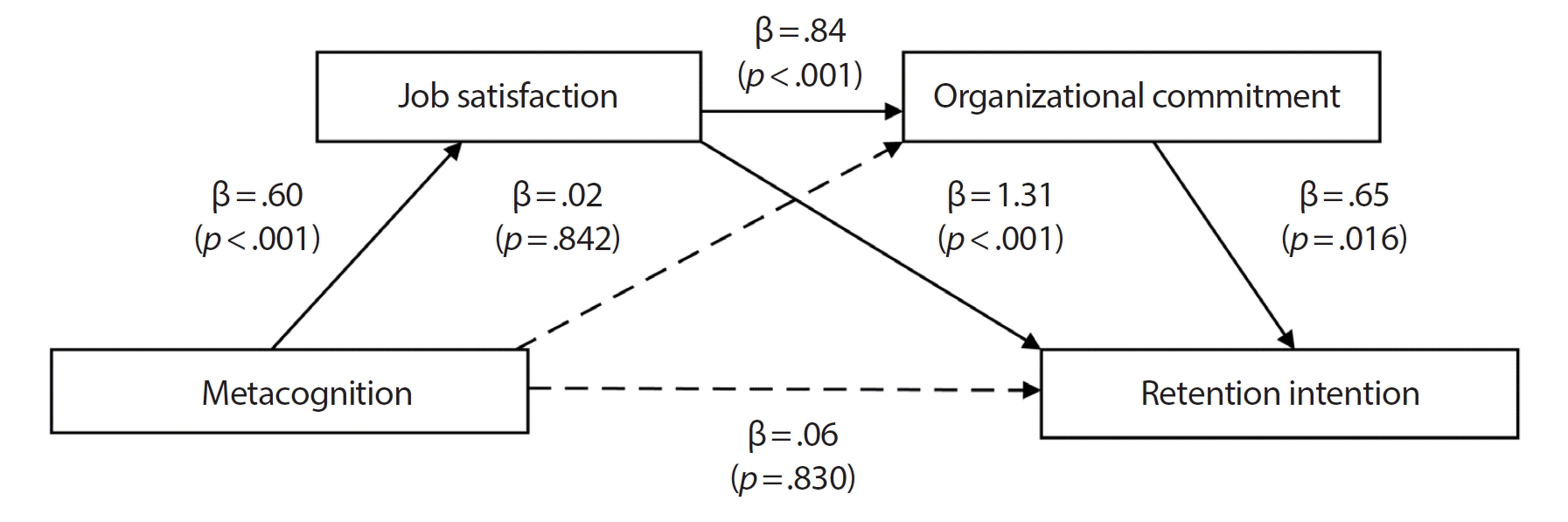
This study investigated the effect of new nurses' metacognition on their retention intention and the dual mediating effect of job satisfaction and organizational commitment in the relationship between those two variables. Methods: Participants included 154 new nurses with 12 months or less of clinical experience working in general hospitals in Seoul. Using a structured questionnaire, data were collected from September 30 to October 29, 2024 and analyzed using IBM SPSS version 29.0 and the Process Macro 4.2 program. Results: Metacognition had a positive effect on job satisfaction (B=0.60, p<.001). Job satisfaction had significant positive effects on organizational commitment (B=0.84, p<.001) and retention intention (B=1.31, p<.001), while organizational commitment had a significant positive effect on retention intention (B=0.65, p=.016). The sequential mediating effect of job satisfaction and organizational commitment was confirmed within the relationship between metacognition and retention intention in new nurses (effect=0.33, 95% confidence interval: 0.03-0.71). Conclusion: The results of this study suggest the presence of a causal structure in which higher metacognition is associated with greater job satisfaction in new nurses; this leads them to commit to the organization, eventually increasing their retention intention.
  • 871 View
  • 57 Download
Purpose
To examine the impact of reading the text of the Nightingale Pledge aloud at the beginning of the shift on nursing workplace spirituality, organizational commitment, and job satisfaction among hospital nurses.
Methods
We used a non-randomized controlled trial design. Forty-four nurses from four wards with similar work environments at M General Hospital in B City were enrolled. The data were analyzed using a x2 test, t-test, and generalized estimating equations.
Results
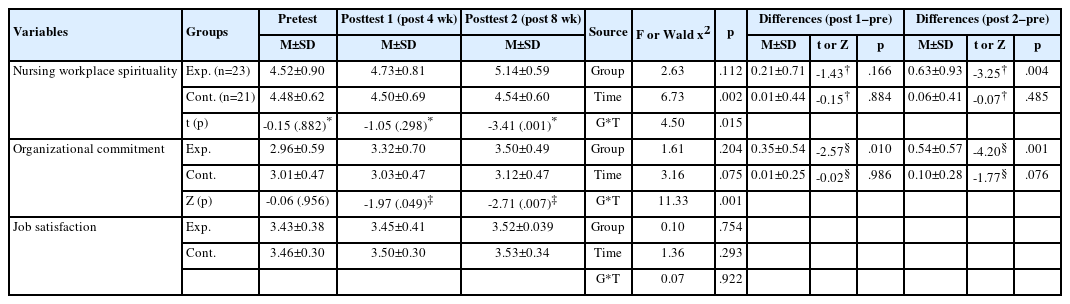
In both groups, we observed a significant group and time interaction effect for nursing workplace spirituality (Wald x2=4.50, p=.015) and organizational commitment (Wald x2=11.33, p=.001). Nursing workplace spirituality was significantly higher in the experimental group than in the control group at eight weeks after the intervention (t=-3.41, p=.001). Likewise, organizational commitment was significantly higher in the experimental group than in the control group at four and eight weeks after the intervention (Z=-1.97, p=.049; Z=-2.71, p=.007, respectively). Job satisfaction did not significantly before and after the intervention.
Conclusion
Despite the short time commitment, reading aloud the text of the Nightingale Pledge at the beginning of shift had positive effects on hospital nurses’ nursing workplace spirituality and organizational commitment.
  • 982 View
  • 36 Download
Effect of the Nursing Work Environment on Turnover Intention: Serial Mediation Effects of Career Motivation and Job Satisfaction
Young Deok Park, Sun Ju You
J Korean Acad Nurs Adm 2023;29(5):529-539.   Published online December 31, 2023
DOI: https://doi.org/10.11111/jkana.2023.29.5.529
Purpose
This study investigated whether the work environment affects nurses' turnover intention with career motivation and job satisfaction acting as mediating factors.
Methods
Data were collected from January 6-25, 2022, using a cross-sectional design. The participants were 205 nurses who had worked for more than six months at four small-to-medium-sized general hospitals in South Korea. Data analysis consisted of descriptive statistics, Pearson's correlation coefficients, independent t-tests, one-way ANOVAs, Scheffé test, and mediation analysis using Hayes’ PROCESS Macro Model 6.
Results
The nursing work environment had a significant positive association with career motivation and job satisfaction and negative effects on nurses' turnover intention. The single mediating effect of job satisfaction and the serial mediation effects of career motivation and job satisfaction on the relationship between the nursing work environment and turnover intention were significant. Thus, nurses' positive perceptions of the work environment strengthened career motivation, which in turn increased job satisfaction and reduced turnover intention.
Conclusion
Providing a healthy work environment to nurses can help reduce their turnover intention. Therefore, the government and hospitals should implement human resource strategies to improve nursing work environments and take steps to enhance career motivation and job satisfaction to strengthen nurse retention.

Citations

Citations to this article as recorded by  
  • Association Between Nurse Turnover and Nurses’ Perception of Patient Outcomes in Acute Care Hospitals in South Korea
    Sung-Heui Bae
    Journal of Nursing Care Quality.2025; 40(4): E57.     CrossRef
  • 4,831 View
  • 131 Download
  • 1 Crossref
Structural Equation Modeling of Advanced Beginner-Stage Nurses' Intention to Continue Employment
Seung-Hee Lee, Hwasoon Kim
J Korean Acad Nurs Adm 2023;29(5):517-528.   Published online December 31, 2023
DOI: https://doi.org/10.11111/jkana.2023.29.5.517
Purpose
The purpose of this study was to establish a structural model explaining the factors affecting advanced beginner-stage nurses' intention to continue employment. This model was designed to provide basic data for improving the intention to continue employment among advanced beginner-stage nurses and to efficiently manage nurses as human resources.
Methods
In order to construct a hypothetical model, latent factors affecting nurses' intention to continue employment were identified through systematic review and meta-analysis. As a result of systematic review, hypothetical model was constructed with nursing professionalism, calling, work environment, positive psychological capital, and job satisfaction. Structural equation modeling was then conducted through SPSS 25.0, AMOS 22.0, and Mplus 6.12 statistics programs.
Results
First, none of the pathways affected by nursing professionalism were statistically significant. Second, the final structural model showed fit very well based on the fit indices RMSEA=.062, SRMR=.052, RMR=.048, CFI=0.95, and TLI=0.94.
Conclusion
This study’s results identified that job satisfaction, calling, work environment, and positive psychological capital affected advanced beginner-stage nurses' intention to continue employment. Among these, job satisfaction was the most powerful variable influencing the decision to continue employment for advanced beginner-stage nurses.

Citations

Citations to this article as recorded by  
  • Retention and Associated Factors among Nurses in Small- and Medium-Sized Hospitals across South Korea
    Eun Mi Kim, Su Jung Choi, mi sug Lee, Hyun Jin Park, Jeong Yun Park
    Journal of Korean Critical Care Nursing.2025; 18(3): 16.     CrossRef
  • The Influences of Teamwork and Grit on Job Adaptation and Intention to Remain among Advanced Beginner Nurses
    Seon Kyeong Jeong, Kyoung Ja Kim, Eun Ji Choi
    Journal of Korean Academy of Nursing Administration.2024; 30(4): 379.     CrossRef
  • 1,027 View
  • 65 Download
  • 2 Crossref
Purpose
This study examined the effect of missed nursing care on nursing sensitive indicators.
Methods
A nationwide cross-sectional survey was conducted using structured questionnaires. Data of 174 clinical nurses employed in general or tertiary hospitals were collected through proportional quota sampling; the quota used was the location of a working hospital in South Korea. Data were collected through an online survey and snowball sampling from July 16 to July 20, 2022. The collected data were analyzed using IBM SPSS 26.0.
Results
Missed nursing care had statistically significant negative correlations with patient safety management activity and job satisfaction, and significant positive correlation with turnover intention. Significant correlation was not found between missed nursing care and adverse event experiences. Hierarchical multiple regression analysis revealed that missed nursing care explained an additional 21%p of patient safety management activity, 14%p of job satisfaction, and 3%p of turnover intention. Thus, missed nursing care was found to be a statistically significant predictor of patient safety management activity, job satisfaction, and turnover intention.
Conclusion
Missed nursing care significantly affects nursing sensitive indicators. To improve positive outcomes and decrease negative outcomes, nurses and nursing managers must make efforts to minimize missed nursing care.

Citations

Citations to this article as recorded by  
  • Effect of Nursing Professionalism on Turnover Intention among Nurses: The Mediating Effect of Job Embeddedness
    Ja In Kim, Seok Hee Jeong, Hyoung Eun Chang, Sunmi Kim
    Journal of Korean Academy of Nursing Administration.2025; 31(4): 446.     CrossRef
  • Effects of presenteeism on turnover intention in clinical nurses through the serial mediating roles of missed nursing care and job satisfaction: a cross-sectional predictive correlational study
    Hyeonseon Cheon, Seok Hee Jeong, Hyun Kyung Kim, Hyoung Eun Chang
    Journal of Korean Academy of Nursing.2025; 55(4): 584.     CrossRef
  • Role of Hi-Tech Call Center Employees’ ESG Activity Recognition in Increasing Corporate Performance via Organizational Identification and Job Satisfaction
    So Ra Park
    Journal of Digital Contents Society.2024; 25(2): 503.     CrossRef
  • Impact of Emotional Labor and Positive Psychological Capital on the Turnover Intention of Nurses Caring for Patients with COVID-19: A Descriptive Survey Study
    Mira Kwon, Yeoungsuk Song, Majd T. Mrayyan
    Journal of Nursing Management.2024; 2024: 1.     CrossRef
  • 1,725 View
  • 81 Download
  • 4 Crossref
Influence of Teamwork, Role Conflict, and Delegation Preparedness on Job Satisfaction among Nurses Working in Integrated Nursing Care Wards
Deokhyun Lee, Yoonju Lee, Haejung Lee, Sunyoung Jung
J Korean Acad Nurs Adm 2023;29(4):478-489.   Published online September 30, 2023
DOI: https://doi.org/10.11111/jkana.2023.29.4.478
Purpose
This study aimed to identify the factors influencing job satisfaction among nurses working in integrated nursing care wards.
Methods
The study participants were 196 nurses working in integrated nursing care wards at four general hospitals and one tertiary hospital. Data were collected using structured questionnaires from April 11 to 25, 2022, through an online survey. Data were analyzed using descriptive statistics, t-test, one-way ANOVA, Pearson correlation, and stepwise multiple regression with SPSS/WIN 26.0.
Results
The factors influencing job satisfaction of participants were team structure (β=.32, p<.001), role conflict regarding nursing practice (β=-.24, p<.001), mutual support (β=.23, p<.001), master's degree or higher(β=.16, p=.004), and spousal presence (β=.15, p=.005).
Conclusion
The findings of this study suggest that the tasks and roles of team members should be clarified, and a supportive team culture of mutual cooperation should be fostered to improve the job satisfaction of nurses working in the integrated nursing ward. In addition, it is necessary to reduce role conflict by providing support focused on allocating tasks that can strengthen the role of professional nurses.

Citations

Citations to this article as recorded by  
  • Effects of Shared Leadership and Communication Competence on Nursing Team Effectiveness in Comprehensive Nursing Service Units: Focusing on the Team Nursing System
    Hye Jin Kim, Eunjoo Lee
    Journal of Korean Academy of Nursing Administration.2025; 31(2): 143.     CrossRef
  • Influence of Job Delegation Preparedness, Individual and Organizational Communication Skills on Job Stress of Nurses in Comprehensive Nursing Care Service Wards
    Soo Jin Lee, Ji Won Kim, Nam Hee Park
    Journal of Korean Public Health Nursing.2025; 39(1): 5.     CrossRef
  • Impact of Grit, Teamwork, Organizational Communication Competence, Perception of Patient Safety Culture on Patient Safety Nursing Activities in Integrated Nursing Care Units
    Jeeseon Kim, Haejung Lee
    Journal of Korean Academy of Nursing Administration.2025; 31(3): 237.     CrossRef
  • Factors Influencing Burnout of Nurses in Comprehensive Nursing Care Service Wards: Focusing on Positive Psychological Capital, Role Conflict, and Authentic Leadership
    Jung Wha Park, Kyoung Ja Kim, Ji Young Im, Ji Young Kim
    Journal of Korean Academy of Nursing Administration.2025; 31(4): 345.     CrossRef
  • 2,312 View
  • 113 Download
  • 4 Crossref
Purpose
This study examined hospital nurses’ perception of work-life balance, nursing work environment, nursing organizational culture, and job satisfaction before turnover, and compared differences in variables between current clinical nurses and non-clinical nurses.
Methods
This descriptive study involved 172 nurses with over six months experience, who changed jobs within the last 5 years in G Province. Data were collected from September 5th-22nd, 2022, and analyzed through independent t-test, one-way ANOVA, and Pearson correlation coefficient using SPSS/WIN 25.0 program.
Results
Total work-life balance (t=3.85, p<.001), work-family balance (t=4.79, p<.001), work-leisure balance (t=2.96, p=.004), work-growth balance (t=3.01, p=.003), and overall work-life balance (t=2.95, p=.004) in work-life balance, the role of professionalism (r=2.05, p=.042) and interpersonal relationships (t=2.59, p=.011) in job satisfaction, the relationship-oriented nursing organizational culture (t=2.68, p=.008), and the nurse-doctor relationship within the nursing work environment (t=2.51, p=.013) were all significantly higher among current clinical nurses than non-clinical nurses.
Conclusion
Hospital-level interventions should be established and implemented to improve work-life balance, the relationship-oriented nursing organizational culture, and job satisfaction through interprofessional relationships to retain hospital nurses.
  • 1,292 View
  • 68 Download
Effects of Nursing Competence on Job Satisfaction across Career Stages
Eun Young Oh, Mi Won Kim, Heon Ju Yoo, Seung Hee Choi, Sa Rang Lee, Chung Sook Kim
J Korean Acad Nurs Adm 2023;29(3):258-267.   Published online June 30, 2023
DOI: https://doi.org/10.11111/jkana.2023.29.3.258
Purpose
This study examined the variations in nursing competence and job satisfaction across different career stages. Additionally, it explored the effect of nursing competence on job satisfaction within each career stages.
Methods
Participants were 468 nurses working at a university hospital in B city. Data collection was conducted using self-report questionnaires from April 1 to 15, 2020. The data were analyzed descriptive statistics, one-way ANOVA, Scheffé test, and multiple regression analysis employing SPSS 23.0.
Results
General nursing competence improved significantly after the proficiency stage. Care execution and critical thinking were improved as nurses progressed from the novice to the advanced beginner stage. Additionally, communication showed progress in the competent stage. Furthermore, responsibility and self-development were improved after the proficiency stage. Among the sub-competencies examined, self-development, care execution, and communication significantly influenced the job satisfaction of a nurse’s career. Moreover, self-development was influential at all stages.
Conclusion
This study shows that there was no substantial improvement in nursing competencies as they progressed through various career stages. Self-development was the most crucial sub-competence impacting job satisfaction, with the effects of the sub-competencies varying across career stages. These results will aid in planning clinical continuing education and formulating policies to enhance nurse competency.

Citations

Citations to this article as recorded by  
  • Shift nurses’ work quality and job satisfaction after implementing the Inha University hospital nursing AI scheduling system (IH-NASS)
    Hye Won Kang, Jiyoung Kim, Kyoung Ja Kim, Eun Kyoung Bae, Heesuk Kang, Jeong Hee Jang, Whasuk Choe
    BMC Nursing.2025;[Epub]     CrossRef
  • The Effectiveness of 360-Degree Virtual Reality-Based Mechanical Ventilation Nursing Education for ICU Nurses
    Doo Ree Kim, Jaeyong Yoo
    Healthcare.2025; 13(14): 1639.     CrossRef
  • The Influences of Teamwork and Grit on Job Adaptation and Intention to Remain among Advanced Beginner Nurses
    Seon Kyeong Jeong, Kyoung Ja Kim, Eun Ji Choi
    Journal of Korean Academy of Nursing Administration.2024; 30(4): 379.     CrossRef
  • 2,023 View
  • 148 Download
  • 3 Crossref
Effects of Positive Psychological Capital, Job Crafting and Job Satisfaction on Intention of Retention in Hospital Nurses
Eun-Ah Lee, Yeongmi Ha
J Korean Acad Nurs Adm 2022;28(5):586-595.   Published online December 31, 2022
DOI: https://doi.org/10.11111/jkana.2022.28.5.586
Purpose
This study aimed to identify the factors that affect intention of retention of hospital nurses by examining correlations between positive psychological capital, job crafting, job satisfaction and intention of retention based on the expanded Job Demand-Resources Model. Methods: A total of 198 nurses with more than 6 months of clinical experience were recruited from a university hospital. Data on positive psychological capital, job crafting, job satisfaction and intention of retention were collected from September to October 2021 using self-report questionnaires. Results: Hierarchical regression analysis demonstrated that the factors affecting hospital nurses’ intention to retain were marital status (β=.15, p=.035) in Model 1, positive psychological capital (β=.18, p=.037), and job crafting (β=.29, p=.001) in Model 2, and job satisfaction (β=.55, p<.001) explained by 35% in Model 3. Conclusion: Based on our findings, employer and nursing leaders should provide job satisfaction programs including offering career growth opportunities and building supportive nursing culture for retention among nurses.

Citations

Citations to this article as recorded by  
  • Influence of Nurses' Moral Distress and Ethical Nursing Competence on Retention Intention
    Ji-Hyun Choi, Mi-Jin Byun, Thi Ninh Do
    Journal of Korean Academy of Nursing Administration.2025; 31(1): 36.     CrossRef
  • Job crafting and employee commitment: key drivers for retaining skilled talent in digitally transformed organizations
    Richard Kofi Boateng, Salomey Ofori Appiah
    Future Business Journal.2025;[Epub]     CrossRef
  • Effect of Transition Shock on Intention to Stay in Newly Graduated Nurses : The Mediating Effect of Positive Psychological Capital
    Hyuna Kam, Chanhee Kim, Yeonok Yoon, Heeyoung Shin, Junghwa Lee, Myoungohk Kim
    Journal of Korean Critical Care Nursing.2024; 17(3): 25.     CrossRef
  • The Influence of Positive Psychological Capital, Perceived Value of Work, and Nurse Practice Environment on Retention Intention in Small-Medium Sized Hospital Nurses
    Su Hye Kwon, Miseon Bang, Young Kyoung Kim
    Journal of Korean Academy of Nursing Administration.2024; 30(3): 189.     CrossRef
  • Affecting factors of clinical dental hygienists’ intention on retention
    Hye-Jin Lee, Hee-Hong Min
    Journal of Korean Society of Dental Hygiene.2024; 24(1): 27.     CrossRef
  • Commitment to Organizational Change in Clinical Nurses: A Structural Model Applying Lewin's Change Theory
    Mihwa Hong, Sujeong Han
    Journal of Korean Academy of Fundamentals of Nursing.2024; 31(1): 38.     CrossRef
  • Influence of Job Crafting on Evidence-Based Practical Skills of Dental Hygienists
    Min-ji Kim, Kyu-ri Kim, Yun-ji Kim, Seo-yeon Im, You-bin Cho, Ru-by Choi, Hee-jung Lim
    Journal of Dental Hygiene Science.2023; 23(4): 330.     CrossRef
  • 1,427 View
  • 62 Download
  • 7 Crossref
Structural Equation Modeling of Nurses’ Experience of Workplace Incivility
So Young Won, Heejung Choi
J Korean Acad Nurs Adm 2022;28(4):342-351.   Published online September 30, 2022
DOI: https://doi.org/10.11111/jkana.2022.28.4.342
Purpose
This study was designed to construct and test a structural equation model of nurses’ experience of workplace incivility based on the model of the Affective Events Theory. Methods: A total of 299 nurses from five general hospitals responded to structured questionnaires measuring personality traits (emotionality and agreeableness), structural empowerment, workplace incivility experience, emotional exhaustion and job satisfaction. Results: The hypothetical model showed a good fit with the data: χ2 /df=1.88, GFI=.93, CFI=.95, NFI=.91, TLI=.94, SRMR=.03, RMSEA=.05. Structural empowerment had an effect on the experience of workplace incivility among nurses, but the influence of personality was not significant. Workplace incivility had significant direct effects on emotional exhaustion and job satisfaction. The experience of workplace incivility mediates the impact of structural empowerment on emotional exhaustion and job satisfaction. Conclusion: Structural empowerment in nursing unit can reduce nurses’ experience of workplace incivility and emotional exhaustion and increase their job satisfaction. At the same time, nurses’ experience of workplace incivility can increase their emotional exhaustion and decrease job satisfaction. This suggests that nurse managers should consider enhancing structural empowerment and develop programs or activities to improve it and manage workplace inciviltiy.
  • 586 View
  • 23 Download
Purpose
This study was conducted to identify the effects of nursing work environment, job crafting and organizational commitment on nurses’ job satisfaction perceived by nurses Methods: The research model was designed based on Hayes’s PROCESS macro model 6. Participants were 122 nurses from general hospitals. A survey was conducted and data were collected in March 2019. Data were analyzed using descriptive statistics, correlations and Hayes's PROCESS macro method for mediation. Results: Job satisfaction showed a significant positive correlation with the nursing work environment, job crafting and organizational commitment. Furthermore, job crafting and organizational commitment had a mediating effect on the relationship between the nursing work environment and job satisfaction. Conclusion: The impact of the nursing work environment on job satisfaction among general hospital nurses was mediated by job crafting and organizational commitment. Considering the mediating effects of job crafting and organizational commitment on the relationship between nursing work environment and job satisfaction, a strategy should be developed for enhancing job crafting and organizational commitment to improve nurses’ working environments and, thus, their job satisfaction.

Citations

Citations to this article as recorded by  
  • Effect of a Nursing Practice Environment, Nursing Performance on Retention Intention: Focused on the Mediating Effects of Nursing Professional Pride
    Shin Hee Kim, Mi Sook Oh, Yun Bok Kwak
    Journal of Korean Academy of Nursing Administration.2025; 31(1): 64.     CrossRef
  • Impact of Resilience, Emotional Exhaustion, and Communication Competency on Organizational Commitment Among Nurses in a Tertiary Hospital Setting in South Korea: A Cross-Sectional Study
    Ho Young Kim, Hee Jeong Kim, Eun Ja Yeun
    Sage Open.2025;[Epub]     CrossRef
  • The impact of grit and job crafting on organizational commitment and job satisfaction among hospital nurses in Korea
    Mi-Suk Hyun
    Medicine.2025; 104(45): e45890.     CrossRef
  • Hemşireler İçin Ekip İş Becerikliliği Ölçeğinin Türkçeye Uyarlanması
    Oya Çelebi Çakıroğlu, Gamze Tunçer Ünver, Naile Boduç
    Celal Bayar Üniversitesi Sağlık Bilimleri Enstitüsü Dergisi.2024; 11(2): 260.     CrossRef
  • Affecting factors of clinical dental hygienists’ intention on retention
    Hye-Jin Lee, Hee-Hong Min
    Journal of Korean Society of Dental Hygiene.2024; 24(1): 27.     CrossRef
  • Nurses Job Crafting
    Sabrein Mahmoud Ali Khalifa Khattab, Marwa Samir Sorour, Sally Mohammed Farghaly Abdelaliem
    JONA: The Journal of Nursing Administration.2023; 53(12): 641.     CrossRef
  • Effects of Clinical Nurses’ Job Crafting on Organizational Effectiveness Based on Job Demands-Resource Model
    Eun Young Lee, Eungyung Kim
    Journal of Korean Academy of Nursing.2023; 53(1): 129.     CrossRef
  • Effects of Job Crafting, Burnout, and Job Satisfaction on Nurses' Turnover Intention: A Path Analysis
    Mihee Chung, Sujeong Han
    Journal of Korean Academy of Fundamentals of Nursing.2023; 30(2): 281.     CrossRef
  • Concept Analysis of Nurses’ Job Crafting
    Sujeong Han, Eunha Jeong
    Journal of Korean Academy of Fundamentals of Nursing.2022; 29(3): 375.     CrossRef
  • Association of Job Crafting and Perception of Patient Safety Culture with Patient Safety Management Activities among Hospital Nurses
    Jung Sook Kim, Ji-Soo Kim
    Journal of Korean Academy of Nursing Administration.2022; 28(4): 382.     CrossRef
  • 755 View
  • 51 Download
  • 10 Crossref
Effects of Meaning of Work, Job Embeddedness, and Workplace Bullying on Turnover Intention of Nurses in a University Hospital
Young Suk Sim, Gui Sook Shim, Bong Hi Sim, Joo Hyun Sung
J Korean Acad Nurs Adm 2021;27(4):227-235.   Published online September 30, 2021
DOI: https://doi.org/10.11111/jkana.2021.27.4.227
Purpose
The purpose of this study was to explore the effect of meaning of work, job embeddedness, and workplace bullying on turnover intention in university hospital nurses. Methods: Data were collected from 126 nurses in a university hospital with more than 500 beds in C-city. Data analysis was performed using multiple linear regression with the SPSS 25.0 program. Results: Significant factors influencing the turnover intention of hospital nurses were meaning of work, job embeddedness and workplace bullying. Conclusion: Negative significant factors influencing the turnover intention of university hospital nurses were meaning of work and job embeddedness. Workplace bullying was the only positive significant factor influencing turnover intention of university hospital nurses. In order to reduce turnover intention, it is necessary to find an alternative that strengthens the meaning of work and job embeddedness and prevents the workplace bullying.

Citations

Citations to this article as recorded by  
  • The effects of communication competence, meaning of work, and work-life balance on turnover intention in Generation Z nurses in South Korea: A cross-sectional study
    Kyu-Yeon Jeong, MiRa Yun, Eun-Hi Choi
    Applied Nursing Research.2025; 83: 151952.     CrossRef
  • Effects of Role Conflict, Work Environment, and Meaning of Work on Job Embeddedness among Physician Assistants
    Kwang Hoon Seo, Tae Yeong Yang, Nam Gyu Park, Jung Eun Park
    Journal of Korean Academy of Nursing Administration.2025; 31(3): 249.     CrossRef
  • Nurses’ job embeddedness and turnover intention: A systematic review and meta-analysis
    Xin Wang, Ming Liu, Angela Y.M. Leung, Xiaoyan Jin, Hongxia Dai, Shaomei Shang
    International Journal of Nursing Sciences.2024; 11(5): 563.     CrossRef
  • Development of a Nurse Turnover Prediction Model in Korea Using Machine Learning
    Seong-Kwang Kim, Eun-Joo Kim, Hye-Kyeong Kim, Sung-Sook Song, Bit-Na Park, Kyoung-Won Jo
    Healthcare.2023; 11(11): 1583.     CrossRef
  • Impact of workplace bullying and resilience on new nurses' turnover intention in tertiary hospitals
    Gyu Li Baek, EunJu Lee
    Nursing & Health Sciences.2022; 24(4): 801.     CrossRef
  • 774 View
  • 30 Download
  • 5 Crossref
Influences of Workplace Bullying and Job Satisfaction on Happiness among Perioperative Nurses
Song I Park, Key Ha Kim
J Korean Acad Nurs Adm 2021;27(1):54-63.   Published online January 31, 2021
DOI: https://doi.org/10.11111/jkana.2021.27.1.54
Purpose
The purpose of this study was to investigate workplace bullying, job satisfaction, and happiness among perioperative nurses. Methods: Participants were 194 nurses who worked in hospitals with over 100 beds and located in G city and J Province. Data collection was conducted from May 4 to June 4, 2020. Descriptive statistics, independent t-test, one-way ANOVA, and stepwise multiple regression were used with IBM SPSS Statistics 26 program for data analysis. Results: The mean score were, for workplace bullying, 1.87, for job satisfaction, 3.50, and for happiness, 3.87. Happiness of perioperative nurses was significantly influenced by job satisfaction (β=.52, p<.001), leisure time (β=.16, p=.008), and marital status (β=.13, p=.026). Conclusion: The results show that job satisfaction of perioperative nurses is important for happiness. Therefore, there is a need to develop programs to increase job satisfaction to improve happiness in perioperative nurses.

Citations

Citations to this article as recorded by  
  • Investigating the Level of Happiness and Its Relationship with Demographic Variables in Nurses of Educational-therapeutic Centers in Ardabil in 2022
    Kimia Faridi, Mohammad Ail Mohamadi, Behrouz Dadkhah, Saeid Mehri
    Journal of Health and Care.2024; 26(4): 418.     CrossRef
  • Decent work and subjective well-being in Mexico
    Hugo Briseño, Lourdes Maisterrena, Manuel Soto-Pérez
    International Journal of Sociology and Social Policy.2024; 44(1/2): 171.     CrossRef
  • Effects of perceived spiritual management, work engagement, and organizational commitment on job satisfaction among clinical nurses: the mediating role of perceived spiritual management
    Eun-Hye Lee, Hea-Jin Yu
    BMC Nursing.2023;[Epub]     CrossRef
  • 639 View
  • 10 Download
  • 3 Crossref
Purpose
The purpose of this study was to explore the frequency of Type D Personality Pattern (TDPP) in shift work nurses who have irregular lifestyles and based on TDPP, to compare health promotion behavior (HPB), subjective health status (SHS), and job satisfaction. Methods: A descriptive cross-sectional design was used with data collected from a convenience sample of 139 shift work nurses. The self-report questionnaires included Personality Scale, Health Promoting Lifestyle Profile II, Health Self Rating Scale, and Job Satisfaction Scale. Results: Fifty three nurses (38.1%) were found to have TDPP. Although there were no significant differences between groups with TDPP and with no TDPP, nurses with TDPP tend to be younger, live alone, and have less years of clinical experience. Also, SHS, HPB and job satisfaction were significantly lower in the nurses with TDPP than those with no TDPP. SHS was positively correlated with HPB and job satisfaction. Also, job satisfaction was positively correlated with HPB. Conclusion: TDPP in shift work nurses should be considered as TDPP is not a trait but a pattern. Therefore for shift work nurses, modifiable strategies should be effective in reducing the risk of developing TDPP and enhancing the nurses’ SHS, HPB, and job satisfaction.

Citations

Citations to this article as recorded by  
  • Factors associated with clinical nurses’ preconception health behavior in Korea: a cross-sectional survey
    Yoon-Jung Park, Sun-Hee Kim
    Women's Health Nursing.2024; 30(1): 79.     CrossRef
  • Moderator role of Type D personality traits between depressive symptoms and job satisfaction among teachers
    Ayşegül Yetkin Tekin, Hekim Karadağ
    Frontiers in Public Health.2024;[Epub]     CrossRef
  • The Influence of Positive Psychological Capital, Perceived Value of Work, and Nurse Practice Environment on Retention Intention in Small-Medium Sized Hospital Nurses
    Su Hye Kwon, Miseon Bang, Young Kyoung Kim
    Journal of Korean Academy of Nursing Administration.2024; 30(3): 189.     CrossRef
  • The Moderating Role of Perceived Social Support in the Relation between Type D Personality and PTSD Symptoms among ICU and ER Nurses
    Sohyeon Kim, Myung-Ho Hyun
    STRESS.2023; 31(4): 197.     CrossRef
  • Factors Affecting Health-promoting Behavior of Nurses in Small and Medium-sized Hospitals based on the IMB Model
    Jin Hee Jeong, Hye Kyung Lee
    The Korean Journal of Rehabilitation Nursing.2022; 25(2): 102.     CrossRef
  • Influences of Type D Personality, Depression, and Stress on Quality of Life in Migraine Patients
    Eunhee Jo, Su-Jin Lee, Jung-Hwa Jo, Sun-Young Oh
    Journal of Korean Academy of Fundamentals of Nursing.2022; 29(3): 316.     CrossRef
  • 736 View
  • 31 Download
  • 6 Crossref
Purpose
The purpose of this study was to investigate the effects of head nurses’ authentic leadership, job satisfaction and organizational commitment as perceived by newly licensed nurses and to identify related factors influencing turnover intention.
Methods
A descriptive survey study was conducted with survey data collected between September 9 and 27, 2019 from 190 newly licensed nurses. The data was analyzed using statistical methods including descriptive statistics, frequency analysis, independent t-test, Pearson correlation coefficients, and multiple linear regression employing SPSS 24.0.
Results
The analysis results show that the turnover intention had positive correlations with the total work experience and work experience with a head nurse, while negative correlations were found with job satisfaction and organizational commitment. The factors affecting the dependent variable of turnover intention were analyzed as the total work experience (β=23, p=.014) and organizational commitment (β=-.68, p<.001). In addition, the explanation ability of turnover intention of newly licensed nurses was 48% (F=36.06, p<.001).
Conclusion
The results show that even after their preceptee period, there is a need for systematic long-term job-training programs to enhance the work adaptability and organizational commitment of newly licensed nurses.

Citations

Citations to this article as recorded by  
  • The Effect of Metacognition on Retention Intention in New Nurses: The Double Mediation Effect of Job Satisfaction and Organizational Commitment
    Solmi Min, Miyoung Kim
    Journal of Korean Academy of Nursing Administration.2025; 31(3): 322.     CrossRef
  • Relationships between Preferred Leadership Styles, Generational Conflict, and Organizational Commitment among Millennial and Generation Z Nurses
    So Yeon Kim, Soo-Hyun Nam, JungMin Lee
    The Korean Journal of Health Service Management.2025; 19(2): 79.     CrossRef
  • The mediating effect of job embeddedness on the nursing work environment and transition shock among new nurses: A cross-sectional study
    Siqi Zhou, Jun Ma, Sisi Fan, Honghong Wang, Wenhong An, Lu Li, Tao Xiao
    Nurse Education in Practice.2024; 78: 104034.     CrossRef
  • Relationships among basic psychological needs, organizational commitment, perceived authentic leadership and turnover intention in Korean nurses: A cross‐sectional study
    Jina Hwang, Eun Kyeung Song, Sangjin Ko
    Journal of Nursing Management.2022; 30(7): 2176.     CrossRef
  • 837 View
  • 35 Download
  • 4 Crossref
The Influence of Importance and Performance of Nursing Activities, and Professional Self-Concept on Ambulatory Care Nurses’ Job Satisfaction
Yeo Jung Kim, Haena Jang, Jeong Hee Kwon, Jin Ju Hwang
J Korean Acad Nurs Adm 2020;26(3):262-273.   Published online June 30, 2020
DOI: https://doi.org/10.11111/jkana.2020.26.3.262
Purpose
The purpose of this study was to identify factors influencing job satisfaction among ambulatory care nurses.
Methods
Data were collected through a self-evaluation survey of 129 nurses in one tertiary hospital. Data were analyzed using paired t-test, independent t-test, one-way ANOVA, Importance-Performance Analysis, Pearson correlation coefficients, and multiple regression analysis.
Results
The mean scores were: for importance, 3.18 out of 4, for performance, 2.24 out of 4, for professional self-concept, 2.92 out of 4, and for job satisfaction 2.77 out of 5. There were statistically significant positive correlations between professional self-concept and job satisfaction (r=.37, p<.001). Stepwise multiple regression analysis showed that satisfaction with professional self-concept, clinical career, and age explained 47.0% of the job satisfaction of ambulatory care nurses (F=37.51, p<.001). Satisfaction with professional self-concept, clinical career, and age were statistically significant predictors of job satisfaction.
Conclusion
Findings indicate motivation programs according to clinical career would be useful to improve job satisfaction of ambulatory care nurses. Additionally, continuous education should be provided to strengthen the professional self-concept of nursing professionals in both undergraduate curricula and clinical fields.

Citations

Citations to this article as recorded by  
  • The Patient Safety Management Activities of Hospital Nurses: An Importance and Performance Analysis
    Eunha RYOO, Hyunbong PARK, Na Yeon SHIN, Soyoung YU
    Journal of Nursing Research.2025; 33(3): e396.     CrossRef
  • Associations among Gerontological Nursing Knowledge, Attitudes Toward Ageism, and Therapeutic Communication Competency: A Cross-sectional Online Survey among Outpatient Nurses in General Hospitals
    Sunhee Kim, Heejung Kim
    Journal of Korean Academy of psychiatric and Mental Health Nursing.2025; 34(2): 164.     CrossRef
  • Patient Safety Personnel's Task analysis using Importance and Performance Analysis
    EunJung Shin, JeongYun Park
    Quality Improvement in Health Care.2024; 30(1): 44.     CrossRef
  • The Influence of Nursing Competency and Professional Self-concept of Outpatient Nurses Caring for Cancer Patients on Job Satisfaction
    Young Hwa Won, Hee Sun Lee, Kyeom Bi Kim, Jee Yoon Kim, Jeong Hye Kim
    Asian Oncology Nursing.2024; 24(4): 165.     CrossRef
  • Effects of Professional Self-concept and Nursing Organizational Culture on Intention of Retention of Middle-aged Nurses
    Jinju Kim, Yeongmi Ha
    Journal of Korean Academy of Nursing Administration.2024; 30(2): 130.     CrossRef
  • Influence of Importance and Performance of Nursing Activities and Role Conflict on Professionalism in Outpatient Nurses
    Jueun Cheon, Hye-Young Jang, Minjae Kim, Milye Jung
    Journal of Korean Academy of Nursing Administration.2024; 30(3): 235.     CrossRef
  • A Phenomenological Study on the Work Experience of Explanation Nurse
    A-Yeon Kim, Yeojin Yi
    Journal of Korean Academy of Nursing Administration.2023; 29(3): 191.     CrossRef
  • 628 View
  • 20 Download
  • 7 Crossref
Influences of Workplace Violence Experience on Job Satisfaction and Turnover Intention of New Nurses
Jung Won Im, Ji Young Lim
J Korean Acad Nurs Adm 2020;26(2):130-141.   Published online March 31, 2020
DOI: https://doi.org/10.11111/jkana.2020.26.2.130
Purpose
The purpose of this study was to identify workplace violence experience of new nurses and to investigate effects on organizational variables. Workplace violence experience can lead to new nurses developing negative attitudes towards nursing jobs. A safe organizational culture in which new nurses can work while being protected from workplace violence must be established.
Methods
An online survey was conducted with 180 nurses. Collected data were analyzed using descriptive statistics, t-test, ANOVA, Pearson correlation coefficients, and regression analysis.
Results
The total score for workplace violence experience of new nurses was 1.75±0.55. There was a statistically significant negative correlation between verbal (r=-.32, p <.001), threatening (r=-.26, p <.001), and total (r=-.28, p <.001) workplace violence experience and job satisfaction, and a positive correlation between verbal (r=.18, p =.016), threatening (r=.17, p =.024), total (r=.17, p =.021) and turnover intention, respectively. Verbal violence experience was found to be a significant factor influencing job satisfaction, and the explanatory power of the model was 9.5%.
Conclusion
Based on the results of this study, it is necessary to develop a workplace violence prevention program for new nurses and a procedure and reporting system to cope with workplace violence. Furthermore, there is a need to expand a culture of mutual cooperation and a nonviolent atmosphere.

Citations

Citations to this article as recorded by  
  • Predicting New Graduate Nurses’ Retention during Transition Using Decision Tree Methods: A Longitudinal Study
    Taewha Lee, Yea Seul Yoon, Yoonjung Ji
    Journal of Nursing Management.2024; 2024: 1.     CrossRef
  • Influences of Job Stress and Positive Psychological Capital on Turnover Intention among Novice Nurses
    Soonjeong Kwon, Moonhee Gang
    Journal of Korean Academy of Nursing Administration.2021; 27(3): 159.     CrossRef
  • Factors Influencing Re-Employment of Newly Graduated Nurses: Longitudinal Study
    Yun Kyung Oh, Eun-Young Kim
    Journal of Korean Academy of Nursing.2021; 51(2): 162.     CrossRef
  • 564 View
  • 29 Download
  • 3 Crossref
Relationship between Organizational Culture and Job Satisfaction among Korean Nurses: A Meta-Analysis
Hee Jin Chung, Sung Hee Ahn
J Korean Acad Nurs Adm 2019;25(3):157-166.   Published online June 30, 2019
DOI: https://doi.org/10.11111/jkana.2019.25.3.157
PURPOSE
This study was undertaken to understand the determinants of job satisfaction for hospital nurses in Korea. Organization culture is deemed as a strong factor which contributes to overall job satisfaction.
METHODS
A systematic review was conducted using five electronic databases to identify Korean studies for the years 1998 to 2017. The Comprehensive Meta-Analysis Software Ver 2.0 was then utilized in data analysis.
RESULTS
A meta-analysis of data from 36 studies indicated that the overall effect size of correlation between organizational culture and job satisfaction was moderate (ESr=.36), and publication year was negatively associated with these factors in the meta-regression model. In addition, the magnitude of the types of organizational culture and job satisfaction varied according to size of the hospitals: innovation-oriented culture for secondary hospitals (ESr=.49) and relation-oriented culture for tertiary hospitals (ESr=.46). Lastly, of four different organizational cultures, innovation-oriented culture showed the strongest correlation with job satisfaction (ESr=.50), followed by relation-oriented culture (ESr=.49), and task-oriented culture (ESr=.30).
CONCLUSION
Results indicate that nursing organization culture plays a significant role in Korean nurses' job satisfaction. The implication of the study is that creating an innovation-oriented and relation-oriented culture in hospitals may effectively promote nurses' job satisfaction more than hierarchy-oriented culture.

Citations

Citations to this article as recorded by  
  • Effects of social support on organizational commitment among experienced nurses experiencing department rotation: the mediating effect of organizational socialization
    Young Jun Jang, Jeong A Jeong, Yu Seung Ban, Seon Hwa Park, Eun Jee Lee
    Journal of Korean Academy of Nursing.2025; 55(3): 364.     CrossRef
  • The effectiveness of a training program on perceptions of caring culture among Turkish nurses: A quasi‐experimental trial
    Mehmet Gülşen, Adalet Kutlu
    International Nursing Review.2024; 71(1): 122.     CrossRef
  • Organizational culture: a systematic review
    Addisalem Tadesse Bogale, Kenenisa Lemi Debela
    Cogent Business & Management.2024;[Epub]     CrossRef
  • The Moderating Effect of Nursing Organizational Culture on the Relationship between Resilience and Clinical Competence of New Graduate Nurses
    Hanna Lee, Eun-Jun Park
    Journal of Korean Academy of Nursing Administration.2024; 30(5): 483.     CrossRef
  • Factors related to the organizational silence of Korean nurses: A systematic review and meta-analysis
    Kyungja Kang, Jeong-Hee Kim
    The Journal of Korean Academic Society of Nursing Education.2023; 29(3): 302.     CrossRef
  • Cross-Sectional Association and Influencing Factors of Job Satisfaction and Burnout Among Nurses in Macao
    Kinfong Leong, Pedro Fong, Chiufai Kuok, Lirong Meng
    Sage Open.2022;[Epub]     CrossRef
  • Factors Influencing Professional Quality of Life in Intensive Care Unit Nurses of University Hospitals
    Sun Jung Moon, Haena Jang
    Journal of Korean Critical Care Nursing.2022; 15(3): 23.     CrossRef
  • Research on the determinants of public employees’ quality of work life: relocation of Korean government agencies to Sejong City
    Soonae Park, Hyo Joo Lee, Sung Min Park
    International Review of Public Administration.2021; 26(4): 390.     CrossRef
  • The Influence of Importance and Performance of Nursing Activities, and Professional Self-Concept on Ambulatory Care Nurses' Job Satisfaction
    Yeo Jung Kim, Haena Jang, Jeong Hee Kwon, Jin Ju Hwang
    Journal of Korean Academy of Nursing Administration.2020; 26(3): 262.     CrossRef
  • Clinical nurses’ beliefs, knowledge, organizational readiness and level of implementation of evidence-based practice: The first step to creating an evidence-based practice culture
    Jae Yong Yoo, Jin Hee Kim, Jin Sun Kim, Hyun Lye Kim, Jung Suk Ki, Tim Schultz
    PLOS ONE.2019; 14(12): e0226742.     CrossRef
  • 1,101 View
  • 38 Download
  • 10 Crossref
Relationship of ICU Nurses' Difficulties in End-of-Life Care to Moral Distress, Burnout and Job Satisfaction
Kkot Bi Jeon, Mihyun Park
J Korean Acad Nurs Adm 2019;25(1):42-51.   Published online January 31, 2019
DOI: https://doi.org/10.11111/jkana.2019.25.1.42
PURPOSE
The aim of this study was to identify the relationships between the difficulty of end-of-life care and moral distress, burnout and job satisfaction of nurses working in intensive care units (ICUs).
METHODS
This descriptive study was conducted using self-report questionnaires. Participants were nurses who had more than one year of ICU experience and were recruited from three university hospitals (N=168).
RESULTS
The mean scores for ICU nurses' difficulty in end-of-life care, moral distress, burnout and job satisfaction were 3.42, 113.88, 3.16 and 2.58 points, respectively. Difficulty in end-of-life care was positively correlated with moral distress (r=.48, p < .001) and burnout (r=.26, p=.001) and was negatively correlated with job satisfaction (r=−.17, p=.024). Difficulties in end-of-life was identified as a predictor of moral distress (β=.44, p < .001), burnout (β=.26, p=.001) and job satisfaction (β=−.18, p=.024).
CONCLUSION
The results of this study suggest the following: it is important to have a deep understanding of ICU nurses who experience various difficulties in end-of-life care and to provide realist support for these nurses. And practical efforts by nursing organizations are needed, including support systems and education programs to alleviate ICU nurses' difficulties in end-of-life care.

Citations

Citations to this article as recorded by  
  • A Conceptual Analysis of Psychological Burnout Among Nurses Providing Terminal Care
    Sunjung Kim, Sunghee H. Tak
    Journal of Advanced Nursing.2025;[Epub]     CrossRef
  • Experiences and Well-Being of Early-Career Trauma Nurses in India: A Mixed Methods Study
    Rajesh Kumar, Antima Soni, Tarannum Ahmed, Kalpana Beniwal
    Journal of Trauma Nursing.2025; 32(4): 189.     CrossRef
  • The Impact of Difficulties in End-of-Life Care and Emotional Intelligence on Burnout among Intensive Care Unit Nurses
    Suk Hee Kim, Myoung-Ju Jo
    Journal of Korean Critical Care Nursing.2025; 18(3): 51.     CrossRef
  • Relationship between moral resilience and secondary traumatic stress among ICU nurses: A cross‐sectional study
    Mengyi Hu, Hongli Zhang, Chao Wu, Lu Li, Xinhui Liang, Yu Zhang, Hongjuan Lang
    Nursing in Critical Care.2024; 29(6): 1363.     CrossRef
  • The Relationship Between Perceived Comfort Level with Moral Sensitivity and Moral Distress Among Oncology Nurses: A Descriptive Correlational Study
    Samira Beiranvand, Kourosh Zarea, Shahram Molavynejad, Simin Madhooshi, Parisa Sheini Jaberi
    Seminars in Oncology Nursing.2024; 40(6): 151742.     CrossRef
  • Factors related to burnout of nurses working at intensive care units: A descriptive survey study
    Yeon Ju Lee, Heeok Park, Ji Hun Joung
    Journal of Korean Gerontological Nursing.2024; 26(2): 221.     CrossRef
  • The Relationship Between Nurses’ Moral Distress, Their Spiritual Well-Being, and Moral Intelligence
    Masoume Moqaddam, Nasrin Hanifi, Parvin Shiri Ghaidari
    Journal of Archives in Military Medicine.2024;[Epub]     CrossRef
  • Talking about dying and death: Essentials of communicating about approaching death from the perspective of major stakeholders
    Sibylle J. Felber, Tommaso Guffi, Beate G. Brem, Felix M. Schmitz, Kai P. Schnabel, Sissel Guttormsen Schär, Steffen Eychmüller, Sofia C. Zambrano
    Palliative and Supportive Care.2024; 22(5): 1199.     CrossRef
  • National and International Trends in Research on Moral Distress in Nursing: Text-network Analysis and Topic Modeling
    Chan-Sook PARK
    Korean Journal of Medical Ethics.2023; 26(2): 133.     CrossRef
  • Perceived Stress, Moral Distress, and Spiritual Intelligence of Clinical Nurses in the Coronavirus Disease 2019 Pandemic
    Milad Bazghaleh, Mohammad Abbasi, Elahe Bahonar, Zohreh Ghomian, Mahdi Sadeghi, Reza Norouzadeh
    Annals of Military and Health Sciences Research.2023;[Epub]     CrossRef
  • The Relationship between Clinical Competence and Ethical Reasoning and Factors Affecting it in Nurses Working in Therapeutic Educational Centers of Ilam
    Masoumeh Otaghi, Mosayeb Mozafari, Yosof Veysani, Azam Taheri
    Romanian Journal of Military Medicine.2023; 126(1): 106.     CrossRef
  • The relationship between secondary traumatic stress and burnout in critical care nurses: The mediating effect of resilience
    Yun Jeong Jeong, Sujin Shin
    Intensive and Critical Care Nursing.2023; 74: 103327.     CrossRef
  • How Do Nursing Students Perceive Moral Distress? An Interpretative Phenomenological Study
    Chiara Gandossi, Elvira Luana De Brasi, Debora Rosa, Sara Maffioli, Sara Zappa, Giulia Villa, Duilio Fiorenzo Manara
    Nursing Reports.2023; 13(1): 539.     CrossRef
  • The severity of moral distress in nurses: a systematic review and meta-analysis
    Nader Salari, Shamarina Shohaimi, Behnam Khaledi-Paveh, Mohsen Kazeminia, Mohammad-Rafi Bazrafshan, Masoud Mohammadi
    Philosophy, Ethics, and Humanities in Medicine.2022;[Epub]     CrossRef
  • The Effect of Nursing Competence on Patient-Centered Care among Nurses Caring for Patients with Chronic Disease: The Mediating Effect of Burnout and the Moderating Effect of Nursing Work Environment
    Jin-Yeong Ahn, Young Eun
    Korean Journal of Adult Nursing.2021; 33(2): 134.     CrossRef
  • Levels of Moral Distress among Health Care Professionals Working in Hospital and Community Settings: A Cross Sectional Study
    Noemi Giannetta, Rebecca Sergi, Giulia Villa, Federico Pennestrì, Roberta Sala, Roberto Mordacci, Duilio Fiorenzo Manara
    Healthcare.2021; 9(12): 1673.     CrossRef
  • End-of-Life Care Mobile App for Intensive-Care Unit Nurses: A Quasi-Experimental Study
    Jin Hee Yang, Gisoo Shin
    International Journal of Environmental Research and Public Health.2021; 18(3): 1253.     CrossRef
  • Mixed Method Research Investigating Turnover Intension with ICU Nurses
    Jung-Hoon Lee, Yeoungsuk Song
    Journal of Korean Academy of Fundamentals of Nursing.2020; 27(2): 153.     CrossRef
  • Emergency nurses’ experience of coping with moral distress
    Na Kyoung Lee, Jee-In Hwang
    The Journal of Korean Academic Society of Nursing Education.2020; 26(2): 176.     CrossRef
  • Current Status of End-of-Life Care Education in Undergraduate Nursing Curriculum
    So-Hi Kwon, Yeon-Su Cho
    The Korean Journal of Hospice and Palliative Care.2019; 22(4): 174.     CrossRef
  • 1,072 View
  • 51 Download
  • 20 Crossref
PURPOSE
The purpose of this study was to explore the effects of head nurses' authentic leadership and empowerment on job satisfaction, and nursing performance of nurses and to identify the mediating effect of empowerment in the relationships of head nurses' authentic leadership, with nurses' job satisfaction, and nursing performance.
METHODS
The sample for this study was 149 nurses from 2 general hospitals located in Busan. Data were collected using self-administered questionnaires and the SPSS/WIN 23.0 program was used for analysis. Mediation analysis was performed according to the Baron and Kenny method and Sobel test.
RESULTS
Head nurses' authentic leadership showed positive correlations with empowerment, job satisfaction, and nursing performance. Empowerment showed partial mediating effects in the relationship between head nurses' authentic leadership and nurses job satisfaction, and a perfect mediating effect in the relationship between head nurses' authentic leadership and the performance of nursing.
CONCLUSION
The results indicate that it is necessary to develop strategies and applications to enhance nurses' empowerment for improved job satisfaction and nursing performance.

Citations

Citations to this article as recorded by  
  • Impact of authentic leadership on employees’ creative work behavior: a mediated moderated model
    Waheed Ali Umrani, Noman Rafique, Yasir Kundi, Umair Ahmed, Reem Abi Abdallah
    Journal of Management Development.2025; 44(2): 138.     CrossRef
  • Authentic leadership, work-family enrichment and nurses’ life satisfaction
    Omar Faroque
    International Journal of Organizational Analysis.2025;[Epub]     CrossRef
  • Factors Influencing Burnout of Nurses in Comprehensive Nursing Care Service Wards: Focusing on Positive Psychological Capital, Role Conflict, and Authentic Leadership
    Jung Wha Park, Kyoung Ja Kim, Ji Young Im, Ji Young Kim
    Journal of Korean Academy of Nursing Administration.2025; 31(4): 345.     CrossRef
  • Latent Profile Analysis of Nurse Work Attitudes and Their Impact on Performance: A Cross-Sectional Study
    Eun Jeong Choi, Ja Yun Choi
    Korean Journal of Adult Nursing.2024; 36(3): 203.     CrossRef
  • Exploring Patient Satisfaction with Nursing Care and its Association with Gender at Tertiary Care Hospital Karachi
    Saqib ur Rashad, Afsha Bibi, Ashfaq Ahmad, Tufail Ahmed, Zakiya Arshad, Yasir Ali, Hussain Ahamd, Fazal Khaliq, Farzana Mehboob Ali
    Pakistan Journal of Health Sciences.2023; : 150.     CrossRef
  • Effect of Authentic Leadership to Organizational Citizenship Behavior of Nurses Mediated by Team Trust
    Eungju Kim, Eungyung Kim
    Journal of Korean Academy of Nursing Administration.2022; 28(4): 451.     CrossRef
  • Experience in Nursing Unit Management on First Line Nurse Managers
    Mi Young Han, Sue Kyung Sohn, Yeon Sil Cho, Ick Jee Kim, Mi Suk Kim
    Journal of Korean Academy of Nursing Administration.2021; 27(3): 138.     CrossRef
  • Authentic leadership and nurses' motivation to engage in leadership roles: The mediating effects of nurse work environment and leadership self‐efficacy
    Leodoro J. Labrague, Sulaiman Al Sabei, Omar Al Rawajfah, Raeda AbuAlRub, Ikram Burney
    Journal of Nursing Management.2021; 29(8): 2444.     CrossRef
  • Authentic leadership, nurse‐assessed adverse patient events and quality of care: The mediating role of nurses' safety actions
    Leodoro J. Labrague, Sulaiman Dawood Al Sabei, Raeda F. AbuAlRub, Ikram A. Burney, Omar Al Rawajfah
    Journal of Nursing Management.2021; 29(7): 2152.     CrossRef
  • A Meta-Analytic Path Analysis on the Outcome Variables of Nursing Unit Managers' Transformational Leadership: Systemic Review and Meta-Analysis
    Sunmi Kim, Seok Hee Jeong
    Journal of Korean Academy of Nursing.2020; 50(6): 757.     CrossRef
  • Effects of Positive Psychological Capital, Social Support and Head Nurses' Authentic Leadership on Organizational Commitment of Nurses at the Advanced Beginner Stage
    Hye Sook Kwon, Yeongmi Ha
    Journal of Korean Academy of Nursing Administration.2020; 26(3): 284.     CrossRef
  • Effects of Head Nurses' Authentic Leadership, Job Satisfaction and Organizational Commitment Perceived by Newly Licenced Nurses on Turnover Intention
    Eun Min An, Ju Young Park
    Journal of Korean Academy of Nursing Administration.2020; 26(4): 428.     CrossRef
  • 635 View
  • 35 Download
  • 12 Crossref
PURPOSE
This study was done to identify the mediating effect of person-environment fit on the relationships between calling and job satisfaction for nurses in small and medium size general hospitals.
METHODS
A cross-sectional survey was used and data were collected in April 2018. Participants were 117 nurses in two small and medium size general hospitals. Data were analyzed using descriptive statistics, Pearson correlation coefficients and hierarchical multiple regression with SPSS/WIN 22.0.
RESULTS
There were statistically significant positive correlations among calling, person-environment fit, and job satisfaction. Hierarchical multiple regression analysis revealed that calling and person-environment fit explained 35% of job satisfaction. Also, person-environment fit had a total mediating effect on the relationship between calling and job satisfaction.
CONCLUSION
Findings indicate that calling and person-environment fit are important factors for job satisfaction of nurses in small and medium size hospitals.

Citations

Citations to this article as recorded by  
  • Effects of Person-Environment Fit, Career Commitment, and Organizational Silence on Turnover Intention among Shift-Working Nurses
    Gyeong-Hee Bae, Ji-Won Kim
    The Korean Journal of Health Service Management.2025; 19(3): 43.     CrossRef
  • Structural Equation Modeling of Advanced Beginner-Stage Nurses' Intention to Continue Employment
    Seung-Hee Lee, Hwasoon Kim
    Journal of Korean Academy of Nursing Administration.2023; 29(5): 517.     CrossRef
  • Work Stressors and Their Relationship with Depression, Anxiety, Stress, and Job Satisfaction Among Nurses in Ecuador, Peru, and Paraguay
    Ana Elizabeth Rosero Solís, Yessenia Mercedes Cisneros Chávez, Isabel Genotti Sanabria, María Teresa Cabanillas-Chávez, Mardel Morales-García , Liset Z. Sairitupa-Sanchez , Wilter C. Morales-García
    Seminars in Medical Writing and Education.2023; 2: 203.     CrossRef
  • Work performance and calling as factors influencing job satisfaction among nurse midwives working in the delivery room
    Geum Ah Jung, Moon Jeong Kim
    Korean Journal of Women Health Nursing.2020; 26(1): 10.     CrossRef
  • Mediation Effects of Calling and Role Breadth Self-efficacy on the Relationship between Supportive Supervision and Job Crafting of Nurses in General Hospitals
    Sujeong Han
    Journal of Korean Academy of Nursing Administration.2020; 26(3): 251.     CrossRef
  • Mediating Effects of Self-efficacy between Calling and Nursing Professionalism for Nurses in General Hospitals
    Hyewon Kim, Sujeong Han
    Journal of Korean Academy of Nursing Administration.2019; 25(3): 220.     CrossRef
  • 421 View
  • 4 Download
  • 6 Crossref
Influence of Awareness and Perceived Ease in Using Parental Leave on Job Satisfaction of Nurses in a Public Hospital
Kyung Suk Jang, Yeo Jin Yi
J Korean Acad Nurs Adm 2018;24(3):211-220.   Published online June 30, 2018
DOI: https://doi.org/10.11111/jkana.2018.24.3.211
PURPOSE
The aim of this study was to identify whether awareness and perceived ease in using parental leave influence job satisfaction of nurses in a public hospital.
METHODS
The participants were 425 nurses working in a public hospital. A questionnaire was used to collect data from October 12 to October 25, 2016. The influence of the factors on job satisfaction of nurses was analyzed by multiple hierarchical regression.
RESULTS
Nurses taking leave accounted for 46.8% (75 nurses) of 160 married nurses. They worried about adaptation after return to work (30.7%) and complained about disadvantages related to using parental leave (45.3%). The percentage of nurses on leave replaced by new full time nurses was 70.7%. Nurses' awareness (β=.16) of perceived ease of using parental leave (β=.32) influenced the nurses' job satisfaction (R2=.21).
CONCLUSION
To improve job satisfaction for nurses, it is necessary to increase awareness and perceived ease of using parental leave. Public hospitals should replace nurses on leave with temporary nurses and help returning nurses adapt to their jobs as they return to work. Nursing managers should create a healthy climate in which it is easy for nurses to take parental leave.

Citations

Citations to this article as recorded by  
  • Work Stressors and Their Relationship with Depression, Anxiety, Stress, and Job Satisfaction Among Nurses in Ecuador, Peru, and Paraguay
    Ana Elizabeth Rosero Solís, Yessenia Mercedes Cisneros Chávez, Isabel Genotti Sanabria, María Teresa Cabanillas-Chávez, Mardel Morales-García , Liset Z. Sairitupa-Sanchez , Wilter C. Morales-García
    Seminars in Medical Writing and Education.2023; 2: 203.     CrossRef
  • A Study on the Awareness of Dental Hygienists on Maternity Protection and Work-Family Balance Assistance Policy
    Seon-Hui Kwak, Bo-Mi Shin, Soo-Myoung Bae
    Journal of Dental Hygiene Science.2023; 23(4): 396.     CrossRef
  • Do parenting stress, work-family conflict, and resilience affect retention intention in Korean nurses returning to work after parental leave?: a cross-sectional study
    Young-Eun Jung, Mi-Hae Sung
    Korean Journal of Women Health Nursing.2022; 28(1): 18.     CrossRef
  • Child‐rearing experiences of female nurses working three shifts in South Korea: A qualitative study
    Hye Jin Yoo, JaeLan Shim
    International Nursing Review.2022; 69(3): 318.     CrossRef
  • The Influence of Women Dental Hygienists’ Work–Family Balance on Happiness Level in Dental Clinics
    Ae-Jung Im, Yun-woo Kim, Su-jung Kim, Seung-yeon Kim, Eo-jin Kim, So-dam Moon, Su-min Shin, Hae-in Jeong, Hee-Ae Jeong, Hee-Jung Lim
    Journal of Dental Hygiene Science.2021; 21(3): 158.     CrossRef
  • Effects of Leader-Member Exchange of Nurses who Return to Work after Parental Leave on Conflict between Work and Family: Focus on the Mediating Effects of Job Stress
    Ji Hyun Yoon, Jung-Ha Park
    Journal of Korean Academy of Nursing Administration.2020; 26(3): 294.     CrossRef
  • Effect of Parenting Stress and Co-worker Support on Work-Life Balance in Nurses Reinstated after Parental Leave
    Yi-Rang Jeong, Taewha Lee
    Journal of Korean Academy of Nursing Administration.2020; 26(4): 331.     CrossRef
  • 530 View
  • 20 Download
  • 7 Crossref
Factor Influencing New Graduate Nurses' Turnover Intention according to Length of Service
Eun A Ji, Ji Soo Kim
J Korean Acad Nurs Adm 2018;24(1):51-60.   Published online January 31, 2018
DOI: https://doi.org/10.11111/jkana.2018.24.1.51
PURPOSE
The purpose of the study was to explore factors influencing turnover intention of new graduate nurses according to length of services.
METHODS
From May to July, 2017, a survey was conducted among 220 nurses working in four hospitals. Inclusion criteria were new graduate nurses who had careers of less than 16 months. Data were collected on organizational socialization, support in work place, job stress, and turnover intention.
RESULTS
Satisfaction with current work department, job satisfaction, organizational commitment, and job stress were significant factors influencing turnover intention of new nurses with less than six months experience. However, in case of nurses with seven to 15 months experience, only organizational commitment influenced turnover intention.
CONCLUSIONS
These findings indicate that the factors influencing turnover intention are different according to the length of time the new graduate nurses have worked. To reduce the turnover intention of new nurses, it is necessary to differentiate human resource management approaches according to length of employment. The study results could be useful evidence for developing strategies to reduce turnover in new nurses.

Citations

Citations to this article as recorded by  
  • Factors Influencing Organizational Socialization in New Nurses: A Focus on Job Stress, Resilience, and Nursing Performance
    Kyungok Park, Yeoungsuk Song
    Journal of Korean Academy of Fundamentals of Nursing.2025; 32(1): 118.     CrossRef
  • Professional Role Transition in Nursing: Leveraging Transition Theory to Mitigate the Current Human Resource Crises
    Stella Akomeng Aryeequaye, Kathryn Corneau, Judy E. Duchscher
    Healthcare.2025; 13(6): 671.     CrossRef
  • Factors affecting the turnover intention of newly graduated Generation Z nurses in Korea: multilevel analysis
    Mee Sun Lee, Sujin Shin
    Human Resources for Health.2025;[Epub]     CrossRef
  • A Study on the Perception of Job Satisfaction and Job Turnover Intention of Nurses in Busan
    Hyeon-Kyoo CHOI, Gyun HEO
    THE JOURNAL OF FISHERIES AND MARINE SCIENCES EDUCATION.2025; 37(5): 1146.     CrossRef
  • Factors Affecting the Field Adaptation of Early-Stage Nurses in South Korea
    Eunhee Hwang, Miyeong Kim, Yunkyeong Lee
    Healthcare.2024; 12(14): 1447.     CrossRef
  • Effect of Nursing Practice Environment on Intent to Leave in Hospital Nurses: Focused on the Mediating Effect of Reciprocity
    So Young Lee, Mi-Aie Lee
    Journal of Korean Academy of Nursing Administration.2024; 30(3): 201.     CrossRef
  • South Korean Nurse Residency Program for New Graduates: A Posttest Study
    Jihye Song, Kyunghee Kim, Yunjung Jang
    The Journal of Continuing Education in Nursing.2024; 55(8): 393.     CrossRef
  • Temporal Exploration of New Nurses’ Field Adaptation Using Text Network Analysis
    Shin Hye Ahn, Hye Won Jeong, Seong Gyeong Yang, Ue Seok Jung, Myoung Lee Choi, Heui Seon Kim
    Journal of Korean Academy of Nursing.2024; 54(3): 358.     CrossRef
  • A survival analysis approach to determine factors associated with non-retention of newly hired health workers in Iran
    Vahid Ghavami, Seyed Saeed Tabatabaee
    BMC Health Services Research.2023;[Epub]     CrossRef
  • Development of Competencies for New Nurses and Verification of Content Validity through a Delphi Survey
    Hanna Jung, Yoonjung Lee, Jung Yeon Kim, Minjin Lee, Soo Young Han, Yumie Rhee, Shinki An, Phill Ja Kim
    Korean Medical Education Review.2023; 25(2): 159.     CrossRef
  • Adaptation and Validation of the Readiness for Practice Instrument for Senior Undergraduate Nursing Students in China
    Zhenwei Dai, Jia Wang, Weiguang Ma, Majd T. Mrayyan
    Journal of Nursing Management.2023; 2023: 1.     CrossRef
  • Content Analysis of Feedback Journals for New Nurses From Preceptor Nurses Using Text Network Analysis
    Shin Hye Ahn, Hye Won Jeong
    CIN: Computers, Informatics, Nursing.2023; 41(10): 780.     CrossRef
  • Mediating Influences of the Exchange Relationship with a Preceptor on the Relationship between Burnout and Job Retention Intention among New Nurses in Korea
    Jihyun Kim, Yaki Yang
    Healthcare.2023; 11(18): 2575.     CrossRef
  • Factors associated with difficulty in adapting and intent to leave among new graduate nurses in South Korea
    Sun-young Park, Heejung Kim, Chenjuan Ma
    Health Care Management Review.2022; 47(2): 168.     CrossRef
  • Validity and Reliability of the Korean Version of the Holistic Nursing Competence Scale
    Kawoun Seo, Taejeong Jang, Taehui Kim
    International Journal of Environmental Research and Public Health.2022; 19(12): 7244.     CrossRef
  • Factors Associated with Job Stress among Hospital Nurses: A Meta-Correlation Analysis
    Ji-Young Lim, Geun-Myun Kim, Eun-Joo Kim
    International Journal of Environmental Research and Public Health.2022; 19(10): 5792.     CrossRef
  • The Factors That Affect Turnover Intention According to Clinical Experience: A Focus on Organizational Justice and Nursing Core Competency
    Hanna Choi, Sujin Shin
    International Journal of Environmental Research and Public Health.2022; 19(6): 3515.     CrossRef
  • The Validity and Reliability of the Korean Version of Readiness for Practice Survey for Nursing Students
    Tae Wha Lee, Yoonjung Ji, Yea Seul Yoon
    Journal of Korean Academy of Nursing.2022; 52(6): 564.     CrossRef
  • Factors Influencing Re-Employment of Newly Graduated Nurses: Longitudinal Study
    Yun Kyung Oh, Eun-Young Kim
    Journal of Korean Academy of Nursing.2021; 51(2): 162.     CrossRef
  • Influences of Job Stress and Positive Psychological Capital on Turnover Intention among Novice Nurses
    Soonjeong Kwon, Moonhee Gang
    Journal of Korean Academy of Nursing Administration.2021; 27(3): 159.     CrossRef
  • Retention Rates and the Associated Risk Factors of Turnover among Newly Hired Nurses at South Korean Hospitals: A Retrospective Cohort Study
    Yunmi Kim, Hyun-Young Kim
    International Journal of Environmental Research and Public Health.2021; 18(19): 10013.     CrossRef
  • Development and Evaluation of a Preceptor Education Program Based on the One-Minute Preceptor Model: Participatory Action Research
    Hye Won Jeong, Deok Ju, Myoung Lee Choi, Suhyun Kim
    International Journal of Environmental Research and Public Health.2021; 18(21): 11376.     CrossRef
  • Effect of Self-efficacy, Resilience, and Nursing Work Environment on Intent to Stay among Newly Graduated Nurses in General Hospitals
    Ju Na Jeon, Seung-Hee Lee
    Journal of Korean Academy of Nursing Administration.2021; 27(4): 291.     CrossRef
  • Exploring barriers and facilitators for successful transition in new graduate nurses: A mixed methods study
    Ju Hee Kim, Hye Sook Shin
    Journal of Professional Nursing.2020; 36(6): 560.     CrossRef
  • Factors Affecting New Graduate Nurses' Intention on Retention in Hospitals: Focused on Nursing Organizational Culture, Empowering Leadership and Organizational Socialization
    Eun Gyung Kim, Myun Sook Jung, Jong Kyung Kim, Sun Ju You
    Journal of Korean Academy of Nursing Administration.2020; 26(1): 31.     CrossRef
  • Relationship of Workplace Violence to Turnover Intention in Hospital Nurses: Resilience as a Mediator
    Hyun-Jung Kang, Jaeyong Shin, Eun-Hyun Lee
    Journal of Korean Academy of Nursing.2020; 50(5): 728.     CrossRef
  • Education Programs for Newly Graduated Nurses in Hospitals: A Scoping Review
    Mijung Kim, Sujin Shin, Inyoung Lee
    Korean Journal of Adult Nursing.2020; 32(5): 440.     CrossRef
  • Influence of Secondary Trauma Stress, and Vocation on Turnover Intention of Nurses in Regional Trauma Centers
    Hyun-Gwan Lee, Ji-Soo Kim
    Journal of Korean Academy of Nursing Administration.2020; 26(1): 65.     CrossRef
  • Effects of Head Nurses' Authentic Leadership, Job Satisfaction and Organizational Commitment Perceived by Newly Licenced Nurses on Turnover Intention
    Eun Min An, Ju Young Park
    Journal of Korean Academy of Nursing Administration.2020; 26(4): 428.     CrossRef
  • Effects of Job Embeddedness, Nursing Work Environment, and Nursing Professionalism on Turnover Intention in Nurses Working at Rehabilitation Hospitals
    Kyung Mi Kim, Sook Young Kim, Hyenam Hwang, Hye Min Hwang, Hyoeun Kim, Eun Sun Lim
    The Korean Journal of Rehabilitation Nursing.2019; 22(2): 134.     CrossRef
  • Survey on the Education System for New Graduate Nurses in Hospitals: Focusing on the Preceptorship
    Sujin Shin, Young Woo Park, Mijung Kim, Jeonghyun Kim, Inyoung Lee
    Korean Medical Education Review.2019; 21(2): 112.     CrossRef
  • 1,776 View
  • 53 Download
  • 31 Crossref
Policy Issues and New Direction for Comprehensive Nursing Service in the National Health Insurance
Jinhyun Kim, Sungjae Kim, Euntae Park, Suyong Jeong, Eunhee Lee
J Korean Acad Nurs Adm 2017;23(3):312-322.   Published online June 30, 2017
DOI: https://doi.org/10.11111/jkana.2017.23.3.312
PURPOSE
This study was done to identify issues surrounding comprehensive nursing care within the national health insurance, analyze results and problems within national health insurance and to suggest new policy directions for stability.
METHODS
A literature search was performed using RISS, KISS, PUBMED databases. Eighteen studies were analyzed.
RESULTS
For implementation of comprehensive nursing care, there was improvement in nursing and in facilities. By improvement of structure, this new system showed positive outcomes in term of patient satisfaction and indicators related to patient safety. However, issues related to overload, job stress and evaluation of the system remain. In order to establish this system, staffing levels for nurses and nurse aids need to be adjusted to appropriate levels that reflect requirements for nursing. In addition, range of work needs to be determined clearly. Lastly, regular and systematic evaluation is needed to provide safe quality services to patients and to prevent waste of financial resources.
CONCLUSION
Comprehensive nursing care needs to be implemented in ways that patients can be provided with safe and high quality service. There is a need to resolve several issues to allow this new system to function.

Citations

Citations to this article as recorded by  
  • The effect of job stress and self-leadership on the quality of nursing service among nurses in integrated nursing and care service wards
    Chae Won Lee, Sujin Kang, Youngji Kim
    The Journal of Korean Academic Society of Nursing Education.2025; 31(1): 28.     CrossRef
  • Nurses' Hospital Selection within a Dual Labor Market Framework: The Dilemma of Professional Identity
    Hyun-Ji Bae, Hyoung Suk Kim, Hwal Lan Bang
    Journal of Korean Academy of Nursing Administration.2025; 31(1): 14.     CrossRef
  • Effects of Shared Leadership and Communication Competence on Nursing Team Effectiveness in Comprehensive Nursing Service Units: Focusing on the Team Nursing System
    Hye Jin Kim, Eunjoo Lee
    Journal of Korean Academy of Nursing Administration.2025; 31(2): 143.     CrossRef
  • Understanding the Association Between Comprehensive Nursing Care Service Policy and Patient Outcomes
    Sung-Heui Bae
    Journal of Nursing Care Quality.2025;[Epub]     CrossRef
  • Topic Modeling of Nursing Issues in the Media During 4 Emerging Infectious Disease Epidemics in South Korea: Descriptive Analysis
    Jungok Kim, Eun Kyoung Yun
    Journal of Medical Internet Research.2025; 27: e60446.     CrossRef
  • Analysis of the relative importance of key factors in nursing workforce management for pandemic response in general hospitals and long-term care hospitals
    Jeong Eun Cha, Eun Kyoung Yun
    Journal of Korean Academy of Nursing.2025; 55(2): 236.     CrossRef
  • Experience of clinical incivility and stress in nursing students: A mixed-method study
    Youngjin Lee, Cheryl Brandt, Younglee Kim, Leona Cilar Budler
    PLOS One.2025; 20(7): e0329333.     CrossRef
  • WITHDRAWN: Nanosilver Gel, as a novel therapeutic approach, ameliorates wound healing in hand injury patients
    Qingyu Wang, Wenyao Zhong, Xingmiao Feng
    SLAS Technology.2025; : 100339.     CrossRef
  • Nurses’ Work Interruptions and Responses: Multitasking During Medication Tasks and Differences by Nursing Delivery System
    Kyung Jin Hong, Eunhee Lee, Lori M. Schirle
    Journal of Nursing Management.2025;[Epub]     CrossRef
  • Incidence and root cause analysis of near‐miss events in medical device use errors in intensive care units using Ishikawa diagram
    Su Mi Seong, Hyeop Oh, Jae Suk Park, Su Hyun Bae, Ki Chang Nam, Sung Yun Park, Bum Sun Kwon, Bo Hae Kim
    Japan Journal of Nursing Science.2025;[Epub]     CrossRef
  • A phenomenological study of the experiences of nurses working in integrated nursing care wards in Korea
    Young-mi Cho, Sun-hui Kim
    BMC Nursing.2024;[Epub]     CrossRef
  • The impact of nurse’s sense of calling, organizational commitment, job stress, and nursing work environment on patient safety management activities in comprehensive nursing care service units during the covid-19 pandemic
    YeJi Lee, Won Ju Hwang
    BMC Nursing.2024;[Epub]     CrossRef
  • Development of Guidelines for the Delegation of Nursing Tasks in Integrated Nursing Care Service
    Yeojin Yi, Haena Lim, Ji-Mee Kim, Jung-Hee Song
    Journal of Korean Academy of Nursing Administration.2024; 30(2): 114.     CrossRef
  • Influences of communication ability, organizational intimacy, and trust among colleagues on job satisfaction of nurses in comprehensive nursing care service units
    Sue Young Hahm, Minkyung Gu, Sohyune Sok
    Frontiers in Public Health.2024;[Epub]     CrossRef
  • An exploratory study of nursing tasks that induce physical and mental stress among hospital nurses
    Younhee Kang, Aekyeong Jin
    Applied Nursing Research.2024; 80: 151853.     CrossRef
  • Examining Work Engagement in Integrated Nursing‐Care Service Wards: Insights from Structural Equation Modeling
    Ok Yeon Cho, Seon-Heui Lee, Soyoung Yu, Majd Mrayyan
    Journal of Nursing Management.2024;[Epub]     CrossRef
  • Effects of Grit, Patient Safety Competence, and Patient Safety Culture on the Patient Safety Nursing Activities of Nurses in Comprehensive Nursing Service Wards
    Ji Hyun Kim, Haena Jang
    Journal of Korean Critical Care Nursing.2024; 17(3): 62.     CrossRef
  • Relationships among Nursing Skill Mix, Missed Nursing Care, and Adverse Events in Small and Medium-Sized Hospital Comprehensive Nursing Care Wards
    Yoon Sook Cho, Hyoung Eun Chang, Hyunjung Lee
    Journal of Korean Academy of Nursing Administration.2024; 30(2): 163.     CrossRef
  • Cancer Patients' and Caregivers' Experiences Admitted to Comprehensive Nursing Care Service Wards: An Exploratory Qualitative Research
    Sarah Lim, Mee Young Cho, Hyun Joo Shin, Ki Yeon Song, Soo Kyoung Shim, Yoon Jung Lee, Hea Jin Kwon, Ji Eun Kim, Hui Ean Kim, Hyun Ja Park, Han Wool An, So Jeong Hyeon, Sue Kim
    Asian Oncology Nursing.2024; 24(4): 173.     CrossRef
  • Effects of work environments on satisfaction of nurses working for integrated care system in South Korea: a multisite cross-sectional investigation
    Jinhyun Kim, Eunhee Lee, Hyunjeong Kwon, Sunmi Lee, Hayoung Choi
    BMC Nursing.2024;[Epub]     CrossRef
  • The Experience of turnover to long-term care hospital nurse: A phenomenological qualitative research
    Inhee Choo, Milim Cho, Eunha Kim
    Journal of Korean Gerontological Nursing.2024; 26(4): 392.     CrossRef
  • Analysis of Factors Affecting the Inpatient Satisfaction in Integrated Nursing Care Service Wards using a Healthcare Service Survey Database
    Young Shin Cho, Jiwon Hong
    Journal of Korean Critical Care Nursing.2024; 17(3): 76.     CrossRef
  • A Delphi Study on the Changes in Work, Organizational Culture, and Health Issues of Nurses at Tertiary Hospitals in South Korea during the COVID‐19 Pandemic
    MiRa Yun, WonJong Kim, Boas Yu, Eun-Hi Choi, Paolo C. Colet
    Journal of Nursing Management.2024;[Epub]     CrossRef
  • Factors Influencing Professional Quality of Life in Intensive Care Unit Nurses of University Hospitals
    Yu Lim Lee, Yun Mi Lee, So Eun Jang
    Journal of Korean Critical Care Nursing.2023; 16(1): 44.     CrossRef
  • Nurses’ Burden of Elimination Care: Sequential Explanatory Mixed-Methods Design
    Se Young Jung, Hui-Woun Moon, Da Som Me Park, Sumi Sung, Hyesil Jung
    International Journal of General Medicine.2023; Volume 16: 4067.     CrossRef
  • Use of the Smart Excretion Care System Linked to Electronic Medical Records to Alleviate Nursing Burden and Enhance Patient Convenience: Mixed Methods Study
    Hui-Woun Moon, Da Som Me Park, Se Young Jung
    JMIR Formative Research.2023; 7: e36324.     CrossRef
  • Association between caregiver type and catastrophic health expenditure among households using inpatient medical services: using Korean health panel
    Yu shin Park, Hyunkyu Kim, Il Yun, Eun-Cheol Park, Suk-Yong Jang
    BMC Health Services Research.2023;[Epub]     CrossRef
  • Future Outlook of Nursing Management Research: Analysis of Articles Published in the Journal of Korean Academy of Nursing Administration from 2012-2021
    Eungyung Kim, Sung-Hyun Cho, Jihyun Kim, Jong Kyung Kim, Eunhee Lee
    Journal of Korean Academy of Nursing Administration.2023; 29(5): 553.     CrossRef
  • Cancer-Oriented Comprehensive Nursing Services in Republic of Korea: Lessons from an Oncologist’s Perspective
    Suk Hun Ha, Moonho Kim, Hyojin Kim, Boram No, Ara Go, Miso Choi, Seol Lee, Yongchel Ahn
    Medicina.2023; 59(1): 144.     CrossRef
  • Comparison of Nursing Needs and Nursing Performance Perceived by Patients and Nurses in Integrated Nursing Care Service Wards in Small and Medium-Sized Hospitals: A Cross-Sectional Descriptive Study
    Hee-Sun Choi, Young Shin Cho
    Korean Journal of Adult Nursing.2023; 35(3): 234.     CrossRef
  • Development of an intentional rounding protocol for nursing undergraduates to apply in clinical practice
    Sueun Kim, Jong Sun Ok, Jin Yi Choi, Heejung Choi
    The Journal of Korean Academic Society of Nursing Education.2023; 29(4): 381.     CrossRef
  • Patient‐level and organizational‐level factors influencing in‐hospital falls
    Jinhyun Kim, Eunhee Lee, Yoomi Jung, Hyunjeong Kwon, Sunmi Lee
    Journal of Advanced Nursing.2022; 78(11): 3641.     CrossRef
  • Analysis of Nursing Task in Integrated Nursing Care Wards by Hospital Type
    Yeojin Yi, Haena Lim, Ji-Mee Kim, Jung-Hee Song
    Journal of Korean Academy of Nursing Administration.2022; 28(2): 131.     CrossRef
  • Influences of Emotional Labor and Work-Life Balance on Organizational Commitment among Nurses in Comprehensive Nursing Care Service Wards
    Young-Yi Yoon, Hye-Young Jang
    Journal of Korean Academy of Nursing Administration.2022; 28(2): 100.     CrossRef
  • Impact evaluation of nurse staffing policy reform in Korea: A quasi‐experimental study
    Jinseon Yi, Jinhyun Kim
    Journal of Nursing Management.2022; 30(7): 3457.     CrossRef
  • Factors Influencing on Performance for Infection Control of Nurses Working in Comprehensive Nursing Care Service Ward under COVID-19 Pandemic
    Mi Jin Kwon, Yeojin Yi
    Journal of Korean Academy of Nursing Administration.2022; 28(2): 121.     CrossRef
  • Validity and Reliability of the Korean Version of the Holistic Nursing Competence Scale
    Kawoun Seo, Taejeong Jang, Taehui Kim
    International Journal of Environmental Research and Public Health.2022; 19(12): 7244.     CrossRef
  • Risk factors for newly acquired pressure ulcer and the impact of nurse staffing on pressure ulcer incidence
    Jinhyun Kim, Jai‐Yon Lee, Eunhee Lee
    Journal of Nursing Management.2022;[Epub]     CrossRef
  • Factors Influencing Probability and Increase of Patients’ Call Bell Use in Integrated Nursing Care Wards
    Jiyeong Seong, Sung-Hyun Cho
    Journal of Korean Academy of Nursing Administration.2022; 28(3): 273.     CrossRef
  • The effect of the reformed nurse staffing policy on employment of nurses in Korea
    Jinhyun Kim, Sungjae Kim, Eunhee Lee, Hyunjeong Kwon, Jayon Lee, Hyunji Bae
    Nursing Open.2021; 8(5): 2850.     CrossRef
  • Nurses' Experience with Inpatients in Comprehensive Nursing Care Service: A Phenomenological Approach
    Purum Kang, Jiwon Kang
    Journal of Korean Academy of Nursing Administration.2021; 27(3): 149.     CrossRef
  • Evaluating the Correlation Between Nursing Practice and Electronic Nursing Records Using Importance-Performance Analysis
    Hyunbong Park, Soyoung Yu, Seon Heui Lee
    CIN: Computers, Informatics, Nursing.2021; 39(9): 492.     CrossRef
  • Exploring the Subjective Frame of Patient Satisfaction among Patients Admitted to the Comprehensive Nursing Care Service: Q Methodology Application
    Ye-Na Lee, Jeehyoung Kim, Geon Go, Purum Kang
    Journal of Korean Academy of Nursing Administration.2021; 27(5): 323.     CrossRef
  • A phenomenological study on the experiences of patient transfer from the intensive care unit to general wards
    Eun-Young Lee, Jin-Hee Park, Alvisa Palese
    PLOS ONE.2021; 16(7): e0254316.     CrossRef
  • The determinants of caregiver use and its costs for elderly inpatients in Korea: a study applying Andersen’s behavioral model of health care utilization and replacement cost method
    Jennifer Ivy Kim, Sukil Kim
    BMC Health Services Research.2021;[Epub]     CrossRef
  • Effects of Awareness of Patient Safety Culture, Emotional Labor and Job Stress on Patient Safety Nursing Activities by Comprehensive Nursing Care Medical Service Ward Nurses
    Hyo Jeong Choi, Yun Mi Lee, Hyo Jin Park
    Journal of Korean Critical Care Nursing.2021; 14(3): 87.     CrossRef
  • Analysis of Nurses' Work Experience in Comprehensive Nursing Care Units of Small and Medium-sized Hospitals
    Mi Ryeong Song, Su Hyang Ryu
    Journal of Korean Academy of Nursing Administration.2020; 26(4): 419.     CrossRef
  • A Comparison of Nursing Work Environment, Role Conflict, and Job Embeddedness of Nurses Working in Comprehensive Nursing Care Service Wards and General Wards in a Tertiary Hospital
    Hye-Eun So, Jee-In Hwang
    Quality Improvement in Health Care.2020; 26(1): 11.     CrossRef
  • Examining the inclusion of patients and their family members in infection prevention and control policies and guidelines across Bangladesh, Indonesia, and South Korea
    Ji Yeon Park, Jerico Franciscus Pardosi, Holly Seale
    American Journal of Infection Control.2020; 48(6): 599.     CrossRef
  • Impact of South Korea’s Comprehensive Nursing Service Policy on Nurse and Patient Outcomes
    Seon Heui Lee, Soyoung Yu, Miok Kim, Hee Sun Kim
    Healthcare.2020; 8(3): 223.     CrossRef
  • Factors Associated with the Utilization of Comprehensive Nursing Services in Hospitals among Elderly Inpatients after Surgery
    Dasom Son, Heejung Kim
    Journal of Korean Gerontological Nursing.2020; 22(4): 358.     CrossRef
  • Improvement Plan of Nurse Staffing Standards in Korea
    Sujin Shin, Jong Duck Park, Juh Hyun Shin
    Asian Nursing Research.2020; 14(2): 57.     CrossRef
  • A Comparative Study on Trust, Collaboration and Teamwork of Other Healthcare Personnel by Nurses Working on Integrated Nursing Care Service Wards versus Nurses on General Wards
    Nam Kyung Han, Taewha Lee, Jonggun Kim
    Journal of Korean Academy of Nursing Administration.2020; 26(4): 316.     CrossRef
  • Research Trends in Korea on Integrated Nursing Care Service: A Scoping Review
    Jui Kim, Hyoung Shim Choi
    Korean Journal of Adult Nursing.2020; 32(5): 455.     CrossRef
  • Influences of Perceived Patient-centered Care and Nursing Service Satisfaction on Hospital Revisit Intent among Inpatients who Received Comprehensive Nursing Service
    Young Ok Kang, Myung Sook Kim, Kyong Sook Jang
    Journal of Korean Gerontological Nursing.2020; 22(1): 45.     CrossRef
  • The Analysis of Trends in Domestic Nursing Research on Integrated Nursing Care Service
    Hyun Ju Choi
    Journal of Korean Academy of Nursing Administration.2019; 25(5): 510.     CrossRef
  • Work-related Characteristics and Sleep Quality of Nurses in Comprehensive Nursing Care Units of Small-medium Sized Hospitals
    Sujin Shin, Inyoung Lee, Jeonghyun Kim, Sung-Heui Bae
    Journal of Korean Academy of Fundamentals of Nursing.2019; 26(4): 260.     CrossRef
  • Why newly graduated nurses in South Korea leave their first job in a short time? A survival analysis
    Eunhee Lee
    Human Resources for Health.2019;[Epub]     CrossRef
  • Video Recording of Nursing Care Activities in Gerontological Nursing to Compare General Units and Comprehensive Nursing Care Units
    Sung-Heui Bae, Jeonghyun Kim, Inyoung Lee, Seung Jin Oh, Sujin Shin
    Journal of Korean Gerontological Nursing.2019; 21(3): 165.     CrossRef
  • A Comparative Study on the Job Stress, Burnout and Nursing Performance of Nurses in Comprehensive Nursing Care Service Wards and Nurses in General Wards
    Youn Sil Kim, Jung Ae Park, Eun Koung Seo
    Stress.2019; 27(1): 46.     CrossRef
  • Development of Strategic Plans for Advancing Nursing in Korea
    Eui Geum Oh, Yeonsoo Jang, Jeongok Park, Hyejung Lee, Heejung Kim, Ari Min, Suhee Kim, Yongmi Kwon
    Asian Nursing Research.2019; 13(2): 115.     CrossRef
  • Multilevel factors influencing falls of patients in hospital: The impact of nurse staffing
    Jinhyun Kim, Sungjae Kim, Jinhee Park, Eunhee Lee
    Journal of Nursing Management.2019; 27(5): 1011.     CrossRef
  • Nursing Tasks and Practice Environment for Nursing Work Perceived by Nurses Working on Comprehensive Wards versus General Wards
    Sung Hee Ahn, Sun Hee Jung, Jung Hwa You, Mi-Aie Lee
    Journal of Korean Academy of Nursing Administration.2018; 24(1): 10.     CrossRef
  • Comparison of Content Coverage of Domestic and International Inpatient Falls Prevention Guidelines Using Standard Nursing Terminologies
    Insook Cho, Jihye Kim, Jisun Chae, Miran Jung, Yeon Hee Kim
    Korean Journal of Adult Nursing.2018; 30(6): 622.     CrossRef
  • Hospitalization Experience of Patients Admitted to Nursing Care Integrated Service Wards in Small and Medium-size General Hospitals
    Hyun Ju Choi, A Leum Han, Young Mi Park, JI Hyeon Lee, Young Sook Tae
    Journal of Korean Academy of Nursing Administration.2018; 24(5): 396.     CrossRef
  • Changes in nursing professions’ scope of practice: A pilot study using electronic nursing records
    Seon Heui Lee, Soyoung Yu
    Health Policy and Technology.2018; 7(1): 15.     CrossRef
  • A Comparison of Patients' Nursing Service Satisfaction, Hospital Commitment and Revisit Intention between General Care Unit and Comprehensive Nursing Care Unit
    Yun A Jung, Kyung Mi Sung
    Journal of Korean Academy of Nursing Administration.2018; 24(1): 30.     CrossRef
  • Related Factors of Turnover Intention among Korean Hospital Nurses: A Systematic Review and Meta-Analysis
    Youngock Lee, Jiyeon Kang
    Korean Journal of Adult Nursing.2018; 30(1): 1.     CrossRef
  • Nursing, Robotics, Technological Revolution: Robotics to Support Nursing Work
    Young Ae Song, Hyun Jeong Kim, Hyun Kyong Lee
    Journal of Korean Gerontological Nursing.2018; 20(Suppl 1): 144.     CrossRef
  • A Study on the Types of Hospitals Participating and the Factors Influencing Comprehensive Nursing Service
    Ki-Sung Kim, Shin-Ho Lee, Mun-Hyung Ryu
    The Korean Journal of Health Service Management.2017; 11(4): 239.     CrossRef
  • 1,399 View
  • 50 Download
  • 70 Crossref
Relationship of Gender Role Conflict and Job Satisfaction to Turnover Intention for Men in Nursing
Ha Man Hwang, Myung Ja Kim
J Korean Acad Nurs Adm 2017;23(1):32-41.   Published online January 31, 2017
DOI: https://doi.org/10.11111/jkana.2017.23.1.32
PURPOSE
The purpose of this study was to identify the relationship between gender role conflict for men in nursing, job satisfaction, and turnover intention.
METHODS
The study data were collected between August 1 and September 1, 2015 from 225 men in nursing currently working in 36 Korean general hospitals, each with ≥100 beds. Frequency and percentages were analyzed, and Pearson correlation coefficient, t-test, ANOVA, and Duncan's test were used.
RESULTS
There was no significant difference in gender role conflict based on the general characteristics of the men. In contrast, significant differences in gender role conflict were found in association with the following job-related characteristics: work experience at the present hospital, work department, work unit, and type of work. A significant negative correlation was detected between male gender role conflict and job satisfaction, a positive correlation was found between male gender role conflict and turnover intention.
CONCLUSION
In order to increase job satisfaction and decrease the turnover intention of men in nursing, measures to reduce gender role conflict are needed.

Citations

Citations to this article as recorded by  
  • A Diversity, Equity, and Inclusion (DEI) Framework for Addressing Gender Disparities in the Nursing Profession
    Khina Sharma, Vikas Chaudhary, Jyoti Kathwal, Anoop Sharma, Shivani Bhardwaj
    Cureus.2025;[Epub]     CrossRef
  • Gender Role Conflict and Male Nursing Students' Academic and Program Success
    Peter Kellett, Chad Ellis O'Lynn, Liliana L. Herakova, Tom O'Connor
    Journal of Nursing Education.2023; 62(1): 42.     CrossRef
  • Factors influencing intention to stay of male nurses: A descriptive predictive study
    Xiaochen Lyu, Thitinut Akkadechanunt, Pratum Soivong, Phanida Juntasopeepun
    Nursing & Health Sciences.2022; 24(1): 322.     CrossRef
  • Role stressors and turnover intention among doctors in Malaysian public hospitals: work–family conflict and work engagement as mediators
    Ifrah Harun, Rosli Mahmood, Hishamuddin Md. Som
    PSU Research Review.2022; 6(1): 1.     CrossRef
  • Analysis of Male and Female Nurses’ Attitudes toward Nurse Uniforms in South Korea: The Functional, Expressive, and Aesthetic (FEA) Framework
    Seon Mi Jang, Sae Eun Lee, Jeong-Ju Yoo
    International Journal of Costume and Fashion.2021; 21(1): 25.     CrossRef
  • Factors Influencing Turnover Intention among Male Nurses in Korea
    Su Ol Kim, Sun-Hee Moon
    International Journal of Environmental Research and Public Health.2021; 18(18): 9862.     CrossRef
  • Do Gender Role Stereotypes and Patriarchal Culture Affect Nursing Students’ Major Satisfaction?
    Sunhee Cho, Sun Joo Jang
    International Journal of Environmental Research and Public Health.2021; 18(5): 2607.     CrossRef
  • Male Nurses’ Experiences of Workplace Gender Discrimination and Sexual Harassment in South Korea: A Qualitative Study
    Hyoung Eun Chang, Suyong Jeong
    Asian Nursing Research.2021; 15(5): 303.     CrossRef
  • Men's Decision-Making to Become Nurses
    Chad E. O'Lynn, Tom O'Connor, Liliana L. Herakova, Peter Kellett
    Advances in Nursing Science.2020; 43(3): 251.     CrossRef
  • Relationship among Perceived Male Friendliness Nursing Programs, Gender Role Stereotype, and Major Satisfaction in Korean Male Nursing Students
    Sunhee Cho, So-Hi Kwon, In Suk Rho
    Stress.2020; 28(4): 213.     CrossRef
  • 613 View
  • 10 Download
  • 10 Crossref
Factors Influencing Turnover Intention in Clinical Nurses: Compassion Fatigue, Coping, Social Support, and Job Satisfaction
Young Hee Yang, Jong Kyung Kim
J Korean Acad Nurs Adm 2016;22(5):562-569.   Published online December 31, 2016
DOI: https://doi.org/10.11111/jkana.2016.22.5.562
PURPOSE
This study was done to construct and verify a model of turnover intention in clinical nurses, considering the effects of compassion fatigue, coping, social support, and job satisfaction.
METHODS
For this study a cross-sectional correlational design was used. Participants were 283 clinical nurses in four general hospitals. Data were collected using a questionnaire and were analyzed with descriptive statistics, Pearson correlation coefficient and path analysis.
RESULTS
The modified model of turnover intention had a good fit in this study. Turnover intention was influenced by job satisfaction, and job satisfaction was affected by workload, problem-focused coping, peer support, family-friend support and compassion fatigue. Compassion fatigue was associated with occupational trauma events, problem-focused coping and emotional-focused coping. Job satisfaction was the most important factors controlling nurse's turnover intention.
CONCLUSION
Findings show that job satisfaction, compassion fatigue, and traumatic events are important factors influencing turnover intention. Nurse managers try to manage job satisfaction, compassion fatigue, support, and coping for nurses, it could be expected making proper nursing circumstance.

Citations

Citations to this article as recorded by  
  • Balancing the Costs of Caring: A study on Compassion Fatigue Among Mental Health Professionals
    Malini Roy, Rekha Wagani, Abdul Raffie Naik
    Journal of Psychosocial Rehabilitation and Mental Health.2025; 12(3): 429.     CrossRef
  • Development and psychometric properties of the Compassion Fatigue Assessment Scale for Indian nurses
    Shifali Sharma, Bharat Pareek, Harpreet Kaur, Priya Baby, Ramya Kundayi Ravi
    BMC Nursing.2025;[Epub]     CrossRef
  • The effect of thanatophobia and professional commitment on compassion fatigue in nurses in Türkiye: Cross sectional study
    Gönül Gökçay, Yeliz Akkuş
    HEALTH SCIENCES QUARTERLY.2024; 4(1): 41.     CrossRef
  • Mental health variables associated with job satisfaction among nurses: A systematic review and meta-analysis
    Mohammed Al Maqbali, Ciara Hughes, Eileen Hacker, Geoffrey Dickens
    International Journal of Healthcare Management.2024; : 1.     CrossRef
  • A Qualitative Study on Lived Experiences of Psychotherapists Working with Trauma
    Tanmayee Baruah, Soma Pramanik, Deepshikha Ray
    Indian Journal of Psychological Medicine.2024;[Epub]     CrossRef
  • A Demographic Research on Compassion Fatigue and Job Satisfaction Levels of Aviation Employees
    Hanifi SEVER
    Journal of Aviation.2023; 7(1): 29.     CrossRef
  • Factors influencing job satisfaction and anticipated turnover among intensive care nurses in Saudi Arabia
    Mohammed I Al Bazroun, Faiza Aljarameez, Roqaya Alhamza, Gasmelseed Y Ahmed, Fatimah Alhybah, Abbas Al Mutair
    British Journal of Healthcare Management.2023; 29(6): 1.     CrossRef
  • The Race to Retain Healthcare Workers: A Systematic Review on Factors that Impact Retention of Nurses and Physicians in Hospitals
    Neeltje de Vries, Anke Boone, Lode Godderis, José Bouman, Szymon Szemik, Domenica Matranga, Peter de Winter
    INQUIRY: The Journal of Health Care Organization, Provision, and Financing.2023;[Epub]     CrossRef
  • Impact of Teachers’ Post-Traumatic Stress Due to Violence Victimization: Moderated Mediation Effect of Living a Calling
    Yiran Li, Jeehyon Ahn, Sein Ko, Inchi Hwang, Youngseok Seo
    Behavioral Sciences.2023; 13(2): 139.     CrossRef
  • Job insecurity and psychological distress during the COVID-19 outbreak: The moderating role of perceived supervisor support among hotel employees in Malaysia
    Jeya Santhini Appannan, Logeswary Maheswaran, Nuraishah Raimee, Wan Leng Lim, Faridah Hanum Amran
    Work.2022; 73(4): 1135.     CrossRef
  • Compassion fatigue as bruises in the soul: A qualitative study on nurses
    Tove Gustafsson, Jessica Hemberg
    Nursing Ethics.2022; 29(1): 157.     CrossRef
  • Factors Influencing Nurse Intent to Leave Acute Care Hospitals
    Debi Skillman, Robin Toms
    JONA: The Journal of Nursing Administration.2022; 52(12): 640.     CrossRef
  • Effect of the COVID-19 Pandemic on Medical Student Career Perceptions: Perspectives from Medical Students in China
    Carla Zi Cai, Yulan Lin, Haridah Alias, Zhijian Hu, Li Ping Wong
    International Journal of Environmental Research and Public Health.2021; 18(10): 5071.     CrossRef
  • The Impact of the Coronavirus Disease (COVID-19) Pandemic on Nurses’ Turnover Intention: An Integrative Review
    Rawaih Falatah
    Nursing Reports.2021; 11(4): 787.     CrossRef
  • Linking nurses’ job security to job satisfaction and turnover intention during reform and privatization: A cross‐sectional survey
    Rawaih Falatah, Jamilah Almuqati, Hala Almuqati, Khaleda Altunbakti
    Journal of Nursing Management.2021; 29(6): 1578.     CrossRef
  • Work-Family Conflict of Emergency Nurses and Its Related Factors: A National Cross-Sectional Survey in China
    Yafei Wu, Xuan Zhou, Yanhong Gong, Nan Jiang, Mengge Tian, Jiali Zhang, Xiaoxv Yin, Chuanzhu Lv
    Frontiers in Public Health.2021;[Epub]     CrossRef
  • Becoming a good nurse – Socialisation of newly employed nurses into the oncological clinic
    Alexandra Pettersson, Stinne Glasdam
    Journal of Clinical Nursing.2020; 29(13-14): 2495.     CrossRef
  • Nurses’ experiences of patient safety incidents in Korea: a cross-sectional study
    Eun Young Choi, Jeehee Pyo, Won Lee, Seung Gyeong Jang, Young-Kwon Park, Minsu Ock, Sang-Il Lee
    BMJ Open.2020; 10(10): e037741.     CrossRef
  • Assessing the Presence of Post-Traumatic Stress and Turnover Intention Among Nurses Post–Middle East Respiratory Syndrome Outbreak: The Importance of Supervisor Support
    Heeja Jung, Sun Young Jung, Mi Hyang Lee, Mi Sun Kim
    Workplace Health & Safety.2020; 68(7): 337.     CrossRef
  • A comparative analysis of work–family conflict among staff, managerial, and executive nurses
    Amanda Raffenaud, Lynn Unruh, Myron Fottler, Albert Xinliang Liu, Diane Andrews
    Nursing Outlook.2020; 68(2): 231.     CrossRef
  • Factors Influencing Nurses’ Intention to Leave and Intention to Stay: An Integrative Review
    Luma Ghazi Al Zamel, Khatijah Lim Abdullah, Chong Mei Chan, Chua Yan Piaw
    Home Health Care Management & Practice.2020; 32(4): 218.     CrossRef
  • Clinical practice and work‐related burden among second career nurses: A cross‐sectional survey
    Toru Hama, Yukari Takai, Maiko Noguchi‐Watanabe, Reiko Yamahana, Ayumi Igarashi, Noriko Yamamoto‐Mitani
    Journal of Clinical Nursing.2019; 28(17-18): 3288.     CrossRef
  • Evidence-Based Practice Guideline: Nurse Retention for Nurse Managers
    Jane H-C. Tang, Pamela Hudson, Marianne Smith, Ryleigh Maas
    Journal of Gerontological Nursing.2019; 45(11): 11.     CrossRef
  • The Cost of Caring: An Exploration of Compassion Fatigue, Compassion Satisfaction, and Job Satisfaction in Pediatric Nurses
    Linda Nancy Roney, Mary C. Acri
    Journal of Pediatric Nursing.2018; 40: 74.     CrossRef
  • 1,102 View
  • 10 Download
  • 24 Crossref
PURPOSE
This study was conducted to identify the mediating effect of affective commitment on the relationship between ethical leadership and job satisfaction.
METHODS
Participants were 216 nurses drawn from three general hospitals in C city. Data were analyzed using descriptive analysis, t-test, ANOVA, Pearson correlation coefficient, and multiple regression.
RESULTS
The findings from multiple regression were as follows. First, people orientation, ethical guidance of ethical leadership factors showed significant positive effects on affective commitment. Second, people orientation, ethical guidance of ethical leadership factors showed significant positive effects on job satisfaction. Finally, when ethical leadership factors and affective commitment were entered into the regression model at the same time, ethical leadership factors showed no significant effects on job satisfaction, however, affective commitment showed a significant effect and so affective commitment had a mediating effect between ethical leadership and job satisfaction.
CONCLUSION
Results of this study indicate that affective commitment with an effect on the relationship between ethical leadership and job satisfaction plays a full mediating role. Thus, developing ethical leadership training programs for head nurses would likely increase the affective commitment and job satisfaction of staff nurses.

Citations

Citations to this article as recorded by  
  • Effect of Head Nurses' Authentic Leadership on Nurses' Job Satisfaction and Nursing Performance: Focusing on the Mediating Effects of Empowerment
    Mi-Jeong Kim, Ji-Young Han
    Journal of Korean Academy of Nursing Administration.2019; 25(1): 25.     CrossRef
  • Impact of Superior's Ethical Leadership as Perceived by Nurses on Nursing Performance: Mediating Effect of Faith in Supervisor
    Miyoung Kim, Hyung-Eun Seo, Eun-Young Doo, Won-Jin Ju
    Journal of Korean Academy of Nursing Administration.2017; 23(5): 483.     CrossRef
  • 349 View
  • 6 Download
  • 2 Crossref
Effects of Work Intensity and Physical Discomfort on Job Satisfaction in Clinical Nurses
Hyojin Kim, Soonjoo Park
J Korean Acad Nurs Adm 2016;22(4):362-372.   Published online September 30, 2016
DOI: https://doi.org/10.11111/jkana.2016.22.4.362
PURPOSE
The aim of this study was to investigate whether job satisfaction in clinical nurses was dependent on work intensity and whether physical discomfort mediated the relationships between these variables.
METHODS
Structural equation modeling was used with a sample of 253 clinical nurses from four general hospitals. In the model, absolute work intensity, relative work intensity, and flexibility were considered as exogenous variables and physical discomfort as a mediating variable. Data were collected using self-report measures such as the Labor Intensity Questionnaire, the Rating of Perceived Exertion, and the Index of Job Satisfaction.
RESULTS
The results of the structural equation modeling found that the higher scores on absolute and relative work intensity were positively associated with physical discomfort but only relative work intensity was significantly related to job satisfaction. Physical discomfort mediated the relationships between absolute work intensity and job satisfaction and between relative work intensity and job satisfaction. Among three kinds of work intensity, only relative work intensity had direct and indirect effects on job satisfaction.
CONCLUSION
The findings suggest that increase in relative work intensity might play an important role in decreasing job satisfaction in clinical nurses and a reasonable reward system considering relative work intensity could be necessary.

Citations

Citations to this article as recorded by  
  • Workload, Teamwork, Compassion Competence, and Person-centered Critical Care Nursing among Critical Care Nurses
    Hyun A Lee, Myung Sun Hyun, Jin-Hee Park, Eun Ji Seo
    Journal of Korean Critical Care Nursing.2025; 18(2): 14.     CrossRef
  • The Relationship Between Chinese Nurses' Subjective Age and Career Satisfaction: The Mediating Role of Role Breadth Self‐Efficacy
    Zhaoping Liu, Siyao Ni, Qunli Zeng, Liuyi Zhang, Xiaojing Dai, Huifang Lu, Jie Zheng, Suyu Luo
    Journal of Advanced Nursing.2025;[Epub]     CrossRef
  • Changes in Working Hours and Labor Intensity and Their Effect on Sleep Difficulties of Shift Work Nurses in Hospitals
    Ji Yun Lee, Kyung Jin Hong
    Journal of Korean Academy of Nursing Administration.2023; 29(4): 446.     CrossRef
  • Work intensity, burnout and quality of work life in the hotel industry: The moderating role of psychological detachment
    Hannah Vivian Osei, Felicity Asiedu-Appiah, Rhoda Owusu Ansah
    Journal of Human Resources in Hospitality & Tourism.2023; 22(1): 26.     CrossRef
  • Efficiency of Obstetric Services in Germany—The Role of Variation and Overheads
    Steffen Flessa
    Healthcare.2023; 12(1): 9.     CrossRef
  • The Predictive Factors of Medication Errors in Clinical Nurse
    Junekyu Kim, Yeoungsuk Song, Soon Rim Suh
    Journal of Health Informatics and Statistics.2021; 46(1): 19.     CrossRef
  • Effect of Work Intensity, Job Stress and Somatization Symptoms on Certified Care Assistants’ Burnout at Long-term Care Facilities
    Enu Hee Hwang, Kon Hee Kim
    Journal of Korean Gerontological Nursing.2021; 23(1): 24.     CrossRef
  • Factors Influencing Musculoskeletal Disorder Symptoms in Hemodialysis Nurses in Tertiary Hospitals
    Seung Mi Jang, Eun A Kim
    Journal of Korean Academy of Nursing Administration.2019; 25(5): 478.     CrossRef
  • Effects of Labor Intensity and Fatigue on Sleep Quality of Clinical Nurses
    Mi Jin Seol, Byoung Sook Lee, Soo-Kyoung Lee
    Journal of Korean Academy of Nursing Administration.2018; 24(4): 276.     CrossRef
  • The Study of Preceptor Nurses’ Occupational Stress and Burden
    Joohee Han, Eun Kwang Yoo
    Korean Journal of Stress Research.2018; 26(1): 38.     CrossRef
  • 680 View
  • 5 Download
  • 10 Crossref
Impact of Nursing Organizational Culture Types on Innovative Behavior and Job Embeddedness Perceived by Nurses
Mi Yeong Mun, Seon Young Hwang
J Korean Acad Nurs Adm 2016;22(4):313-322.   Published online September 30, 2016
DOI: https://doi.org/10.11111/jkana.2016.22.4.313
PURPOSE
The aim of this study was to determine the impact of nursing organizational culture types on innovative behavior and job embeddedness among clinical nurse.
METHODS
For this study a descriptive correlational study design was used. Participants were 293 nurses who had more than one year work experience. They were recruited from two university hospitals, one in Seoul and one in Gyeonggi province in 2016. Collected data were analyzed using SPSS/WIN 21.0 statistics program.
RESULTS
Hierarchy-oriented culture was the highest type of organizational culture perception and innovation-oriented culture, the lowest. Multiple linear regression analyses showed that, when age and total clinical experience were adjusted for, innovation-oriented culture perception was the most significant factor influencing innovative behavior, followed by task-oriented culture and relation-oriented culture in that order (R²=.33, F=24.50, p<.001). Relation-oriented culture perception was the factor most influencing job embeddedness, followed by task-oriented culture and innovation-oriented culture in that order (R²=.48, F=55.98, p<.001).
CONCLUSION
More systematic and sustained organizational efforts are required to improve the hierarchy-oriented culture highly perceived by nurses and to emphasize innovation-oriented, relation-oriented and task-oriented organizational culture to increase innovative behavior and job embeddedness among clinical nurses.

Citations

Citations to this article as recorded by  
  • Experiences of Generation Z Nurses Adapting to Work in a Tertiary Hospital: A Grounded Theory Study
    Youngji Moon, Sunhee Lee
    Journal of Advanced Nursing.2025; 81(4): 2050.     CrossRef
  • Effects of nursing professionalism and self-efficacy on job embeddedness in nurses
    Hee-jeong Kim, Dahye Park
    Heliyon.2023; 9(6): e16991.     CrossRef
  • Impact of proactive personality and leader member exchange on innovative work behavior: a job design perspective
    Marium Arslan Zuberi, Arif Khattak
    International Journal of Innovation Science.2021; 13(5): 664.     CrossRef
  • Factors related to nursing performance in South Korean intensive care units
    Chiyoung Cha, Choa Sung
    International Journal of Nursing Practice.2020;[Epub]     CrossRef
  • Effect of Nursing Organizational Culture, Organizational Health, and Job Crafting on Intent to Stay among Registered Nurses
    Hun Ha Cho, Eun-Young Kim
    Journal of Korean Academy of Nursing Administration.2020; 26(2): 172.     CrossRef
  • The Effect of Nurses’ Participatory Decision-making, Organizational Justice, Supervisory Support on Job Satisfaction: Focused on Mediating Effect of Work-Life Conflict
    Hye-Kyung Oh, Cheol-yeung Jang, Mi-suk Ko
    Journal of Health Informatics and Statistics.2020; 45(2): 124.     CrossRef
  • The Influence of Organizational Justice, Organizational Culture and Emotional Intelligence on Intention of Retention in Reemployed Nurses
    Yu Ri Jung, So Young Choi
    Journal of Korean Academy of Nursing Administration.2020; 26(5): 501.     CrossRef
  • Effects of Job Embeddedness, Nursing Work Environment, and Nursing Professionalism on Turnover Intention in Nurses Working at Rehabilitation Hospitals
    Kyung Mi Kim, Sook Young Kim, Hyenam Hwang, Hye Min Hwang, Hyoeun Kim, Eun Sun Lim
    The Korean Journal of Rehabilitation Nursing.2019; 22(2): 134.     CrossRef
  • 478 View
  • 8 Download
  • 8 Crossref
PURPOSE
This study was done to build and verify a model of clinical nurses' turnover intention using organizational characteristics, job satisfaction and job embeddedness.
METHODS
The study participants were 389 hospital nurses. SPSS and AMOS 22.0 program were used to analyze the data and the modeling of turnover intention.
RESULTS
A total of 41% of turnover intention was explained by job satisfaction, job embeddedness and organizational characteristics. Nurses with higher job satisfaction and job embeddedness showed lower turnover intention, while organizational characteristics had an indirect effect on their turnover intention. It was found that organizational characteristics had positive effects on both job satisfaction and job embeddedness, and job embeddedness played a mediating role between organizational characteristics and turnover intention.
CONCLUSION
To reduce nurses' turnover intention, hospitals' organizational characteristics should be considered. Nurse managers should strive to increase nurses' job satisfaction and job embeddedness through an understanding of the factors of organizational characteristics such as organizational fairness, nursing work environment, motivation, organizational citizenship behavior, and transformational leadership.

Citations

Citations to this article as recorded by  
  • Assesing the Dynamics of Employee Benefits for Virtual and Flexible Work Arrangements of Obapack Company Limited, Ghana
    Jacqueline Ama Nimoh Dwomoh, Oscar Agyemang Opoku, Albert Mensah, Abdul Wahah Atta Bashiru, Duah Prempeh Kelvin
    Journal of Production, Operations Management and Economics.2024; (43): 21.     CrossRef
  • The relationship between Participative Decision Making and Organizational Citizenship Behavior of nurses: Mediation Effect of Psychological Empowerment and Moderated Mediation Effect of Power Distance Orientation
    Soo Jung Kim, Hee Je Yun, Yeong Hun Park, Young Jun Lee, Jung Hwan Heo, Gi Hwan Park, Ji Won Kim, I Gyeong Jo
    Journal of Korean Academy of Nursing Administration.2023; 29(3): 268.     CrossRef
  • RETRACTED: Impact of workplace bullying and burnout on job satisfaction among Bangladeshi nurses: A cross-sectional study
    Saifur Rahman Chowdhury, Humayun Kabir, Nahida Akter, Mohammad Azmain Iktidar, Anjan Kumar Roy, Mahfuzur Rahman Chowdhury, Ahmed Hossain
    Heliyon.2023; 9(2): e13162.     CrossRef
  • Structural Equation Modeling of Advanced Beginner-Stage Nurses' Intention to Continue Employment
    Seung-Hee Lee, Hwasoon Kim
    Journal of Korean Academy of Nursing Administration.2023; 29(5): 517.     CrossRef
  • Nursing Professional Self-Concept: A Scoping Review Protocol
    Inês Franco Almeida, Rafael Alves Bernardes, Liliana Baptista Sousa, Paulo Santos-Costa, Rosa Silva, Joana Bernardo, Elaine Santana, Amorim Rosa
    Nursing Reports.2023; 13(1): 51.     CrossRef
  • Influence of Ethical Leadership of Nursing Unit Managers on Job Embeddedness of Staff Nurses: Focusing on Mediating Effect of Trust in Supervisor
    Sunmi Kim, Seohee Jeong, Seok Hee Jeong, Myung Ha Lee
    Journal of Korean Academy of Nursing Administration.2021; 27(1): 21.     CrossRef
  • Effects of organizational commitment, job satisfaction and workplace violence on turnover intention of emergency nurses: A cross‐sectional study
    Na Li, Lichuan Zhang, Guangqing Xiao, Zhuo Job Chen, Qian Lu
    International Journal of Nursing Practice.2020;[Epub]     CrossRef
  • Effects of Self-leadership, Professional Self-concept, Emotional Labor on Professional Quality of Life in Hospital Nurses
    Yu-Yeong Kyun, Mi-Aie Lee
    Journal of Korean Academy of Nursing Administration.2020; 26(5): 447.     CrossRef
  • Influence of Job Embeddedness and Resilience on Turnover Intention in Dental Hygienists
    Ji-Min Hwang, Ji-Hyoung Han
    Journal of Dental Hygiene Science.2020; 20(3): 171.     CrossRef
  • A Meta-Analytic Path Analysis on the Outcome Variables of Nursing Unit Managers' Transformational Leadership: Systemic Review and Meta-Analysis
    Sunmi Kim, Seok Hee Jeong
    Journal of Korean Academy of Nursing.2020; 50(6): 757.     CrossRef
  • The relationship between workplace violence, job satisfaction and turnover intention in emergency nurses
    Na Li, Lichuan Zhang, Guangqing Xiao, Jie Chen, Qian Lu
    International Emergency Nursing.2019; 45: 50.     CrossRef
  • Influence of Resilience and Job Embeddedness on Turnover Intention in General Hospital Nurses
    Kyoung Ja Ko, Soo-Kyoung Lee
    Journal of Korean Academy of Nursing Administration.2019; 25(4): 362.     CrossRef
  • Effects of recognition of flexible work systems, organizational commitment, and quality of life on turnover intentions of healthcare nurses
    Myoungjin Kwon, Jungsoo Han
    Technology and Health Care.2019; 27(5): 499.     CrossRef
  • Influence of Job Stress, Team Cohesion and Organizational Justice on Workplace Bullying in Clinical Nurses
    Jung-Won Kong, Yong-Sook Eo
    Journal of Korean Academy of Nursing Administration.2019; 25(5): 448.     CrossRef
  • Effects of Job Demand and Recovery Experience from Job Stress on Job Embeddedness among Workers in the Service Industry
    So Yeun Jun, Youn Hyang Lee, Eun Kyung Choi
    Journal of Korean Academy of Community Health Nursing.2018; 29(2): 143.     CrossRef
  • 608 View
  • 4 Download
  • 15 Crossref
PURPOSE
This study was performed to investigate the effect of work environment on nursing performance and the effect of job satisfaction and empowerment on nurses performance in hemodialysis units.
METHODS
Participants in this study were 206 nurses from 22 hemodialysis units in local clinics, general and university hospitals in two metropolitan areas. The work environment, nursing performance, job satisfaction and empowerment of the participants were measured using four self-report questionnaires. Data were analyzed using SPSS/WIN 18.0.
RESULTS
Nursing performance correlated significantly with work environment, job satisfaction, and empowerment in the participants. Predictability of work environment for nursing performance was 28%. Job satisfaction and empowerment showed complete mediating effects, but not moderating effects in the relationship of work environment and nursing performance in the participants.
CONCLUSION
Findings indicate that work environment is an important variable affecting nursing performance in nurses in hemodialysis units and that job satisfaction and empowerment are mediating variables in the relationship of work environment and nursing performance in nurses in hemodialysis units. Improvements in the work environment are needed to induce the high job satisfaction and empowerment that can lead to improvement of nursing performance.

Citations

Citations to this article as recorded by  
  • Deep Learning-Based Death Prediction Model for Chronic Kidney Disease
    Hyeji Kim, Hyekyung Woo
    Healthcare Informatics Research.2025; 31(4): 396.     CrossRef
  • Conceptual model of predicting employee performance through the mediating role of employee engagement and empowerment
    Imad Al Zeer, Mousa Ajouz, Mahmoud Salahat
    International Journal of Educational Management.2023; 37(5): 986.     CrossRef
  • Impact of Perceived Importance to Rehabilitation Nursing, Role Conflict, and Working Environment on Performance of Rehabilitation Nursing of Nurses in Rehabilitation Hospitals
    Ji Hye Kim, Ji Yun Lee
    The Korean Journal of Rehabilitation Nursing.2021; 24(1): 86.     CrossRef
  • Prediction Model for Nursing Work Outcome of Nurses: Focused on Positive Psychological Capital
    Soon Neum Lee, Jung A Kim
    Journal of Korean Academy of Nursing.2020; 50(1): 1.     CrossRef
  • A Meta-Analytic Path Analysis on the Outcome Variables of Nursing Unit Managers' Transformational Leadership: Systemic Review and Meta-Analysis
    Sunmi Kim, Seok Hee Jeong
    Journal of Korean Academy of Nursing.2020; 50(6): 757.     CrossRef
  • Relationship among Nursing Professionalism, Nursing Work Environment, and Patient Safety Nursing Activities in General Hospital Nurses
    Mi-Aie Lee, Sunjoo Kang, Hye Sun Hyun
    Journal of Korean Academy of Nursing Administration.2019; 25(4): 317.     CrossRef
  • Nursing Tasks and Practice Environment for Nursing Work Perceived by Nurses Working on Comprehensive Wards versus General Wards
    Sung Hee Ahn, Sun Hee Jung, Jung Hwa You, Mi-Aie Lee
    Journal of Korean Academy of Nursing Administration.2018; 24(1): 10.     CrossRef
  • Effects of Workplace Fun to Job Satisfaction and Work Engagement of Hospital Nurses
    Geum Sik Ahn, Seewon Ryu
    Journal of Health Informatics and Statistics.2017; 42(2): 144.     CrossRef
  • 453 View
  • 4 Download
  • 8 Crossref
PURPOSE
This study was designed to examine effects of sense of calling, job satisfaction and organizational commitment on retention intention in nurses who are at the advanced beginner-stage.
METHODS
Participants were 199 nurses with 13 to 36 months' clinical career at hospital located in Busan, Korea. Data were analyzed using descriptive statistics, independent t-test, one-way ANOVA, Scheffé test, Pearson correlation, and Multiple regression.
RESULTS
Retention intention correlated positively with sense of calling (r=.43, p<.001), job satisfaction (r=.31, p<.001) and organizational commitment (r=.31, p<.001). Factors affecting the participants' retention intention were found to be statistically significant (F=21.96, p<.001). Total factor score accounted for 24.1% of retention intention. Out of the related factors, the most influential factor was 'goals/meaning', belonging to the sub-areas of the sense of calling and explaining 18.2% of retention intention, followed by organizational commitment and average monthly income in that order.
CONCLUSION
The results of this study suggest a need to develop a management program that helps promote retention intention for nurses at the advanced beginner-stage by both improving their monthly income and outside conditions and, more importantly, raising their sense of calling, especially in association with the goals/meaning of their life.

Citations

Citations to this article as recorded by  
  • The Moderating Effect of Calling in the Relationship between Post-Traumatic Stress and Turnover Intention of Nurses Who Cared for COVID-19 Patients
    Min Ju Woo, Bu Kyung Park
    Journal of Korean Academy of Nursing Administration.2025; 31(1): 75.     CrossRef
  • Correlation of Beauty Shop Workers’ Work Environment, Calling and Job Embeddedness
    Ji-Hyun Ryu, Eun-Jun Park
    Journal of the Korean Society of Cosmetology.2025; 31(2): 279.     CrossRef
  • Linking workplace incivility to turnover outcomes in nursing
    Ifeyimika O. Ajaiyeoba, Matthew J. Aplin-Houtz
    Journal of Health Organization and Management.2025; 39(6): 1195.     CrossRef
  • Effects of social support on organizational commitment among experienced nurses experiencing department rotation: the mediating effect of organizational socialization
    Young Jun Jang, Jeong A Jeong, Yu Seung Ban, Seon Hwa Park, Eun Jee Lee
    Journal of Korean Academy of Nursing.2025; 55(3): 364.     CrossRef
  • The Influences of Teamwork and Grit on Job Adaptation and Intention to Remain among Advanced Beginner Nurses
    Seon Kyeong Jeong, Kyoung Ja Kim, Eun Ji Choi
    Journal of Korean Academy of Nursing Administration.2024; 30(4): 379.     CrossRef
  • ÖRGÜT KÜLTÜRÜ, YETENEK YÖNETİMİ VE İŞ TATMİNİ ARASINDAKİ İLİŞKİ
    Zeynep KIZILTAN, Yahya FİDAN
    Uluslararası İktisadi ve İdari İncelemeler Dergisi.2023; (40): 49.     CrossRef
  • Structural Equation Modeling of Advanced Beginner-Stage Nurses' Intention to Continue Employment
    Seung-Hee Lee, Hwasoon Kim
    Journal of Korean Academy of Nursing Administration.2023; 29(5): 517.     CrossRef
  • Mediating Influences of the Exchange Relationship with a Preceptor on the Relationship between Burnout and Job Retention Intention among New Nurses in Korea
    Jihyun Kim, Yaki Yang
    Healthcare.2023; 11(18): 2575.     CrossRef
  • The Moderating Effects of Self-Care on the Relationships between Perceived Stress, Job Burnout and Retention Intention in Clinical Nurses
    Seung-Hee Lee, Min-Ho Joo
    Healthcare.2023; 11(13): 1870.     CrossRef
  • Structural Model of Retention Intention of Nurses in Small- and Medium-Sized Hospitals: Based on Herzberg’s Motivation-Hygiene Theory
    Joo Yeon Lee, Mi Hyang Lee
    Healthcare.2022; 10(3): 502.     CrossRef
  • Effect of Anxiety and Calling on Professional Quality of Life in COVID-19 Dedicated Nurses in Korea
    Minjung Moon, Kyoungsan Seo
    Healthcare.2022; 10(9): 1797.     CrossRef
  • Reasons Behind Generation Z Nursing Students’ Intentions to Leave their Profession: A Cross-Sectional Study
    Jaseon Kim, Duckhee Chae, Jae Yong Yoo
    INQUIRY: The Journal of Health Care Organization, Provision, and Financing.2021;[Epub]     CrossRef
  • Influencing Factors on Performance of Person-Centered Care among Intensive Care Unit Nurses: An Ecological Perspective
    Yein Lee, Yunhee Kim
    Korean Journal of Adult Nursing.2021; 33(5): 522.     CrossRef
  • The Relationship between Calling and Posttraumatic Growth of the Air Force Pilot
    A Ram Lee, Young Woo Sohn, Jeong Hoon Seol
    Journal of the Korean Society for Aviation and Aeronautics.2021; 29(3): 1.     CrossRef
  • The Influence of Organizational Justice, Organizational Culture and Emotional Intelligence on Intention of Retention in Reemployed Nurses
    Yu Ri Jung, So Young Choi
    Journal of Korean Academy of Nursing Administration.2020; 26(5): 501.     CrossRef
  • Effects of Positive Psychological Capital, Social Support and Head Nurses' Authentic Leadership on Organizational Commitment of Nurses at the Advanced Beginner Stage
    Hye Sook Kwon, Yeongmi Ha
    Journal of Korean Academy of Nursing Administration.2020; 26(3): 284.     CrossRef
  • Influence of Secondary Trauma Stress, and Vocation on Turnover Intention of Nurses in Regional Trauma Centers
    Hyun-Gwan Lee, Ji-Soo Kim
    Journal of Korean Academy of Nursing Administration.2020; 26(1): 65.     CrossRef
  • Development of an Instrument to Assess the Nursing Professional Pride
    JaeHee Jeon, EunHee Lee, EunJoo Kim
    Journal of Korean Academy of Nursing.2020; 50(2): 228.     CrossRef
  • Factors Affecting New Graduate Nurses' Intention on Retention in Hospitals: Focused on Nursing Organizational Culture, Empowering Leadership and Organizational Socialization
    Eun Gyung Kim, Myun Sook Jung, Jong Kyung Kim, Sun Ju You
    Journal of Korean Academy of Nursing Administration.2020; 26(1): 31.     CrossRef
  • Influence of Nurse Manager and Peer Group Caring Behaviors as Perceived by Nurses on Organizational Socialization and Nursing Performance
    Na Yeon Shin, Soyoung Yu, Seong Suk Kang, Seung Shin Lee, Min Jeung Park, DaeYeon Lee, Sun Mi Nam
    Journal of Korean Academy of Nursing Administration.2020; 26(2): 110.     CrossRef
  • Prediction Model for Nursing Work Outcome of Nurses: Focused on Positive Psychological Capital
    Soon Neum Lee, Jung A Kim
    Journal of Korean Academy of Nursing.2020; 50(1): 1.     CrossRef
  • Work performance and calling as factors influencing job satisfaction among nurse midwives working in the delivery room
    Geum Ah Jung, Moon Jeong Kim
    Korean Journal of Women Health Nursing.2020; 26(1): 10.     CrossRef
  • Mediating Effects of Self-efficacy between Calling and Nursing Professionalism for Nurses in General Hospitals
    Hyewon Kim, Sujeong Han
    Journal of Korean Academy of Nursing Administration.2019; 25(3): 220.     CrossRef
  • Design of Services for Improving the Quality of Care of Hospitalized Children with Acute Diseases
    Hyun Young Koo, Kyungmin Yi, Young Eun Gu
    Child Health Nursing Research.2019; 25(4): 528.     CrossRef
  • Occupational values of nurses who succeeded their mothers in nursing
    Kyoung Ju Lee, Miyoung Kim
    Journal of Advanced Nursing.2019; 75(7): 1493.     CrossRef
  • Importance and Performance Analysis of Competency for Advanced Beginner-stage Nurses of Ward
    Inhee Hwang, Soyoung Yu
    Journal of Health Informatics and Statistics.2019; 44(3): 292.     CrossRef
  • The Effect of Perceiving a Calling on Pakistani Nurses’ Organizational Commitment, Organizational Citizenship Behavior, and Job Stress
    Bilal Afsar, Asad Shahjehan, Sadia Cheema, Farheen Javed
    Journal of Transcultural Nursing.2018; 29(6): 540.     CrossRef
  • Mediating Effect of Self-efficacy in the Relationship between Informal Learning, Shared Leadership and Organizational Socialization of Beginner · Advanced Beginner Nurses
    Nam Yi Kim, Chung Hee Woo
    Journal of Korean Academy of Nursing Administration.2018; 24(1): 1.     CrossRef
  • Mediating Effects of Person-environment Fit between Calling and Job Satisfaction of Nurses in Small and Medium Size General Hospitals
    Jaewoo Oh, Sujeong Han
    Journal of Korean Academy of Nursing Administration.2018; 24(5): 365.     CrossRef
  • Factors Influencing Korean Nurses' Intention to Stay: A Systematic Review and Meta-analysis
    Sunhee Park, Taewha Lee
    Journal of Korean Academy of Nursing Administration.2018; 24(2): 139.     CrossRef
  • Factors affecting Retention Intention of Male Nurses Working Health Care Institution in Korea
    Mi Yu, Kyung Ja Kang, Su Jeong Yu, Myungsook Park
    Journal of Korean Academy of Nursing Administration.2017; 23(3): 280.     CrossRef
  • Influence of Nurse Manager and Peer Group Caring Behaviors as Perceived by Nurses on Intention to Retention
    Moon Yeon Kong, Jeong-Hee Kim
    Journal of Korean Academy of Nursing Administration.2017; 23(2): 191.     CrossRef
  • Influences of Customer Orientation, Emotional Labor, Unit Manager-nurse Exchange and Relational Bonds on Nurses' Turnover Intension
    Young-Soon Kim, Kyung-Yeon Park
    Journal of Korean Academy of Nursing Administration.2016; 22(4): 396.     CrossRef
  • Impact of Self-leadership and Organizational Commitment on the Intention of Psychiatric Mental Health Nurses to Remain in the Profession
    Hyun Sook Park
    Journal of Korean Academy of Psychiatric and Mental Health Nursing.2016; 25(4): 409.     CrossRef
  • The Influence of Job Stress and Calling on the Organizational Commitment of Nurses: Focused on Clinical Nurses at University Hospitals in Busan
    Moon-Jeong Kim, Yu-Mi Lee
    The Korean Journal of Health Service Management.2016; 10(3): 27.     CrossRef
  • 839 View
  • 17 Download
  • 35 Crossref
PURPOSE
The purpose of this study was to identify the relationship of nurses' job performance with job embeddedness, self-leadership and social support and the role of self-leadership and social support in the relation between job embeddedness and job performance among general hospital nurses.
METHODS
The participants for this study were 244 nurses from 3 general hospitals in Seoul and Gyunggi Province. Data were analyzed using frequency, percentage, mean, standard deviation, t-test, ANOVA, Scheffe test, Pearson correlation and Hierarchical Multiple Regression.
RESULTS
Job performance showed positive correlations with job embeddedness (r=.56, p<.001), self-leadership(r=.68, p<.001), organizational support (r=.30, p<.001), supervisors' support (r=.31, p<.001) and colleagues' support (r=.31, p<.001). Job embeddedness and self-leadership had significant influence on nurses' job performance. However self-leadership and social support did not show moderating effects of job embeddedness on nurses' job performance.
CONCLUSION
These findings indicate that job embeddednes and self-leadership are important factors to enhance nurses' job performance. Therefore, promoting activities for job embeddedness and self-leadership might be a way to increase nurses' job performance. As there was no moderating effects of self-leadership and social support on job embeddedness and job performance, further studies are necessary to refine these findings in different environments.

Citations

Citations to this article as recorded by  
  • Job crafting, positive psychological capital, and social support as predictors of job embeddedness on among clinical nurses- a structural model design
    Mi-Soon Yun, Miyoung Lee, Eun-Hi Choi
    BMC Nursing.2024;[Epub]     CrossRef
  • The impact of perceived organizational justice on young nurses’ job performance: a chain mediating role of organizational climate and job embeddedness
    Jiamei Song, Xindi Shi, Xiaojia Zheng, Guangli Lu, Chaoran Chen
    BMC Nursing.2024;[Epub]     CrossRef
  • Factors Influencing Nurses’ Job Performance in Korea and Mongolia: A Cross-Sectional Study
    Zolzaya Bayarsaikhan, YunHee Shin
    Journal of Korean Academy of Fundamentals of Nursing.2023; 30(3): 404.     CrossRef
  • Impact of Job Rotation Stress on Nursing Work Performance among Clinical Nurses: Mediating Effects of Job Embeddedness and Moderated Mediating Effects of Resilience
    Jeong A Jeong, Seok Hee Jeong, Hyun Kyung Kim, Hee Sun Kim
    Journal of Korean Academy of Nursing Administration.2023; 29(5): 503.     CrossRef
  • Job Burnout Affecting Job Performance Among Teaching and Non-Teaching Personnel: Bases for Intervention
    Christian O Angus, Leslie Jeaness Luna-Angus
    American Journal of Multidisciplinary Research and Innovation .2023; 2(3): 49.     CrossRef
  • The influence of servant leadership on employees' outcomes via job embeddedness in hospitality industry
    Muhammad Qamar Zia, Muhammad Naveed, Muhammad Adnan Bashir, Asif Iqbal
    Journal of Hospitality and Tourism Insights.2022; 5(3): 612.     CrossRef
  • The influence of social support and health promotion behaviors on nursing work performance among nurses
    Eunbi Choi, Kyung Hee Yoo
    The Journal of Korean Academic Society of Nursing Education.2021; 27(3): 333.     CrossRef
  • Influence of Ethical Leadership of Nursing Unit Managers on Job Embeddedness of Staff Nurses: Focusing on Mediating Effect of Trust in Supervisor
    Sunmi Kim, Seohee Jeong, Seok Hee Jeong, Myung Ha Lee
    Journal of Korean Academy of Nursing Administration.2021; 27(1): 21.     CrossRef
  • Influence of Nurse Manager and Peer Group Caring Behaviors as Perceived by Nurses on Organizational Socialization and Nursing Performance
    Na Yeon Shin, Soyoung Yu, Seong Suk Kang, Seung Shin Lee, Min Jeung Park, DaeYeon Lee, Sun Mi Nam
    Journal of Korean Academy of Nursing Administration.2020; 26(2): 110.     CrossRef
  • The influence of psychological capital and self-leadership strategies on job embeddedness in the banking industry
    Martha Harunavamwe, Daphne Pillay, Petrus Nel
    SA Journal of Human Resource Management.2020;[Epub]     CrossRef
  • Prediction Model for Nursing Work Outcome of Nurses: Focused on Positive Psychological Capital
    Soon Neum Lee, Jung A Kim
    Journal of Korean Academy of Nursing.2020; 50(1): 1.     CrossRef
  • Effect of a Nursing Practice Environment on Nursing Job Performance and Organizational Commitment: Focused on the Mediating Effects of Job Embeddedness
    Shin Hee Kim, Sook Kyoung Park, Myung Ha Lee
    Journal of Korean Academy of Nursing Administration.2019; 25(3): 208.     CrossRef
  • Core nursing competency assessment tool for graduates of outcome‐based nursing education in South Korea: A validation study
    YuKyung Ko, Soyoung Yu
    Japan Journal of Nursing Science.2019; 16(2): 155.     CrossRef
  • The Moderating Effect of Social Support on the Relationship between Emotional Labor and Nursing Performance in General Hospital
    Hee Sug Park, Yang Gyeong Yoo
    Journal of Korean Academy of Nursing Administration.2019; 25(2): 136.     CrossRef
  • Effects of Perceived Collaboration with Nurses and Physicians on Nursing Performance in Perioperative Nurses
    Seohee Jeong, Seok Hee Jeong, Myung Ha Lee, Hyun Kyung Kim
    Journal of Korean Academy of Nursing Administration.2018; 24(3): 253.     CrossRef
  • The Influences of Emotional Intelligence, Self-leadership, and Job Embeddedness on Nursing Work Performance
    Yo-na Kim
    The Korean Journal of Health Service Management.2018; 12(2): 51.     CrossRef
  • Effects of Nurses' Social Capital and Job Engagement on Nursing Performance: Focused on the Mediating effects of Organizational Citizenship Behavior
    Mi Soon Ko, Hyunsook Zin Lee, Myung Suk Koh
    Journal of Korean Academy of Nursing Administration.2017; 23(1): 42.     CrossRef
  • Effects of Job Embeddedness and Emotional Intelligence on Performance of Nurses in Medium and Small sized Hospital
    Sung-Bok Kwon, Mee-Jeong Park, Hyeong-Mi Song, Ji-Seon Moon
    The Korean Journal of Health Service Management.2017; 11(1): 55.     CrossRef
  • Influence of teamwork skill and decision making competency on nursing work performance
    Mi Yeong Mun, Mi Yeon Kim
    Journal of the Korean Data and Information Science Society.2016; 27(5): 1361.     CrossRef
  • Effects of Workplace Spirituality and Organizational Citizenship Behavior on Nursing Performance
    Gyeong Min Noh, Myung Sook Yoo
    Journal of Korean Academy of Nursing Administration.2016; 22(3): 251.     CrossRef
  • 477 View
  • 2 Download
  • 20 Crossref
Effects of Job Characteristics, Organizational Culture on Job Satisfaction and Turnover Intention in Public Institution Nurses
Young Joo Lee, So Hee Kim, Taewha Lee
J Korean Acad Nurs Adm 2015;21(4):354-365.   Published online September 30, 2015
DOI: https://doi.org/10.11111/jkana.2015.21.4.354
PURPOSE
The aim of this study was to examine the relationship between job characteristics, organizational culture, job satisfaction and turnover intention, including the direct and indirect effects of the variables on turnover intention.
METHODS
A questionnaire was completed by a convenience sample of 144 nurses working for two public institutions. Data were analyzed using independent t-test, One-way ANOVA, Pearson correlation, Hierarchical multiple regression and Path analysis with SPSS/WIN 21.0 and AMOS 21.0 programs.
RESULTS
The mean score for job satisfaction and turnover intention was similar to that of other hospital nurses. The factors affecting job satisfaction were: position, number of job changes, relationship-oriented culture, and hierarchical-oriented culture(Adj. R2=.48, F=14.43, p<.001). The factors affecting turnover intention were: age, position, overtime, and job satisfaction(Adj. R2=.61, F=19.48, p<.001). Job autonomy and relationship-oriented culture had a significant indirect effect on turnover intention.
CONCLUSION
In developing intervention strategies to improve job satisfaction and reduce turnover intention there is a need to consider both the job characteristics and organizational culture of nurses in public institutions.

Citations

Citations to this article as recorded by  
  • Factors Influencing Clinical Nurses’ Perception of Structural and Content Career Plateau
    Ji Hye Kim, Ji Yun Lee
    Journal of Korean Academy of Nursing.2024; 54(4): 534.     CrossRef
  • Factors Affecting Political Competency of Advanced Practice Nurses
    Wooyeong Park, Taewha Lee
    Journal of Korean Academy of Nursing Administration.2023; 29(3): 246.     CrossRef
  • Impact of Nursing Organizational Culture and Nursing Practice Environment on Generational Conflict in Organization among Hospital Nurses
    Jieun Kwon, Eun-Young Kim
    Journal of Korean Academy of Nursing Administration.2023; 29(1): 45.     CrossRef
  • Effects of Job Crafting and Job Engagement on Career Management Behavior among Public Institution Nurses: Mediating Effect of Job Engagement
    Seohyun Kwon, Taewha Lee
    Journal of Korean Academy of Nursing Administration.2022; 28(3): 261.     CrossRef
  • Effects of nursing organizational culture and job stress on Korean infection control nurses’ turnover intention
    Jeong Sil Choi, Kyung Mi Kim
    American Journal of Infection Control.2020; 48(11): 1404.     CrossRef
  • Trends in Turnover Research on Korean Nurses: Based on 8 Journals Published by Member Societies under the Korean Academy of Nursing Science, 2006-2015
    Hyo Geun Geun
    The Open Nursing Journal.2019; 13(1): 92.     CrossRef
  • Impact of Nursing Organizational Culture Types on Innovative Behavior and Job Embeddedness Perceived by Nurses
    Mi Yeong Mun, Seon Young Hwang
    Journal of Korean Academy of Nursing Administration.2016; 22(4): 313.     CrossRef
  • A Structural Model of Hospital Nurses' Turnover Intention: Focusing on Organizational Characteristics, Job Satisfaction, and Job Embeddedness
    Mi Ja Yoo, Jong Kyung Kim
    Journal of Korean Academy of Nursing Administration.2016; 22(3): 292.     CrossRef
  • Convergence Study of The Effects of Nurses' Perceived Nursing Organization Culture and on Their Customer Orientation
    Min-Jeong Lee, Jin-Sook Han, Young-Mi Jang
    Journal of Digital Convergence.2015; 13(11): 303.     CrossRef
  • 644 View
  • 10 Download
  • 9 Crossref
PURPOSE
The purpose of this study was to identify the level of project perception for those nurses from research-driven hospitals and to analyze the effect of research-relevant performance in the health care field focusing on the mediated effect of research capacity and job satisfaction.
METHODS
Data were collected from June, 2014 to July, 2014, and participants were 106 research nurses in Research-driven hospitals. Descriptive statistics, Independent t-test, One-way ANOVA, structural equation modeling (SEM).
RESULTS
As a result, Research-relevant performance according to project perception of research nurses from Research-driven Hospitals was not statistically significant, but research capacity and job satisfaction had a mediating role. Evaluation System Perception was significantly different from Research Capacity (p<.001), Research Capacity was significantly different from Job Satisfaction (p<.001), Job Satisfaction was significantly different from Research Performance (p<.001) CONCLUSION: The results indicate that research capacity building and job security research nurses are able to contribute to improving research performance of research-driven hospitals.

Citations

Citations to this article as recorded by  
  • A Study of the Critical Factors on Research Capability of Research-driven Hospital
    Ki Sung Kim, Mun Hyung Ryu, Dar Oh Lim
    Journal of Health Informatics and Statistics.2016; 41(4): 428.     CrossRef
  • 318 View
  • 2 Download
  • 1 Crossref
A Study of Nursing Tasks, Nurses' Job Stress and Job Satisfaction in Hospitals with No Guardians
Min Kyung Lee, Duk Yoo Jung
J Korean Acad Nurs Adm 2015;21(3):287-296.   Published online June 30, 2015
DOI: https://doi.org/10.11111/jkana.2015.21.3.287
PURPOSE
Purpose of the study was to investigate task performance, importance, knowledge, and level of job stress and job satisfaction of nurses working in a hospital with no family or family paid auxiliary caregivers.
METHODS
Participants were 119 nurses working in hospitals with no guardians. The questionnaire contained 488 items: general characteristics, performance, importance, knowledge of nursing tasks, job stress and job satisfaction. Data were analyzed using descriptive statistics and Pearson correlation coefficients with SPSS/WIN 21.0.
RESULTS
Most frequently performed nursing tasks were patient nursing management and information management. Nursing tasks perceived as most important were medication and transfusion and nursing tasks with the highest knowledge were also medication and transfusion. Nursing task (subcategory) most frequently performed was oral medication. Nursing task (subcategory) perceived as most important was mental status observation and nursing task (subcategory) with the highest knowledge was vital sign check. Nurses' job stress was significantly associated with job satisfaction. The mean scores for nurses' job stress and job satisfaction were low.
CONCLUSION
The results indicate that nurses working in hospitals with no guardians perform daily living assistance services more often than previously, and nurses need to be prepared to do these tasks.

Citations

Citations to this article as recorded by  
  • Influence of Job Delegation Preparedness, Individual and Organizational Communication Skills on Job Stress of Nurses in Comprehensive Nursing Care Service Wards
    Soo Jin Lee, Ji Won Kim, Nam Hee Park
    Journal of Korean Public Health Nursing.2025; 39(1): 5.     CrossRef
  • Factors Associated with Intent to Leave and Burnout among Canadian Nurses Amidst the COVID-19 Pandemic: A Quantitative Analysis of the Survey on Health Care Workers’ Experiences During the Pandemic
    Kishana Balakrishnar, Bao-Zhu Stephanie Long, Alexia M. Haritos, Edris Formuli, Behdin Nowrouzi-Kia
    Canadian Journal of Nursing Research.2025; 57(3): 448.     CrossRef
  • Exploring the causes and consequences of non-nursing tasks among nurses in Jordan: An in-depth qualitative investigation
    Ayman Abed Aldarawsheh, Ahmad Rajeh Saifan, Murad Adnan Sawalha, Enas A. Assaf, Intima Alrimawi, Rami A. Elshatarat, Zyad T. Saleh, Wesam T. Almagharbeh, Nermen A. Mohamed, Mudathir M. Eltayeb
    Applied Nursing Research.2024; 77: 151791.     CrossRef
  • A phenomenological study of the experiences of nurses working in integrated nursing care wards in Korea
    Young-mi Cho, Sun-hui Kim
    BMC Nursing.2024;[Epub]     CrossRef
  • Job stress, Resilience and Geriatric Nursing Performance of Nurses in the General Hospital Comprehensive nursing care service
    Ye-Eun Shim, Moon Sook Shim
    Journal of Korean Public Health Nursing.2024; 38(1): 28.     CrossRef
  • The effect of nurses’ knowledge and self-confidence on delirium nursing performance of nurses in an integrated nursing and caring services ward: A cross-sectional descriptive study
    Ho Yeong Kim, Su Ol Kim
    Journal of Korean Gerontological Nursing.2024; 26(1): 80.     CrossRef
  • Comparison Between Comprehensive Nursing Care Ward and Private Care Ward on Functional Recovery in Stroke Patients
    Yang Rok Hur, Woo Sup Song, Kyung Min Kim, Ki Hun Hwang
    Brain & Neurorehabilitation.2022;[Epub]     CrossRef
  • Factors Influencing on Performance for Infection Control of Nurses Working in Comprehensive Nursing Care Service Ward under COVID-19 Pandemic
    Mi Jin Kwon, Yeojin Yi
    Journal of Korean Academy of Nursing Administration.2022; 28(2): 121.     CrossRef
  • Analysis of Nursing Task in Integrated Nursing Care Wards by Hospital Type
    Yeojin Yi, Haena Lim, Ji-Mee Kim, Jung-Hee Song
    Journal of Korean Academy of Nursing Administration.2022; 28(2): 131.     CrossRef
  • Nurses' perspectives of the patient care experience assessment items using importance–performance analysis
    Hyo Jin Kang, Soyoung Yu
    Journal of Nursing Management.2022; 30(7): 3247.     CrossRef
  • What does family involvement in care provision look like across hospital settings in Bangladesh, Indonesia, and South Korea?
    J. Y. Park, J. F. Pardosi, M. S. Islam, T. Respati, K. Chowdhury, H. Seale
    BMC Health Services Research.2022;[Epub]     CrossRef
  • Relationship of Stress Variables with Reduction of Job Satisfaction Level of Nurses during COVID-19 Period
    Amit Mahajan, Parul Jhajharia, Bishan Singh Nagi
    Health and Population: Perspectives and Issues.2022; 45(4): 202.     CrossRef
  • Evaluating the Correlation Between Nursing Practice and Electronic Nursing Records Using Importance-Performance Analysis
    Hyunbong Park, Soyoung Yu, Seon Heui Lee
    CIN: Computers, Informatics, Nursing.2021; 39(9): 492.     CrossRef
  • Effects of Customer Orientation, Belief of Patient Activation and Professional Self-concept on Caring Behaviors of Nurses in Comprehensive Nursing Care Units
    Ji Eun Jeon, Eun Hee Kim
    Journal of Health Informatics and Statistics.2021; 46(3): 344.     CrossRef
  • The effects of auricular acupressure on stress, anxiety, and depression of outpatient nurses in South Korea
    Se-Na Lee, Bomi Kim, Hyojung Park
    Complementary Therapies in Clinical Practice.2021; 44: 101447.     CrossRef
  • The Relationships Between Oncology Nurses’ Attitudes Toward a Dignified Death, Compassion Competence, Resilience, and Occupational Stress in South Korea
    Sun-A Park, Hee Jung Park
    Seminars in Oncology Nursing.2021; 37(3): 151147.     CrossRef
  • Empathy and Self-Efficacy in Elderly Nursing Practice among Korean Nurses
    Seyoon Kim, Hyun Jin Roh, Sohyune Sok
    International Journal of Environmental Research and Public Health.2021; 18(6): 3072.     CrossRef
  • Effects of Awareness of Patient Safety Culture, Emotional Labor and Job Stress on Patient Safety Nursing Activities by Comprehensive Nursing Care Medical Service Ward Nurses
    Hyo Jeong Choi, Yun Mi Lee, Hyo Jin Park
    Journal of Korean Critical Care Nursing.2021; 14(3): 87.     CrossRef
  • Analysis of Nurses' Work Experience in Comprehensive Nursing Care Units of Small and Medium-sized Hospitals
    Mi Ryeong Song, Su Hyang Ryu
    Journal of Korean Academy of Nursing Administration.2020; 26(4): 419.     CrossRef
  • Effect of Aggression Management Training on Perceived Stress Levels of Nurses Working in Mental Health Care Settings in Jordan
    Rami Masa'Deh, Omayma Masadeh, Samiha Jarrah, Manar AlAzzam, Fadwa Alhalaiqa
    Journal of Psychosocial Nursing and Mental Health Services.2020; 58(10): 32.     CrossRef
  • Impact of nurse staffing on intent to leave, job satisfaction, and occupational injuries in Korean hospitals: A cross‐sectional study
    Sujin Shin, Seung Jin Oh, Jeonghyun Kim, Inyoung Lee, Sung‐Heui Bae
    Nursing & Health Sciences.2020; 22(3): 658.     CrossRef
  • Impact of South Korea’s Comprehensive Nursing Service Policy on Nurse and Patient Outcomes
    Seon Heui Lee, Soyoung Yu, Miok Kim, Hee Sun Kim
    Healthcare.2020; 8(3): 223.     CrossRef
  • Examining the inclusion of patients and their family members in infection prevention and control policies and guidelines across Bangladesh, Indonesia, and South Korea
    Ji Yeon Park, Jerico Franciscus Pardosi, Holly Seale
    American Journal of Infection Control.2020; 48(6): 599.     CrossRef
  • Factors Influencing Nurses’ Job Satisfaction in Integrated Nursing and Care Services Unit: Focused on Compassion Fatigue, Compassion Satisfaction and Communication Efficacy
    Kyounghee Kim, Jongeun Lee
    The Korean Journal of Rehabilitation Nursing.2019; 22(2): 124.     CrossRef
  • Effects of Self-Efficacy and Job Stress on Organizational Commitment among Clinical Dental Hygienists
    Kyeong-Jin Lee, Young-im Kim
    Journal of Dental Hygiene Science.2019; 19(1): 60.     CrossRef
  • Students’ Observations of the Nursing Role in Seven Nations
    Sheri P. Palmer, Leslie W. Miles
    Nursing Education Perspectives.2019; 40(5): 283.     CrossRef
  • Patient safety competency and the new nursing care delivery model
    Jaeok Jin, Yeo Jin Yi
    Journal of Nursing Management.2019; 27(6): 1167.     CrossRef
  • A Comparative Study on the Job Stress, Burnout and Nursing Performance of Nurses in Comprehensive Nursing Care Service Wards and Nurses in General Wards
    Youn Sil Kim, Jung Ae Park, Eun Koung Seo
    Stress.2019; 27(1): 46.     CrossRef
  • Video Recording of Nursing Care Activities in Gerontological Nursing to Compare General Units and Comprehensive Nursing Care Units
    Sung-Heui Bae, Jeonghyun Kim, Inyoung Lee, Seung Jin Oh, Sujin Shin
    Journal of Korean Gerontological Nursing.2019; 21(3): 165.     CrossRef
  • Hospitalization Experience of Patients Admitted to Nursing Care Integrated Service Wards in Small and Medium-size General Hospitals
    Hyun Ju Choi, A Leum Han, Young Mi Park, JI Hyeon Lee, Young Sook Tae
    Journal of Korean Academy of Nursing Administration.2018; 24(5): 396.     CrossRef
  • Nurses’ needs for care robots in integrated nursing care services
    Jai‐Yon Lee, Young Ae Song, Ji Young Jung, Hyun Jeong Kim, Bo Ram Kim, Hyun‐Kyung Do, Jae‐Young Lim
    Journal of Advanced Nursing.2018; 74(9): 2094.     CrossRef
  • Adequacy of Nurse Staffing Level in Integrated Nursing Care
    Jinhyun Kim, Sungjae Kim, Jinhee Park, Euntae Park, Suyong Jeong, Eunhee Lee
    Journal of Korean Academy of Nursing Administration.2018; 24(4): 288.     CrossRef
  • The influence of nursing care integration services on nurses’ work satisfaction and quality of nursing care
    Jeong-Im Ryu, Kisook Kim
    Journal of Nursing Management.2018; 26(8): 1024.     CrossRef
  • Nursing Tasks and Practice Environment for Nursing Work Perceived by Nurses Working on Comprehensive Wards versus General Wards
    Sung Hee Ahn, Sun Hee Jung, Jung Hwa You, Mi-Aie Lee
    Journal of Korean Academy of Nursing Administration.2018; 24(1): 10.     CrossRef
  • Changes in nursing professions’ scope of practice: A pilot study using electronic nursing records
    Seon Heui Lee, Soyoung Yu
    Health Policy and Technology.2018; 7(1): 15.     CrossRef
  • Policy Issues and New Direction for Comprehensive Nursing Service in the National Health Insurance
    Jinhyun Kim, Sungjae Kim, Euntae Park, Suyong Jeong, Eunhee Lee
    Journal of Korean Academy of Nursing Administration.2017; 23(3): 312.     CrossRef
  • A Study on the Types of Hospitals Participating and the Factors Influencing Comprehensive Nursing Service
    Ki-Sung Kim, Shin-Ho Lee, Mun-Hyung Ryu
    The Korean Journal of Health Service Management.2017; 11(4): 239.     CrossRef
  • Experience of Nurses Participating in Comprehensive Nursing Care
    Kwang-Ok Park, Mi Yu, Jong-Kyung Kim
    Journal of Korean Academy of Nursing Administration.2017; 23(1): 76.     CrossRef
  • Clinical Nurses' Job Stress, Emotional labor, Nursing Performance, and Burnout in Comprehensive Nursing Care Service Wards and General Wards
    So-Eun Kim, Ji-Young Han
    Journal of Korean Academy of Nursing Administration.2017; 23(3): 336.     CrossRef
  • Comparison Analysis between Integrated Nursing Care Service and Non Integrated Nursing Care Service through Electronic Nursing Documentation
    Seung Shin Lee, Soyoung Yu
    Journal of Health Informatics and Statistics.2017; 42(2): 170.     CrossRef
  • Perception on Nursing Practice of Total Care Service in Nursing Students
    Mi-Kyoung Cho, Byung-Chul Koo, Ga-Ran Kim, Hong-Seop Cheon, Jee-Young Lee, Hwan-Hee Lee, A-Ra Cho, Ga-Ram Whang, Shin-Hu Kang, Ji-Hyeon Oh, Hyun-A Jin
    Perspectives in Nursing Science.2017; 14(2): 70.     CrossRef
  • Semantic Network Analysis of Online News and Social Media Text Related to Comprehensive Nursing Care Service
    Minji Kim, Mona Choi, Yoosik Youm
    Journal of Korean Academy of Nursing.2017; 47(6): 806.     CrossRef
  • The relationship between the character, interpersonal relations, and adjustment to a college life of nursing students
    Sunsook Sim, Miran Bang
    Journal of the Korea Academia-Industrial cooperation Society.2016; 17(12): 634.     CrossRef
  • Factors Influencing Depression of Nurses among Comprehensive Nursing Care Service Ward
    Eliza Lee, Sung Sook Chang
    Korean Journal of Occupational Health Nursing.2016; 25(4): 340.     CrossRef
  • 1,494 View
  • 10 Download
  • 44 Crossref
PURPOSE
This was a correlational study to identify effects of perception of clinical ladder system on job satisfaction and intention to leave in perioperative nurses.
METHODS
Participants were 154 of perioperative nurses from larger general hospitals in Seoul. Data were collected from April, 16 to 22, 2013 using self-report questionnaires which included items on perception of clinical ladder system, job satisfaction, and intention to leave. Data were analyzed using frequency, t-test, ANOVA, Scheffe? test, Pearson correlation coefficients, and multiple stepwise regression.
RESULTS
The average mean score for perception of clinical ladder system was midline at 2.69 point out of 4 point. Perception of clinical ladder system correlated positively with job satisfaction (r=.38, p<.01) and negatively with intention to leave (r=-.88, p<.01). Perception of clinical ladder system was the factor which most influenced job satisfaction explaining 17.1% of the variance, also perception of clinical ladder system was the factor which most influenced intention to leave, explaining 12.7% of the variance.
CONCLUSION
Results of this study suggest that there is a need to enhance the perception of the clinical ladder system and to find ways to fulfill the expected effects for improving perioperative nurses' job satisfaction and reducing the intention to leave.

Citations

Citations to this article as recorded by  
  • Clinical nurses’ experience of participating in a career ladder system: A qualitative study using focus group interviews
    Myoung-sook Kim, Ae-ju Noh, Young-sun Jung, Hye-jin Lee, Kyoung-eun Lee
    The Journal of Korean Academic Society of Nursing Education.2025; 31(1): 53.     CrossRef
  • Effect of a Nursing Practice Environment, Nursing Performance on Retention Intention: Focused on the Mediating Effects of Nursing Professional Pride
    Shin Hee Kim, Mi Sook Oh, Yun Bok Kwak
    Journal of Korean Academy of Nursing Administration.2025; 31(1): 64.     CrossRef
  • The Impact of Clinical Competence and Perception of Clinical Ladder System on Organizational Commitment among Nurses at a General Tertiary Hospital
    Yeon Hee Shin, Mi Ra Lee, Sung Nam Kim, Min Jung Kim, Ae Jin Kim, Hyun Ja Kim, Ji Yoon Kang
    Journal of Korean Academy of Nursing Administration.2025; 31(1): 120.     CrossRef
  • Experience of Nurses Promoted to Clinical Nurse III through the Career Ladder System
    Bo Kyung Kim, Yeon Hee Kim, Jeong Hye Kim
    Journal of Korean Association for Qualitative Research.2024; 9(3): 227.     CrossRef
  • Legal and Practical Solutions for the Expanding the Roles of Medical Support Staff Nurses
    Su Jung Choi, Min Young Kim
    Journal of Korean Academy of Nursing.2024; 54(3): 300.     CrossRef
  • Nurses' perceptions of career ladder systems, job satisfaction and turnover intention: A cross‐sectional study
    Young Seon Ahn, Jeong Sil Choi
    Nursing Open.2023; 10(1): 195.     CrossRef
  • Effect of the Nursing Work Environment on Turnover Intention: Serial Mediation Effects of Career Motivation and Job Satisfaction
    Young Deok Park, Sun Ju You
    Journal of Korean Academy of Nursing Administration.2023; 29(5): 529.     CrossRef
  • Perception of Clinical Ladder System, Professional Self-Concept, Self-Efficacy, and Organizational Commitment by the Level of Clinical ladder among Intensive Care Unit Nurses
    Ji Hyun Lee, Su Jung Choi
    Journal of Korean Critical Care Nursing.2022; 15(3): 51.     CrossRef
  • Effect of Verbal Violence on the Turnover Intention among Operating Room Nurses: Focusing on the Moderating Effects of Social Support and Coping
    Ae-Sook Kim, Eun Hee Jang
    Journal of Korean Academy of Nursing Administration.2021; 27(5): 433.     CrossRef
  • THE RELATIONSHIP BETWEEN CAREER LADDER AND NURSES JOB SATISFACTION AT A HOSPITAL
    Ekawati Saputri, Syahrir A Pasinringi, Julianus Ake
    Jurnal Administrasi Kesehatan Indonesia.2021; 9(1): 55.     CrossRef
  • Influences of Workplace Bullying and Job Satisfaction on Happiness among Perioperative Nurses
    Song I Park, Key Ha Kim
    Journal of Korean Academy of Nursing Administration.2021; 27(1): 54.     CrossRef
  • A Hierarchical Model of Occupational Burnout in Nurses Associated With Job-Induced Stress, Self-Concept, and Work Environment
    Ru-Wen LIAO, Mei-Ling YEH, Kuan-Chia LIN, Kwua-Yun WANG
    Journal of Nursing Research.2020; 28(2): e79.     CrossRef
  • The Impact of Nurse Scheduling Management on Nurses’ Job Satisfaction in Army Hospital: A Cross-Sectional Research
    Ichsan Rizany, Rr. Tutik Sri Hariyati, Efy Afifah, Rusdiyansyah
    Sage Open.2019;[Epub]     CrossRef
  • Trends in Turnover Research on Korean Nurses: Based on 8 Journals Published by Member Societies under the Korean Academy of Nursing Science, 2006-2015
    Hyo Geun Geun
    The Open Nursing Journal.2019; 13(1): 92.     CrossRef
  • The impacts of career ladder system for nurses in hospital
    Bela Pertiwi, Rr. Tutik Sri Hariyati
    Enfermería Clínica.2019; 29: 106.     CrossRef
  • Nurses’ understanding and perception of career ladder system are related to work motivation: A multicenter cross-sectional study in Aceh, Indonesia
    Mela Filani, Enie Novieastari, Tuti Nuraini
    Enfermería Clínica.2019; 29: 434.     CrossRef
  • Factors Affecting on Turnover Intentions among Operating Room Nurses
    Yeo-Jin Kim, Keum-Sook Park, Eun-Ja Yang
    Journal of the Korea Academia-Industrial cooperation Society.2016; 17(12): 352.     CrossRef
  • Effect of Career Development and Career Plateau on Career Satisfaction of Nurses
    Yo Na Kim
    Journal of Korean Public Health Nursing.2016; 30(1): 83.     CrossRef
  • 680 View
  • 8 Download
  • 18 Crossref
Job Satisfaction, Organizational Commitment and Turnover Intention among Male Nurses
Min Kweon Ahn, Myung Ha Lee, Hyun Kyung Kim, Seok Hee Jeong
J Korean Acad Nurs Adm 2015;21(2):203-211.   Published online March 31, 2015
DOI: https://doi.org/10.11111/jkana.2015.21.2.203
PURPOSE
This study aimed to investigate job satisfaction, organizational commitment and turnover intention among male nurses in South Korea.
METHODS
Data were collected in May, 2013 and a total of 150 male hospital nurses participated in this study. Job satisfaction, organizational commitment and turnover intention were measured using a structured questionnaire. Collected data were analyzed using SPSS/WIN 20.0 for windows.
RESULTS
There were statistically significant correlations between job satisfaction and organizational commitment (r=.74, p<.001), job satisfaction and turnover intention (r=-.56, p<.001), and organizational commitment and turnover intention (r=-.69, p< .001). There was a statistically significant difference in job satisfaction of participants according to education, work unit, and salary. Organizational commitment showed significant difference according to age, education, work unit, and salary. Turnover intention was significantly different according to duration of employment in the hospital, and salary. The most influential factor for turnover intention was organizational commitment (beta=-.69, p<.001). This factor accounted for 47.8% of the variance in turnover intention.
CONCLUSION
The results of this study indicate that to reduce turnover intention for men in nursing, it is necessary to increase job satisfaction, and organizational commitment.

Citations

Citations to this article as recorded by  
  • Organizational Commitment of Korean American Nurses: A Cross-Sectional Study
    Myunghee Jun, Hye-Kyung Kim, Sungsu Kim, Michael Wreen, Yeon Hee Kim, Christine Vandenhouten, Soo Il Shin
    Western Journal of Nursing Research.2025; 47(5): 338.     CrossRef
  • TOPLAM KALİTE YÖNETİMİ UYGULAMALARI İLE HASTANE ÇALIŞANLARININ İŞ TATMİNİ, İŞ YAŞAM KALİTESİ VE İŞTEN AYRILMA NİYETİ ARASINDAKİ İLİŞKİ
    Tuğçe Nur DURSUN TEMİZ, Derya SİVUK
    Verimlilik Dergisi.2022; (1): 120.     CrossRef
  • Factors Influencing Turnover Intention among Male Nurses in Korea
    Su Ol Kim, Sun-Hee Moon
    International Journal of Environmental Research and Public Health.2021; 18(18): 9862.     CrossRef
  • Mediating effect of job satisfaction on the organizational commitment of civil engineers and architects
    Gözde (Tantekin) Çelik, Emel (Laptalı) Oral
    International Journal of Construction Management.2021; 21(10): 969.     CrossRef
  • Clinical Work and Life of Mid-Career Male Nurses: A Qualitative Study
    Soo-Yong Shin, Eun-Ju Lim
    International Journal of Environmental Research and Public Health.2021; 18(12): 6224.     CrossRef
  • Factors Influencing Patient-Centered Care by Nursing Staff in Nursing Homes
    Eun Mee Kim, Juh Hyun Shin
    Journal of Korean Gerontological Nursing.2020; 22(1): 10.     CrossRef
  • Identifying the factors influencing Saudi Arabian nurses' turnover
    Abdullah Ghaleb Alshareef, Darren Wraith, Kaeleen Dingle, Jennifer Mays
    Journal of Nursing Management.2020; 28(5): 1030.     CrossRef
  • The Effect of Career Decision Making Self-efficacy and Military Duty Planning on Career Preparation Behavior among Male Nursing Students
    MinKweon Ahn
    Journal of Korean Academic Society of Nursing Education.2019; 25(1): 93.     CrossRef
  • The Effects of Work Performance, Perceived Organizational Support and Personal Coping Resources on Job Satisfaction among Infusion Nurses in Korea
    Young Soon Cho, Young Im Kim
    Journal of Korean Academic Society of Nursing Education.2019; 25(1): 148.     CrossRef
  • Factors affecting Retention Intention of Male Nurses Working Health Care Institution in Korea
    Mi Yu, Kyung Ja Kang, Su Jeong Yu, Myungsook Park
    Journal of Korean Academy of Nursing Administration.2017; 23(3): 280.     CrossRef
  • Effects of Relational Bonds and Professional Authority in the Organizational Commitment of Intensive Care Unit Nurses
    Naeyoung Lee, Young Soon Kim
    Journal of Korean Academy of Nursing Administration.2017; 23(2): 151.     CrossRef
  • Relationship of Gender Role Conflict and Job Satisfaction to Turnover Intention for Men in Nursing
    Ha-Man Hwang, Myung Ja Kim
    Journal of Korean Academy of Nursing Administration.2017; 23(1): 32.     CrossRef
  • The Influence of Job Stress and Job Satisfaction on Turnover Intention for Male Dental Hygienists
    Young-ki Kim, Ho-Jang Kwon
    Journal of dental hygiene science.2016; 16(2): 142.     CrossRef
  • A Convergence Study on the Relationship among Job Rotation, Verbal Abuse and Organizational Commitment of Perioperative Nurses
    Ke-Sook Yoon
    Journal of the Korea Convergence Society.2016; 7(3): 131.     CrossRef
  • The Effect of Career Barrier, Satisfaction and Career Decision Making Pattern on Career Search Behavior in Male Nursing Students
    Eun Young Choi, Mi Jung Choi, Sang Bin Park
    The Journal of Korean Academic Society of Nursing Education.2016; 22(3): 334.     CrossRef
  • A Prediction Model on the Male Nurses' Turnover Intention
    Su Ol Kim, Younhee Kang
    Korean Journal of Adult Nursing.2016; 28(5): 585.     CrossRef
  • The Relationship among Practice Environment, Organizational Justice, and Job Satisfaction of Male Nurses
    Mi-Kyoung Cho, Chul-Gyu Kim
    Korean Journal of Occupational Health Nursing.2016; 25(3): 177.     CrossRef
  • Nursing Jobs and Gender in our age of convergence: Research on Male Nurses
    Ja Hyun Shin, Myoung Hee Seo, Myung In Lee
    Journal of Digital Convergence.2016; 14(3): 287.     CrossRef
  • An Adaptation Experience of Male Nurses at General Nursing Unit
    Ji Hye Kim, Kwang Ok Park, Jong Kyung Kim, Ha Jeong Yun, Jin hee Lee, Eun Kyung Cho, Soon Hee Kim, Yeon Hee Kim
    Journal of Korean Academy of Nursing Administration.2016; 22(5): 496.     CrossRef
  • Influence of Interpersonal relation and Job Stress on Nursing Performance of Male Nurses
    Mi-Kyoung Cho, Chul-Gyu Kim, Hyeong-Jung Mo
    Journal of muscle and joint health.2015; 22(3): 195.     CrossRef
  • 775 View
  • 10 Download
  • 20 Crossref
PURPOSE
This study was done to investigate the effects of individual-organization personality agreement using a five-factor model on job satisfaction and organizational commitment of hospital nurses.
METHODS
Participants were 222 nurses who had worked for more than 1 year in a university hospital. Data were collected from January 14 to 20, 2012, using self-recorded questionnaires. Collected data were analyzed using descriptive statistics and multiple regression methods.
RESULTS
Extraversion personality fit and the Agreeableness personality fit had a significant effect on job satisfaction. Extraversion personality fit, agreeableness personality fit, and openness personality fit had a significant effect on organizational commitment.
CONCLUSION
Results of this study show that individual-organizational personality agreement affects hospital nurses' job satisfaction and organizational commitment. The extraversion personality fit and agreeableness personality fit of the 5 factors are identified as important variables to increase organizational performance. Based on these results, it is necessary to develop an integrated organizational personality measure model for increasing nurses' work environment satisfaction related to individual-organization personality fit.

Citations

Citations to this article as recorded by  
  • Relations among Participants in Sport for all, Satisfaction of Participation and Intention to Adhere to Exercise I (A Study on Characteristics of Participants)
    Sheng-Yen Lee
    Journal of Digital Convergence.2016; 14(10): 463.     CrossRef
  • 344 View
  • 2 Download
  • 1 Crossref
Impact of DISC Behavioral Styles on Job Satisfaction and Clinical Competencies among Newly Hired Nurses
Mi Yeong Mun, Seon Young Hwang
J Korean Acad Nurs Adm 2015;21(1):43-52.   Published online January 31, 2015
DOI: https://doi.org/10.11111/jkana.2015.21.1.43
PURPOSE
In this study, behavioral styles of Dominance, Influence, Steadiness, and Conscientiousness (DISC) were examined and differences in job satisfaction and clinical competence among newly hired nurses were explored.
METHODS
For this explanatory correlational research, 176 newly hired clinical nurses were recruited from three university hospitals and one general hospital located in Seoul and Gyeonggi province. Data were collected in August, 2013 though self-report questionnaires.
RESULTS
The distribution of behavioral styles was 11.4%, 42%, 29% and 17.6% for Dominance, Influence, Steadiness, and Conscientiousness respectively. DISC behavioral styles were associated with sub-areas of job satisfaction such as professional position and doctor-nurse relationship. DISC behavioral styles were significantly associated with the total score for clinical competence and sub-areas of data collection, basic nursing skills, critical thinking, education and leadership, and attitudes toward professional development and practical skills. Multiple linear regression analysis showed that DISC behavioral styles predicted clinical competence (Adj. R2=.14, F=9.42, p<.001).
CONCLUSION
A focus on cultivating influential and steady behavioral styles among newly hired nurses can be helpful in improving job satisfaction and clinical competence. There is a need to improve interpersonal relationships through a deeper understanding of each person's behavioral style based on the analysis of DISC behavioral styles.

Citations

Citations to this article as recorded by  
  • The Effect of Metacognition on Retention Intention in New Nurses: The Double Mediation Effect of Job Satisfaction and Organizational Commitment
    Solmi Min, Miyoung Kim
    Journal of Korean Academy of Nursing Administration.2025; 31(3): 322.     CrossRef
  • The Relationship between Empathy Ability and Work Consciousness according to the DISC Behavioral Types of Some Dental Hygiene Students
    Mi-Hae Yun, Eun-Joo Na
    International Journal of Clinical Preventive Dentistry.2023; 19(4): 77.     CrossRef
  • Linking Behavioral Styles of Leaders to Organizational Success
    Kimberley A. Gordon, Jill N. Auten, Derek Gordon, Autumn Rook
    International Journal of Adult Vocational Education and Technology.2019; 10(1): 40.     CrossRef
  • Physiotherapy students’ DiSC behaviour styles can be used to predict the likelihood of success in clinical placements
    Nikki Milne, Chanelle Louwen, Dianne Reidlinger, Jo Bishop, Megan Dalton, Linda Crane
    BMC Medical Education.2019;[Epub]     CrossRef
  • 458 View
  • 9 Download
  • 4 Crossref
Effect of Nurses' Job Stress on Job Satisfaction: Mediating Effect of Head Nurses' Emotional Leadership Perceived by Nurses
Moon Jung Jang, Eun Nam Lee, Yong Hwan Lee
J Korean Acad Nurs Adm 2015;21(1):133-141.   Published online January 31, 2015
DOI: https://doi.org/10.11111/jkana.2015.21.1.133
PURPOSE
The purpose of this study was to identify the mediating effect of head nurses' emotional leadership as perceived by nurses in the relationship between nurses' job stress and job satisfaction.
METHODS
Study participants were 278 staff nurses currently working at two university hospitals in Busan, Korea. SPSS/WIN 21.0 program was used for data analysis to analyze descriptive statistics, t-test, correlation, and stepwise multiple regression. The significance level was set at p<.05.
RESULTS
Nurses' job satisfaction had a significant correlation with job stress (r=-.31, p<.001) and emotional leadership of nurse managers as perceived by nurses (r=.53, p<.001). Also, head nurses' emotional leadership experienced by nurses had a partial mediating effect in the relationship between nurses' job stress and job satisfaction.
CONCLUSION
The results of this study show that the nurse managers' emotional leadership has an important influence on nurses' job stress and job satisfaction. Therefore, head nurses' emotional leadership is very important for effective human resource management and the hospital should offer education and training to booster head nurses' leadership by developing emotional intelligence to promote staff job satisfaction.

Citations

Citations to this article as recorded by  
  • Factors Related to Emotional Leadership in Nurses Manager: Systematic Review and Meta-Analysis
    Se Young Jang, Chan Mi Park, Eun Hee Yang
    Journal of Korean Academy of Nursing.2024; 54(2): 119.     CrossRef
  • Factors Associated with Job Stress among Hospital Nurses: A Meta-Correlation Analysis
    Ji-Young Lim, Geun-Myun Kim, Eun-Joo Kim
    International Journal of Environmental Research and Public Health.2022; 19(10): 5792.     CrossRef
  • Nurses’ turnover intention in secondary hospitals in China: A structural equation modelling approach
    Yong‐ai Zhang, Xiao‐na Zhang, Na Xu, EunKyoung Yun
    Journal of Nursing Management.2021; 29(7): 2216.     CrossRef
  • Response Patterns of Nursing Unit Managers regarding Workplace Bullying: A Q Methodology Approach
    Jin Kyu Choi, Byoungsook Lee
    Journal of Korean Academy of Nursing.2019; 49(5): 562.     CrossRef
  • The Effect of Emotional Labor, Job Stress and Social Support on Nurses’ Job Satisfaction
    Seung Young Lee, Duck Ho Kim
    Stress.2019; 27(3): 215.     CrossRef
  • Effect of Supportive Work Environment on the Job Satisfaction of Registered Nurses : Resonant Leadership and Structural Empowerment
    Eun-Soon Lee, See-Won Ryu
    The Korean Journal of Health Service Management.2017; 11(2): 43.     CrossRef
  • The Role of Job Satisfaction in the Relationship between Job Stress and Organizational Commitment among Nurses in Small-sized General Hospitals
    Hyun-Ju Choi
    The Korean Journal of Health Service Management.2016; 10(2): 35.     CrossRef
  • Concept Analysis of Nursing Leadership
    Jung Sook Kim, Yun Min Kim, Keum Seong Jang, Bok Nam Kim, Seok Hee Jeong
    Journal of Korean Academy of Nursing Administration.2015; 21(5): 575.     CrossRef
  • 406 View
  • 2 Download
  • 8 Crossref
PURPOSE
The purpose of this study was to identify moderating and mediating effects of social support in the relationship between work-family conflict, job satisfaction and turnover intention among married women nurses.
METHODS
The sample for this study consisted of 225 married female nurses from two hospitals located in Seoul. Data were collected through structured questionnaires and analyzed using descriptive statistics, t-test, ANOVA, Pearson correlation coefficients and hierarchical multiple regression with the SPSS 21.0 program.
RESULTS
(a) Social support of married female nurses had significant moderating and mediating effects between work-family conflict and job satisfaction. (b) Social support of married female nurses had significant moderating and mediating effects between work-family conflict and turnover intention.
CONCLUSION
The results of the study indicate that social support is an important factor in work-family conflict, job satisfaction and turnover intention among married female nurses. Supervisor support is important to married nurses as social support as it is controlled by the organization. Therefore, supportive relationships based on mutual respect between supervisors and nurses are necessary for a creative organizational atmosphere and system.

Citations

Citations to this article as recorded by  
  • Work-family balance mediates self-efficacy and subjective well-being among nurses in Chinese intensive care units: A cross-sectional study
    Lating Zhang, Xianzhen Jin, Na Cheng, Ruhua Wang, Xinhui Liang, Haiyan Fan, Xue Jiang
    Applied Nursing Research.2025; 82: 151932.     CrossRef
  • Predictors of perceived future decent work and the moderating role of social support among low-income Turkish Female Students
    Zeynep Oznur Yazan, Furkan Kırazcı, Aysenur Buyukgoze-Kavas
    International Journal for Educational and Vocational Guidance.2025;[Epub]     CrossRef
  • The influence of psychosocial work environment, personal perceived health and job crafting on nurses’ well-being: a cross-sectional survey study
    Xin Zhang, Chen Zhang, Jiayan Gou, Shih-Yu Lee
    BMC Nursing.2024;[Epub]     CrossRef
  • Effect of Work-Family Conflict on Turnover Intention among Married Female Nurses: The Mediating Effect of Nursing Work Environment
    Min Gyeong Jeong, So Young Choi
    Journal of Korean Academy of Nursing Administration.2024; 30(5): 451.     CrossRef
  • Moderated mediation between work–life conflict and employee turnover intentions: the role of job dissatisfaction and workplace social support
    Arsalan Shakoor, Sajid Haider, Muhammad Hanif Akhtar, Muhammad Ali Asadullah
    International Journal of Organizational Analysis.2023; 31(4): 1037.     CrossRef
  • Effects of Leader-Member Exchange of Nurses who Return to Work after Parental Leave on Conflict between Work and Family: Focus on the Mediating Effects of Job Stress
    Ji Hyun Yoon, Jung-Ha Park
    Journal of Korean Academy of Nursing Administration.2020; 26(3): 294.     CrossRef
  • The Effect of Work-Life Balance on Job Satisfaction and Turnover Intention of Hospital Nurses: Compared to Female Wage Workers
    Dong Min Son, Young-Il Jung
    Stress.2019; 27(3): 268.     CrossRef
  • Trends in Turnover Research on Korean Nurses: Based on 8 Journals Published by Member Societies under the Korean Academy of Nursing Science, 2006-2015
    Hyo Geun Geun
    The Open Nursing Journal.2019; 13(1): 92.     CrossRef
  • A Study on the Mediating and Moderating Effect of Work-Family Conflict in the Relationship Among Emotional Labor, Occupational Stress, and Turnover Intention
    Byeung Jin Na, Eun Jung Kim
    Journal of Korean Academy of Nursing Administration.2016; 22(3): 260.     CrossRef
  • The Effect of Work-Family Conflict, Fatigue and Perceived Health on the Health Promoting Behavior of Married Working Women a Rural Population
    HyeaKyung Lee, EunHee Shin
    Korean Journal of Stress Research.2016; 24(3): 167.     CrossRef
  • 520 View
  • 9 Download
  • 10 Crossref
Effects of Empowerment and Job Satisfaction on Nursing Performance of Clinical Nurses
Ji Yeon Choi, Eun Kyung Kim, Se Young Kim
J Korean Acad Nurs Adm 2014;20(4):426-436.   Published online September 30, 2014
DOI: https://doi.org/10.11111/jkana.2014.20.4.426
PURPOSE
This study was conducted to identify factors that affect nursing performance; Those factors are personal characteristics, sub-categories of empowerment and job satisfaction of clinical nurses.
METHODS
Data were collected from November 24, 2012 to March 11, 2013, and participants were 451 hospital nurses in 6 hospitals. Descriptive statistics, t-test, one-way ANOVA, Pearson correlation coefficient, and stepwise multiple regression were used for data analysis.
RESULTS
Nurses who were older, married, highly educated, in the position of charge nurse, and with longer clinical careers showed relatively higher empowerment, higher job satisfaction, and higher nursing performance than others. Also, there were strong correlations between nursing performance and empowerment (r=.576)/job satisfaction (r=.617). Factors predicted nursing performance were relationship with coworkers (beta=.398), duty (beta=.181), promotion system (beta=.134), and turnover intention (beta=-.109). Factors predicting job satisfaction were competency of empowerment (beta=.249), and clinical career (beta=.151). These 6 factors explained 55.2% of the variance in nursing performance (F=93.37, <.001).
CONCLUSION
Regarding human resource management, relationship with co-workers is a changeable factor. Therefore nursing organizations should apply these factors in human resource management to enhance nursing performance and achieve organizational goals.

Citations

Citations to this article as recorded by  
  • Strength Use and Thriving at Work Among Chinese Nurses: The Mediating Roles of Control Beliefs About Stress and Cognitive Reappraisal
    Baoyu Bai, Chengzhi Bai, Jacopo Fiorini
    Journal of Nursing Management.2024;[Epub]     CrossRef
  • The Role of Institutional Logics in Shaping Sustainable Talent Management: A Comparative Study of Two South Korean Conglomerates
    Joonghak Lee
    Systems.2024; 12(7): 227.     CrossRef
  • Refinement and Validation of the Team Effectiveness Scale for Nursing Units
    Se Young Kim, Young Ko, Bong Hee Sim, Yeon Ok Yoon, Chunseon Jang
    Risk Management and Healthcare Policy.2024; Volume 17: 2385.     CrossRef
  • Factors Influencing Frontline Screening Nurses’ Depression as a Long-Term Impact of COVID-19
    Min-Sun Song, Sung Suk Park, Soohyun Park
    Western Journal of Nursing Research.2023; 45(6): 554.     CrossRef
  • Effect of Nurses’ Grit on Nursing Job Performance and the Double Mediating Effect of Job Satisfaction and Organizational Commitment
    Hyun-Kuk Cho, Boyoung Kim
    Healthcare.2022; 10(2): 396.     CrossRef
  • The Influence of Moral Distress, Empowerment and Nursing Practice Environment on Nurses’ Person-centered Care in Long-term Care Hospitals: A Cross-Sectional Study
    Se Ryoung Jung, Hae Young Min
    Journal of Korean Gerontological Nursing.2022; 24(3): 291.     CrossRef
  • Effects of Just Culture and Empowerment on Patient Safety Activities of Hospital Nurses
    Bo Bae Kim, Soyoung Yu
    Healthcare.2021; 9(10): 1324.     CrossRef
  • Influence of Nurse Manager and Peer Group Caring Behaviors as Perceived by Nurses on Organizational Socialization and Nursing Performance
    Na Yeon Shin, Soyoung Yu, Seong Suk Kang, Seung Shin Lee, Min Jeung Park, DaeYeon Lee, Sun Mi Nam
    Journal of Korean Academy of Nursing Administration.2020; 26(2): 110.     CrossRef
  • Effect of Head Nurses' Authentic Leadership on Nurses' Job Satisfaction and Nursing Performance: Focusing on the Mediating Effects of Empowerment
    Mi-Jeong Kim, Ji-Young Han
    Journal of Korean Academy of Nursing Administration.2019; 25(1): 25.     CrossRef
  • Effects of Perceived Collaboration with Nurses and Physicians on Nursing Performance in Perioperative Nurses
    Seohee Jeong, Seok Hee Jeong, Myung Ha Lee, Hyun Kyung Kim
    Journal of Korean Academy of Nursing Administration.2018; 24(3): 253.     CrossRef
  • Effects of Emotional Competence, Learning Organization, and Nursing Organization Culture among Nursing Performance of Clinical Nurses
    Yu-Mi Yun, Myung-Sook Yoo
    The Korean Journal of Health Service Management.2017; 11(4): 29.     CrossRef
  • Effects of Job Embeddedness and Emotional Intelligence on Performance of Nurses in Medium and Small sized Hospital
    Sung-Bok Kwon, Mee-Jeong Park, Hyeong-Mi Song, Ji-Seon Moon
    The Korean Journal of Health Service Management.2017; 11(1): 55.     CrossRef
  • Factors related to empowerment of paramedic students who experienced clinical practice
    Seo-Yeong Song, Mi-Ah Han
    The Korean Journal of Emergency Medical Services.2016; 20(1): 17.     CrossRef
  • Influence of Head Nurses' Ethical Leadership on Job Satisfaction among Staff Nurses: Mediating Effect of Affective Commitment
    Min Jung
    Journal of Korean Academy of Nursing Administration.2016; 22(5): 553.     CrossRef
  • Effect of Nurses' Mentoring Function and Organizational Citizen Behavior on Nursing Performance
    Kyung-Hee Park, Jeong Won Han
    Journal of the Korea Academia-Industrial cooperation Society.2016; 17(2): 179.     CrossRef
  • Influence of teamwork skill and decision making competency on nursing work performance
    Mi Yeong Mun, Mi Yeon Kim
    Journal of the Korean Data and Information Science Society.2016; 27(5): 1361.     CrossRef
  • A Comparison of Empowerment, Job Satisfaction, Organizational Commitment between Advanced Practice Nurses and Registered Nurses of Hospitals
    Im-Jin Jung, Yun-Mi Kim
    The Journal of the Korea Contents Association.2016; 16(3): 354.     CrossRef
  • A Convergence Study about System of Public Health Nurse
    Young-Shin Lee
    Journal of Digital Convergence.2016; 14(3): 13.     CrossRef
  • The Influence of Nursing Informatics Competency on Job-Satisfaction and Nursing Performance
    Jeon-Ma Lee, In-Sun Gang, Su-Jeong Yu
    The Korean Journal of Health Service Management.2015; 9(1): 109.     CrossRef
  • The Factors Influencing Compliance of Multidrug-resistant Organism Infection Control in Intensive Care Units Nurses
    Ji Hee Kim, Kyung Hee Lim
    Korean Journal of Adult Nursing.2015; 27(3): 325.     CrossRef
  • Effects of Project Perception of Research Nurses from Research-driven Hospitals, Research-relevant Performance: Focusing on the Mediating Effects of Research Capacity and Job Satisfaction
    Kyoung-Mi Cho, Yang-Kyun Kim
    Journal of Korean Academy of Nursing Administration.2015; 21(3): 308.     CrossRef
  • 677 View
  • 6 Download
  • 21 Crossref
Impact of 12-hour Shifts on Job Satisfaction, Quality of Life, Hospital Incident Reporting, and Overtime Hours in a Pediatric Intensive Care Unit
Eun Young Lim, Ju Yeon Uhm, Eun Ji Chang, Na Yeon Kim, Eun Joo Ha, Sun Hee Lee, Hee Kyung Kim, Yeon Hee Kim
J Korean Acad Nurs Adm 2014;20(4):353-361.   Published online September 30, 2014
DOI: https://doi.org/10.11111/jkana.2014.20.4.353
PURPOSE
The aim of this study was to compare job satisfaction, quality of life (QOL), incident report rate and overtime hours for 12-hour shifts and for 8-hour shifts in a pediatric intensive care unit (PICU).
METHODS
A descriptive survey was conducted with a convenience sample of 36 staff nurses from a PICU in a regional hospital in Korea. Data were collected using self-administrated questionnaires regarding job satisfaction and QOL at 6 months before and after the beginning of 12-hour shifts. Incident report rate and overtime hours for both 12-hour and 8-hour shifts were compared. Comparisons were made using chi2-test, paired t-test and Mann-Whitney U test.
RESULTS
After 12-hour shifts were initiated, job satisfaction significantly increased (t=3.93, p<.001) and QOL was higher for nurses on 12-hour shifts compared to 8-hour (t=7.83, p<.001). There was no statistically significant change in incident report rate (chi2=0.15, p=.720). The overtimes decreased from 36.3+/-34.7 to 17.3+/-34.9 minutes (Z=-8.91, p<.001).
CONCLUSION
These results provide evidence that 12-hour shifts can be an effective ways of scheduling for staff nurses to increase job satisfaction and quality of life without increasing patient safety incidents or prolonged overtime work hours.

Citations

Citations to this article as recorded by  
  • Scheduled Naps Improve Drowsiness and Quality of Nursing Care among 12-Hour Shift Nurses
    Kihye Han, Heejeong Hwang, Eunyoung Lim, Mirang Jung, Jihye Lee, Eunyoung Lim, Sunhee Lee, Yeon-Hee Kim, Smi Choi-Kwon, Hyang Baek
    International Journal of Environmental Research and Public Health.2021; 18(3): 891.     CrossRef
  • The effects of three consecutive 12-hour shifts on cognition, sleepiness, and domains of nursing performance in day and night shift nurses: A quasi-experimental study
    Lois James, Nathaniel Elkins-Brown, Marian Wilson, Stephen M. James, Elizabeth Dotson, Charles D. Edwards, Laura Wintersteen-Arleth, Kevin Stevens, Patricia Butterfield
    International Journal of Nursing Studies.2021; 123: 104041.     CrossRef
  • Comparison of Fatigue, Quality of Life, Turnover Intention, and Safety Incident Frequency between 2-Shift and 3-Shift Korean Nurses
    Jeonghee Hong, Misoon Kim, Eunyoung E. Suh, Sangwoon Cho, Soyoung Jang
    International Journal of Environmental Research and Public Health.2021; 18(15): 7953.     CrossRef
  • The Influence of Dementia Attitude, Empathy, and Burden Related to Behavioral and Psychological Symptoms in Dementia Patients on Job Satisfaction of Long-Term Care Hospital Nurses
    Yun-Suk Lee, Hwasoon Kim
    Journal of Korean Gerontological Nursing.2020; 22(3): 205.     CrossRef
  • Comparison of Shift Satisfaction, Sleep, Fatigue, Quality of Life, and Patient Safety Incidents Between Two-Shift and Three-Shift Intensive Care Unit Nurses
    Min Jin Chae, Su Jung Choi
    Journal of Korean Critical Care Nursing.2020; 13(2): 1.     CrossRef
  • 460 View
  • 2 Download
  • 5 Crossref
Influential Factors Related to Job Satisfaction in Hospice Nurses: Focus on Emotional Labor and Burnout
Bokyae Chung, Ji Young Han
J Korean Acad Nurs Adm 2014;20(3):322-331.   Published online June 30, 2014
DOI: https://doi.org/10.11111/jkana.2014.20.3.322
PURPOSE
The purpose of this study was to identify factors influencing job satisfaction in hospice nurses. The focus was on emotional labor and burnout.
METHODS
Between September 30 and October 18, 2013, hospice nurses (n=63) in 5 hospitals in 4 cities completed measures of emotional labor, burnout, and job satisfaction. Data were collected using questionnaires and analyzed using descriptive statistics, t-test, ANOVA, Pearson correlation coefficient, and multiple regression with the SPSS/Win 21.0 program.
RESULTS
The mean score per item for emotional labor was 3.0, the mean of burnout score was 2.7, and the mean job satisfaction score was 3.4. Emotional labor showed a positive correlation with burnout (r=.61), and a negative correlation with job satisfaction (r=-.52). Burnout showed a negative correlation with job satisfaction (r=-.64). The factors influencing job satisfaction were burnout (beta=-.65, p<.001) and clinical experience (beta=.25, p=.007). Burnout and clinical experience explained 57.0% of the variance in hospice nurses' job satisfaction.
CONCLUSION
The findings of this study indicate a need to develop strategies to prevent burnout and control emotional labor in order to increase job satisfaction for hospice nurses.

Citations

Citations to this article as recorded by  
  • Emotional Labor, Job Satisfaction, and Burnout in Medical Technicians: Insights from the Korea Veterans Health Service
    Eun-Taek HONG, Yo-Han SEO
    Korean Journal of Clinical Laboratory Science.2025; 57(1): 37.     CrossRef
  • A Conceptual Analysis of Psychological Burnout Among Nurses Providing Terminal Care
    Sunjung Kim, Sunghee H. Tak
    Journal of Advanced Nursing.2025;[Epub]     CrossRef
  • Mediating Effect of Resilience on the Relationship Between Job Stress and the Professional Quality of Life of Hospice and Palliative Care Nurses: A Multicenter Cross-sectional Study
    Eunhee Jo, Soon-Jung Hwang, Hyang-Suk Kwon
    Korean Journal of Adult Nursing.2024; 36(3): 241.     CrossRef
  • The Experience of Emotional Labor and Its Related Factors among Nurses in General Hospital Settings in Republic of Korea: A Systematic Review and Meta-Analysis
    Da-Jung Ha, Jung-Hyun Park, Su-Eun Jung, Boram Lee, Myo-Sung Kim, Kyo-Lin Sim, Yung-Hyun Choi, Chan-Young Kwon
    Sustainability.2021; 13(21): 11634.     CrossRef
  • Influences of Type D Personality, Positive Psychological Capital, and Emotional Labor on the Burnout of Psychiatric Nurses
    Seung Mi Park, Myung Ha Lee, Ji Young Kim
    Journal of Korean Academy of psychiatric and Mental Health Nursing.2020; 29(2): 133.     CrossRef
  • Nurses’ emotions, emotional labor, and job satisfaction
    Mikyoung Lee, Keum-Seong Jang
    International Journal of Workplace Health Management.2019; 13(1): 16.     CrossRef
  • The effects of emotional labor(surface acting, deep acting) and job burnout on job satisfaction among securities branch clerks
    SoonJeong Yang, DonHun Lee
    Korean Journal of Industrial and Organizational Psychology.2019; 32(3): 265.     CrossRef
  • Effectiveness of a short-term psychotherapeutic group for doctors and nurses in a Hospice in Southern Europe
    Caccamo Floriana, Caldironi Luca, Ghedin Simona
    Progress in Palliative Care.2019; 27(2): 58.     CrossRef
  • Nurses’ emotions, emotion regulation and emotional exhaustion
    Mikyoung Lee, Keum-Seong Jang
    International Journal of Organizational Analysis.2019; 27(5): 1409.     CrossRef
  • Effect of Nurses' Emotional Labor on Customer Orientation and Service Delivery: The Mediating Effects of Work Engagement and Burnout
    Sang-Sook Han, Jeong-Won Han, Yun-Hyung Kim
    Safety and Health at Work.2018; 9(4): 441.     CrossRef
  • Influences of Burnout, Emotional labor, and Positive Psychological Capital on Job Satisfaction of Nurses
    Soo Young Jun
    Journal of Korean Academy of Nursing Administration.2017; 23(2): 201.     CrossRef
  • The Influences of Burnout on Job Satisfaction on School Health Teachers (School Nurse): Focused on the Mediating Effects of Self-leadership
    Oh Yun Kwon, Kyung Sook Park
    Journal of the Korean Society of School Health.2017; 30(1): 1.     CrossRef
  • Relationships among Emotional Labor, Burnout, and Organizational Effectiveness of Employees in Public Health Centers
    Dong Youn Kone, Jae Sun Ahn
    Journal of Korean Public Health Nursing.2016; 30(3): 544.     CrossRef
  • Relationships among Emotional Labor, Self Efficacy, and Burnout of Employees in Public Health Centers
    Hyunkyung Choi, Yeongmi Ha, Seungkyoung Yang
    Korean Journal of Occupational Health Nursing.2016; 25(1): 75.     CrossRef
  • Factors Influencing Turnover Intention of Nurses after Evaluation for Certification at Geriatric Hospitals: Focused on Job Stress and Burnout
    Eun Joung Choi, Ji Won Park, Mi Lim Cho
    Journal of the Korea Academia-Industrial cooperation Society.2016; 17(3): 438.     CrossRef
  • A Study on the Mediating Effect of Emotional Intelligence between Perfectionism and Burnout in Advanced Practice Nurses (APN)
    Gie Ok Noh, Kyung Sook Park, Young Soon Im
    Journal of Korean Academy of Nursing Administration.2016; 22(2): 109.     CrossRef
  • A study on Emotional labor, Positive resources and Job burnout in clinical Nurses
    Soo-Ok Kim, Mee-Suk Wang
    Journal of the Korea Academia-Industrial cooperation Society.2015; 16(2): 1273.     CrossRef
  • Factors Influencing Job Satisfaction of Nurses Working in Long-term Care Hospitals: Focused on Burnout and Burden for Caring Problematic Behaviors in Dementia
    Ji Won Park, Eun Joung Choi
    Journal of the Korea Academia-Industrial cooperation Society.2015; 16(11): 7403.     CrossRef
  • Factors Affecting the Self Esteem of a Convergence Dental Hygienist
    Kyeung-Ae Jang, Hee-Su Lee
    Journal of the Korea Convergence Society.2015; 6(4): 177.     CrossRef
  • Nursing Need and Satisfaction of Patients in Hospice Ward
    Jung Ah Kim, Kyunghee Kim, Hee Sun Kang, Ji-su Kim
    The Korean Journal of Hospice and Palliative Care.2014; 17(4): 248.     CrossRef
  • 493 View
  • 4 Download
  • 20 Crossref
Effects of Organizational Culture, Self-Leadership and Empowerment on Job Satisfaction and Turnover Intention in General Hospital Nurses
Seunghye Choi, Insun Jang, Seungmi Park, Haeyoung Lee
J Korean Acad Nurs Adm 2014;20(2):206-214.   Published online March 31, 2014
DOI: https://doi.org/10.11111/jkana.2014.20.2.206
PURPOSE
In this study factors affecting job satisfaction and turnover intention of nurses were explored in the context of organizational culture, self-leadership, and empowerment.
METHODS
Participants were 286 nurses drawn from 3 general hospitals. Data were analyzed using t-test, one-way ANOVA, Pearson correlation, and hierarchial multiple regression with the SPSS/WIN 18.0 program.
RESULTS
Significant differences in job satisfaction and turnover intention were found according to organizational culture types. Significant positive correlations were found between self-leadership, empowerment, task oriented organizational culture, relationship oriented organizational culture, innovation oriented organizational culture and job satisfaction. On the other hand, significant negative relationships were found between empowerment, relationship oriented organizational culture, innovation oriented organizational culture and turnover intention. The factors that enhance job satisfaction were found to be higher innovation-oriented organizational culture. Lower turnover intention was shown to be positively associated with relationship- or innovation oriented organization culture.
CONCLUSION
Innovation oriented organizational culture is needed in order to raise job satisfaction and reduce turnover intention of nurses.

Citations

Citations to this article as recorded by  
  • The mediating role of job autonomy in the relationships between self-leadership and job satisfaction: A study on public healthcare workers
    Pınar Kutanis, Semra Güney, Leyla Boy Akdağ
    Erciyes Üniversitesi İktisadi ve İdari Bilimler Fakültesi Dergisi.2025; (70): 141.     CrossRef
  • Intentions to leave the job and nursing profession among nurses in Kenya’s referral hospitals: exploring the effects of organizational culture, work-related stress and job satisfaction
    Evans Kasmai Kiptulon, Miklós Zrínyi, Adrienn Ujváriné Siket
    BMC Nursing.2025;[Epub]     CrossRef
  • Organisational Culture Predictors of Job Satisfaction Among Nurses in Kenya, Sub‐Sahara Africa: A Cross‐Sectional Study
    Evans Kasmai Kiptulon, Anna Szőllősi, Zrínyi Miklós, Adrienn Ujváriné Siket
    Nursing Open.2025;[Epub]     CrossRef
  • Servant leadership and psychological empowerment of hotel service employees – the moderating role of openness
    Steffen Raub, Sébastien Fernandez, Margaux Vitalis
    Journal of Human Resources in Hospitality & Tourism.2024; 23(1): 1.     CrossRef
  • A Structural Equation Model for Turnover Intention of General Hospital Nurses: Focusing on Mediation Effect of Organizational Silence
    Mi-Hwan Kim, Myungja Kim
    Journal of Korean Academy of Nursing Administration.2024; 30(2): 102.     CrossRef
  • The Moderating Effect of Nursing Organizational Culture on the Relationship between Resilience and Clinical Competence of New Graduate Nurses
    Hanna Lee, Eun-Jun Park
    Journal of Korean Academy of Nursing Administration.2024; 30(5): 483.     CrossRef
  • Hospital organisational health as a mediator between positive nursing organisational culture, caring behaviour, and quality of nursing care
    Bo Ram Ku, Mi Yu
    Humanities and Social Sciences Communications.2024;[Epub]     CrossRef
  • Comparative Study on Work-Life Balance, Nursing Work Environment, Nursing Organizational Culture, and Job Satisfaction before Turnover among Nurses Leaving Hospital: Current Clinical Nurses versus Non-clinical Nurses
    Yejin Seo, Mi Yu
    Journal of Korean Academy of Nursing Administration.2023; 29(4): 385.     CrossRef
  • Impact of Nursing Organizational Culture and Nursing Practice Environment on Generational Conflict in Organization among Hospital Nurses
    Jieun Kwon, Eun-Young Kim
    Journal of Korean Academy of Nursing Administration.2023; 29(1): 45.     CrossRef
  • Effects of Workplace Bullying and Empowerment on Nurses' Turnover Intention
    Yesul Lee, Yoonju Lee, Ju-Young Ha, Minjeong Jo
    Journal of Korean Academy of Nursing Administration.2021; 27(1): 1.     CrossRef
  • A nationwide survey of the perception of the APPE by community pharmacy preceptors in South Korea
    Yejee Kim, Kyeong Hye Jeong, EunYoung Kim
    Journal of the American Pharmacists Association.2021; 61(6): 715.     CrossRef
  • Operating Room Nurses Want Differentiated Education for Perioperative Competencies—Based on the Clinical Ladder
    Yu Yeon Shin, Sang Suk Kim
    International Journal of Environmental Research and Public Health.2021; 18(19): 10290.     CrossRef
  • Factors Affecting New Graduate Nurses' Intention on Retention in Hospitals: Focused on Nursing Organizational Culture, Empowering Leadership and Organizational Socialization
    Eun Gyung Kim, Myun Sook Jung, Jong Kyung Kim, Sun Ju You
    Journal of Korean Academy of Nursing Administration.2020; 26(1): 31.     CrossRef
  • Nurses’ Fatigue, Job Stress, Organizational Culture, and Turnover Intention: A Culture–Work–Health Model
    Eunsook Lee, Insil Jang
    Western Journal of Nursing Research.2020; 42(2): 108.     CrossRef
  • The Effect of Leadership, Organization Culture Toward Turnover Intention With Job Satisfaction as Mediator Variable: Analysis of Millenial Generation Employees at PT. X, PT. Y and PT. Z.
    SANTI RAHMAYANTI
    SSRN Electronic Journal.2020;[Epub]     CrossRef
  • Sağlık Çalışanlarının Öz Liderlik Düzeylerinin Sosyo-Demografik Değişkenler Açısından İncelenmesi
    Cuma ÇAKMAK, Özgür UĞURLUOĞLU
    Anemon Muş Alparslan Üniversitesi Sosyal Bilimler Dergisi.2019; 7(3): 219.     CrossRef
  • The effect of gender on transformational leadership and job satisfaction among Saudi nurses
    Mohammed G. Alghamdi, Robert Topp, Mansour S. AlYami
    Journal of Advanced Nursing.2018; 74(1): 119.     CrossRef
  • Factors related to Self-leadership of Korean Clinical Nurses: A Systematic Review and Meta-analysis
    Kyoung-Hee Yu, Hyunyoung Park, Keum-Seong Jang
    Journal of Korean Academy of Nursing Administration.2018; 24(5): 410.     CrossRef
  • Effects of Emotional Competence, Learning Organization, and Nursing Organization Culture among Nursing Performance of Clinical Nurses
    Yu-Mi Yun, Myung-Sook Yoo
    The Korean Journal of Health Service Management.2017; 11(4): 29.     CrossRef
  • The Influences of Burnout on Job Satisfaction on School Health Teachers (School Nurse): Focused on the Mediating Effects of Self-leadership
    Oh Yun Kwon, Kyung Sook Park
    Journal of the Korean Society of School Health.2017; 30(1): 1.     CrossRef
  • The Impact of Organizational Commitment and Nursing Organizational Culture on Job Satisfaction in Korean American Registered Nurses
    Young Im Kim, Hyo Geun Geun, SookJa Choi, Young Sil Lee
    Journal of Transcultural Nursing.2017; 28(6): 590.     CrossRef
  • The Moderating Effect of Empowerment in Relationship between Self-leadership and Job Satisfaction for Nurses Working in Long-term Care Hospitals
    Kyoungsuk Kim, Heeok Park
    Journal of Korean Gerontological Nursing.2016; 18(1): 32.     CrossRef
  • Impact of Self-leadership and Organizational Commitment on the Intention of Psychiatric Mental Health Nurses to Remain in the Profession
    Hyun Sook Park
    Journal of Korean Academy of Psychiatric and Mental Health Nursing.2016; 25(4): 409.     CrossRef
  • The Huddling Programme: effects on empowerment, organisational commitment and ego‐resilience in clinical nurses – a randomised trial
    Sook Bin Im, Mi‐Kyoung Cho, Se Young Kim, Myoung Lyun Heo
    Journal of Clinical Nursing.2016; 25(9-10): 1377.     CrossRef
  • The Influence of Job Characteristics and Job Stress on Children's Hospital Nurses' Turnover Intention
    Se-Young Kim, Seong-Hee Back
    The Journal of the Korea Contents Association.2016; 16(4): 100.     CrossRef
  • The organizational culture, psychological empowerment, and organizationefficiency in fashion companies
    Eun-Jin Lee
    The Research Journal of the Costume Culture.2016; 24(2): 198.     CrossRef
  • Relationships of Nursing Professionalism, Self-Leadership and Empowerment of Nursing Students
    Eun-Hee Kim
    Journal of Korean Clinical Health Science.2016; 4(1): 532.     CrossRef
  • Influencing Factors on the Nurse's Shiftwork Tolerance
    Yeon-ok Seo, Souk Young Kim
    Korean Journal of Occupational Health Nursing.2016; 25(4): 373.     CrossRef
  • Effects of Comprehensive Nursing Service on the Nursing Performance, Job Satisfaction and Customer Orientation among Nurses
    Young-Ran Yeun
    Journal of the Korea Academia-Industrial cooperation Society.2015; 16(1): 317.     CrossRef
  • Effects of Job Characteristics, Organizational Culture on Job Satisfaction and Turnover Intention in Public Institution Nurses
    Young Joo Lee, So Hee Kim, Taewha Lee
    Journal of Korean Academy of Nursing Administration.2015; 21(4): 354.     CrossRef
  • Organizational Culture and Organizational Support as Factors Affecting the Innovative Behaviors of General Hospital Nurses
    Yu Kyung Ko, Soyoung Yu, Kyeong Hwa Kang
    Journal of Korean Academy of Nursing Administration.2015; 21(2): 223.     CrossRef
  • Development of Nursing Competence Scale for Graduating Nursing Students
    Ga Eul Joo, Kyeong-Yae Sohng
    Journal of Korean Public Health Nursing.2014; 28(3): 590.     CrossRef
  • The Impact of Social Support and Self-esteem on Nurses' Empowerment
    Myung-Ja Kim, Hyun-Young Kim
    Journal of Korean Academy of Nursing Administration.2014; 20(5): 558.     CrossRef
  • Effect of Self-leadership Recognized by Newly-employed Nurses on Job Satisfaction: Mediating Effect of Organizational Commitment
    Yeon Hee Choi, Hyeon Mi Kim
    Journal of Korean Academy of Psychiatric and Mental Health Nursing.2014; 23(4): 242.     CrossRef
  • 867 View
  • 15 Download
  • 34 Crossref
PURPOSE
The purpose was to identify the influence the quality of head and clinical nurses' LMX (Leader-Member Exchange) on job satisfaction and organizational commitment.
METHODS
The participants were 42 head nurses and 202 clinical nurses who worked in 7 hospitals with more than 300 beds in I-city. The data were collected from March 10 to April 10, 2013 using a self-report questionnaire. Data analysis was performed using hierarchical regression with the SPSS/WIN 20.0 program.
RESULTS
The mean score for head nurses' LMX quality was 3.66 and for clinical nurses, 3.51. Clinical nurses' LMX quality and age had a positive impact on job satisfaction (F=8.00, p<.001). Clinical nurses' LMX quality and marriage (not single) had a positive impact on organizational commitment (F=6.76, p<.001).
CONCLUSION
The LMX quality of head nurse was higher than that of clinical nurses, but did not positively affect clinical nurses' job satisfaction or organizational commitment indicating that the LMX quality of clinical nurses is more important than that of head nurse. Thus head nurses should make efforts to lead their units or teams in a positive and friendly way. This positive recognition will promote greater job satisfaction and organizational commitment of clinical nurses.

Citations

Citations to this article as recorded by  
  • Organizational Silence and Related Factors Among Shift Work Nurses in Korea: A Cross‐Sectional Study
    Sung Eon Sim, Hye-Young Jang, De-Chih Lee
    Journal of Nursing Management.2025;[Epub]     CrossRef
  • Examining the mediating effect of job satisfaction on the relationship between leader-member exchange and safety behavior among Algerian healthcare workers
    Aida Bennouna, Assia Boughaba, Mohamed Mouda, Salim Djabou
    Leadership in Health Services.2024; 37(1): 112.     CrossRef
  • Experience in Nursing Unit Management on First Line Nurse Managers
    Mi Young Han, Sue Kyung Sohn, Yeon Sil Cho, Ick Jee Kim, Mi Suk Kim
    Journal of Korean Academy of Nursing Administration.2021; 27(3): 138.     CrossRef
  • Association of Nursing Work Environment, Relationship with the Head Nurse, and Resilience with Post-Traumatic Growth in Emergency Department Nurses
    Sun-Young Jung, Jin-Hwa Park
    International Journal of Environmental Research and Public Health.2021; 18(6): 2857.     CrossRef
  • Effects of Leader-Member Exchange of Nurses who Return to Work after Parental Leave on Conflict between Work and Family: Focus on the Mediating Effects of Job Stress
    Ji Hyun Yoon, Jung-Ha Park
    Journal of Korean Academy of Nursing Administration.2020; 26(3): 294.     CrossRef
  • Factors affecting Organizational Commitment of General Hospital Nurses in Small and Medium Sized Cities
    Jin Hee Kim, Min Young Kim
    Journal of Korean Academy of Nursing Administration.2019; 25(1): 14.     CrossRef
  • Impact of leader‐member‐exchange and team‐member‐exchange on nurses’ job satisfaction and turnover intention
    M.‐H. Kim, Y.‐J. Yi
    International Nursing Review.2019; 66(2): 242.     CrossRef
  • Converged Study of Influencing Factors on Occupational Stress in Workers
    Eun Kyung Lee, Jin-Hwa Park
    Journal of the Korea Convergence Society.2016; 7(3): 15.     CrossRef
  • Impact of Self-leadership and Organizational Commitment on the Intention of Psychiatric Mental Health Nurses to Remain in the Profession
    Hyun Sook Park
    Journal of Korean Academy of Psychiatric and Mental Health Nursing.2016; 25(4): 409.     CrossRef
  • The Related Factors to Workplace Bullying in Nursing: A Systematic Review and Meta-analysis
    Jiyeon Kang, Minju Lee
    Korean Journal of Adult Nursing.2016; 28(4): 399.     CrossRef
  • Influence of Workplace Bullying and Leader-Member Exchange on Turnover Intention among Nurses
    Mi Ra Han, Jeung Ah Gu, Il Young Yoo
    Journal of Korean Academy of Nursing Administration.2014; 20(4): 383.     CrossRef
  • 482 View
  • 4 Download
  • 11 Crossref
Effects of Resilience and Job Satisfaction on Organizational Commitment in Korean-American Registered Nurses
Kum Sook Seo, Miyoung Kim, Jinhwa Park
J Korean Acad Nurs Adm 2014;20(1):48-58.   Published online January 31, 2014
DOI: https://doi.org/10.11111/jkana.2014.20.1.48
PURPOSE
The purpose of this study was to examine the effects of resilience and job satisfaction on organizational commitment in Korean-American registered nurses.
METHODS
A cross-sectional study was conducted using a structured questionnaire survey with 203 Korean-American registered nurses living in New York State and New Jersey State. Data were collected from May 8 to August 25, 2012. Collected data were analyzed using t-test, ANOVA, Scheffe test and hierarchical multiple regression.
RESULTS
The mean organizational commitment of Korean-American registered nurses was 3.34+/-0.59 out of a possible 5.00. The resilience and job satisfaction were significant variables predicting the level of organizational commitment among Korean-American registered nurses, accounting for 50% of the variability.
CONCLUSION
The results of the study indicate that it is necessary to identify factors influencing job satisfaction and develop programs to strengthen personal resilience in order to increase organizational commitment.

Citations

Citations to this article as recorded by  
  • Organizational Commitment of Korean American Nurses: A Cross-Sectional Study
    Myunghee Jun, Hye-Kyung Kim, Sungsu Kim, Michael Wreen, Yeon Hee Kim, Christine Vandenhouten, Soo Il Shin
    Western Journal of Nursing Research.2025; 47(5): 338.     CrossRef
  • Success doesn’t come to you, you go to it: the role of self-perceived employability among engineering graduates
    Arun Aggarwal, Amit Mittal, Ishani Sharma, Pawan Kumar Chand, Amruta Deshpande
    Industrial and Commercial Training.2025;[Epub]     CrossRef
  • Resilient Coping Levels and Psychometric Properties of the Brief Resilient Coping Scale Among Nursing Professionals in Saudi Arabia
    Abdulrhman Albougami
    Healthcare.2024; 12(21): 2181.     CrossRef
  • The relationship of stress, self-efficacy and sociodemographic factors among physicians during the COVID-19 pandemic
    Burcu Beyazgül, Çiğdem Cindoğlu, İbrahim Koruk
    Journal of Surgery and Medicine.2023; 7(6): 369.     CrossRef
  • The job demands-resource model and performance: the mediating role of employee engagement
    Da Ye Lee, Yunseong Jo
    Frontiers in Psychology.2023;[Epub]     CrossRef
  • A Nuanced Analysis of Salesperson Grit: Exploring Perseverance, Consistency, and Mind-set
    Matthew M. Lastner, Michael C. Peasley, Mark J. Pelletier
    Journal of Business-to-Business Marketing.2022; 29(3-4): 271.     CrossRef
  • Hemşirelerin Psikolojik Dayanıklılığının Merhamet Yorgunluğu, Tükenmişlik ve Merhamet Memnuniyetini Yordayıcı Rolü
    Bahar SEVİN, Neslihan GÜNÜŞEN
    Dokuz Eylül Üniversitesi Hemşirelik Fakültesi Elektronik Dergisi.2021; 14(4): 379.     CrossRef
  • Factors Influencing Organizational Commitment of Nurses in Korean Red Cross Blood Center: Focusing on Positive Psychological Capital, Communication Ability, and Social Support
    Sun Young Park, Jae Soon Yoo
    Journal of Korean Academy of Community Health Nursing.2020; 31(2): 179.     CrossRef
  • The Impact of Organizational Commitment and Nursing Organizational Culture on Job Satisfaction in Korean American Registered Nurses
    Young Im Kim, Hyo Geun Geun, SookJa Choi, Young Sil Lee
    Journal of Transcultural Nursing.2017; 28(6): 590.     CrossRef
  • A Study on the Influencing Factors of Forest Trail Guide's Organizational Commitment: Focused on the Job Motivation
    Siyeon Ha
    Journal of Korean Forest Society.2016; 105(04): 496.     CrossRef
  • Influence of Head Nurses' Ethical Leadership on Job Satisfaction among Staff Nurses: Mediating Effect of Affective Commitment
    Min Jung
    Journal of Korean Academy of Nursing Administration.2016; 22(5): 553.     CrossRef
  • A Study on the Influencing Factors of Forest Interpreter's Organizational Commitment: Focused on the Job Motivation
    Ji Won Son, Si Yeon Ha, Il Sun Choi
    Journal of Korean Forest Society.2014; 103(4): 655.     CrossRef
  • 417 View
  • 3 Download
  • 12 Crossref
Effects of Decision Making Competency, Nursing Professionalism, and Job Satisfaction on Turnover Impulse among Nurses
Heun Keung Yoon, Jihea Choi, Eun Young Lee, Haeyoung Lee, Mijeong Park
J Korean Acad Nurs Adm 2013;19(5):658-667.   Published online December 31, 2013
DOI: https://doi.org/10.11111/jkana.2013.19.5.658
PURPOSE
The study was undertaken to investigate effects of decision making competency, nursing professionalism and job satisfaction on turnover impulse, and identify factors contributing to turnover impulse among nurses.
METHODS
The study was a descriptive study with 231 nurses from 4 general tertiary hospitals participating. Data were collected during March, 2013 using a structured self-report questionnaire. Decision making competency, nursing professionalism, and job satisfaction were measured with validated instruments, and turnover impulse was measured with one question using a 5-point Likert scale. Data were analyzed using descriptive statistics, t-test, one-way ANOVA, Pearson correlation coefficients and multiple regression.
RESULTS
The significant predictors of turnover impulse among nurses were professionalism (beta=-0.18, p=.015) and job satisfaction (beta=-0.18, p=.009). These variables explained 12% of the variance in turnover impulse among nurses.
CONCLUSION
The results indicate that nursing managers need to put efforts in improving nurses' job satisfaction and to develop plans to increase nursing professionalism in order to reduce nurses' turnover impulse.

Citations

Citations to this article as recorded by  
  • Development and evaluation of a collaborative reflection-based debriefing strategy for simulation-based education using virtual simulations in practical nursing: A randomized controlled trial
    Ji-Ah Yun, In-Soon Kang
    Nurse Education in Practice.2024; 81: 104170.     CrossRef
  • Relationship between effort–reward imbalance, job satisfaction, and intention to leave the profession among the medical staff of Qom University of Medical Sciences†
    Azadeh Asgarian, Mohammad Abbasinia, Roghayeh Sadeghi, Fatemeh Moadab, Hamid Asayesh, Abolfazl Mohammadbeigi, Farahnaz Heshmati, Farzaneh Mahdianpour
    Frontiers of Nursing.2022; 9(1): 11.     CrossRef
  • Structural Equation Modeling of Nurses’ Turnover Intention Based on Affective Events Theory
    Eun Ha Choi, Eun Gyung Kim
    Journal of Korean Academy of Nursing Administration.2022; 27(5): 399.     CrossRef
  • Clinical Work and Life of Mid-Career Male Nurses: A Qualitative Study
    Soo-Yong Shin, Eun-Ju Lim
    International Journal of Environmental Research and Public Health.2021; 18(12): 6224.     CrossRef
  • Effects of Positive Psychological Capital, Reward on Retention Intention of Hospital Nurses
    Sun-Joo Cho, Su-Jin Lim
    Journal of Korean Academy of Nursing Administration.2020; 26(5): 563.     CrossRef
  • Effects of Job Embeddedness, Nursing Work Environment, and Nursing Professionalism on Turnover Intention in Nurses Working at Rehabilitation Hospitals
    Kyung Mi Kim, Sook Young Kim, Hyenam Hwang, Hye Min Hwang, Hyoeun Kim, Eun Sun Lim
    The Korean Journal of Rehabilitation Nursing.2019; 22(2): 134.     CrossRef
  • Influence of Hospital Ethical Climate and Nursing Professionalism on Patient Safety Management Activity by Nurses
    Mi Yeong Mun, Mi Yeon Kim
    Journal of Korean Academy of Nursing Administration.2019; 25(5): 458.     CrossRef
  • The Effect of Basic Psychological Needs, Quality of Life on College Living Satisfaction of First Grade Nursing Students in a College
    Jee Yoon Kim
    Journal of Health Informatics and Statistics.2019; 44(3): 301.     CrossRef
  • Factors Influencing Confidence in Performing Fundamental Nursing Skills of Nursing Students: Focused on Professionalism and Self-efficacy
    Gum-Hee Choi, Minjoo Hong, Suhye Kwon
    Journal of Korean Academy of Fundamentals of Nursing.2019; 26(2): 107.     CrossRef
  • Effects of Clinical Decision-making on Job Satisfaction among Pediatric Nurses: The Mediating Effect of the Nurse-Parent Partnership
    Kyoung-Suk Shin, Hye-Young Kim
    Child Health Nursing Research.2018; 24(1): 9.     CrossRef
  • Effects of Job Embeddedness and Nursing Professionalism on Intent to Stay in Hospital Nurses
    Sug Young Choi, Mi-Aie Lee
    Journal of Korean Academy of Nursing Administration.2018; 24(3): 234.     CrossRef
  • Influence of Nurses' Work Environment, Organizational Commitment, and Nursing Professionalism on Turnover Intention of Nurses in Long Term Care Hospitals
    Hyun Suk Joo, Won Hee Jun
    Journal of Korean Academy of Nursing Administration.2018; 24(4): 265.     CrossRef
  • The Influence of Nursing Professionalism, Academic Failure Tolerance and Social Self-efficacy on College Life Satisfaction among Nursing Students
    Hae Ok Jeon
    The Journal of Korean Academic Society of Nursing Education.2016; 22(2): 171.     CrossRef
  • Nursing Jobs and Gender in our age of convergence: Research on Male Nurses
    Ja Hyun Shin, Myoung Hee Seo, Myung In Lee
    Journal of Digital Convergence.2016; 14(3): 287.     CrossRef
  • Influence of teamwork skill and decision making competency on nursing work performance
    Mi Yeong Mun, Mi Yeon Kim
    Journal of the Korean Data and Information Science Society.2016; 27(5): 1361.     CrossRef
  • Predictors of Turnover among New Nurses using Multilevel Survival Analysis
    Suhee Kim, Kyongeun Lee
    Journal of Korean Academy of Nursing.2016; 46(5): 733.     CrossRef
  • Effects of Nursing Professionalism and Job Involvement on Turnover Intention among New Graduate Nurses
    Hye Yun Jeoung, Se Young Kim
    Journal of Korean Academy of Nursing Administration.2016; 22(5): 531.     CrossRef
  • Factors Influencing Hospital Nurses' Turnover Intention: A Cross-sectional Survey
    Eun-Ja Yeun, Young-Mi Kwon, Mi-Soon Je, Jeong-Hwa An
    The Journal of the Korea Contents Association.2016; 16(1): 94.     CrossRef
  • Influence of Emotional Labor and Nursing Professional Values on Job Satisfaction in Small and Medium-sized Hospital Nurses*
    Yeong Ok Ryu, Eun Ko
    Journal of Korean Academy of Fundamentals of Nursing.2015; 22(1): 7.     CrossRef
  • Differences of Organizational Health and Customer Orientation by the Hospital Ownership
    Gyu-Hee Lee, Chang-Seok Oh, Kyoung-Won Cho
    The Korean Journal of Health Service Management.2015; 9(3): 69.     CrossRef
  • Experiences of Clinical Nurses Aged over 40 as Shift Workers
    Seonim Choi, Jinhyun Kim
    Journal of Korean Academy of Nursing Administration.2014; 20(5): 514.     CrossRef
  • 449 View
  • 3 Download
  • 21 Crossref
TOP