
• KANAD
  • Contact us
  • E-Submission
ABOUT
BROWSE ARTICLES
EDITORIAL POLICY
FOR CONTRIBUTORS

Page Path

148
results for

"Job"

Filter

Article category

Keywords

Publication year

Authors

Funded articles

"Job"

Original Articles
Effect of Nursing Professionalism on Turnover Intention among Nurses: The Mediating Effect of Job Embeddedness
Ja In Kim, Seok Hee Jeong, Hyoung Eun Chang, Sunmi Kim
J Korean Acad Nurs Adm 2025;31(4):446-457.   Published online September 30, 2025
DOI: https://doi.org/10.11111/jkana.2025.0013
Purpose
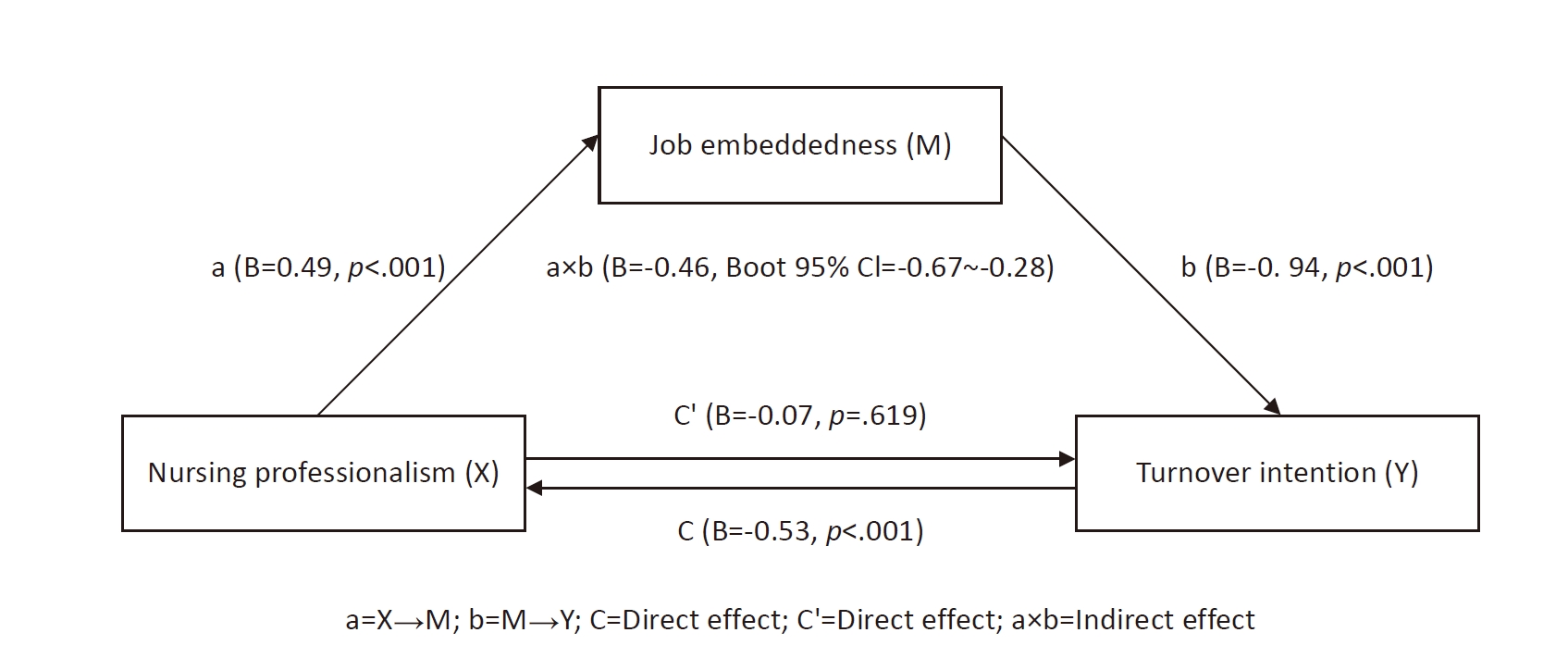
This study investigates the mediating effect of job embeddedness in the relationship between nursing professionalism and turnover intention among clinical nurses. Methods: A nationwide online survey was conducted using a structured questionnaire. Participants included 204 clinical nurses from tertiary hospitals in South Korea. Data on general characteristics, nursing professionalism, job embeddedness, and turnover intention were collected through self-reported questionnaires from March 19 to March 22, 2024. The analysis involved descriptive statistics, independent t-tests, one-way analysis of variance, Scheffé test, Pearson's correlation coefficients, multiple linear regression analysis, and bootstrapping, using SPSS/WIN version 29.0 and the SPSS PROCESS macro 4.2 version programs. Results: The mean score of nursing professionalism was 3.48±0.45 out of 5, job embeddedness was 3.13±0.52 out of 5, and turnover intention was 2.80±1.00 out of 5. Nursing professionalism did not directly impact turnover intention (B=-0.07, p=.649). Job embeddedness acted as a mediating factor in the relationship between nursing professionalism and turnover intention (B=-0.46, p<.05). Conclusion: These findings suggest that increasing job embeddedness can reduce nurses' turnover intention. Therefore, to decrease nurses' turnover intention, it is essential to enhance nursing professionalism while simultaneously promoting job embeddedness.
  • 1,034 View
  • 41 Download
The Mediating Effect of Self-Transcendence on the Relationship between Job Stress and Wellness among Nurses
Sung Mi Kim, Da Eun Kim
J Korean Acad Nurs Adm 2025;31(4):394-404.   Published online September 30, 2025
DOI: https://doi.org/10.11111/jkana.2025.0003
Purpose
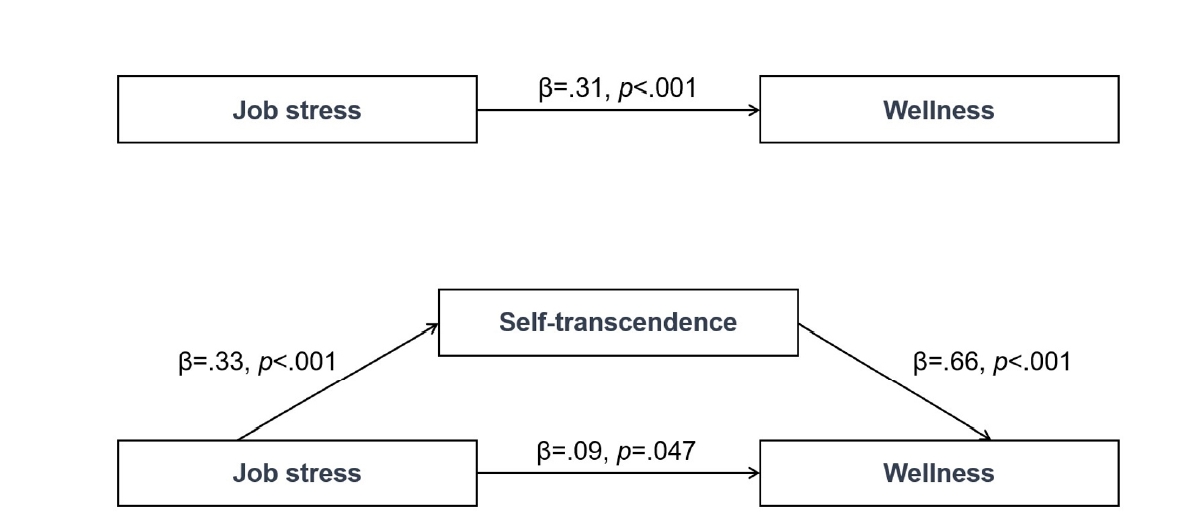
This study aimed to explore the mediating role of self-transcendence in the relationship between job stress and wellness among nurses based on self-transcendence theory. Methods: A descriptive cross-sectional design was adopted, and data were collected via an online survey using Google Forms from July 22 to August 20, 2024. This study analyzed data from 290 nurses working in 10 hospitals. Correlation and multiple regression analyses were conducted, alongside simple mediation analysis with bootstrapping, to evaluate the mediating role of self-transcendence. All statistical analyses were performed using Jamovi software. Results: Positive correlations were identified among job stress, self-transcendence, and wellness in nurses. Regression analyses revealed that self-transcendence was positively associated with wellness (β=.62, p<.001), while job stress had no significant association with wellness. Mediation analysis demonstrated that self-transcendence significantly mediated the relationship between job stress and wellness (β=.22, p<.001). Conclusion: The findings highlight the influence of self-transcendence on the relationship between job stress and wellness among nurses. This underscores the importance of designing interventions to enhance self-transcendence as a strategy to promote wellness among nurses.
  • 1,260 View
  • 38 Download
Purpose
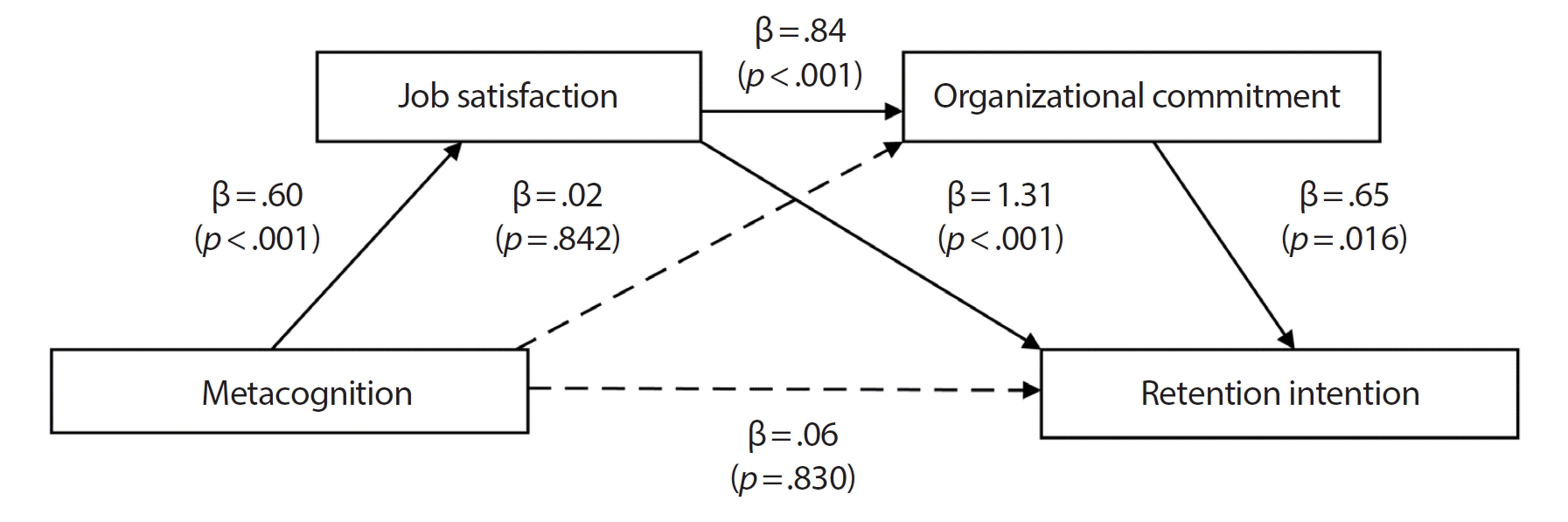
This study investigated the effect of new nurses' metacognition on their retention intention and the dual mediating effect of job satisfaction and organizational commitment in the relationship between those two variables. Methods: Participants included 154 new nurses with 12 months or less of clinical experience working in general hospitals in Seoul. Using a structured questionnaire, data were collected from September 30 to October 29, 2024 and analyzed using IBM SPSS version 29.0 and the Process Macro 4.2 program. Results: Metacognition had a positive effect on job satisfaction (B=0.60, p<.001). Job satisfaction had significant positive effects on organizational commitment (B=0.84, p<.001) and retention intention (B=1.31, p<.001), while organizational commitment had a significant positive effect on retention intention (B=0.65, p=.016). The sequential mediating effect of job satisfaction and organizational commitment was confirmed within the relationship between metacognition and retention intention in new nurses (effect=0.33, 95% confidence interval: 0.03-0.71). Conclusion: The results of this study suggest the presence of a causal structure in which higher metacognition is associated with greater job satisfaction in new nurses; this leads them to commit to the organization, eventually increasing their retention intention.
  • 877 View
  • 57 Download
Effects of Role Conflict, Work Environment, and Meaning of Work on Job Embeddedness among Physician Assistants
Kwang Hoon Seo, Tae Yeong Yang, Nam Gyu Park, Jung Eun Park
J Korean Acad Nurs Adm 2025;31(3):249-258.   Published online June 30, 2025
DOI: https://doi.org/10.11111/jkana.2025.0011
Purpose
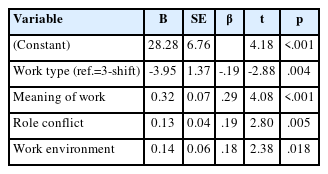
This study examined the effects of role conflict, work environment, and meaning of work on job embeddedness among physician assistants to provide foundational data for their retention and professional development. Methods: A descriptive survey was conducted with 180 physician assistants from six tertiary hospitals in Seoul and Chungcheong Province. Data were collected from July to November 2022. Role conflict, work environment, meaning of work, and job embeddedness were measured using validated scales. Data were analyzed using SAS Enterprise Guide 7.1 with descriptive statistics, the independent t-test, ANOVA, Pearson correlation coefficients, and multiple regression analysis. Results: Job embeddedness correlated positively with meaning of work (r=.28, p<.001) and work environment (r=.22, p=.002) and weakly with role conflict (r=.14, p=.045). Multiple regression identified meaning of work (B=0.32, p<.001), role conflict (B=0.13, p=.005), work environment (B=0.14, p=.018), and work type (B=-3.95, p=.004) as significant predictors (Adj. R²=19.8%). Meaning of work had the greatest impact. Conclusion: Enhancing job embeddedness among physician assistants requires improving the work environment, clarifying professional roles, and strengthening professional recognition and organizational support.
  • 1,687 View
  • 139 Download
Influences of Generation Z Characteristics on Job Embeddedness and Turnover Intention
Su Hyun Kim, Chae Yeon Park, Seung Mok Shin, Seung Hun Shin, Grace Choe, Da Yeong Hwang, Young Hee Chae, Geun-Hee Kim
J Korean Acad Nurs Adm 2025;31(3):291-301.   Published online June 30, 2025
DOI: https://doi.org/10.11111/jkana.2024.0050
Purpose
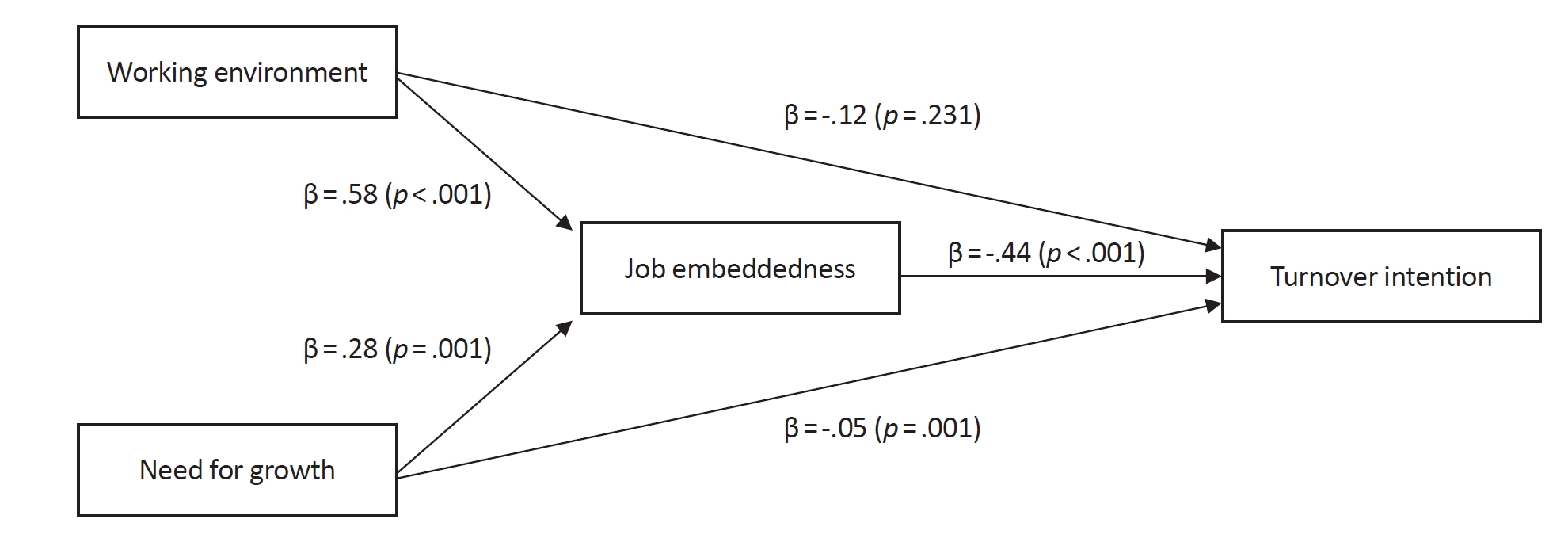
This study explored how Generation Z characteristics—specifically work–life balance, growth needs, and individualism—along with work environment, emotional labor, and interpersonal skills, affect job embeddedness among newly graduated nurses. It also examined whether job embeddedness mediates the relationship between these factors and turnover intention. Methods: A correlational descriptive study was conducted by analyzing survey data collected from 131 clinical nurses born between 1995 and 2000, who had less than three years of nursing work experience in South Korea. Hierarchical multiple regression analysis was employed to identify the independent effects of Generation Z characteristics on job embeddedness, over and above the effects of work environment, emotional labor, and interpersonal skills. Path analysis using bootstrapping method was conducted to examine the mediating role of job embeddedness in turnover intention. Results: Needs for growth and work environment were significant predictors of job embeddedness among newly graduated nurses. Furthermore, the effects of needs for growth and work environment on turnover intention were significantly mediated by job embeddedness. Conclusion: Understanding the characteristics of Generation Z, particularly their needs for growth, along with the work environment, is essential for enhancing job embeddedness among newly graduated nurses. Strengthening job embeddedness can effectively reduce their turnover intention.
  • 1,450 View
  • 117 Download
The Effect of Job Characteristics and Professional Self-concept on Competency of Forensic Nursing among Perioperative Nurses
Yeo-Jin Jeon, Bu Kyung Park
J Korean Acad Nurs Adm 2025;31(3):302-311.   Published online June 30, 2025
DOI: https://doi.org/10.11111/jkana.2023.0073
Purpose
This study aimed to investigate the effects of job characteristics and professional self-concept on competency in forensic nursing among operating room nurses at university hospitals. Methods: Data were collected from 164 operating room nurses employed at university hospitals. The collected data were analyzed in SPSS 23.0, using the mean, standard deviation, independent t-test, one-way analysis of variance, Scheffé post-hoc test, Pearson correlation coefficients, and multiple regression analysis. Results: Professional self-concept showed a statistically significant positive correlation with forensic nursing competency (r=.60, p<.001). The following factors significantly influenced forensic nursing competency among operating room nurses: professional self-concept (β=.69, p<.001), total career lengths of <5 years (β=.21, p=.006) and 5-9 years (β=.20, p=.011), and job characteristics (β=.19, p=.007). A three-step regression model was statistically significant (F=29.74, p<.001) and the total explanatory power of the regression model was 41.4%. Conclusion: This study identified that professional self-concept, total career years, and job characteristics as the most significant factors influencing operating room nurses' forensic nursing competency. Therefore, it will be necessary to develop educational programs to improve professional self-concept and job characteristics.
  • 534 View
  • 33 Download
Purpose
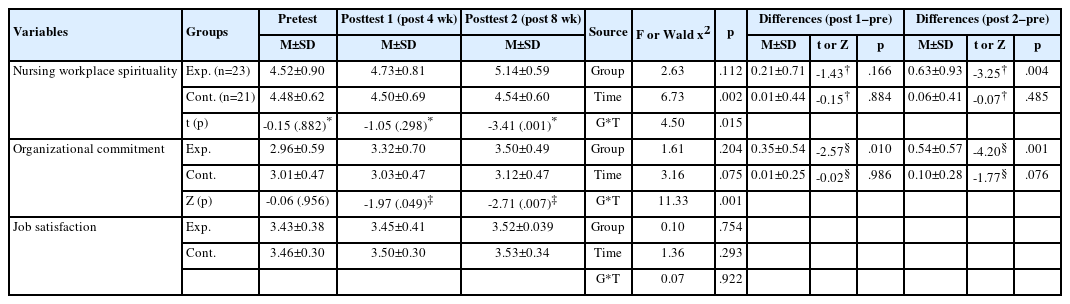
To examine the impact of reading the text of the Nightingale Pledge aloud at the beginning of the shift on nursing workplace spirituality, organizational commitment, and job satisfaction among hospital nurses.
Methods
We used a non-randomized controlled trial design. Forty-four nurses from four wards with similar work environments at M General Hospital in B City were enrolled. The data were analyzed using a x2 test, t-test, and generalized estimating equations.
Results
In both groups, we observed a significant group and time interaction effect for nursing workplace spirituality (Wald x2=4.50, p=.015) and organizational commitment (Wald x2=11.33, p=.001). Nursing workplace spirituality was significantly higher in the experimental group than in the control group at eight weeks after the intervention (t=-3.41, p=.001). Likewise, organizational commitment was significantly higher in the experimental group than in the control group at four and eight weeks after the intervention (Z=-1.97, p=.049; Z=-2.71, p=.007, respectively). Job satisfaction did not significantly before and after the intervention.
Conclusion
Despite the short time commitment, reading aloud the text of the Nightingale Pledge at the beginning of shift had positive effects on hospital nurses’ nursing workplace spirituality and organizational commitment.
  • 999 View
  • 36 Download
Purpose
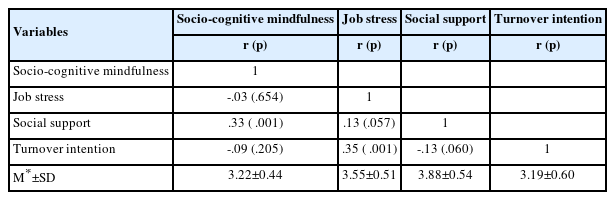
This study aimed to investigate the relationship between socio-cognitive mindfulness, job stress, social support, and turnover intention among general hospital nurses and identify the factors influencing nurses’ turnover intention.
Methods
A descriptive survey was conducted among 218 nurses from five general hospitals located in G metropolitan city. The participants completed a questionnaire measuring the study variables, and the data were analyzed using t-tests, ANOVA, Pearson’s correlation coefficient, and hierarchical multiple regression analysis in SPSS/WIN 28.0.
Results
Significant differences were found in turnover intention by gender (t=-2.12, p=.036), family type (t=-3.09, p=.002), work department (F=7.01, p<.001), and work type (t=2.55, p=.011). Socio-cognitive mindfulness was positively related to social support (r=.331, p<.001), and turnover intention was positively related to job stress (r=.347, p<.001). The factors influencing nurses’ turnover intention included job stress (β=.317, p<.001), work department (artificial kidney room: β=-.287, p=.004; emergency room: β=-.219, p=.015), social support (β=-.183, p=.005), and work type (shift work: β=.170, p=.036), respectively. These factors explained 23.4% of the variance.
Conclusion
The findings indicate the need to develop programs to effectively cope with job stress and implement mentoring systems or psychological support programs to reduce turnover intention among nurses at the organizational level.
  • 2,112 View
  • 69 Download
The Influences of Teamwork and Grit on Job Adaptation and Intention to Remain among Advanced Beginner Nurses
Seon Kyeong Jeong, Kyoung Ja Kim, Eun Ji Choi
J Korean Acad Nurs Adm 2024;30(4):379-391.   Published online September 30, 2024
DOI: https://doi.org/10.11111/jkana.2024.30.4.379
Purpose
This study aimed to explore the influence of teamwork and grit on job adaptation and intention to remain among advanced beginner nurses.
Methods
A cross-sectional descriptive research design employing a survey method was used. The study involved 203 advanced beginner nurses with 13~36 months of experience working at a tertiary hospital. Collected data were analyzed using descriptive statistics, independent t-tests, one-way ANOVA, Pearson's correlation coefficients, and hierarchical regression analysis.
Results
Job adaptation positively correlated with teamwork (r=.58, p<.001) and grit (r=.65, p<.001). Intention to remain was also positively correlated with teamwork (r=.32, p<.001) and grit (r=.59, p<.001). A hierarchical multiple regression model including control variables, teamwork, and grit accounted for 64% of the factors influencing job adaptation. Another hierarchical multiple regression model, incorporating control variables, teamwork, and grit, explained 44% of the factors influencing the intention to remain. Among the related factors, grit emerged as the most influential in regarding job adaption and intention to remain.
Conclusion
These findings underscore the importance of establishing a support system to bolster grit, enhancing adaptation to the job and fostering intention to remain among advanced beginner nurses.
  • 826 View
  • 53 Download
Influence of Work Environment, Missed Nursing Care, and Non-Nursing Tasks of Hospital Nurses on Job Stress
Ji Yeong Park, Kyoung Ja Kim
J Korean Acad Nurs Adm 2024;30(3):246-258.   Published online June 30, 2024
DOI: https://doi.org/10.11111/jkana.2024.30.3.246
Purpose
This study aimed to determine the impact of work environment, missed nursing care, and non-nursing tasks on the job stress of hospital nurses.
Methods
A descriptive, cross-sectional survey of 164 nurses working in three hospitals was conducted. Data were collected using structured questionnaires and analyzed using descriptive statistics, t-test, one-way analysis of variance, Pearson’s correlation coefficient, and multiple regression analysis using SPSS/WIN 26.0.
Results
Hospital Nurses' job stress was negatively correlated with the work environment (r=-.37, p<.001). Job stress had a statistically significant positive correlation with non-nursing tasks (r=.34, p<.001); however, it had no significant correlation with missed nursing care (r=.05, p=.552). Regression model analysis revealed that the variables associated with job stress were non-nursing tasks (β=.29, p<.001) and the foundation for quality nursing care (β=-.25, p=.034), which are subdomains of the work environment. In contrast, missed nursing care was not determined to be a significant factor.
Conclusion
To effectively manage nurses' job stress, nurse managers should provide higher quality care by reducing the number of non-nursing tasks and creating a positive work environment, especially by providing adequate nursing workforce and material support.

Citations

Citations to this article as recorded by  
  • Effects of Role Conflict, Work Environment, and Meaning of Work on Job Embeddedness among Physician Assistants
    Kwang Hoon Seo, Tae Yeong Yang, Nam Gyu Park, Jung Eun Park
    Journal of Korean Academy of Nursing Administration.2025; 31(3): 249.     CrossRef
  • Occupational Stress, Coping, and Outcomes among Korean Nurses: An Integrative Review Based on the Transactional Model of Stress and Coping
    Myungji Kim, Hyunkyung Choi
    STRESS.2025; 33(3): 127.     CrossRef
  • Comparison of Factors Affecting Delirium Nursing Stress between Nurses in Comprehensive Nursing Care Service Wards and General Wards
    Sumin Gwon, Gaeun Kim
    Journal of Korean Academy of Nursing Administration.2024; 30(5): 517.     CrossRef
  • 3,410 View
  • 178 Download
  • 3 Crossref
Purpose
This study aimed to identify the effects of job stress, social support, and infection control fatigue on professional quality of life among nurses in designated coronavirus disease 2019 (COVID-19) hospitals.
Methods
As a descriptive study, data were collected from 157 nurses working at four designated COVID-19 hospitals employing self-report questionnaires. The data were collected from September 1 to September 30, 2021, and analyzed using descriptive statistics, t-test, one-way ANOVA, Pearson’s correlation coefficients and stepwise multiple regression analysis.
Results
Job stress, marital status and social support affected compassion satisfaction with the professional quality of life, showing 30% of explanatory power. Job stress and social support affected burnout with the professional quality of life, showing 34% of explanatory power. Infection control fatigue affected secondary traumatic stress in the professional quality of life and the explanatory power was 11%.
Conclusion
Efforts are needed to improve nurses' professional quality of life by preparing and applying interventions to reduce job stress and improve social support for nurses working in hospitals dedicated to COVID-19. Further, nursing efforts and institutional support will be needed to reduce infection control fatigue.

Citations

Citations to this article as recorded by  
  • Mediating Effect of Social Support on the Relationship between Occupational Stress during the COVID-19-Related Respiratory Disease Pandemic and Professional Quality of Life of Clinical Nurses: A Descriptive Study
    Eunhee Jo, Rahyeon Hwang, Ju-Hee Lee, Yoon-Ji Lee
    Journal of Korean Academy of Fundamentals of Nursing.2025; 32(3): 364.     CrossRef
  • Effects of stress on burnout among infection control nurses during the COVID-19 pandemic: the mediating effects of social support and self-efficacy
    Su-jin Lee, Ju-Young Park, Seo-Hyeon Kim
    BMC Nursing.2024;[Epub]     CrossRef
  • Mediating Effect of Resilience on the Relationship Between Job Stress and the Professional Quality of Life of Hospice and Palliative Care Nurses: A Multicenter Cross-sectional Study
    Eunhee Jo, Soon-Jung Hwang, Hyang-Suk Kwon
    Korean Journal of Adult Nursing.2024; 36(3): 241.     CrossRef
  • 1,139 View
  • 20 Download
  • 3 Crossref
Effect of the Nursing Work Environment on Turnover Intention: Serial Mediation Effects of Career Motivation and Job Satisfaction
Young Deok Park, Sun Ju You
J Korean Acad Nurs Adm 2023;29(5):529-539.   Published online December 31, 2023
DOI: https://doi.org/10.11111/jkana.2023.29.5.529
Purpose
This study investigated whether the work environment affects nurses' turnover intention with career motivation and job satisfaction acting as mediating factors.
Methods
Data were collected from January 6-25, 2022, using a cross-sectional design. The participants were 205 nurses who had worked for more than six months at four small-to-medium-sized general hospitals in South Korea. Data analysis consisted of descriptive statistics, Pearson's correlation coefficients, independent t-tests, one-way ANOVAs, Scheffé test, and mediation analysis using Hayes’ PROCESS Macro Model 6.
Results
The nursing work environment had a significant positive association with career motivation and job satisfaction and negative effects on nurses' turnover intention. The single mediating effect of job satisfaction and the serial mediation effects of career motivation and job satisfaction on the relationship between the nursing work environment and turnover intention were significant. Thus, nurses' positive perceptions of the work environment strengthened career motivation, which in turn increased job satisfaction and reduced turnover intention.
Conclusion
Providing a healthy work environment to nurses can help reduce their turnover intention. Therefore, the government and hospitals should implement human resource strategies to improve nursing work environments and take steps to enhance career motivation and job satisfaction to strengthen nurse retention.

Citations

Citations to this article as recorded by  
  • Association Between Nurse Turnover and Nurses’ Perception of Patient Outcomes in Acute Care Hospitals in South Korea
    Sung-Heui Bae
    Journal of Nursing Care Quality.2025; 40(4): E57.     CrossRef
  • 4,904 View
  • 131 Download
  • 1 Crossref
Structural Equation Modeling of Advanced Beginner-Stage Nurses' Intention to Continue Employment
Seung-Hee Lee, Hwasoon Kim
J Korean Acad Nurs Adm 2023;29(5):517-528.   Published online December 31, 2023
DOI: https://doi.org/10.11111/jkana.2023.29.5.517
Purpose
The purpose of this study was to establish a structural model explaining the factors affecting advanced beginner-stage nurses' intention to continue employment. This model was designed to provide basic data for improving the intention to continue employment among advanced beginner-stage nurses and to efficiently manage nurses as human resources.
Methods
In order to construct a hypothetical model, latent factors affecting nurses' intention to continue employment were identified through systematic review and meta-analysis. As a result of systematic review, hypothetical model was constructed with nursing professionalism, calling, work environment, positive psychological capital, and job satisfaction. Structural equation modeling was then conducted through SPSS 25.0, AMOS 22.0, and Mplus 6.12 statistics programs.
Results
First, none of the pathways affected by nursing professionalism were statistically significant. Second, the final structural model showed fit very well based on the fit indices RMSEA=.062, SRMR=.052, RMR=.048, CFI=0.95, and TLI=0.94.
Conclusion
This study’s results identified that job satisfaction, calling, work environment, and positive psychological capital affected advanced beginner-stage nurses' intention to continue employment. Among these, job satisfaction was the most powerful variable influencing the decision to continue employment for advanced beginner-stage nurses.

Citations

Citations to this article as recorded by  
  • Retention and Associated Factors among Nurses in Small- and Medium-Sized Hospitals across South Korea
    Eun Mi Kim, Su Jung Choi, mi sug Lee, Hyun Jin Park, Jeong Yun Park
    Journal of Korean Critical Care Nursing.2025; 18(3): 16.     CrossRef
  • The Influences of Teamwork and Grit on Job Adaptation and Intention to Remain among Advanced Beginner Nurses
    Seon Kyeong Jeong, Kyoung Ja Kim, Eun Ji Choi
    Journal of Korean Academy of Nursing Administration.2024; 30(4): 379.     CrossRef
  • 1,037 View
  • 65 Download
  • 2 Crossref
Purpose
This study examined the effect of missed nursing care on nursing sensitive indicators.
Methods
A nationwide cross-sectional survey was conducted using structured questionnaires. Data of 174 clinical nurses employed in general or tertiary hospitals were collected through proportional quota sampling; the quota used was the location of a working hospital in South Korea. Data were collected through an online survey and snowball sampling from July 16 to July 20, 2022. The collected data were analyzed using IBM SPSS 26.0.
Results
Missed nursing care had statistically significant negative correlations with patient safety management activity and job satisfaction, and significant positive correlation with turnover intention. Significant correlation was not found between missed nursing care and adverse event experiences. Hierarchical multiple regression analysis revealed that missed nursing care explained an additional 21%p of patient safety management activity, 14%p of job satisfaction, and 3%p of turnover intention. Thus, missed nursing care was found to be a statistically significant predictor of patient safety management activity, job satisfaction, and turnover intention.
Conclusion
Missed nursing care significantly affects nursing sensitive indicators. To improve positive outcomes and decrease negative outcomes, nurses and nursing managers must make efforts to minimize missed nursing care.

Citations

Citations to this article as recorded by  
  • Effect of Nursing Professionalism on Turnover Intention among Nurses: The Mediating Effect of Job Embeddedness
    Ja In Kim, Seok Hee Jeong, Hyoung Eun Chang, Sunmi Kim
    Journal of Korean Academy of Nursing Administration.2025; 31(4): 446.     CrossRef
  • Effects of presenteeism on turnover intention in clinical nurses through the serial mediating roles of missed nursing care and job satisfaction: a cross-sectional predictive correlational study
    Hyeonseon Cheon, Seok Hee Jeong, Hyun Kyung Kim, Hyoung Eun Chang
    Journal of Korean Academy of Nursing.2025; 55(4): 584.     CrossRef
  • Role of Hi-Tech Call Center Employees’ ESG Activity Recognition in Increasing Corporate Performance via Organizational Identification and Job Satisfaction
    So Ra Park
    Journal of Digital Contents Society.2024; 25(2): 503.     CrossRef
  • Impact of Emotional Labor and Positive Psychological Capital on the Turnover Intention of Nurses Caring for Patients with COVID-19: A Descriptive Survey Study
    Mira Kwon, Yeoungsuk Song, Majd T. Mrayyan
    Journal of Nursing Management.2024; 2024: 1.     CrossRef
  • 1,747 View
  • 81 Download
  • 4 Crossref
Influence of Teamwork, Role Conflict, and Delegation Preparedness on Job Satisfaction among Nurses Working in Integrated Nursing Care Wards
Deokhyun Lee, Yoonju Lee, Haejung Lee, Sunyoung Jung
J Korean Acad Nurs Adm 2023;29(4):478-489.   Published online September 30, 2023
DOI: https://doi.org/10.11111/jkana.2023.29.4.478
Purpose
This study aimed to identify the factors influencing job satisfaction among nurses working in integrated nursing care wards.
Methods
The study participants were 196 nurses working in integrated nursing care wards at four general hospitals and one tertiary hospital. Data were collected using structured questionnaires from April 11 to 25, 2022, through an online survey. Data were analyzed using descriptive statistics, t-test, one-way ANOVA, Pearson correlation, and stepwise multiple regression with SPSS/WIN 26.0.
Results
The factors influencing job satisfaction of participants were team structure (β=.32, p<.001), role conflict regarding nursing practice (β=-.24, p<.001), mutual support (β=.23, p<.001), master's degree or higher(β=.16, p=.004), and spousal presence (β=.15, p=.005).
Conclusion
The findings of this study suggest that the tasks and roles of team members should be clarified, and a supportive team culture of mutual cooperation should be fostered to improve the job satisfaction of nurses working in the integrated nursing ward. In addition, it is necessary to reduce role conflict by providing support focused on allocating tasks that can strengthen the role of professional nurses.

Citations

Citations to this article as recorded by  
  • Effects of Shared Leadership and Communication Competence on Nursing Team Effectiveness in Comprehensive Nursing Service Units: Focusing on the Team Nursing System
    Hye Jin Kim, Eunjoo Lee
    Journal of Korean Academy of Nursing Administration.2025; 31(2): 143.     CrossRef
  • Influence of Job Delegation Preparedness, Individual and Organizational Communication Skills on Job Stress of Nurses in Comprehensive Nursing Care Service Wards
    Soo Jin Lee, Ji Won Kim, Nam Hee Park
    Journal of Korean Public Health Nursing.2025; 39(1): 5.     CrossRef
  • Impact of Grit, Teamwork, Organizational Communication Competence, Perception of Patient Safety Culture on Patient Safety Nursing Activities in Integrated Nursing Care Units
    Jeeseon Kim, Haejung Lee
    Journal of Korean Academy of Nursing Administration.2025; 31(3): 237.     CrossRef
  • Factors Influencing Burnout of Nurses in Comprehensive Nursing Care Service Wards: Focusing on Positive Psychological Capital, Role Conflict, and Authentic Leadership
    Jung Wha Park, Kyoung Ja Kim, Ji Young Im, Ji Young Kim
    Journal of Korean Academy of Nursing Administration.2025; 31(4): 345.     CrossRef
  • 2,337 View
  • 115 Download
  • 4 Crossref
Effects of Nurses' Grit on the Nursing Performance: Multiple Mediating Effects of Work Engagement and Job Crafting
Jeong-Lim Ryu, So-Hyoung Hong, Yoon Seo Yang
J Korean Acad Nurs Adm 2023;29(4):468-477.   Published online September 30, 2023
DOI: https://doi.org/10.11111/jkana.2023.29.4.468
Purpose
The purpose of this study was to identify the mediating effect of work engagement and job crafting on the relationship between nurses’ Grit on nursing performance.
Methods
The data were collected using structured questionnaires through online surveys from 142 clinical nurses in five hospitals. Data were analyzed using SPSS 24.0, Hayes’s SPSS Process Macro 4.0 version program.
Results
Nursing performance was significantly associated with Grit, work engagement and job crafting. The mediating effect of job crafting on the Grit on nursing performance was confirmed.
Conclusion
These results suggest that it is necessary to develop an intervention program that focuses on improving job crafting. Further, job crafting needs to be considered in developing nursing interventions to nurses' Grit and improve nursing performance for nurses.

Citations

Citations to this article as recorded by  
  • Mediating effect of grit on the influence of nurses’ silence behavior on medication safety competence: a cross-sectional study
    Haengsuk Kim, Wanju Park
    Journal of Korean Academy of Nursing.2025; 55(1): 81.     CrossRef
  • The impact of grit and job crafting on organizational commitment and job satisfaction among hospital nurses in Korea
    Mi-Suk Hyun
    Medicine.2025; 104(45): e45890.     CrossRef
  • 827 View
  • 51 Download
  • 2 Crossref
Purpose
This study examined hospital nurses’ perception of work-life balance, nursing work environment, nursing organizational culture, and job satisfaction before turnover, and compared differences in variables between current clinical nurses and non-clinical nurses.
Methods
This descriptive study involved 172 nurses with over six months experience, who changed jobs within the last 5 years in G Province. Data were collected from September 5th-22nd, 2022, and analyzed through independent t-test, one-way ANOVA, and Pearson correlation coefficient using SPSS/WIN 25.0 program.
Results
Total work-life balance (t=3.85, p<.001), work-family balance (t=4.79, p<.001), work-leisure balance (t=2.96, p=.004), work-growth balance (t=3.01, p=.003), and overall work-life balance (t=2.95, p=.004) in work-life balance, the role of professionalism (r=2.05, p=.042) and interpersonal relationships (t=2.59, p=.011) in job satisfaction, the relationship-oriented nursing organizational culture (t=2.68, p=.008), and the nurse-doctor relationship within the nursing work environment (t=2.51, p=.013) were all significantly higher among current clinical nurses than non-clinical nurses.
Conclusion
Hospital-level interventions should be established and implemented to improve work-life balance, the relationship-oriented nursing organizational culture, and job satisfaction through interprofessional relationships to retain hospital nurses.
  • 1,308 View
  • 68 Download
Effects of Job Embeddedness, Professional Self-concept, and Work-life Balance on Clinical Nurses’ Intention to Stay
Ae-ri Choi, Jee-In Hwang
J Korean Acad Nurs Adm 2023;29(4):353-362.   Published online September 30, 2023
DOI: https://doi.org/10.11111/jkana.2023.29.4.353
Purpose
This study aimed to assess the influence of job embeddedness, professional self-concept, and work-life balance on clinical nurses’ workplace retention intention.
Methods
A descriptive cross-sectional survey was conducted from July 27 to August 2, 2022, involving 296 nurses at a university hospital in Seoul. The questionnaire-based data collected were analyzed using t-tests, one-way ANOVA, Pearson's correlation coefficients, and multiple regression.
Results
The mean score for intention to stay is 4.92±1.05 out of 8. The mean scores for job embeddedness, professional self-concept, and work-life balance were 2.91±0.48 out of 5, 2.61±0.28 out of 4, and 3.10±0.71 out of 5, respectively. Job embeddedness (β=.17, p=.002) and professional self-concept (β=.42, p<.001) were significantly associated with clinical nurses’ intention to stay in their workplace. Specifically, the “community suitability” subfactor of job embeddedness (β=.16, p=.003) and the “satisfaction” subfactor of professional self-concept (β=.58, p<.001) were significantly related to nurses’ intention to stay. No significant relationship was found between work-life balance and intention to stay.
Conclusion
Nurses’ job embeddedness and professional self-concept significantly affected their intention to stay. Therefore, fostering community bonding outside the organization and increasing professional satisfaction are suggested to increase clinical nurses’ intentions to stay.

Citations

Citations to this article as recorded by  
  • The Influence of Work-Life Balance and Job Embeddedness on Turnover Intention among Nurses Caring for Cancer Patients
    Jin-young Park, Yeunhee Kwak, Jiwoo Jung, Seoung-Wha Lim
    Journal of Korean Critical Care Nursing.2025; 18(3): 28.     CrossRef
  • The effect of dental hygienist work cooperation and compensation satisfaction on job embeddedness: mediating effect of positive psychological capital
    Ju-Eon Kim, Seon-Yeong Kim
    Journal of Korean Society of Dental Hygiene.2024; 24(3): 263.     CrossRef
  • A Study on the Effect of the Quality of the Relationship between Nail Shop Workers and Consumers on the Balance of Work and Life: Focusing on the Mediating Effect of Burnout
    Hyun-Jeong Lee, Hye-Young Kim
    Journal of the Korean Society of Cosmetology.2024; 30(2): 415.     CrossRef
  • 962 View
  • 64 Download
  • 3 Crossref
The Effect of Nurses’ Perceived Leader-Member Exchange on Psychological Ownership, Job Engagement, and Turnover Intention
Eun Ah Cho, Myun Sook Jung, Eun Ju Heo
J Korean Acad Nurs Adm 2023;29(3):298-308.   Published online June 30, 2023
DOI: https://doi.org/10.11111/jkana.2023.29.3.298
Purpose
This study is a hypothetical model of the effect of the leader-member exchange relationship on psychological ownership, job engagement, and turnover intention.
Methods
Data collection was conducted for general nurses who have worked for at least 6 months in a university hospital. The collected data were analyzed using the SPSS/WIN 25.0, and AMOS 18.0 program was used to conduct confirmatory factor analysis as well as goodness of fit verification and hypothesis testing for the hypothetical model.
Results
The leader-member exchange had a significant, static effect on psychological ownership. The leader-member exchange relationship did not have a significant effect on job engagement and psychological ownership had a significant, static effect on job engagement. The leader-member exchange relationship did not have a significant effect on turnover intention and psychological ownership and job engagement had significant, negative effects on turnover intention.
Conclusion
Intervention and the development of programs to increase the psychological ownership and job engagement of members are proposed to improve the leader-member exchange relationship through leadership education and training and reduce the turnover intention of nurses.

Citations

Citations to this article as recorded by  
  • Hospital Nurses’ Professional Quality of Life Model: A Cross‐Sectional Study Based on the Expanded Job Demands‐Resources Model
    Younghee Kim, Mi Yu, Jacopo Fiorini
    Journal of Nursing Management.2025;[Epub]     CrossRef
  • Mediating Effect of Leader-Member Exchange on the Ethical Leadership of Nursing Unit Managers and Turnover Intention of Clinical Nurses: A Nationwide Survey using Proportional Quota Sampling
    Jihun Kim, Sunmi Kim, Nara Han, Seok Hee Jeong
    Journal of Korean Academy of Nursing Administration.2024; 30(1): 42.     CrossRef
  • The Effect of Work Value, Psychological Ownership and Nursing Working Environment on Intention of Retention in Hospital Nurses
    Ji Hey Kim, Yoon Ju Cho, So Eun Jang
    Journal of Korean Critical Care Nursing.2023; 16(3): 62.     CrossRef
  • 958 View
  • 36 Download
  • 3 Crossref
Effects of Nursing Competence on Job Satisfaction across Career Stages
Eun Young Oh, Mi Won Kim, Heon Ju Yoo, Seung Hee Choi, Sa Rang Lee, Chung Sook Kim
J Korean Acad Nurs Adm 2023;29(3):258-267.   Published online June 30, 2023
DOI: https://doi.org/10.11111/jkana.2023.29.3.258
Purpose
This study examined the variations in nursing competence and job satisfaction across different career stages. Additionally, it explored the effect of nursing competence on job satisfaction within each career stages.
Methods
Participants were 468 nurses working at a university hospital in B city. Data collection was conducted using self-report questionnaires from April 1 to 15, 2020. The data were analyzed descriptive statistics, one-way ANOVA, Scheffé test, and multiple regression analysis employing SPSS 23.0.
Results
General nursing competence improved significantly after the proficiency stage. Care execution and critical thinking were improved as nurses progressed from the novice to the advanced beginner stage. Additionally, communication showed progress in the competent stage. Furthermore, responsibility and self-development were improved after the proficiency stage. Among the sub-competencies examined, self-development, care execution, and communication significantly influenced the job satisfaction of a nurse’s career. Moreover, self-development was influential at all stages.
Conclusion
This study shows that there was no substantial improvement in nursing competencies as they progressed through various career stages. Self-development was the most crucial sub-competence impacting job satisfaction, with the effects of the sub-competencies varying across career stages. These results will aid in planning clinical continuing education and formulating policies to enhance nurse competency.

Citations

Citations to this article as recorded by  
  • Shift nurses’ work quality and job satisfaction after implementing the Inha University hospital nursing AI scheduling system (IH-NASS)
    Hye Won Kang, Jiyoung Kim, Kyoung Ja Kim, Eun Kyoung Bae, Heesuk Kang, Jeong Hee Jang, Whasuk Choe
    BMC Nursing.2025;[Epub]     CrossRef
  • The Effectiveness of 360-Degree Virtual Reality-Based Mechanical Ventilation Nursing Education for ICU Nurses
    Doo Ree Kim, Jaeyong Yoo
    Healthcare.2025; 13(14): 1639.     CrossRef
  • The Influences of Teamwork and Grit on Job Adaptation and Intention to Remain among Advanced Beginner Nurses
    Seon Kyeong Jeong, Kyoung Ja Kim, Eun Ji Choi
    Journal of Korean Academy of Nursing Administration.2024; 30(4): 379.     CrossRef
  • 2,042 View
  • 150 Download
  • 3 Crossref
Factors Affecting Political Competency of Advanced Practice Nurses
Wooyeong Park, Taewha Lee
J Korean Acad Nurs Adm 2023;29(3):246-257.   Published online June 30, 2023
DOI: https://doi.org/10.11111/jkana.2023.29.3.246
Purpose
This descriptive correlation study was designed to identify the job characteristics of advanced practice nurses (APNs) and the degree of nursing professionalism as factors influencing the political competency of APNs. Additionally, the relationship between these two factors and political competency was analyzed.
Methods
Data were collected through an online survey of 118 APNs from June 16 to September 16, 2021. The data collected were analyzed using descriptive statistics, a t-test, ANOVA, Scheffé ́’s test, Pearson’s correlation, and a multiple regression analysis using SPSS/WIN 25.0.
Results
Statistically significant differences were noted in the political competency of APNs based on age, workplace, position, experience as an APN, political education, and political party membership. Furthermore, political competency positively correlated with job characteristics and nursing professionalism. The factors affecting the political competency of APNs included skill variety, workplace, political education, political party membership, and nursing professionalism.
Conclusion
Findings of this study confirmed the importance of the political competency of APNs. Furthermore, policy efforts to promote independent job development reflecting the job characteristics of APNs and improvement in nursing professionalism are required, and support from professional nursing organizations is needed.

Citations

Citations to this article as recorded by  
  • Enhancing political competency among nurses and nursing students: A scoping review
    Min Kyoung Han, Jeonghyun Kim, Minjae Lee, Sujin Shin
    Nurse Education in Practice.2025; 87: 104497.     CrossRef
  • 1,097 View
  • 27 Download
  • 1 Crossref
Factors Influencing Patient Safety Management Activities among General Hospital Operating Room Nurses
Seon Mi Kim, Su Hye Kwon
J Korean Acad Nurs Adm 2023;29(2):89-98.   Published online March 31, 2023
DOI: https://doi.org/10.11111/jkana.2023.29.2.89
Purpose
This study was to examine the influential factors on patient safety management activities of operating room nurses in general hospitals.
Methods
The subject of this study were 133 operating room nurses of seven general hospitals in B metropolitan city. Data were collected from July 23 to August 14, 2020 using self-report questionnaires. For data analysis, a descriptive analysis and stepwise multiple regression were utilized with IBM SPSS Statistics for Windows version 22.0.
Results
The significant predictors of patient safety management activities were perception of patient safety culture (β=.73, p<.001) and physical burden (β=-.13, p=.025). These variables were found to contribute 56.3% to the outcomes of patient safety management activities.
Conclusion
Based on the research results, to promote patient safety management activities of operating room nurses, it is required to establish active and multifaceted strategies and systems at the hospital level to enhance awareness of patient safety culture and reduce physical burden.

Citations

Citations to this article as recorded by  
  • Study of Patient Safety Culture Awareness of Radiological Technologists in Magnetic Resonance Imaging Laboratories
    Min-Seo Park, Dong-Ha Lee, Hyun-Jin Jo, Hea-Youn Cho, Yeong-Cheol Heo
    Journal of the Korean Society of MR Technology.2024; 34(1): 9.     CrossRef
  • The Effects of a Simulation-Based Patient Safety Education Program on Compliance with Patient Safety, Perception of Patient Safety Culture, and Educational Satisfaction of Operating Room Nurses
    OkBun Park, MiYang Jeon, MiSeon Kim, ByeolAh Kim, HyeonCheol Jeong
    Healthcare.2023; 11(21): 2824.     CrossRef
  • 985 View
  • 40 Download
  • 2 Crossref
Influence of Work Environment, Job Engagement, and Positive Psychological Capital on Job Embeddedness of Hospital Nurses
Hee Jung Kwag, Nam Young Yang
J Korean Acad Nurs Adm 2023;29(2):109-118.   Published online March 31, 2023
DOI: https://doi.org/10.11111/jkana.2023.29.2.109
Purpose
This study examined the effects of work environment, job engagement, and positive psychological capital on hospital nurses’ job embeddedness.
Methods
Participants were 118 hospital nurses. Data were analyzed using descriptive statistics, independent t-test, One-way ANOVA, Pearson correlation coefficients, and multiple regression analysis using SPSS/Win 25.0.
Results
Mean work environment was 2.70±0.14, mean job engagement was 3.03±0.42, positive psychological capital was 4.05±0.27, and job embeddedness was 3.24±0.31. There were significant differences in job embeddedness by turnover experience and current working hospital type. The factors influencing the job embeddedness of the hospital nurses were turnover experience, current working hospital type, and nurse manager ability, leadership, and nueses’ support in the work environment. It was found that 23% could explain job embeddedness.
Conclusion
Implementing a nurse support program related to turnover experience and type of hospital is necessary to enhance job embeddedness. The results indicate a need to develop a coaching program for cultivating leadership and supporting nurses to improve job embeddedness.

Citations

Citations to this article as recorded by  
  • The Influence of Work-Life Balance and Job Embeddedness on Turnover Intention among Nurses Caring for Cancer Patients
    Jin-young Park, Yeunhee Kwak, Jiwoo Jung, Seoung-Wha Lim
    Journal of Korean Critical Care Nursing.2025; 18(3): 28.     CrossRef
  • 1,081 View
  • 61 Download
  • 1 Crossref
Purpose
This study aimed to identify the effects of empowering leadership and job crafting on work engagement among nurses. Methods: Data were collected from 161 hospital nurses. Data were analyzed using the independent t-test, Mann-Whitney U test, one-way ANOVA, Pearson correlation coefficient and Hayes's PROCESS macro method for the mediation effect. Results: Empowering leadership and job crafting showed a significantly positive correlation with work engagement. Furthermore, job crafting had a mediating effect on the relationship between empowering leadership and work engagement. Conclusion: A strategy that enhances task job crafting and cognitive job crafting of members by strengthening manager's empowering leadership can lead to work engagement and have a positive effect on organizational performance.

Citations

Citations to this article as recorded by  
  • Team job crafting as a mediator between sparking leadership and work engagement among nurses: a structural equation modeling approach
    Gamze Tuncer Unver, Oya Celebi Cakiroglu, Naile Boduc
    Journal of Health Organization and Management.2025; : 1.     CrossRef
  • Nurses’ job crafting, work engagement, and well-being: a path analysis
    Sujeong Han
    BMC Nursing.2023;[Epub]     CrossRef
  • Influence of Job Crafting on Evidence-Based Practical Skills of Dental Hygienists
    Min-ji Kim, Kyu-ri Kim, Yun-ji Kim, Seo-yeon Im, You-bin Cho, Ru-by Choi, Hee-jung Lim
    Journal of Dental Hygiene Science.2023; 23(4): 330.     CrossRef
  • 1,109 View
  • 47 Download
  • 3 Crossref
Effects of Positive Psychological Capital, Job Crafting and Job Satisfaction on Intention of Retention in Hospital Nurses
Eun-Ah Lee, Yeongmi Ha
J Korean Acad Nurs Adm 2022;28(5):586-595.   Published online December 31, 2022
DOI: https://doi.org/10.11111/jkana.2022.28.5.586
Purpose
This study aimed to identify the factors that affect intention of retention of hospital nurses by examining correlations between positive psychological capital, job crafting, job satisfaction and intention of retention based on the expanded Job Demand-Resources Model. Methods: A total of 198 nurses with more than 6 months of clinical experience were recruited from a university hospital. Data on positive psychological capital, job crafting, job satisfaction and intention of retention were collected from September to October 2021 using self-report questionnaires. Results: Hierarchical regression analysis demonstrated that the factors affecting hospital nurses’ intention to retain were marital status (β=.15, p=.035) in Model 1, positive psychological capital (β=.18, p=.037), and job crafting (β=.29, p=.001) in Model 2, and job satisfaction (β=.55, p<.001) explained by 35% in Model 3. Conclusion: Based on our findings, employer and nursing leaders should provide job satisfaction programs including offering career growth opportunities and building supportive nursing culture for retention among nurses.

Citations

Citations to this article as recorded by  
  • Influence of Nurses' Moral Distress and Ethical Nursing Competence on Retention Intention
    Ji-Hyun Choi, Mi-Jin Byun, Thi Ninh Do
    Journal of Korean Academy of Nursing Administration.2025; 31(1): 36.     CrossRef
  • Job crafting and employee commitment: key drivers for retaining skilled talent in digitally transformed organizations
    Richard Kofi Boateng, Salomey Ofori Appiah
    Future Business Journal.2025;[Epub]     CrossRef
  • Effect of Transition Shock on Intention to Stay in Newly Graduated Nurses : The Mediating Effect of Positive Psychological Capital
    Hyuna Kam, Chanhee Kim, Yeonok Yoon, Heeyoung Shin, Junghwa Lee, Myoungohk Kim
    Journal of Korean Critical Care Nursing.2024; 17(3): 25.     CrossRef
  • The Influence of Positive Psychological Capital, Perceived Value of Work, and Nurse Practice Environment on Retention Intention in Small-Medium Sized Hospital Nurses
    Su Hye Kwon, Miseon Bang, Young Kyoung Kim
    Journal of Korean Academy of Nursing Administration.2024; 30(3): 189.     CrossRef
  • Affecting factors of clinical dental hygienists’ intention on retention
    Hye-Jin Lee, Hee-Hong Min
    Journal of Korean Society of Dental Hygiene.2024; 24(1): 27.     CrossRef
  • Commitment to Organizational Change in Clinical Nurses: A Structural Model Applying Lewin's Change Theory
    Mihwa Hong, Sujeong Han
    Journal of Korean Academy of Fundamentals of Nursing.2024; 31(1): 38.     CrossRef
  • Influence of Job Crafting on Evidence-Based Practical Skills of Dental Hygienists
    Min-ji Kim, Kyu-ri Kim, Yun-ji Kim, Seo-yeon Im, You-bin Cho, Ru-by Choi, Hee-jung Lim
    Journal of Dental Hygiene Science.2023; 23(4): 330.     CrossRef
  • 1,445 View
  • 62 Download
  • 7 Crossref
Relationship of Job Stress to Turnover Intention in Hospital Nurses of Rural Areas: Job Embeddedness as a Mediator
Eun Hee Kang, Im Sun Seo
J Korean Acad Nurs Adm 2022;28(5):534-544.   Published online December 31, 2022
DOI: https://doi.org/10.11111/jkana.2022.28.5.534
Purpose
The purpose of this study was to identify the relationship between job stress and turnover intention and the mediating effect of job embeddedness on the relationship among hospital nurses in rural areas. Methods: This is a descriptive study. A total of 277 registered nurses were enrolled in the study from three hospitals in rural areas of South Korea from April 29 to May 10, 2019. The participants completed self-reporting questionnaires, which measured job stress, turnover intention, and job embeddedness, and collected demographic information. The data were analyzed using IBM SPSS Statistics 25.0, for multiple regression, and a simple mediation model applying the Hayes PROCESS macro with a 95% bias-corrected bootstrap confidence interval (5,000 bootstrap resampling). Results: Job stress had a direct effect (c’=0.35, p<.001) on turnover intention. It was also demonstrated that job embeddedness partially mediated the relationship between job stress and turnover intention among the hospital nurses (a ․ b=-0.40 × -0.58=0.23, 95% Boot C). Conclusion: The job stress and turnover intention of nurses in rural areas are not higher than those in large cities. Nevertheless, hospital administrators need to provide a nursing workforce policy to increase job embeddedness and reduce nurses’ turnover intention.

Citations

Citations to this article as recorded by  
  • Effects of Role Conflict, Work Environment, and Meaning of Work on Job Embeddedness among Physician Assistants
    Kwang Hoon Seo, Tae Yeong Yang, Nam Gyu Park, Jung Eun Park
    Journal of Korean Academy of Nursing Administration.2025; 31(3): 249.     CrossRef
  • Moderating Effect of Job Satisfaction in the Relationship Between Nursing Work Environment and Turnover Intention: A Perspective From Magnet Hospitals in South Korea
    Wonji Lee, Soyoung Yu
    SAGE Open.2025;[Epub]     CrossRef
  • Effect of Nursing Professionalism on Turnover Intention among Nurses: The Mediating Effect of Job Embeddedness
    Ja In Kim, Seok Hee Jeong, Hyoung Eun Chang, Sunmi Kim
    Journal of Korean Academy of Nursing Administration.2025; 31(4): 446.     CrossRef
  • 971 View
  • 59 Download
  • 3 Crossref
Occupational Stress in Korean Hospital Nurses: Secondary Data Analysis of the Development of a Korean Nurses’ Occupational Stress Scale
MiRa Yun, Heechong Baek, In A Kim, Jung-Min Sung
J Korean Acad Nurs Adm 2022;28(4):393-405.   Published online September 30, 2022
DOI: https://doi.org/10.11111/jkana.2022.28.4.393
Purpose
This study aimed to elucidate the situational context and describe the factors and attributes pertaining to occupational stress among hospital nurses in Korea. Methods: Secondary data from focus group interviews conducted with 26 hospital nurses were analyzed using the content analysis method. Data were analyzed using Graneheim and Lundman’s content analysis method. Results: Based on the job demand-resource theory, the contents were divided into two major themes: the “excessive job demands” and the “shortage of job resources”. The first theme was summarized into the following four categories: excessive workload and work intensity, complex and difficult work demands, hazardous work environment, and role- and relationship-related conflicts. The second theme was summarized into the following five categories: inadequate staffing, insufficient education and training, lack of support system, poor monetary compensation, and low internal compensation. Conclusion: The occupational stress factors of Korean hospital nurses can be summarized as excessive job demands and a lack job resources.

Citations

Citations to this article as recorded by  
  • Effects of Role Conflict, Work Environment, and Meaning of Work on Job Embeddedness among Physician Assistants
    Kwang Hoon Seo, Tae Yeong Yang, Nam Gyu Park, Jung Eun Park
    Journal of Korean Academy of Nursing Administration.2025; 31(3): 249.     CrossRef
  • Occupational Stress, Coping, and Outcomes among Korean Nurses: An Integrative Review Based on the Transactional Model of Stress and Coping
    Myungji Kim, Hyunkyung Choi
    STRESS.2025; 33(3): 127.     CrossRef
  • Influence of Work Environment, Missed Nursing Care, and Non-Nursing Tasks of Hospital Nurses on Job Stress
    Ji Yeong Park, Kyoung Ja Kim
    Journal of Korean Academy of Nursing Administration.2024; 30(3): 246.     CrossRef
  • Service Robots in the Workplace: Fostering Sustainable Collaboration by Alleviating Perceived Burdensomeness
    Eeman Almokdad, Chung Hun Lee
    Sustainability.2024; 16(21): 9518.     CrossRef
  • Validity and Reliability of the Korean Version of the Occupational Coping Self-Efficacy Scale for Nurses
    Youngrye Park, Sunah Park, Hee Ran Kang
    Journal of Korean Academy of Nursing.2024; 54(4): 633.     CrossRef
  • A Delphi Study on the Changes in Work, Organizational Culture, and Health Issues of Nurses at Tertiary Hospitals in South Korea during the COVID‐19 Pandemic
    MiRa Yun, WonJong Kim, Boas Yu, Eun-Hi Choi, Paolo C. Colet
    Journal of Nursing Management.2024;[Epub]     CrossRef
  • 1,256 View
  • 67 Download
  • 6 Crossref
Structural Equation Modeling of Nurses’ Experience of Workplace Incivility
So Young Won, Heejung Choi
J Korean Acad Nurs Adm 2022;28(4):342-351.   Published online September 30, 2022
DOI: https://doi.org/10.11111/jkana.2022.28.4.342
Purpose
This study was designed to construct and test a structural equation model of nurses’ experience of workplace incivility based on the model of the Affective Events Theory. Methods: A total of 299 nurses from five general hospitals responded to structured questionnaires measuring personality traits (emotionality and agreeableness), structural empowerment, workplace incivility experience, emotional exhaustion and job satisfaction. Results: The hypothetical model showed a good fit with the data: χ2 /df=1.88, GFI=.93, CFI=.95, NFI=.91, TLI=.94, SRMR=.03, RMSEA=.05. Structural empowerment had an effect on the experience of workplace incivility among nurses, but the influence of personality was not significant. Workplace incivility had significant direct effects on emotional exhaustion and job satisfaction. The experience of workplace incivility mediates the impact of structural empowerment on emotional exhaustion and job satisfaction. Conclusion: Structural empowerment in nursing unit can reduce nurses’ experience of workplace incivility and emotional exhaustion and increase their job satisfaction. At the same time, nurses’ experience of workplace incivility can increase their emotional exhaustion and decrease job satisfaction. This suggests that nurse managers should consider enhancing structural empowerment and develop programs or activities to improve it and manage workplace inciviltiy.
  • 590 View
  • 24 Download
Purpose
The purpose of this study was to identify the effects of job crafting, job engagement on career management behavior among public institution nurses and to investigate the mediating effect of job engagement. Methods: This study was a descriptive survey, with 176 public institution nurses working in seven institutions participating. Structured questionnaires were used, collected data were analyzed using descriptive statistics independent t-test, One-way ANOVA, Scheffé test, Pearson correlation coefficient, multiple regression analysis with SPSS statistics 26.0 program. Results: Career management behavior were significantly associated with job crafting (β=.52, p<.001), job engagement (β=.20, p=.015). These variables explained 48.0% of career management behavior. Also, job engagement had a partial mediating effect on the relationship between job crafting and career management behavior. Conclusion: Findings indicate that the relationship between job crafting and career management behavior among public institution nurses is mediated by job engagement. Strategies for enhancing career management behavior among public institution nurses should be considered to enhance job crafting and job engagement. The results can contribute to the establishment of a human resource management system for public institution nurses.

Citations

Citations to this article as recorded by  
  • Effects of Grit and Nursing Work Environment on Work Engagement in Clinical Nurses
    Young Ju Kim, Hye Young Cho
    Journal of Korean Academy of Nursing Administration.2025; 31(3): 312.     CrossRef
  • The impact of nurses’ career crafting and career satisfaction on career commitment
    Sujeong Han
    The Journal of Korean Academic Society of Nursing Education.2025; 31(3): 337.     CrossRef
  • Development and Evaluation of Passion Continuation Program based on GRIT Theory for Nurses in COVID-19 Pandemic: A Non-Randomized Experimental Study
    Do-Young Lee, Nam-Joo Je, Yoon Jung Kim, Chunseon Jang, Hyun-Ju Kim
    Journal of Korean Academy of Fundamentals of Nursing.2023; 30(3): 357.     CrossRef
  • The effect of grit on the work engagement of nurses: The mediating effects of positive psychological capital and burnout
    Mi Kyung Park, Won Hwa Kim
    The Journal of Korean Academic Society of Nursing Education.2023; 29(2): 161.     CrossRef
  • 668 View
  • 21 Download
  • 4 Crossref
The Effects of Positive Psychological Capital and Organizational Justice on Job Embeddedness of Clinical Nurses
Youn Shin Lee, Heeyoung Kim
J Korean Acad Nurs Adm 2022;28(3):228-237.   Published online June 30, 2022
DOI: https://doi.org/10.11111/jkana.2022.28.3.228
Purpose
This study aimed to investigate factors affecting the job embeddedness of clinical nurses. Methods: Participants were 204 nurses working in four general hospitals. Data were collected from September 3 to October 8, 2020 and analyzed using the SPSS/WIN 25.0 program. Results: The mean scores for positive psychological capital, organizational justice, and job embeddedness were 3.31±0.38, 3.16±0.46, and 3.17±0.38, respectively. The job embeddedness of the participants had a positive correlation with optimism (r=.57, p<.001), hope (r=.56, p<.001), self-efficacy (r=.44, p<.001), and resilience (r=.38, p<.001) in the sub-factors of positive psychological capital. It also had a positive correlation with procedural (r=.58, p<.001), distributive (r=.52, p<.001), and interactional (r=.35, p<.001) justice in the sub-factors of organizational justice. The factors affecting nurses’ job embeddness were procedural justice, optimism, position, distributive justice, and hope. In addition, the explanatory power of the model was 60% (F=39.11, p<.001). Conclusion: The results suggest that to improve the job embeddedness, positive psychology-based coaching and counseling programs suitable for individual clinical nurses, organizational management through transparent procedures and objective and systematic distribution are needed. In addition, a position system suitable for the characteristics of a nursing organization is required.

Citations

Citations to this article as recorded by  
  • Factors Influencing Clinical Nurses’ Perception of Structural and Content Career Plateau
    Ji Hye Kim, Ji Yun Lee
    Journal of Korean Academy of Nursing.2024; 54(4): 534.     CrossRef
  • Factors Influencing Job Embeddedness in Emergency Room Nurses: Focus on Positive Psychological Capital, Gratitude, and Anger Expression
    Sa Rang Joo, Mi-Jung Kang
    Journal of Korean Academy of psychiatric and Mental Health Nursing.2024; 33(4): 383.     CrossRef
  • The impact of perceived organizational justice on young nurses’ job performance: a chain mediating role of organizational climate and job embeddedness
    Jiamei Song, Xindi Shi, Xiaojia Zheng, Guangli Lu, Chaoran Chen
    BMC Nursing.2024;[Epub]     CrossRef
  • 714 View
  • 27 Download
  • 3 Crossref
Purpose
This study was conducted to identify the effects of nursing work environment, job crafting and organizational commitment on nurses’ job satisfaction perceived by nurses Methods: The research model was designed based on Hayes’s PROCESS macro model 6. Participants were 122 nurses from general hospitals. A survey was conducted and data were collected in March 2019. Data were analyzed using descriptive statistics, correlations and Hayes's PROCESS macro method for mediation. Results: Job satisfaction showed a significant positive correlation with the nursing work environment, job crafting and organizational commitment. Furthermore, job crafting and organizational commitment had a mediating effect on the relationship between the nursing work environment and job satisfaction. Conclusion: The impact of the nursing work environment on job satisfaction among general hospital nurses was mediated by job crafting and organizational commitment. Considering the mediating effects of job crafting and organizational commitment on the relationship between nursing work environment and job satisfaction, a strategy should be developed for enhancing job crafting and organizational commitment to improve nurses’ working environments and, thus, their job satisfaction.

Citations

Citations to this article as recorded by  
  • Effect of a Nursing Practice Environment, Nursing Performance on Retention Intention: Focused on the Mediating Effects of Nursing Professional Pride
    Shin Hee Kim, Mi Sook Oh, Yun Bok Kwak
    Journal of Korean Academy of Nursing Administration.2025; 31(1): 64.     CrossRef
  • Impact of Resilience, Emotional Exhaustion, and Communication Competency on Organizational Commitment Among Nurses in a Tertiary Hospital Setting in South Korea: A Cross-Sectional Study
    Ho Young Kim, Hee Jeong Kim, Eun Ja Yeun
    Sage Open.2025;[Epub]     CrossRef
  • The impact of grit and job crafting on organizational commitment and job satisfaction among hospital nurses in Korea
    Mi-Suk Hyun
    Medicine.2025; 104(45): e45890.     CrossRef
  • Hemşireler İçin Ekip İş Becerikliliği Ölçeğinin Türkçeye Uyarlanması
    Oya Çelebi Çakıroğlu, Gamze Tunçer Ünver, Naile Boduç
    Celal Bayar Üniversitesi Sağlık Bilimleri Enstitüsü Dergisi.2024; 11(2): 260.     CrossRef
  • Affecting factors of clinical dental hygienists’ intention on retention
    Hye-Jin Lee, Hee-Hong Min
    Journal of Korean Society of Dental Hygiene.2024; 24(1): 27.     CrossRef
  • Nurses Job Crafting
    Sabrein Mahmoud Ali Khalifa Khattab, Marwa Samir Sorour, Sally Mohammed Farghaly Abdelaliem
    JONA: The Journal of Nursing Administration.2023; 53(12): 641.     CrossRef
  • Effects of Clinical Nurses’ Job Crafting on Organizational Effectiveness Based on Job Demands-Resource Model
    Eun Young Lee, Eungyung Kim
    Journal of Korean Academy of Nursing.2023; 53(1): 129.     CrossRef
  • Effects of Job Crafting, Burnout, and Job Satisfaction on Nurses' Turnover Intention: A Path Analysis
    Mihee Chung, Sujeong Han
    Journal of Korean Academy of Fundamentals of Nursing.2023; 30(2): 281.     CrossRef
  • Concept Analysis of Nurses’ Job Crafting
    Sujeong Han, Eunha Jeong
    Journal of Korean Academy of Fundamentals of Nursing.2022; 29(3): 375.     CrossRef
  • Association of Job Crafting and Perception of Patient Safety Culture with Patient Safety Management Activities among Hospital Nurses
    Jung Sook Kim, Ji-Soo Kim
    Journal of Korean Academy of Nursing Administration.2022; 28(4): 382.     CrossRef
  • 771 View
  • 51 Download
  • 10 Crossref
Purpose
This study aimed to confirm the association between job crafting and quality of nursing services among Korean clinical nurses, as well as the mediating effect of work engagement. Methods: Data from 194 hospital nurses were surveyed in this descriptive cross-sectional study. They were collected from May 17 to May 28, 2021, using self-report questionnaires. The collected data were analyzed using descriptive statistics, independent t-test, one-way analysis of variance, Scheffé test, Pearson's correlation coefficient analysis, and multiple regression using the SPSS/WIN 24.0. Results: Job crafting was positively associated with work engagement (r=.55, p<.001) and quality of nursing services (r=.66, p<.001). Furthermore, work engagement had a mediating effect on the relationship between job crafting and quality of nursing services (Sobel test: Z=2.58, p=.010). These variables explained 45.0% of the variance in the quality of nursing services. Conclusion: The impact of job crafting on the quality of nursing services among clinical nurses was mediated by work engagement. Therefore, to improve the quality of nursing services, it is necessary to develop an educational program to increase job crafting and work engagement.

Citations

Citations to this article as recorded by  
  • The Mediating Effect of Work Friendship on the Relationship between Grit and Work Engagement among Millennial and Generation Z Nurses in Korea
    Dain Park, Hyunjin Lee
    Journal of Korean Academy of Nursing Administration.2025; 31(1): 45.     CrossRef
  • Effects of Grit and Nursing Work Environment on Work Engagement in Clinical Nurses
    Young Ju Kim, Hye Young Cho
    Journal of Korean Academy of Nursing Administration.2025; 31(3): 312.     CrossRef
  • Effects of Nurses' Grit on the Nursing Performance: Multiple Mediating Effects of Work Engagement and Job Crafting
    Jeong-Lim Ryu, So-Hyoung Hong, Yoon Seo Yang
    Journal of Korean Academy of Nursing Administration.2023; 29(4): 468.     CrossRef
  • Effects of Job Crafting and Job Engagement on Career Management Behavior among Public Institution Nurses: Mediating Effect of Job Engagement
    Seohyun Kwon, Taewha Lee
    Journal of Korean Academy of Nursing Administration.2022; 28(3): 261.     CrossRef
  • 604 View
  • 33 Download
  • 4 Crossref
Effects of Career Management and Organizational Justice on Job Rotation Attitude among Hospital Nurses
Eunkyung Kim, Taewha Lee
J Korean Acad Nurs Adm 2021;27(5):390-398.   Published online December 31, 2021
DOI: https://doi.org/10.11111/jkana.2021.27.5.390
Purpose
The purpose of this study was to identify the relationship between career management, organizational justice, and job rotation attitude among tertiary hospital nurses. Methods: A cross-sectional descriptive design was used. The participants were 195 nurses with more than one year of experience working at tertiary care hospitals. Data was collected with self-reported questionnaires from April to May 2018. Data was analyzed using SPSS Statistics version 25.0 for windows including descriptive statistics, bivariate analysis, and multiple regression analysis. Results: The mean score of career management of participants was 3.14±0.49 (range 1~5), organizational justice was 2.95±0.53 (range 1~5), and job rotation attitude was 4.02±0.97 (range 1~7). There were significant positive correlations among the participants' career management, organizational justice, and job rotation attitude. 37% of job rotation attitude was explained by position, organizational justice, career management, and the frequency of job rotation experience in the regression model. Conclusion: This study provided the empirical evidence that it is necessary to improve the perception of organizational justice, and to establish a systematic job rotation in order for nurses to positively recognize job rotation.
  • 589 View
  • 20 Download
Purpose
This study aimed to assess the effect of a job crafting intervention program for hospital nurses to confirm the effect on the organizational commitment of clinical nurses, and their embeddedness and organizational well-being in the workplace. Methods: The study used a non-equivalent control group pre-test and post-test design, which included 68 nurses working at a general hospital. The job crafting intervention program was held for a total of 5 weeks from May 27 to June 27, 2019, and the program lasted for 2 weeks including 2 h each. The program effectiveness was assessed through a self-reporting survey of program participants 2 weeks prior to application, 2 weeks after application, and 6 weeks after application. Data were analyzed using the Kolmogorov-Smirnov test, chi-squared test, independent t-test, and repeated measures multivariate analysis of variance using the SPSS 26.0 for Windows. Results: Significant differences were observed between the experimental and control groups regarding job crafting (F=6.20, p=.003), task crafting (F=8.37, p<.001), cognitive crafting (F=6.29, p=.003), embeddedness (F=8.49, p<.001), and organizational well-being (F=4.90, p=.009). Conclusion: The job crafting intervention program can be actively utilized to induce efficient nursing staff management in hospitals, expanding it into hospital nurse's work area and developing nurse's job crafting further.

Citations

Citations to this article as recorded by  
  • On-the-job Embeddedness and Job Hopping: A Moderated Mediation Model of Organisational Citizenship Behaviour and Affective Commitment in the Service Sector of India
    Tanisha Samariya, Shabnam Saxena
    South Asian Journal of Human Resources Management.2025;[Epub]     CrossRef
  • Job crafting, positive psychological capital, and social support as predictors of job embeddedness on among clinical nurses- a structural model design
    Mi-Soon Yun, Miyoung Lee, Eun-Hi Choi
    BMC Nursing.2024;[Epub]     CrossRef
  • Effects of Clinical Nurses’ Job Crafting on Organizational Effectiveness Based on Job Demands-Resource Model
    Eun Young Lee, Eungyung Kim
    Journal of Korean Academy of Nursing.2023; 53(1): 129.     CrossRef
  • Concept Analysis of Nurses’ Job Crafting
    Sujeong Han, Eunha Jeong
    Journal of Korean Academy of Fundamentals of Nursing.2022; 29(3): 375.     CrossRef
  • 765 View
  • 50 Download
  • 4 Crossref
Effects of Meaning of Work, Job Embeddedness, and Workplace Bullying on Turnover Intention of Nurses in a University Hospital
Young Suk Sim, Gui Sook Shim, Bong Hi Sim, Joo Hyun Sung
J Korean Acad Nurs Adm 2021;27(4):227-235.   Published online September 30, 2021
DOI: https://doi.org/10.11111/jkana.2021.27.4.227
Purpose
The purpose of this study was to explore the effect of meaning of work, job embeddedness, and workplace bullying on turnover intention in university hospital nurses. Methods: Data were collected from 126 nurses in a university hospital with more than 500 beds in C-city. Data analysis was performed using multiple linear regression with the SPSS 25.0 program. Results: Significant factors influencing the turnover intention of hospital nurses were meaning of work, job embeddedness and workplace bullying. Conclusion: Negative significant factors influencing the turnover intention of university hospital nurses were meaning of work and job embeddedness. Workplace bullying was the only positive significant factor influencing turnover intention of university hospital nurses. In order to reduce turnover intention, it is necessary to find an alternative that strengthens the meaning of work and job embeddedness and prevents the workplace bullying.

Citations

Citations to this article as recorded by  
  • The effects of communication competence, meaning of work, and work-life balance on turnover intention in Generation Z nurses in South Korea: A cross-sectional study
    Kyu-Yeon Jeong, MiRa Yun, Eun-Hi Choi
    Applied Nursing Research.2025; 83: 151952.     CrossRef
  • Effects of Role Conflict, Work Environment, and Meaning of Work on Job Embeddedness among Physician Assistants
    Kwang Hoon Seo, Tae Yeong Yang, Nam Gyu Park, Jung Eun Park
    Journal of Korean Academy of Nursing Administration.2025; 31(3): 249.     CrossRef
  • Nurses’ job embeddedness and turnover intention: A systematic review and meta-analysis
    Xin Wang, Ming Liu, Angela Y.M. Leung, Xiaoyan Jin, Hongxia Dai, Shaomei Shang
    International Journal of Nursing Sciences.2024; 11(5): 563.     CrossRef
  • Development of a Nurse Turnover Prediction Model in Korea Using Machine Learning
    Seong-Kwang Kim, Eun-Joo Kim, Hye-Kyeong Kim, Sung-Sook Song, Bit-Na Park, Kyoung-Won Jo
    Healthcare.2023; 11(11): 1583.     CrossRef
  • Impact of workplace bullying and resilience on new nurses' turnover intention in tertiary hospitals
    Gyu Li Baek, EunJu Lee
    Nursing & Health Sciences.2022; 24(4): 801.     CrossRef
  • 787 View
  • 30 Download
  • 5 Crossref
Influences of Workplace Bullying and Job Satisfaction on Happiness among Perioperative Nurses
Song I Park, Key Ha Kim
J Korean Acad Nurs Adm 2021;27(1):54-63.   Published online January 31, 2021
DOI: https://doi.org/10.11111/jkana.2021.27.1.54
Purpose
The purpose of this study was to investigate workplace bullying, job satisfaction, and happiness among perioperative nurses. Methods: Participants were 194 nurses who worked in hospitals with over 100 beds and located in G city and J Province. Data collection was conducted from May 4 to June 4, 2020. Descriptive statistics, independent t-test, one-way ANOVA, and stepwise multiple regression were used with IBM SPSS Statistics 26 program for data analysis. Results: The mean score were, for workplace bullying, 1.87, for job satisfaction, 3.50, and for happiness, 3.87. Happiness of perioperative nurses was significantly influenced by job satisfaction (β=.52, p<.001), leisure time (β=.16, p=.008), and marital status (β=.13, p=.026). Conclusion: The results show that job satisfaction of perioperative nurses is important for happiness. Therefore, there is a need to develop programs to increase job satisfaction to improve happiness in perioperative nurses.

Citations

Citations to this article as recorded by  
  • Investigating the Level of Happiness and Its Relationship with Demographic Variables in Nurses of Educational-therapeutic Centers in Ardabil in 2022
    Kimia Faridi, Mohammad Ail Mohamadi, Behrouz Dadkhah, Saeid Mehri
    Journal of Health and Care.2024; 26(4): 418.     CrossRef
  • Decent work and subjective well-being in Mexico
    Hugo Briseño, Lourdes Maisterrena, Manuel Soto-Pérez
    International Journal of Sociology and Social Policy.2024; 44(1/2): 171.     CrossRef
  • Effects of perceived spiritual management, work engagement, and organizational commitment on job satisfaction among clinical nurses: the mediating role of perceived spiritual management
    Eun-Hye Lee, Hea-Jin Yu
    BMC Nursing.2023;[Epub]     CrossRef
  • 644 View
  • 10 Download
  • 3 Crossref
Job Analysis for Nurse-led Rapid Response Teams in Korea
Ju-Ry Lee, Eui Geum Oh, Eun-Young Yoo
J Korean Acad Nurs Adm 2021;27(1):43-53.   Published online January 31, 2021
DOI: https://doi.org/10.11111/jkana.2021.27.1.43
Purpose
The purpose of this study was to identify the work activities of nurse-led rapid response teams (RRT). Methods: For this study a methodological approach was used to identify work activities for nurse-led RRT. The study was conducted in two stages. The first step was to analyze the work activities of domestic nurse-led RRTs using the interview method, and then develop a questionnaire based on the results of the interviews. As a second step, field surveys were conducted by nurse-led RRT nurses to investigate importance and performance based on the developed questionnaire. Results: Fifty-eight work activities were identified for nurse-led RRTs in the following nine core areas: advanced nursing practice, education, counseling, consultation, collaboration, ethical decision-making, research, evidence-based practice, and leadership. Conclusion: The identified work activities for nurse-led RRTs will be used as basic data in nurse-led RRTs job description, developing job standards and can also serve as basic data for developing a nurse-led RRT educational curriculum. The results of this study suggest that follow-up research is needed to develop job standards based on the identified nurse-led RRT's work activities.

Citations

Citations to this article as recorded by  
  • Exploring the Facilitators and Barriers of Rapid Response Teams in Korea: A Qualitative Study from the Nursing Perspective
    Sun-Hee Moon, Hyeonjin Jeong, Daun Jeong
    Korean Journal of Adult Nursing.2025; 37(1): 1.     CrossRef
  • The effect of nurses' perceptions and satisfaction with hospital rapid response teams on burnout related to emergency situations in Korea: a cross-sectional study
    Bumin Kim, Nahyun Kim
    Journal of Korean Biological Nursing Science.2025; 27(2): 234.     CrossRef
  • A Study on Proactive Rounding by Rapid Response Team Nurses Using NEWS : Focused on Patients Discharged from the Intensive Care Units
    Boyoung Kim, Minyoung Kim
    Journal of Korean Critical Care Nursing.2025; 18(3): 40.     CrossRef
  • Application of the Think-Aloud Method in Simulation-based Cardiovascular Emergency Management Training
    Sung Hae Kim
    Journal of Korea Society for Simulation in Nursing.2024; 12(1): 45.     CrossRef
  • Impact of an independent pediatric rapid response team on pediatric patient safety
    Jin Hwan Lyu, Soo Keun Lee, Min Joo Kang, Sumin Lee, Mireu Park, Soo Yeon Kim, Kyung Won Kim, Jong Deok Kim
    Archives of Pediatric Critical Care.2024; 2(2): 91.     CrossRef
  • 1,149 View
  • 44 Download
  • 5 Crossref
Purpose
The purpose of this study was to explore the frequency of Type D Personality Pattern (TDPP) in shift work nurses who have irregular lifestyles and based on TDPP, to compare health promotion behavior (HPB), subjective health status (SHS), and job satisfaction. Methods: A descriptive cross-sectional design was used with data collected from a convenience sample of 139 shift work nurses. The self-report questionnaires included Personality Scale, Health Promoting Lifestyle Profile II, Health Self Rating Scale, and Job Satisfaction Scale. Results: Fifty three nurses (38.1%) were found to have TDPP. Although there were no significant differences between groups with TDPP and with no TDPP, nurses with TDPP tend to be younger, live alone, and have less years of clinical experience. Also, SHS, HPB and job satisfaction were significantly lower in the nurses with TDPP than those with no TDPP. SHS was positively correlated with HPB and job satisfaction. Also, job satisfaction was positively correlated with HPB. Conclusion: TDPP in shift work nurses should be considered as TDPP is not a trait but a pattern. Therefore for shift work nurses, modifiable strategies should be effective in reducing the risk of developing TDPP and enhancing the nurses’ SHS, HPB, and job satisfaction.

Citations

Citations to this article as recorded by  
  • Factors associated with clinical nurses’ preconception health behavior in Korea: a cross-sectional survey
    Yoon-Jung Park, Sun-Hee Kim
    Women's Health Nursing.2024; 30(1): 79.     CrossRef
  • Moderator role of Type D personality traits between depressive symptoms and job satisfaction among teachers
    Ayşegül Yetkin Tekin, Hekim Karadağ
    Frontiers in Public Health.2024;[Epub]     CrossRef
  • The Influence of Positive Psychological Capital, Perceived Value of Work, and Nurse Practice Environment on Retention Intention in Small-Medium Sized Hospital Nurses
    Su Hye Kwon, Miseon Bang, Young Kyoung Kim
    Journal of Korean Academy of Nursing Administration.2024; 30(3): 189.     CrossRef
  • The Moderating Role of Perceived Social Support in the Relation between Type D Personality and PTSD Symptoms among ICU and ER Nurses
    Sohyeon Kim, Myung-Ho Hyun
    STRESS.2023; 31(4): 197.     CrossRef
  • Factors Affecting Health-promoting Behavior of Nurses in Small and Medium-sized Hospitals based on the IMB Model
    Jin Hee Jeong, Hye Kyung Lee
    The Korean Journal of Rehabilitation Nursing.2022; 25(2): 102.     CrossRef
  • Influences of Type D Personality, Depression, and Stress on Quality of Life in Migraine Patients
    Eunhee Jo, Su-Jin Lee, Jung-Hwa Jo, Sun-Young Oh
    Journal of Korean Academy of Fundamentals of Nursing.2022; 29(3): 316.     CrossRef
  • 742 View
  • 31 Download
  • 6 Crossref
Effect of the Professional Quality of Life on Verbal Abuse Experience among Emergency Nurses: Mediating Effect of Job Stress
Kyoung Ju Lee, Hye Young Kim
J Korean Acad Nurs Adm 2020;26(5):533-541.   Published online December 31, 2020
DOI: https://doi.org/10.11111/jkana.2020.26.5.533
Purpose
The purpose of this study was to investigate the relationships between verbal abuse, professional quality of life, and job stress among emergency nurses and to identify the mediating effect of job stress on professional quality of life. Methods: The participants were 121 emergency nurses working in general hospitals. The data were collected from December 1st, 2017 to February 1st, 2018. Collected data were analyzed using descriptive statistics, t-test, ANOVA, Pearson correlation, and three-step mediated regression analysis. Results: As a result of correlation analysis, verbal abuse job stress had significant negative correlations with the professional quality of life, whereas verbal abuse experience had a positive correlation with job stress. Job stress showed significant effects on verbal abuse experience and the professional quality of life, with the explanatory powers being 43% and 29%, respectively, indicating partial mediator effects in the relationship between the three variables. Conclusion: Verbal abuse experience and job stress in emergency nurses could reduce the professional quality of life, and their relationship by manifested partial mediating effects. Therefore it is necessary to decrease verbal abuse experience and job stress to further improve the professional quality of life in emergency nurses.

Citations

Citations to this article as recorded by  
  • The Influence of Violence Experience, Violence Response and Coping with Violence on Professional Quality of Life among Emergency Department Nurses
    Eunju Choi, Youngjin Lee
    Journal of Korean Academy of Nursing Administration.2024; 30(2): 91.     CrossRef
  • Emergency nurses’ communication experiences with patients and their families during the COVID-19 pandemic: A qualitative study
    Soyoung Shin, Hye Jin Yoo
    International Emergency Nursing.2023; 66: 101240.     CrossRef
  • Clinical nurses’ experiences of workplace verbal violence: a phenomenological study
    Min Soo Woo, Hyoung Suk Kim, Jeung-Im Kim
    Korean Journal of Women Health Nursing.2022; 28(2): 154.     CrossRef
  • Professional Self-Concept, Job Stress, and Triage Competency Among Emergency Nurses: Secondary Data Analysis of a Cross-Sectional Survey
    You-Jin Cho, Young-Ran Han, Yeo-Won Jeong
    Journal of Emergency Nursing.2022; 48(3): 288.     CrossRef
  • 573 View
  • 11 Download
  • 4 Crossref
Purpose
The purpose of this study was to identify the mediating effect of the nursing work environment in the relationship between job embeddedness and turnover intention of nurses working in long term care hospital. Methods: The study was conducted with 183 nurses working in long term care hospitals. Results: There were significant negative relationships between job embeddedness and turnover intentions. There were significant positive relationships between job embeddedness and nursing work environment. Nursing work environment had a partial mediation effect in job embeddedness and turnover intentions. Conclusion: In this study, the nursing work environment had a partial mediated effect in the relationship between job embeddedness and turnover. In order to reduce turnover intention of nurses working in long term care hospital, it is necessary to improve job embeddedness and the nursing work environment.

Citations

Citations to this article as recorded by  
  • Influential factors of moral distress and job satisfaction on turnover intention of long-term care hospital nurses: A cross-sectional descriptive study
    Ningjie Liu, Sun Mi Ha
    Journal of Korean Gerontological Nursing.2025; 27(2): 216.     CrossRef
  • Clinical Nurses’ Job Embeddedness and Its Relationship to Professional Identity, Organizational Climate, and Compassion Fatigue: A Structural Equation Model
    Shuqi Zhai, Congcong Dai, Qinqin Liu, Yifan Lu, Chaoran Chen, Haibo Xu
    Journal of Nursing Management.2025;[Epub]     CrossRef
  • Nurses’ job embeddedness and turnover intention: A systematic review and meta-analysis
    Xin Wang, Ming Liu, Angela Y.M. Leung, Xiaoyan Jin, Hongxia Dai, Shaomei Shang
    International Journal of Nursing Sciences.2024; 11(5): 563.     CrossRef
  • The impact of perceived organizational justice on young nurses’ job performance: a chain mediating role of organizational climate and job embeddedness
    Jiamei Song, Xindi Shi, Xiaojia Zheng, Guangli Lu, Chaoran Chen
    BMC Nursing.2024;[Epub]     CrossRef
  • Factors Influencing Job Embeddedness in Emergency Room Nurses: Focus on Positive Psychological Capital, Gratitude, and Anger Expression
    Sa Rang Joo, Mi-Jung Kang
    Journal of Korean Academy of psychiatric and Mental Health Nursing.2024; 33(4): 383.     CrossRef
  • Structure equation modeling of job embeddedness in general hospital nurses
    Kyoung Mi Kim, So Yeun Jun, Hyeon Jeong Ju, Youn Hyang Lee, Kyung Mi Woo
    The Journal of Korean Academic Society of Nursing Education.2022; 28(2): 204.     CrossRef
  • 473 View
  • 8 Download
  • 6 Crossref
Purpose
The purpose of this study was to investigate the effects of head nurses’ authentic leadership, job satisfaction and organizational commitment as perceived by newly licensed nurses and to identify related factors influencing turnover intention.
Methods
A descriptive survey study was conducted with survey data collected between September 9 and 27, 2019 from 190 newly licensed nurses. The data was analyzed using statistical methods including descriptive statistics, frequency analysis, independent t-test, Pearson correlation coefficients, and multiple linear regression employing SPSS 24.0.
Results
The analysis results show that the turnover intention had positive correlations with the total work experience and work experience with a head nurse, while negative correlations were found with job satisfaction and organizational commitment. The factors affecting the dependent variable of turnover intention were analyzed as the total work experience (β=23, p=.014) and organizational commitment (β=-.68, p<.001). In addition, the explanation ability of turnover intention of newly licensed nurses was 48% (F=36.06, p<.001).
Conclusion
The results show that even after their preceptee period, there is a need for systematic long-term job-training programs to enhance the work adaptability and organizational commitment of newly licensed nurses.

Citations

Citations to this article as recorded by  
  • The Effect of Metacognition on Retention Intention in New Nurses: The Double Mediation Effect of Job Satisfaction and Organizational Commitment
    Solmi Min, Miyoung Kim
    Journal of Korean Academy of Nursing Administration.2025; 31(3): 322.     CrossRef
  • Relationships between Preferred Leadership Styles, Generational Conflict, and Organizational Commitment among Millennial and Generation Z Nurses
    So Yeon Kim, Soo-Hyun Nam, JungMin Lee
    The Korean Journal of Health Service Management.2025; 19(2): 79.     CrossRef
  • The mediating effect of job embeddedness on the nursing work environment and transition shock among new nurses: A cross-sectional study
    Siqi Zhou, Jun Ma, Sisi Fan, Honghong Wang, Wenhong An, Lu Li, Tao Xiao
    Nurse Education in Practice.2024; 78: 104034.     CrossRef
  • Relationships among basic psychological needs, organizational commitment, perceived authentic leadership and turnover intention in Korean nurses: A cross‐sectional study
    Jina Hwang, Eun Kyeung Song, Sangjin Ko
    Journal of Nursing Management.2022; 30(7): 2176.     CrossRef
  • 849 View
  • 35 Download
  • 4 Crossref
Communication Competence, Nursing Professionalism and Job Performance among Home Healthcare Nurses
Eunha Jeong, Sujeong Han
J Korean Acad Nurs Adm 2020;26(4):409-418.   Published online September 30, 2020
DOI: https://doi.org/10.11111/jkana.2020.26.4.409
Purpose
This study was done to identify the effects of communication competence and nursing professionalism on job performance among home healthcare nurses.
Methods
The participants were 116 home healthcare nurses working at the hospitals. Data were collected from February 11 to March 22, 2019 and were analyzed with Multiple Regression Analysis.
Results
The most influential factors on job performance were hospital type (β=-.21, p=.006), communication competence (β=.30, p=.001) and nursing professionalism (β=.32, p<.001) which together explained up to 40% of job performance.
Conclusion
To improve nursing performance of home healthcare nurses, it is necessary to develop programs and strategies to enhance communication competence and nursing professionalism.

Citations

Citations to this article as recorded by  
  • Factors Associated with Nurse Self-Leadership: A Cross-Sectional Study of Nurses Working at Public Health Centers and Primary Healthcare Posts
    Saeryun Kim, Younkyoung Kim
    Research in Community and Public Health Nursing.2024; 35: 195.     CrossRef
  • Moderating Role of Communication Competence in the Association between Professionalism and Job Satisfaction in Korean Millennial and Generation Z Nurses: A Cross-Sectional Study
    Young Jin Lee, Hyunjin Lee, Eun-Hi Choi
    Healthcare.2023; 11(18): 2547.     CrossRef
  • Factors Affecting Political Competency of Advanced Practice Nurses
    Wooyeong Park, Taewha Lee
    Journal of Korean Academy of Nursing Administration.2023; 29(3): 246.     CrossRef
  • Effects of Nursing Competence on Job Satisfaction across Career Stages
    Eun Young Oh, Mi Won Kim, Heon Ju Yoo, Seung Hee Choi, Sa Rang Lee, Chung Sook Kim
    Journal of Korean Academy of Nursing Administration.2023; 29(3): 258.     CrossRef
  • Factors Influencing Nursing Professionalism on the Nursing Performance in Intensive Care Unit Nurses
    Sunyoung Jung, Hyojung Park
    Journal of Korean Academy of Fundamentals of Nursing.2022; 29(4): 451.     CrossRef
  • 1,161 View
  • 46 Download
  • 5 Crossref
Purpose
This study was done to analyze effects of leader-member exchange as perceived by nurses who returned to work after parental leave: conflict between work and family via job stress.
Methods
A cross-sectional study design was adopted and data were collected from 140 nurses. Collected data were analyzed using the SPSS 23.0 program (descriptive statistics, t-test, ANOVA, Pearson correlation, and regression analysis).
Results
Mean scores were 3.44±0.64 out of 5 for leader-member exchange, 3.45±0.59 out of 5 for job stress, and 2.82±0.80 out of 5 for conflict between work and family. The leader-member exchange had negative correlations with job stress (r=-.31, p=.003) and conflict between work and family (r=-.36, p<.001). The leader-member exchange had direct impacts on conflict between work and family (β=-.26, p=.002) and indirect via job stress (β=.35, p<.001). Job stress had partial mediating effects on relations between leader-member exchange and conflict between work and family (Z=-3.00, p<.001). The leader-member exchange and job stress explained 41% of the conflict between work and family.
Conclusion
The findings from this study indicate that active human resource management policies should be established in order to increase the leader-member exchange.

Citations

Citations to this article as recorded by  
  • Effect of Work-Family Conflict on Turnover Intention among Married Female Nurses: The Mediating Effect of Nursing Work Environment
    Min Gyeong Jeong, So Young Choi
    Journal of Korean Academy of Nursing Administration.2024; 30(5): 451.     CrossRef
  • Factors influencing burnout among Korean nurses caring for patients with COVID-19: a cross-sectional study
    Seon Yeong Lee, Mi-Ae You, Jeong Ah Ahn, Eun Ji Seo
    Journal of Korean Biological Nursing Science.2023; 25(4): 276.     CrossRef
  • Experiences of Female Nurses’ Parental Leave in Taiwan: A Qualitative Study
    Ya-Hui Tseng, Kuo-Feng Wu, Hung-Ru Lin
    Healthcare.2023; 11(5): 664.     CrossRef
  • Do parenting stress, work-family conflict, and resilience affect retention intention in Korean nurses returning to work after parental leave?: a cross-sectional study
    Young-Eun Jung, Mi-Hae Sung
    Korean Journal of Women Health Nursing.2022; 28(1): 18.     CrossRef
  • 456 View
  • 7 Download
  • 4 Crossref
Effects of Nursing Professionalism and Job Stress on the Problem Solving Ability of Community Health Practitioners
Min Sun Song, Nam Young Yang, Jin Hak Kim
J Korean Acad Nurs Adm 2020;26(3):274-283.   Published online June 30, 2020
DOI: https://doi.org/10.11111/jkana.2020.26.3.274
Purpose
The purpose of this study was to examine the influences of nursing professionalism and job stress on problem solving ability of community health practitioners.
Methods
The participants were 167 community health practitioners. Data were collected from December 18 to 28, 2019. Self-report questionnaires were administered to collect data regarding general characteristics, degree of nursing professionalism, job stress, and problem solving ability. Data were analyzed using descriptive statistics, independent t-test, One-way ANOVA, Pearson correlation coefficients and multiple regression analysis.
Results
The factors influencing the degree of problem solving ability of the community health practitioners were professionalism of nursing (β=.29, p<.001), and interpersonal factors (β=-.25, p=.001). It was found that 15% could explain problem solving ability.
Conclusion
It is necessary to strengthen the professionalism of nursing and to decrease the interpersonal factors due to job stress for the community health practitioners. The results indicate a need to increase development of educational programs for capacity building of community health practitioners.

Citations

Citations to this article as recorded by  
  • Kişi Merkezli Palyatif Bakım Hemşireliği Ölçeği’nin Türkçe Geçerlik ve Güvenirlik Çalışması
    Cemal Özalp
    İstanbul Gelişim Üniversitesi Sağlık Bilimleri Dergisi.2025; (25): 12.     CrossRef
  • Needs assessment of community health practitioners for community care competency of older adults
    Na Bee Yoon, Hyeon Kyeong Lee, Haesun Lee, Sang Woo Park
    Research in Community and Public Health Nursing.2023; 34: 32.     CrossRef
  • Factors Associated with Person-Centered Care among Hospice Nurses
    Sinyoung Kwon, Kyoung Hee Kim
    The Korean Journal of Hospice and Palliative Care.2022; 25(2): 66.     CrossRef
  • The COVID-19 Correspondence Work Experience of Community Health Practitioners
    Jae-Hyun Ha, Hyun-Ju Lee
    Journal of Korean Academy of Community Health Nursing.2022; 33(2): 139.     CrossRef
  • 492 View
  • 7 Download
  • 4 Crossref
The Influence of Importance and Performance of Nursing Activities, and Professional Self-Concept on Ambulatory Care Nurses’ Job Satisfaction
Yeo Jung Kim, Haena Jang, Jeong Hee Kwon, Jin Ju Hwang
J Korean Acad Nurs Adm 2020;26(3):262-273.   Published online June 30, 2020
DOI: https://doi.org/10.11111/jkana.2020.26.3.262
Purpose
The purpose of this study was to identify factors influencing job satisfaction among ambulatory care nurses.
Methods
Data were collected through a self-evaluation survey of 129 nurses in one tertiary hospital. Data were analyzed using paired t-test, independent t-test, one-way ANOVA, Importance-Performance Analysis, Pearson correlation coefficients, and multiple regression analysis.
Results
The mean scores were: for importance, 3.18 out of 4, for performance, 2.24 out of 4, for professional self-concept, 2.92 out of 4, and for job satisfaction 2.77 out of 5. There were statistically significant positive correlations between professional self-concept and job satisfaction (r=.37, p<.001). Stepwise multiple regression analysis showed that satisfaction with professional self-concept, clinical career, and age explained 47.0% of the job satisfaction of ambulatory care nurses (F=37.51, p<.001). Satisfaction with professional self-concept, clinical career, and age were statistically significant predictors of job satisfaction.
Conclusion
Findings indicate motivation programs according to clinical career would be useful to improve job satisfaction of ambulatory care nurses. Additionally, continuous education should be provided to strengthen the professional self-concept of nursing professionals in both undergraduate curricula and clinical fields.

Citations

Citations to this article as recorded by  
  • The Patient Safety Management Activities of Hospital Nurses: An Importance and Performance Analysis
    Eunha RYOO, Hyunbong PARK, Na Yeon SHIN, Soyoung YU
    Journal of Nursing Research.2025; 33(3): e396.     CrossRef
  • Associations among Gerontological Nursing Knowledge, Attitudes Toward Ageism, and Therapeutic Communication Competency: A Cross-sectional Online Survey among Outpatient Nurses in General Hospitals
    Sunhee Kim, Heejung Kim
    Journal of Korean Academy of psychiatric and Mental Health Nursing.2025; 34(2): 164.     CrossRef
  • Patient Safety Personnel's Task analysis using Importance and Performance Analysis
    EunJung Shin, JeongYun Park
    Quality Improvement in Health Care.2024; 30(1): 44.     CrossRef
  • The Influence of Nursing Competency and Professional Self-concept of Outpatient Nurses Caring for Cancer Patients on Job Satisfaction
    Young Hwa Won, Hee Sun Lee, Kyeom Bi Kim, Jee Yoon Kim, Jeong Hye Kim
    Asian Oncology Nursing.2024; 24(4): 165.     CrossRef
  • Effects of Professional Self-concept and Nursing Organizational Culture on Intention of Retention of Middle-aged Nurses
    Jinju Kim, Yeongmi Ha
    Journal of Korean Academy of Nursing Administration.2024; 30(2): 130.     CrossRef
  • Influence of Importance and Performance of Nursing Activities and Role Conflict on Professionalism in Outpatient Nurses
    Jueun Cheon, Hye-Young Jang, Minjae Kim, Milye Jung
    Journal of Korean Academy of Nursing Administration.2024; 30(3): 235.     CrossRef
  • A Phenomenological Study on the Work Experience of Explanation Nurse
    A-Yeon Kim, Yeojin Yi
    Journal of Korean Academy of Nursing Administration.2023; 29(3): 191.     CrossRef
  • 642 View
  • 20 Download
  • 7 Crossref
Purpose
This study was done to identify mediating effects of calling and role breadth self-efficacy in the relationship between supportive supervision and job crafting for nurses in general hospitals.
Methods
A descriptive correlational design was used. Participants were 128 nurses in general hospitals. Measurements included the Supportive Supervision Scale, the Job Crafting Scale, the Korean version of the Calling and Vocation Questionnaire, and the Role Breadth Self-efficacy Scale. Data were analyzed using descriptive statistics, Pearson correlation coefficients analysis, and multiple regression analysis with Hayes's method for mediation.
Results
Supportive supervision showed a significant positive correlation with calling (r=.51, p<.001) and role breadth self-efficacy (r=.40, p<.001). Job crafting was also significantly correlated with supportive supervision (r=.51, p<.001), calling (r=.42, p<.001), and role breadth self-efficacy (r=.38, p<.001). Furthermore, calling (β=.15, p=.013) and role breadth self-efficacy (β=.15, p=.011) showed a mediation effect on the relationship between supportive supervision and job crafting.
Conclusion
The impact of supportive supervision on job crafting in general hospital nurses was mediated by calling and role breadth self-efficacy. This result suggests that strategies for enhancing supportive supervision, calling and role breadth self-efficacy of nurses in general hospitals should be considered when developing programs for improving nurses’ job crafting.

Citations

Citations to this article as recorded by  
  • Proactive Breakthrough or Passive Exhaustion? A Dual-Path Integrated Model Driven by Perceived Overqualification
    Chuanhao Fan, Bingbing Shang
    Behavioral Sciences.2025; 15(5): 702.     CrossRef
  • Development and Validation of the Clinical Nurses' Job Crafting Scale
    Eunha Jeong, Sujeong Han
    Journal of Korean Academy of Nursing Administration.2025; 31(3): 333.     CrossRef
  • Spiritual Leadership Enhances Caring Behaviour: The Mediating Role of Calling
    Sang Ayu Ketut Candrawati, Ni Kadek Ayu Sriani, Putu Gede Subhaktiyasa, Ni Komang Sukra Andini, Ni Luh Nova Dilisca Dwi Putri, Ni Ketut Citrawati, Megah Andriany
    Nurse Media Journal of Nursing.2024;[Epub]     CrossRef
  • Fostering proactive work behavior: Where to start?
    A. Yuspahruddin, Hafid Abbas, Indra Pahala, Anis Eliyana, Zaleha Yazid, Bo Pu
    PLOS ONE.2024; 19(5): e0298936.     CrossRef
  • Influence of body image on quality of life in breast cancer patients undergoing breast reconstruction: Mediating of self‐esteem
    Yunhee Jang, Mihyeon Seong, Sohyune Sok
    Journal of Clinical Nursing.2023; 32(17-18): 6366.     CrossRef
  • Effect of Empowering Leadership on Work Engagement and the Mediating Effect of Job Crafting among Clinical Nurses
    Sujeong Han
    Journal of Korean Academy of Nursing Administration.2023; 29(1): 22.     CrossRef
  • Concept Analysis of Nurses’ Job Crafting
    Sujeong Han, Eunha Jeong
    Journal of Korean Academy of Fundamentals of Nursing.2022; 29(3): 375.     CrossRef
  • 578 View
  • 19 Download
  • 7 Crossref
Purpose
This study was to investigate the structural relationship between nurses' motivation and effectiveness in their occupations using the Job Crafting model. This study was identified that the nurses' occupational motivation affected task, cognitive, and relational crafting. The factors affecting job effectiveness, organizational commitment and job embeddedness were also identified.
Methods
The survey was conducted with 596 participating nurses working in common general hospitals and tertiary hospitals within South Korea. A structural equation model was constructed to verify the fitness of this model. Data was analyzed using SPSS 23.0 and AMOS 21.0 programs.
Results
The identified factors affecting occupational motivation was positive affectivity job crafting. Cognitive crafting had a significant impact on task and relational crafting, but task crafting had no significant influence on organizational commitment. Organizational commitment was found to have a significant impact on job embeddedness. As a result of comparing by size of the hospital, the Job Crafting model validated in this study showed higher fitness at tertiary hospitals than in common general hospitals.
Conclusion
We found that nurses' job crafting behavior and occupational motivation cause them to have a significant influence on organizational commitment and job embeddedness, which are factors of job effectiveness.

Citations

Citations to this article as recorded by  
  • The impact of grit and job crafting on organizational commitment and job satisfaction among hospital nurses in Korea
    Mi-Suk Hyun
    Medicine.2025; 104(45): e45890.     CrossRef
  • Does job crafting affect employee outcomes via job characteristics? A meta‐analytic test of a key job crafting mechanism
    David Holman, Maximiliano Escaffi‐Schwarz, Cristian A. Vasquez, Julien P. Irmer, Dieter Zapf
    Journal of Occupational and Organizational Psychology.2024; 97(1): 47.     CrossRef
  • Commitment to Organizational Change in Clinical Nurses: A Structural Model Applying Lewin's Change Theory
    Mihwa Hong, Sujeong Han
    Journal of Korean Academy of Fundamentals of Nursing.2024; 31(1): 38.     CrossRef
  • Job crafting, positive psychological capital, and social support as predictors of job embeddedness on among clinical nurses- a structural model design
    Mi-Soon Yun, Miyoung Lee, Eun-Hi Choi
    BMC Nursing.2024;[Epub]     CrossRef
  • Associations of perceptions of patient safety culture, job crafting, and perceptions of patient rounding with patient safety management activities among tertiary hospital nurses
    Saet-Byeol Kim, Yun-Hee Kim
    Journal of Korean Biological Nursing Science.2024; 26(3): 259.     CrossRef
  • The influence of psychosocial work environment, personal perceived health and job crafting on nurses’ well-being: a cross-sectional survey study
    Xin Zhang, Chen Zhang, Jiayan Gou, Shih-Yu Lee
    BMC Nursing.2024;[Epub]     CrossRef
  • Affecting factors of clinical dental hygienists’ intention on retention
    Hye-Jin Lee, Hee-Hong Min
    Journal of Korean Society of Dental Hygiene.2024; 24(1): 27.     CrossRef
  • The Influence of Leader-Member Exchange Relationship, Perceived Organizational Support, and Work-Life Balance on Tertiary Hospital Nurses’ Retention Intention
    Ji Hoe Yoon, Hyojung Park
    Journal of Korean Academy of Fundamentals of Nursing.2023; 30(1): 13.     CrossRef
  • Influence of Job Crafting on Evidence-Based Practical Skills of Dental Hygienists
    Min-ji Kim, Kyu-ri Kim, Yun-ji Kim, Seo-yeon Im, You-bin Cho, Ru-by Choi, Hee-jung Lim
    Journal of Dental Hygiene Science.2023; 23(4): 330.     CrossRef
  • Igniting innovative: how transformational leadership and job crafting empower innovative among Iraqi nurses in public hospitals
    Joather Alwali
    Industrial and Commercial Training.2023; 55(4): 417.     CrossRef
  • Effect of Empowering Leadership on Work Engagement and the Mediating Effect of Job Crafting among Clinical Nurses
    Sujeong Han
    Journal of Korean Academy of Nursing Administration.2023; 29(1): 22.     CrossRef
  • Influence of job autonomy on job crafting of dental hygienists
    Young‐Eun Jang, Nam‐Hee Kim
    International Journal of Dental Hygiene.2023; 21(3): 497.     CrossRef
  • Factors Affecting Nursing Intention for Patients with Emerging Infectious Diseases among Nurses in Hospitals Dedicated to COVID-19: A Focus on the Mediating Effects of Job Crafting
    Yu Na Lim, Ju Young Park
    Journal of Korean Academy of Fundamentals of Nursing.2022; 29(1): 105.     CrossRef
  • Effect of Nursing Work Environment, Job Crafting and Organizational Commitment on Nurses’ Job Satisfaction
    Sujeong Han
    Journal of Korean Academy of Nursing Administration.2022; 28(1): 9.     CrossRef
  • Concept Analysis of Nurses’ Job Crafting
    Sujeong Han, Eunha Jeong
    Journal of Korean Academy of Fundamentals of Nursing.2022; 29(3): 375.     CrossRef
  • Development of Job Crafting Intervention Program for Hospital Nurses: Effects on Organizational Commitment, Embeddedness, and Organizational Well-being
    Mi Suk Hyun
    Journal of Korean Academy of Nursing Administration.2021; 27(5): 366.     CrossRef
  • 795 View
  • 31 Download
  • 16 Crossref
Effect of Nursing Organizational Culture, Organizational Health, and Job Crafting on Intent to Stay among Registered Nurses
Hun Ha Cho, Eun-Young Kim
J Korean Acad Nurs Adm 2020;26(2):172-180.   Published online March 31, 2020
DOI: https://doi.org/10.11111/jkana.2020.26.2.172
Purpose
The purpose of this study was to identify the effects of nursing organizational culture, organizational health, and job crafting on intent to stay among registered nurses. Methods: A cross sectional study design was used in this study. The participants were 210 nurses working at three hospitals in B city, South Korea. Data were collected from March 2 to 31 2018. A self-report questionnaire was used. Data were analyzed using descriptive statistics, t-test, ANOVA, Pearson correlation coefficients, and multiple regression analyses with the IBM/SPSS 25.0 for Window Program.
Results
Factors affecting intent to stay among registered nurses included relation oriented culture of nursing organization (β=.17, p=.029), organizational health (β=.16, p=.043), job crafting (β=.17, p=.031), and age(β= .25,p<.001), and these variables explained 25.0% of intent to stay (F=17.37, p<.001).
Conclusion
These findings show that there is a correlation between relation oriented culture of nursing organizational culture, organizational health, job crafting, and intent to stay among registered nurses. In order to increase nurses’ retention, it is important to establish a relation oriented culture in the nursing organization and to improve organizational health. Also, more attention should be paid to create positive job crafting to increase nurses’ intent to stay.

Citations

Citations to this article as recorded by  
  • Impact of Professional Quality of Life on Turnover Intention among General Hospital Nurses: A Comparative Study Using Linear and Nonlinear Analysis Methods
    Mi-Jin Park, Il-Ok Kim
    Journal of Korean Academy of Nursing Administration.2025; 31(1): 132.     CrossRef
  • Influence of Nurses' Moral Distress and Ethical Nursing Competence on Retention Intention
    Ji-Hyun Choi, Mi-Jin Byun, Thi Ninh Do
    Journal of Korean Academy of Nursing Administration.2025; 31(1): 36.     CrossRef
  • Factors Affecting Retention Intention Among Married Nurses With Preschool-Aged Children
    Hyeseon Shin, Minjeong Jo
    Advances in Nursing Science.2025; 48(2): 177.     CrossRef
  • Intentions to leave the job and nursing profession among nurses in Kenya’s referral hospitals: exploring the effects of organizational culture, work-related stress and job satisfaction
    Evans Kasmai Kiptulon, Miklós Zrínyi, Adrienn Ujváriné Siket
    BMC Nursing.2025;[Epub]     CrossRef
  • Development and Validation of the Clinical Nurses' Job Crafting Scale
    Eunha Jeong, Sujeong Han
    Journal of Korean Academy of Nursing Administration.2025; 31(3): 333.     CrossRef
  • The Impact of Nursing Organizational Culture and Workplace Bullying on Nursing Performance
    Naeyoung LEE
    THE JOURNAL OF FISHERIES AND MARINE SCIENCES EDUCATION.2025; 37(5): 1272.     CrossRef
  • Exploring research trends in nursing organizational culture using topic modeling
    Eun-Jun Park, Chan Sook Park
    The Journal of Korean Academic Society of Nursing Education.2024; 30(4): 371.     CrossRef
  • Effects of Professional Self-concept and Nursing Organizational Culture on Intention of Retention of Middle-aged Nurses
    Jinju Kim, Yeongmi Ha
    Journal of Korean Academy of Nursing Administration.2024; 30(2): 130.     CrossRef
  • Effects of Clinical Nurses’ Job Crafting on Organizational Effectiveness Based on Job Demands-Resource Model
    Eun Young Lee, Eungyung Kim
    Journal of Korean Academy of Nursing.2023; 53(1): 129.     CrossRef
  • Development and Evaluation of Passion Continuation Program based on GRIT Theory for Nurses in COVID-19 Pandemic: A Non-Randomized Experimental Study
    Do-Young Lee, Nam-Joo Je, Yoon Jung Kim, Chunseon Jang, Hyun-Ju Kim
    Journal of Korean Academy of Fundamentals of Nursing.2023; 30(3): 357.     CrossRef
  • Determining the Role of Employee Engagement in Nurse Retention along with the Mediation of Organizational Culture
    Ridhya Goyal, Gurvinder Kaur
    Healthcare.2023; 11(5): 760.     CrossRef
  • Intention to Stay in Specialist Trauma Nurses: Relationship With Role Conflict, Stress, and Organizational Support
    Jeong Eun Yoon, Ok-Hee Cho
    Journal of Trauma Nursing.2022; 29(1): 21.     CrossRef
  • Effects of Job Crafting and Job Engagement on Career Management Behavior among Public Institution Nurses: Mediating Effect of Job Engagement
    Seohyun Kwon, Taewha Lee
    Journal of Korean Academy of Nursing Administration.2022; 28(3): 261.     CrossRef
  • Concept Analysis of Nurses’ Job Crafting
    Sujeong Han, Eunha Jeong
    Journal of Korean Academy of Fundamentals of Nursing.2022; 29(3): 375.     CrossRef
  • Effects of Positive Psychological Capital, Job Crafting and Job Satisfaction on Intention of Retention in Hospital Nurses
    Eun-Ah Lee, Yeongmi Ha
    Journal of Korean Academy of Nursing Administration.2022; 28(5): 586.     CrossRef
  • The mediating effect of workplace incivility on organization culture in South Korea: A descriptive correlational analysis of the turnover intention of nurses
    Yoon Heui Lee, Jumi Lee, Soo‐Kyoung Lee
    Journal of Nursing Scholarship.2022; 54(3): 367.     CrossRef
  • Effect of Self-efficacy, Resilience, and Nursing Work Environment on Intent to Stay among Newly Graduated Nurses in General Hospitals
    Ju Na Jeon, Seung-Hee Lee
    Journal of Korean Academy of Nursing Administration.2021; 27(4): 291.     CrossRef
  • Development of Job Crafting Intervention Program for Hospital Nurses: Effects on Organizational Commitment, Embeddedness, and Organizational Well-being
    Mi Suk Hyun
    Journal of Korean Academy of Nursing Administration.2021; 27(5): 366.     CrossRef
  • 1,122 View
  • 52 Download
  • 18 Crossref
Influences of Workplace Violence Experience on Job Satisfaction and Turnover Intention of New Nurses
Jung Won Im, Ji Young Lim
J Korean Acad Nurs Adm 2020;26(2):130-141.   Published online March 31, 2020
DOI: https://doi.org/10.11111/jkana.2020.26.2.130
Purpose
The purpose of this study was to identify workplace violence experience of new nurses and to investigate effects on organizational variables. Workplace violence experience can lead to new nurses developing negative attitudes towards nursing jobs. A safe organizational culture in which new nurses can work while being protected from workplace violence must be established.
Methods
An online survey was conducted with 180 nurses. Collected data were analyzed using descriptive statistics, t-test, ANOVA, Pearson correlation coefficients, and regression analysis.
Results
The total score for workplace violence experience of new nurses was 1.75±0.55. There was a statistically significant negative correlation between verbal (r=-.32, p <.001), threatening (r=-.26, p <.001), and total (r=-.28, p <.001) workplace violence experience and job satisfaction, and a positive correlation between verbal (r=.18, p =.016), threatening (r=.17, p =.024), total (r=.17, p =.021) and turnover intention, respectively. Verbal violence experience was found to be a significant factor influencing job satisfaction, and the explanatory power of the model was 9.5%.
Conclusion
Based on the results of this study, it is necessary to develop a workplace violence prevention program for new nurses and a procedure and reporting system to cope with workplace violence. Furthermore, there is a need to expand a culture of mutual cooperation and a nonviolent atmosphere.

Citations

Citations to this article as recorded by  
  • Predicting New Graduate Nurses’ Retention during Transition Using Decision Tree Methods: A Longitudinal Study
    Taewha Lee, Yea Seul Yoon, Yoonjung Ji
    Journal of Nursing Management.2024; 2024: 1.     CrossRef
  • Influences of Job Stress and Positive Psychological Capital on Turnover Intention among Novice Nurses
    Soonjeong Kwon, Moonhee Gang
    Journal of Korean Academy of Nursing Administration.2021; 27(3): 159.     CrossRef
  • Factors Influencing Re-Employment of Newly Graduated Nurses: Longitudinal Study
    Yun Kyung Oh, Eun-Young Kim
    Journal of Korean Academy of Nursing.2021; 51(2): 162.     CrossRef
  • 574 View
  • 29 Download
  • 3 Crossref
A Study the Relationships among Verbal Violence Experience, Job Stress, and Resilience and the Communication Ability of Operating Room Nurses
Hyejung Jung, Yoonshin Lee, Sung Hee Shin
J Korean Acad Nurs Adm 2020;26(2):120-129.   Published online March 31, 2020
DOI: https://doi.org/10.11111/jkana.2020.26.2.120
Purpose
This study was done to provide basic data for nursing intervention to increase communication ability of operating room nurses by identifying the relation among their verbal violence experience, job stress, resilience, and communication ability.
Methods
The participants were 136 nurses, working in the operating rooms of six academic and general hospitals located in Seoul and Gyeonggi-Do. Data were collected from May 1st through October 31st, 2016. Collected data were analyzed for frequency and percentage, mean and standard deviation, association among related factors, and stepwise multi-regression using the SPSS 21.0 program.
Results
It was found that the strongest factor influencing the communication ability of operating room nurses was persistence (β=.41, p <.001; sub-item of Resilience), followed by support (β=.26, p =.001; sub-item of Resilience). These two sub-items have positive influences on communication ability of operating room nurses. The lack of professional knowledge and skill (β=-.19, p <.001; sub-item of job stress) and verbal violence experience from nurse (β=-.16, p <.001; sub-item of verbal violence experience) have negative influences on communication ability of operating room nurses. These sub-items explained 47.0% of communication ability of operating room nurses.
Conclusion
The study results can be used as basic data to develop effective communication. Also, the results show the necessity of developing and applying concrete nursing interventions to improve job satisfaction of operating room nurses.

Citations

Citations to this article as recorded by  
  • Influence of Self-awareness, Communication Efficacy, Empathy, and Nursing Organizational Culture on Communication Competence among Hospital Nurses
    Sunhee Jung, Sunyoung Jung
    Journal of Korean Academy of Nursing Administration.2025; 31(3): 280.     CrossRef
  • The Effects of Operating Room Nurses’ Experiences of Verbal Violence, Resilience, and Social Support on Post-Traumatic Stress
    Do Kyun Kim, Sung Hee Shin
    Healthcare.2025; 13(16): 2027.     CrossRef
  • Effects of Verbal Abuse Experience and Communication Competence on Burnout among Operating Room Nurses
    Yesol Byon, Yoon Goo Noh
    Journal of Health Informatics and Statistics.2024; 49(2): 117.     CrossRef
  • The Effects of Communication Ability, Job Satisfaction, and Organizational Commitment on Nursing Performance of Intensive Care Unit Nurses
    Nu Ri Kim, Sung Eun Kim, So Eun Jang
    Journal of Korean Critical Care Nursing.2022; 15(1): 58.     CrossRef
  • Clinical nurses’ experiences of workplace verbal violence: a phenomenological study
    Min Soo Woo, Hyoung Suk Kim, Jeung-Im Kim
    Korean Journal of Women Health Nursing.2022; 28(2): 154.     CrossRef
  • Communication competence and resilience are modifiable factors for burnout of operating room nurses in South Korea
    Eun Yeong Lee, Kyoung-ja Kim, Sangjin Ko, Eun Kyeung Song
    BMC Nursing.2022;[Epub]     CrossRef
  • Moderating Effect of Nursing Organizational Culture on the Relationship between Verbal Violence and Burnout in Operating Room Nurses
    Sojeong Lim, Sujin Shin
    Korean Journal of Adult Nursing.2022; 34(2): 196.     CrossRef
  • Influences of Workplace Bullying and Job Satisfaction on Happiness among Perioperative Nurses
    Song I Park, Key Ha Kim
    Journal of Korean Academy of Nursing Administration.2021; 27(1): 54.     CrossRef
  • 1,523 View
  • 28 Download
  • 8 Crossref
TOP