
• KANAD
  • Contact us
  • E-Submission
ABOUT
BROWSE ARTICLES
EDITORIAL POLICY
FOR CONTRIBUTORS

Page Path

49
results for

"Student"

Filter

Article category

Keywords

Publication year

Authors

"Student"

Review Article

A Systematic Review and Meta-Analysis of Information Literacy Competencies and Associated Variables among Korean Nursing Students
Shin Hyang Kim, Jong Mi Lim
J Korean Acad Nurs Adm 2025;31(4):358-370.   Published online September 30, 2025
DOI: https://doi.org/10.11111/jkana.2024.0061
Purpose
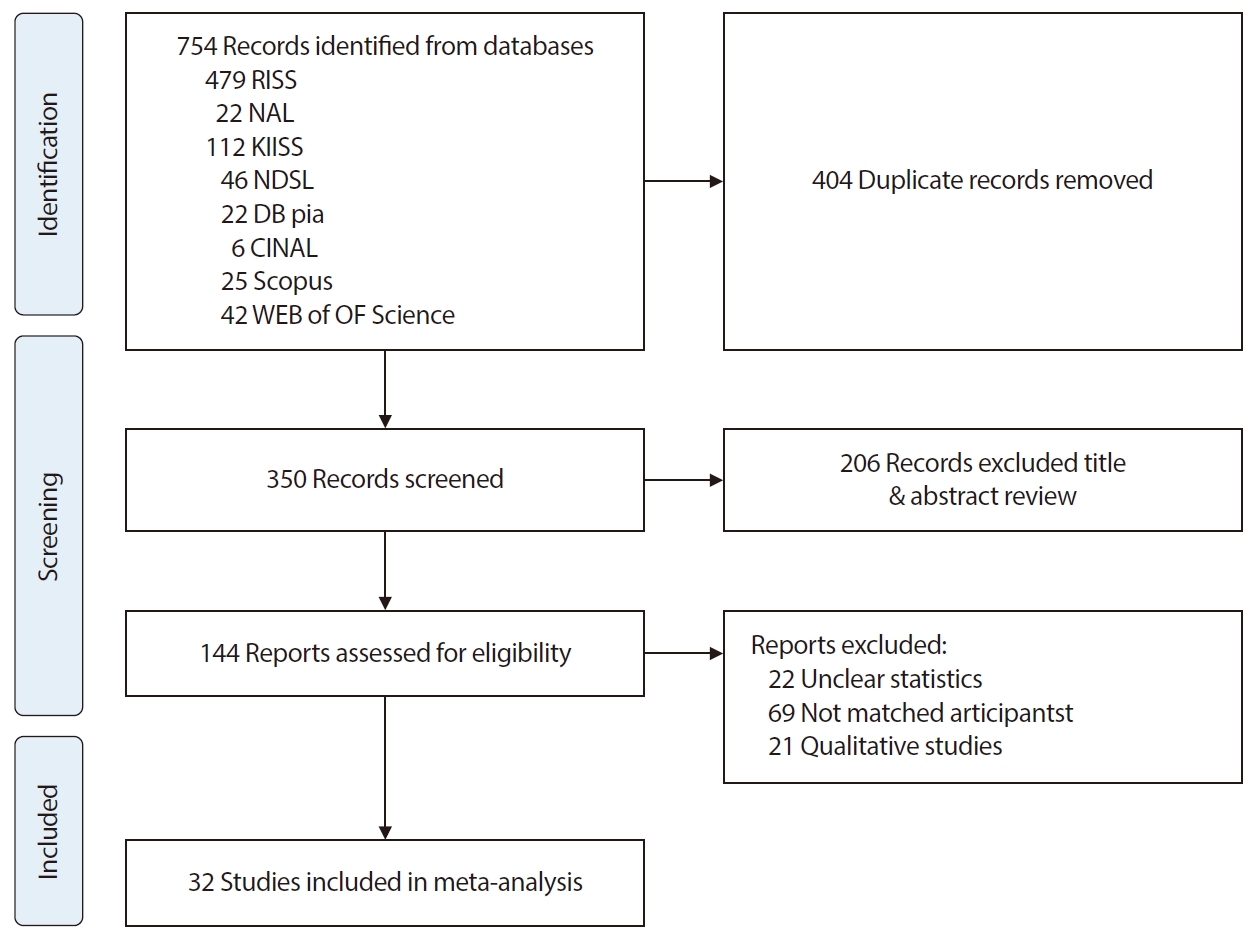
The purpose of this study is to provide academic basic data by quantitatively integrating variables related to information literacy competence of Korean nursing students. Methods: This study is a meta-analysis study to systematically review the research on information literacy competence of Korean nursing students and related variables to identify the effectiveness of each variable group. The selection criteria for the analysis subjects were determined using the PICOS framework in accordance with the PRISMA (Preferred Reporting Items for Systematic Reviews and Meta-Analyses) systematic review reporting guidelines. Theses and journal articles published from September 1, 2024, to September 30, 2024, were searched. Results: The effect sizes of the sub-variables of each variable group showed that the personal thinking competence group showed the largest effect size in the order of problem-solving ability (Fisher’s Z=.90) and critical thinking ability (Fisher’s Z=.57); the professional competence group showed evidence-based practice (Fisher’s Z=.84), clinical performance (Fisher’s Z=.65), learning engagement (Fisher’s Z=.51), communication ability (Fisher’s Z=.49), and academic achievement (Fisher’s Z=.45); and the professional competence group showed privacy awareness (Fisher’s Z=.51), professionalism (Fisher’s Z=.42), and ethical awareness (Fisher’s Z=.41). Conclusion: Based on the results of this study, it is necessary to develop a program to strengthen the information literacy competence of nursing students. Furthermore, there is a need to develop curricula and teaching-learning strategies to enhance information utilization capabilities, along with sustained attention to practice-based educational models tailored to AI and digital environments.
  • 1,156 View
  • 40 Download
Original Articles
Readiness for Practice among Senior Nursing Students in South Korea: A Cross-sectional Study
Jihye Kim, Kyungmi Lee, Hye Suk Jun
J Korean Acad Nurs Adm 2025;31(1):54-63.   Published online January 31, 2025
DOI: https://doi.org/10.11111/jkana.2025.31.1.54
Purpose
Nursing students are future healthcare workers responsible for maintaining public health. Owing to the increase in early resignation among new nurses, nursing education outcomes must be evaluated by investigating students' practice readiness.
Methods
Using convenience sampling, we recruited fourth-year students from two nursing colleges to participate in a cross-sectional online survey in November 2023. The Casey-Fink Readiness for Practice Survey was used to assess practice readiness and the data were analyzed using descriptive statistics, independent t-tests, and ANOVA.
Results
Among the 157 participants (female, 77.7%; mean age, 23.12±1.93 yrs), the overall practice readiness score was 63.53±8.30 (range: 20~80) and the mean subscale score was 23.14±3.73 for clinical problem-solving (range: 7~28), 6.69±1.25 for learning techniques (range: 2~8), 16.87±2.46 for professional identity (range: 5~20), and 16.82±3.46 for trials and tribulations (range: 6~24). Practice readiness did not differ significantly by gender or age and was greater among subgroups with high grades and satisfaction with the major, classroom practice, simulation practice, clinical practice, and lectures.
Conclusion
Universities must improve the quality of classes and practical education to enhance fourth-year nursing students’ practice readiness. Nursing education programs incorporating problem-based learning must be developed and evaluated to strengthen students’ clinical inference and critical-thinking skills.
  • 5,807 View
  • 59 Download
Nursing Students’ Experience of Using Digital Healthcare Applications (DiGA)
Young-Eun Jang, Hwa-Mi Yang
J Korean Acad Nurs Adm 2024;30(4):319-331.   Published online September 30, 2024
DOI: https://doi.org/10.11111/jkana.2024.30.4.319
Purpose
This study examined nursing students' experiences of using digital healthcare applications in terms of the source and demand of socio-psychological needs, expectations, exposures, use satisfaction, and derivative effects based on the components of use satisfaction theory.
Methods
This study was conducted using focus group interviews, and data were collected from 12 nursing students enrolled in two universities located in Seoul and Gyeonggi Province from April 1 to May 31, 2023.
Results
The nursing students mainly used digital healthcare applications to address needs such as sleep, exercise, goal setting, social support, and motivation, which included the need for physical well-being, growth and development, emotional stability, and social needs. Participants met various needs such as achieving goals, feeling of achievement, enhancing self-confidence, and acquiring helpful information through digital healthcare applications. The satisfaction gained in setting and achieving goals was the driving force for motivation.
Conclusion
Nursing students value intuitive interfaces, personalized features, and appropriate notifications. Step-by-step rewards and reasonable pricing are also vital for using digital healthcare apps. These findings should be incorporated into developing programs to improve nursing students' health management and digital healthcare skills.
  • 1,053 View
  • 35 Download
Nursing Students‘Perception of Injustice in Clinical Practice
Hye Young Cho, Kyoung Ah Kang
J Korean Acad Nurs Adm 2023;29(4):433-445.   Published online September 30, 2023
DOI: https://doi.org/10.11111/jkana.2023.29.4.433
Purpose
This study explores nursing students’ perception and experience of injustice in clinical practice and to devise ways to improve the quality and increase satisfaction with clinical practice.
Methods
This study was conducted from December 9-28, 2021 among 22 nursing students with clinical practice experience attending two universities in Jeollabuk-do. Focus group interviews were used for collecting data that were analyzed using qualitative content analysis.
Results
A total of four main analysis units were derived from 220 statements comprising, the original data, and 30 concepts were identified through 112 meaningful statements. The injustice that nursing students perceived during clinical practice consisted of four categories: ‘not respected,’ ‘not guaranteed safety,’ ‘not protected by the system,’ ‘not resolved structural problems in clinical practice.’ Each category was derived from a statement based on the 'injustice in clinical practice' perceived by nursing students in the course of clinical practice.
Conclusion
To maintain quality in clinical practice and promote nursing students’ satisfaction with clinical practice, continuous problem analysis and multilateral efforts of clinical and educational institutions are considered necessary.
  • 691 View
  • 14 Download
A Study on the Outflow Intention of Nursing Students in Non-Metropolitan Area: Honam Region
Purum Kang, A Young Han
J Korean Acad Nurs Adm 2023;29(3):234-245.   Published online June 30, 2023
DOI: https://doi.org/10.11111/jkana.2023.29.3.234
Purpose
Nursing colleges are continuously being expanded to solve the problem of imbalance among regions, but the outflow of the provincial brain-drain to metropolitan regions continues. Therefore, this study aimed to identify the influencing factors on the regional outflow intention of nursing students.
Methods
This study employed a mixedmethod design, and 214 nursing students in the Honam region filled out a self-administered questionnaire. Eight participants recruited through random sampling were interviewed in depth. Data were analyzed using a t-test, x2 test and logistic regression.
Results
Among the total respondents, 161 students (75.2%) had intent to regional outflow. Influencing factors were significantly correlated with employment in tertiary general hospitals (OR=3.32, 95% CI=1.35~8.16), perception of job opportunities in the province (OR=0.52, 95% CI=0.31~0.87), intrinsic job values (OR=2.43, 95% CI=1.14~5.22), and voluntary employment preparation behaviors (OR=2.75, 95% CI=1.05~ 7.19). Through the interviews, themes related to regional outflow intentions were drawn into the following three categories: “recognition of working environment by region”, “aspiration for professional growth”, and “expectation for self-development and rich experience”.
Conclusion
This study’s results are expected to be used as strategic data for establishing plans for nurturing regional human resources and improving the local nursing workforce in non-metropolitan areas.

Citations

Citations to this article as recorded by  
  • Factors Affecting Non-response in a Cohort Study of Female Participants: The Korea Nurses' Health Study (Preprint)
    Young Taek Kim, Chiyoung Prof. Cha, Gumhee Baek, Bohye Kim, Bo Mi Song, Joong-Yeon Lim, Hyun-Young Park, Juhyun Shin
    JMIR Public Health and Surveillance.2024;[Epub]     CrossRef
  • 631 View
  • 15 Download
  • 1 Crossref
The Current Status of Nursing Management Practicum during the COVID-19 Pandemic
Eun A Kim, Yoomi Jung, Miyoung Kim, Jeong Hee Kim, Myonghwa Park, Kyung Ryu
J Korean Acad Nurs Adm 2022;28(4):471-485.   Published online September 30, 2022
DOI: https://doi.org/10.11111/jkana.2022.28.4.471
Purpose
This study was to identify how a nursing management practicum was operated during the COVID-19 pandemic in Korea. Methods: This study surveyed instructors teaching the nursing management practicum with a questionnaire covering five domains and 42 items. The data were analyzed using descriptive statistics and content analysis. Results: The practicum was performed mainly by mixed methods (40.8% and 38.5%), in hospitals only (30.8% and 60.4%), online only (19.8% and 1.1%) in 2020 and 2021, respectively. The mixed methods were most frequently used for instructor teaching and conferences (43.9% and 58.3%). and the average teaching time per week was 9.40 and 8.69 hours per week, respectively. Taking charge in one to three core nursing skill items, 87.8% and 90.1% of the respondents each year performed face to face evaluation for the skills. Four to six out of 12 POs were covered by 58.2% and 54.9% of the participants, respectively, in 2020 and 2021. The greatest difficulty under the pandemic was securing students’ hospital assignments. Conclusion: The nursing management practicum needs to adopt various digital technologies, and create new education models including hybrid ones combining both contact and untact methods to improve the educational effect for the post COVID-19 era.

Citations

Citations to this article as recorded by  
  • The Impact of the COVID-19 Pandemic on Clinical Practice Education in South Korea: A Cross-Sectional Study
    Kuemju Park
    International Journal of Environmental Research and Public Health.2025; 22(4): 577.     CrossRef
  • Effects of stress on burnout among infection control nurses during the COVID-19 pandemic: the mediating effects of social support and self-efficacy
    Su-jin Lee, Ju-Young Park, Seo-Hyeon Kim
    BMC Nursing.2024;[Epub]     CrossRef
  • Development and testing effectiveness of a simulation program to control COVID-19 infections in nursing students
    Kino Kang, Mihae Im, Miyoung Jang, Jaewoon Lee, Okjong Lee
    Journal of Korean Critical Care Nursing.2023; 16(2): 54.     CrossRef
  • 1,534 View
  • 8 Download
  • 3 Crossref
Factors Affecting Willingness to Medical Error-reporting of Nursing Students
Eunsim Kim, Juyoun Yu
J Korean Acad Nurs Adm 2022;28(4):440-450.   Published online September 30, 2022
DOI: https://doi.org/10.11111/jkana.2022.28.4.440
Purpose
This study aimed to identify factors affecting nursing students’ willingness to report medical errors. Methods: A cross-sectional design was used, and 175 senior nursing students answered a web-based questionnaire that included ‘attitude and knowledge towards medical error reporting’, ‘ethical sensitivity’, ‘systems thinking’, and ‘willingness to report medical errors’. Data were analyzed using descriptive statistics, t-test, ANOVA, Pearson’s correlation coefficients, and multiple linear regressions with the SPSS/WIN 25.0 program. Results: Participants’ attitude and knowledge toward medical error-reporting were 3.45, and 3.00, respectively. Their ethical sensitivity was 4.15, and systems thinking was 3.89. Factors significantly affecting willingness to report adverse events included systems thinking, medical error-reporting attitude, and ethical sensitivity, and these variables accounted for 34.3% (F=23.73, p<.001). Factors significantly affecting willingness to report near misses included medical error-reporting attitude, which accounted for 11.5% (F=6.68, p<.001). Conclusion: Increasing nursing students’ willingness to report medical errors requires integrated education to improve their attitude and knowledge of medical error reporting, ethical sensitivity, and systems thinking.

Citations

Citations to this article as recorded by  
  • Impact of Nursing Professionalism, Ethical Sensitivity, and the Clinical Learning Environment on Nursing Students' Intention to Report Near Misses and Adverse Events
    Sookhee Yoon, Ha-Young Park
    Journal of Korean Academy of Fundamentals of Nursing.2025; 32(2): 209.     CrossRef
  • Nursing Informatics Competencies of Public Health Nurses in Chungcheongnam-do
    Hyun Kim, Miyoung Kim
    Journal of Korean Academy of Community Health Nursing.2013; 24(1): 20.     CrossRef
  • 834 View
  • 23 Download
  • 2 Crossref
Nursing Students’ Orientation toward Patient-Centered Care: Testing the Effects of Empathy and Psychological Capital Using a Mediation Model
Myonghwa Park, Thi-Thanh-Tinh Giap, Eungyung Kim, Kyoungja Kim, Eunkyong Ahn, Namyoung Yang, Mi Hyang Lee, Eunyoung Jeong
J Korean Acad Nurs Adm 2022;28(4):361-370.   Published online September 30, 2022
DOI: https://doi.org/10.11111/jkana.2022.28.4.361
Purpose
This study aims to determine nursing students’ orientation toward patient-centered care (PCC) and identify its influencing factors: their personality traits, empathy, and psychological capital (PsyCap). A mediating model was used to test the role of PsyCap in the association between empathy and PCC. Methods: This cross-sectional study included 300 nursing students from seven universities in South Korea. Their orientation toward PCC was measured using the Patient-Practitioner Orientation Scale (PPOS). Moreover, we analyzed the data using independent t-tests, ANOVA, Pearson's r, and SPSS PROCESS macro. Results: The overall mean score on the PPOS was 3.82±0.43, with the Caring and Sharing subscales accounting for 3.95±0.68 and 3.69±0.50, respectively. Nursing students’ satisfaction with their majors, practicums, and motivation for choosing this profession was significantly related to Caring-not Sharing. Nevertheless, PsyCap positively influenced both Caring (β=.24, p<.001) and Sharing (β=.18, p=.002). While empathy failed to significantly impact both Caring (β=.12, p=.087) and Sharing (β=.01, p=.931). PsyCap mediated the association of empathy with Caring (β=.20, p=.004); however, the same was not true for Sharing (β=.07, p=.366). Conclusion: The findings indicate that the orientation of Korean nursing students toward PCC is not high. Therefore, to improve the PPOS Caring subscale, nurse educators should formulate better strategies to enhance nursing students’ satisfaction with their major and practicums, empathy, and PsyCap. The importance of sharing health-related information with patients and family caregivers should be emphasized in the nursing curriculum.

Citations

Citations to this article as recorded by  
  • Assessing Needs for Practical Training in Intensive Care Unit to Enhance Nursing Education: A Focus Group Interview
    Sunah Park, Bokyoung Kim
    Journal of Korean Critical Care Nursing.2024; 17(2): 55.     CrossRef
  • Contemporary contexts of higher medical education development: Patient-centred care in medical students’ understanding
    T. D. Podkladova, L. G. Smyshliaeva, A. O. Okorokov, I. I. Soshenko
    The Education and science journal.2023; 25(9): 44.     CrossRef
  • 1,248 View
  • 13 Download
  • 2 Crossref
Effect of Pro-Social Behavior and Self-Determination on Life Satisfaction among Nursing Students
Chung Hee Woo, Hye Young Cho
J Korean Acad Nurs Adm 2022;28(3):251-260.   Published online June 30, 2022
DOI: https://doi.org/10.11111/jkana.2022.28.3.251
Purpose
This study aimed to identify pro-social behavior, self-determination, and life satisfaction status among nursing students, and to analyze the relationships between these variables and their effects on nursing students’ life satisfaction. Methods: It was conducted from January 10 to January 19, and data from 210 nursing students were collected through the online survey system of an Internet portal site. Results: As a result of the study, pro-social behavior and self-determination (autonomy, competence, relationship (s)), and life satisfaction showed a statistically significant positive correlation with each other. Competence (p<.001) and relationships (p=.018), affected nursing students‘life satisfaction. The higher the competence (B=0.41), the stronger the relationships. Further, the higher the score (B=0.21), the higher the satisfaction. Additionally, it was found that the effect of competence (β=.40) on life satisfaction was higher than that of relationships on life satisfaction (β=.16). Pro-social behavior did not affect nursing students’ life satisfaction (p=.654). Conclusion: Through the results of this study, we suggest the need for efforts to improve nursing students’ life satisfaction by developing and applying various programs that can increase self-determination in the nursing education process.

Citations

Citations to this article as recorded by  
  • The mediating effect of grit and social support on the relationship between self-determination and life satisfaction in nursing students
    Seojin Oh, Hyeyoung Cho
    The Journal of Korean Academic Society of Nursing Education.2023; 29(3): 281.     CrossRef
  • The mediating effect of the positive psychological capital between self-determination and grit in nursing students
    Chul-Gyu Kim, Su-Jeong Jeong
    The Journal of Korean Academic Society of Nursing Education.2023; 29(4): 362.     CrossRef
  • 521 View
  • 12 Download
  • 2 Crossref
Examining Students’ Experience with the Nursing Management Practicum Based on the Service Design
Yoomi Jung, Myungja Kim
J Korean Acad Nurs Adm 2022;28(3):214-227.   Published online June 30, 2022
DOI: https://doi.org/10.11111/jkana.2022.28.3.214
Purpose
This study aimed to identify nursing students’ experience with the Nursing Management Practicum based on the service design concept to provide a basis for an ideal subject design. Methods: This study was a qualitative research that analyzed the experience of students and their clinical instructors based on the blueprint of Nursing Management Practicum. Focus group interviews were conducted with 13 graduates from two nursing schools and 11 clinical instructors from three hospitals. Results: The students went through six stages during the practicum. They met clinical instructors during the ward orientation and learning activities in wards and met school instructors during the general orientation and conference. The students perceived the learning activities and teaching from the clinical instructors in wards as the most important practicum factors. Conclusion: This study provided information which helped us to understand nursing students’ experience with the Nursing Management Practicum as the time passed by. This information can be used to improve students’ experience with the practicum and convert the subject into a more learner-centered education.
  • 970 View
  • 7 Download
Effect of Infection Control Education Based on Isolation Room-Simulation for Nursing Students
Insook Jang, Myonghwa Park
J Korean Acad Nurs Adm 2021;27(5):379-389.   Published online December 31, 2021
DOI: https://doi.org/10.11111/jkana.2021.27.5.379
Purpose
This study aimed to analyze the effects of infection control education (ICE) prospectively, based on isolation room simulation for nursing college students. Methods: From September 21 to 30 2020, a total of 97 students in the 4th grade of nursing college located in D city, were enrolled (48 in the experimental group and 49 in the control group). The experimental group received an isolation room simulation for ICE. The control group conducted an objective structured clinical evaluation for the same education. The effects after education were evaluated using the items of awareness of standard precaution, knowledge of wearing personal protective equipment (PPE), and confidence in wearing it. Results: There was no statistically significant difference in the awareness of standard precautions between the two groups, and the knowledge of wearing PPE was significantly higher in the experimental group (t=-3.41, p<.001) after education. The confidence score for wearing PPE was also significantly higher in the experimental group (t=-2.23, p=.028). Conclusion: The ICE using the isolation room simulation can be effective for knowledge and confidence regarding the aspect of wearing PPE for nursing students, during and after the pandemic.

Citations

Citations to this article as recorded by  
  • Empowering hospital-associated infection prevention and control: A quasi-experimental study on the effect of scenario-based simulation training
    Soon-Hee Lee, In-Suk Yang
    Nurse Education in Practice.2024; 76: 103936.     CrossRef
  • Development and Implementation of a Mobile-Integrated Simulation for COVID-19 Nursing Practice: A Randomized Controlled Pretest–Posttest Experimental Design
    Sun-Hwa Lee, Jeong-Sil Choi
    Healthcare.2024; 12(4): 419.     CrossRef
  • Development and Evaluation of Infection Control Nursing Simulation Education Program for Nurses in a NICU
    Min-hee Cho, Sunghee Kim
    Journal of Korea Society for Simulation in Nursing.2024; 12(2): 1.     CrossRef
  • Effect of Infection Control Simulation Based on a Negative Pressure Isolation Room Using Mixed Reality
    Kyeng-Jin Kim, Joonyoung Lee, Moon-Ji Choi
    CIN: Computers, Informatics, Nursing.2024; 42(8): 608.     CrossRef
  • Development and Evaluation of Infection Control Education Contents Using Virtual Reality
    Kyeng-Jin Kim
    Journal of Digital Contents Society.2023; 24(11): 2711.     CrossRef
  • Effect of Infection Control Education Based on Digital Story-telling for New Graduate Nurses
    Nuri Han, Ji-Hyun Kim, Insook Jang
    Journal of Korean Academy of Fundamentals of Nursing.2022; 29(4): 517.     CrossRef
  • 910 View
  • 43 Download
  • 6 Crossref
Purpose
The purpose of this study was to investigate the association between self-control, social responsibility, transformational leadership, and career preparation behavior, and to identify factors influencing career preparation behavior.
Methods
The participants were 215 nursing students in one university located in J-city. Data collection was conducted between June 1st and June 19th, 2020, and was analyzed using independent t-test, one way ANOVA, Scheffé test, Pearson correlation coefficients, and stepwise multiple regression analysis with SPSS/WIN 20.0.
Results
The career preparation behavior showed a significant positive correlation with social responsibility (r=.44, p<.001), and transformational leadership (r=.44, p<.001). The significant predictors of career preparation behavior were academic year (β=.36, p<.001), social responsibility (β=.28, p=.002), transformational leadership (β=.25, p=.004), and reason for application (β=.14, p=.015). These factors explained 36.0% of the career preparation behavior in the regression model (F=19.87, p<.001).
Conclusion
The findings indicate that grade, social responsibility, transformational leadership, and reason for application impact career behavior preparation. It is necessary to provide systematic career preparation behavior programs considering academic year, social responsibility, transformational leadership, and reason for application of nursing students.

Citations

Citations to this article as recorded by  
  • The relationship between professional self-concept and responsibility with nursing students’ clinical performance of Bushehr University of Medical Sciences
    Niloufar Hajipour, Shahnaz Pouladi, Marzieh Mahmoudi, Sherafat Akaberian
    Journal of Education and Health Promotion.2025;[Epub]     CrossRef
  • Career choice experiences of nursing students
    Hyun Ju Kim, Ji Hyun Kim
    The Journal of Korean Academic Society of Nursing Education.2022; 28(2): 127.     CrossRef
  • 639 View
  • 33 Download
  • 2 Crossref
Development of a Simulation Program related to Patient Safety: Focusing on Medication Error
Mi Yu, Eun-Young Kim, Jong Kyung Kim, Youngjin Lee
J Korean Acad Nurs Adm 2021;27(2):107-117.   Published online March 31, 2021
DOI: https://doi.org/10.11111/jkana.2021.27.2.107
Purpose
Ensuring patient safety is an essential professional competency that is conceptualized and developed during undergraduate nursing education. To reduce the incidence of preventable medication errors, it is critical to learn how errors are made and the importance of collaboration with healthcare workers. This study was done to develop a simulation program related to the medication process and improving patient safety in nursing students.
Methods
This methodological study was designed to develop a simulation program on teaching preventable medication errors and communication among nurses, doctors, pharmacists and nurse managers in the nursing management curriculum of colleges of nursing. The design included creation of two scenarios. Guideline-based scenarios were verified by nursing experts using the three-round Delphi method.
Results
The two scenarios using high-fidelity patient simulators or standard patients address ‘resolving medication errors related to patients’ identification and history, and reporting safety incidents’ and ‘resolving medication errors related to medication prescription and dispensing, and reporting safety incidents’.
Conclusion
This simulation program supports practical education for nursing students in the nursing management course and novice nurses in patient safety-related education.

Citations

Citations to this article as recorded by  
  • Effectiveness of room-of-error interventions for healthcare providers: a systematic review
    Su Jin Jung, Jiwon Kang, Youngjin Lee
    BMC Nursing.2025;[Epub]     CrossRef
  • Mediating effect of grit on the influence of nurses’ silence behavior on medication safety competence: a cross-sectional study
    Haengsuk Kim, Wanju Park
    Journal of Korean Academy of Nursing.2025; 55(1): 81.     CrossRef
  • Development and Effectiveness of Progressive Simulation Education Program on Medication Safety for Nursing Students
    Se-Young Jung, Eun-Young Kim
    Journal of Korean Academy of Nursing.2024; 54(4): 563.     CrossRef
  • The effects of flipped learning and gamification on nursing students’ patient safety education: A mixed method study
    Soo Jung Chang, Geun Myun Kim, Jeong Ah Kim
    Heliyon.2024; 10(8): e29538.     CrossRef
  • Patient safety interprofessional education program using medical error scenarios for undergraduate nursing and medical students in Korea
    Hea Kung Hur, Ki Kyong Kim, Young Mi Lim, Junghee Kim, Kyung Hye Park, Yon Chul Park
    Journal of Interprofessional Care.2023; 37(6): 944.     CrossRef
  • Efficacy of an error reporting-based education program on nursing students’ skill confidence, immersion, and satisfaction
    Youngsook Lim, Sunae Kim, Ohsoon Yoon, SunJung Park
    International Journal of ADVANCED AND APPLIED SCIENCES.2023; 10(10): 200.     CrossRef
  • Capturing New Nurses' Experiences and Supporting Critical Thinking
    Sun Hee Seon, Hye Won Jeong, Deok Ju, Jung A. Lee, Shin Hye Ahn
    CIN: Computers, Informatics, Nursing.2023; 41(6): 434.     CrossRef
  • Patient Safety Error Reporting Education for Undergraduate Nursing Students: A Scoping Review
    Mi Ok Song, So Young Yun, Aeri Jang
    Journal of Nursing Education.2023; 62(9): 489.     CrossRef
  • Effects of “Room of Errors” Simulation Education for Nursing Students on Patient Safety Management Behavior Intention and Confidence in Performance
    Sun-Young Jung, Hee-Jung Kim, Eun-Kyung Lee, Ji-Hyun Park
    Journal of Korea Society for Simulation in Nursing.2023; 11(2): 107.     CrossRef
  • Content Analysis of Feedback Journals for New Nurses From Preceptor Nurses Using Text Network Analysis
    Shin Hye Ahn, Hye Won Jeong
    CIN: Computers, Informatics, Nursing.2023; 41(10): 780.     CrossRef
  • 1,790 View
  • 151 Download
  • 10 Crossref
Purpose
This study was done to identify the mediating effect of biomedical ethics awareness in the relationship between moral sensitivity and perceived ethical confidence among nursing students. Methods Participants were 211 nursing students from 7 universities in G city. A self-report questionnaire was used to measure moral sensitivity, biomedical ethics awareness, and perceived ethical confidence. The data were analyzed with descriptive statistics, Pearson correlation coefficient analysis, and multiple regression analysis using Baron and Kenny's method. Results Moral sensitivity was significantly positively correlated with biomedical ethics awareness (r=.52, p<.001) and perceived ethical confidence (r=.60, p<.001). Biomedical ethics awareness was also significantly correlated with perceived ethical confidence (r=.50, p<.001). Also, biomedical ethics awareness (β=.25, p<.001) showed a partial mediating effect on the relationship between moral sensitivity and perceived ethical confidence. Conclusion The impact of moral sensitivity on perceived ethical confidence in nursing students was mediated by biomedical ethics awareness. Therefore, it is suggest that strategies for improving biomedical ethics awareness in nursing students should be considered when developing an educational program for enhancing their perceived ethical confidence.

Citations

Citations to this article as recorded by  
  • Assessing the relationship between ethical reasoning confidence and self-esteem among female nursing students for enhancing the quality of work life: A cross-sectional study
    Shaherah Yousef Andargeery, Sally Mohammed Farghaly Abdelaliem
    Medicine.2024; 103(14): e37614.     CrossRef
  • Mediating effect of moral sensitivity on the relationship between nursing professionalism and ethical decision-making confidence in nursing students
    Bae-Hwa Kang, Hye-Young Cho
    The Journal of Korean Academic Society of Nursing Education.2023; 29(2): 180.     CrossRef
  • The impact of nursing students’ biomedical and artificial intelligence ethical awareness, ethical values, and professional self-concept on their ethical decision-making confidence
    Seungmi Park, Insun Jang
    The Journal of Korean Academic Society of Nursing Education.2023; 29(4): 371.     CrossRef
  • 815 View
  • 32 Download
  • 3 Crossref
Development of the Nursing Start-up Attitude Scale for Student Nurses
Ji Young Lim, Geun Myun Kim, Eun Joo Kim
J Korean Acad Nurs Adm 2020;26(4):388-399.   Published online September 30, 2020
DOI: https://doi.org/10.11111/jkana.2020.26.4.388
Purpose
The purpose of this study was to develop and psychometrically test the nursing start-up attitude scale for student nurses.
Methods
The initial items were based on the second analysis of systematic review of previous studies and in-depth interview data with 9 nurse entrepreneurs. In total, 25 items were derived based on the pilot survey. Psychometric testing was conducted with 324 student nurses. Data were analyzed using validity and reliability test methods.
Results
Six factors, including 12 items explaining 74.4% of the total variance, were verified. The factors were opportunity of self actualization, network building, enhacing start-up competencies, outcomes of start-up, preparation for start-ups, and risk taking. Cronbach's ⍺ was .75.
Conclusion
As validity and reliability have been verified through various methods, the developed scale in this study can contribute to assessing student nurses’ attitudes to nursing start-ups.

Citations

Citations to this article as recorded by  
  • Psychometric properties of the nursing start-up attitude scale in Iranian nursing students
    Iman Jafari, Mehdi Jafari-Oori, Abbas Ebadi
    BMC Nursing.2025;[Epub]     CrossRef
  • 593 View
  • 16 Download
  • 1 Crossref
Purpose
This study was done to explore research trends on start-up intention of college students in Korea.
Methods
Articles published from 2014 to 2018 were searched. Search term was “start-up intention.” At the first search, 2,137 articles were extracted from academic databases (DB). One hundred forty six articles were used in the systematic review and 88 articles were used in the meta analysis.
Results
There were 384 variables explored in relation to start-up intention. In the correlation and regression analysis, self efficacy and risk taking showed statistical significance in most research. In the meta analysis, career orientation, start-up preparation behavior, and start-up attitude showed statistical significant effect size.
Conclusion
We propose that structural equation model analysis be conducted to find causal relation among variables affecting start-up intention of college students. This will contribute to development of theoretical models for the activation of nursing entrepreneurship.

Citations

Citations to this article as recorded by  
  • Factors Affecting Entrepreneurial Intention of Clinical Nurses in Korea: A Cross-sectional Study
    Jieon Hong, Yunsoo Kim, Kyu Eun Lee
    Journal of Health Informatics and Statistics.2023; 48(4): 382.     CrossRef
  • 675 View
  • 8 Download
  • 1 Crossref
Factors Affecting the Patient Safety Management Activity of Nursing Students: A Quantile Regression Approach
Myungsuk Kang, Yeonsoo Jang, Ui Rim Song
J Korean Acad Nurs Adm 2020;26(3):230-240.   Published online June 30, 2020
DOI: https://doi.org/10.11111/jkana.2020.26.3.230
Purpose
The purpose of this study was to identify factors affecting the Patient Safety Management Activity (PSMA) of nursing students according to levels of PSMA based on the Theory of Planned Behavior (TPB).
Methods
A descriptive study was used. The participants were 135 nursing students from universities in Korea. Data were collected with self-reported questionnaires through online survey. The questionnaire consisted of PSMA scale and modified version of the TBP-based questionnaire. Data were analyzed using multiple linear regression and quantile regression.
Results
The average score of PSMA was 4.09±0.44 out of 5 points. In the multiple linear regression, patient safety education, subjective norm, perceived behavioral control and intention were significant factors. In the quantile regression, place of clinical practice (in 75%), patient safety education (in 50% and 90%), subjective norm (in 75%), perceived behavioral control (in 50% and 75%) and intention (in 50%) were significant factors.
Conclusion
We confirmed the dynamic influences of all factors according to the levels of PSMA. It is proposed that the affecting factors according to the levels of PSMA should be considered in designing effective programs to enhance PSMA among nursing students.

Citations

Citations to this article as recorded by  
  • Effects of “Room of Errors” Simulation Education for Nursing Students on Patient Safety Management Behavior Intention and Confidence in Performance
    Sun-Young Jung, Hee-Jung Kim, Eun-Kyung Lee, Ji-Hyun Park
    Journal of Korea Society for Simulation in Nursing.2023; 11(2): 107.     CrossRef
  • Development and Evaluation of Patient Safety Education Program for Undergraduate Nursing Students
    Hyun Ju Kim, Young Soon Jung, Yu Kyung Park
    The Korean Journal of Rehabilitation Nursing.2023; 26(1): 39.     CrossRef
  • Development and psychometric evaluation of Clinical Practice Self-Efficacy Scale for nursing students
    Heejung Choi, Sueun Kim, Harim Jeong
    The Journal of Korean Academic Society of Nursing Education.2022; 28(3): 236.     CrossRef
  • 823 View
  • 29 Download
  • 3 Crossref
Nursing Students' Communication Experience with Professor
Kwang-Ok Park, Jong Kyung Kim
J Korean Acad Nurs Adm 2020;26(3):205-217.   Published online June 30, 2020
DOI: https://doi.org/10.11111/jkana.2020.26.3.205
Purpose
The aim of this study was to gain in-depth understanding and insight into how student nurses experienced communication with professors.
Methods
The research method was a qualitative study in which data were collected and analyzed through in-depth interviews with individual students. Colaizzi's phenomenological research method was used. The participants in this study were students who graduated from the nursing department and were considered able to describe the communication experience between professors and students in the college of.nursing.
Results
The analysis showed that the communication experiences between professors and students who had graduated from the college of nursing consisted of six themes for a total of 15 themes clusters and 78 meaningful statements. The 6 theme-clusters were ‘invisible barrier between participant and professors’, ‘motivational driving force’, ‘enrich meta cognition through experiential discourse’, ‘having a dream of lifelong development’, ‘wanting to have meaningful encounters’.
Conclusion
The participants were not able to easily form relationships with the professors of the college of nursing during their academic life, but they learned the practical know-how from the strengths and experiences of the professors that led them from beginning student to graduate nurse.

Citations

Citations to this article as recorded by  
  • The college life experiences of nursing students who are North Korean defectors: A thematic analysis study
    Da-Eun Seo, Kyung-Sook Bang, Hyunju Kang
    The Journal of Korean Academic Society of Nursing Education.2025; 31(1): 96.     CrossRef
  • Nursing faculty’s experiences of teaching North Korean defector nursing students
    Kyung-Sook Bang, Hyunju Kang, Da-Eun Seo
    The Journal of Korean Academic Society of Nursing Education.2025; 31(2): 183.     CrossRef
  • 948 View
  • 6 Download
  • 2 Crossref
Nursing Students' Knowledge, Attitudes to Advance Medical Directives and Ethics Values
Hyun Ju Lee, Jae Hyun Ha, Jungmi Yun
J Korean Acad Nurs Adm 2019;25(4):282-291.   Published online September 30, 2019
DOI: https://doi.org/10.11111/jkana.2019.25.4.282
PURPOSE
The purpose of this study was to identify the relationships among nursing students' knowledge, attitudes to advance medical directives and ethics values.
METHODS
The study was a cross-sectional and descriptive survey, carried out with 232 students from two schools of nursing, one located in B and C city. Student nurses' knowledge, attitudes for advance medical directives and ethics values were measured using structured self-report questionnaires. Data were analyzed using t-test or one-way ANOVA, and Pearson correlation coefficients.
RESULTS
The scores for knowledge, attitudes for medical advance directives were 7.18 and 3.07, and for ethics values, 3.47. Nursing students' knowledge and attitude showed a significant difference depending on grade. Nursing students' ethics values showed significant differences depending on whether a study on ethics had been completed. A positive correlation was observed between nursing students' knowledge, attitudes for advance medical directives and ethics values.
CONCLUSION
The results of this study indicate that basic data for the development of an effective education program on ethics is important in establishing a positive attitude toward advance medical directives and the appropriate ethical values in student nurses.

Citations

Citations to this article as recorded by  
  • Factors Associated with Family Caregivers’ Intentions to Complete an Advance Directive for Individuals with Dementia: A Cross-Sectional Descriptive Study
    Hyeseon Park, Sujin Kang, Youngji Kim
    Healthcare.2025; 13(11): 1297.     CrossRef
  • Knowledge, Attitudes and Nursing Stress Related to Life-Sustaining Treatment among Oncology Nurses
    Seul Lee, Suyoun Hong, Sojung Park, Soojung Lim
    The Journal of Hospice and Palliative Care.2023; 26(3): 112.     CrossRef
  • Determinants of nursing students’ inclination to ethical values: Compassionate love and perceived social support from the family
    Neslihan Lok, Gülten Uzun, Alime Selçuk Tosun
    Nurse Education in Practice.2023; 67: 103556.     CrossRef
  • Health Personnel's Knowledge, Attitudes, and Self-Efficacy Related to Providing Palliative Care in Persons with Chronic Diseases
    EunSeok Cha, Sojung Lee, Jooseon Lee, Insil Lee
    The Korean Journal of Hospice and Palliative Care.2020; 23(4): 198.     CrossRef
  • Effects of Awareness to Well-dying, Knowledge and Attitudes toward Advance-directives on Attitude toward End-of-life Care in Nursing Students
    Insun Jang, Youngji Kim
    The Korean Journal of Rehabilitation Nursing.2019; 22(2): 104.     CrossRef
  • 533 View
  • 12 Download
  • 5 Crossref
Experience of Nursing Management Practice in Graduate Nurses
Kwang Ok Park, Jong Kyung Kim
J Korean Acad Nurs Adm 2019;25(4):259-271.   Published online September 30, 2019
DOI: https://doi.org/10.11111/jkana.2019.25.4.259
PURPOSE
The purpose of this qualitative study was to evaluate nursing students' experience during nursing management practicum.
METHODS
Data were collected from 10 in-depth interviews. The main question was “Could you describe your experience during the nursing management practicum?” The qualitative data from the field notes and transcriptions of the interviews were analyzed using Colaizzi's method.
RESULTS
The experiential themes of students' experience during a nursing management practicum were ‘differentiate clinical practice which is immersed in the nursing management process’, ‘understand nurse managers’ leadership qualities and influence of communication', ‘understand why the general nurse engages in management tasks on duty’, ‘gain insight into organizational operations from new and diverse perspectives’, ‘engage in nursing practice through abundant interaction’.
CONCLUSION
The results show that the nursing management practicum focuses on the management of nurses and nurse manager, so instruction and guidance by professors and practicing leaders is needed for students to practice these goals, In addition, in the clinical practice field, students should be provided with a practical environment and guidance in accordance with the goal of management practice.

Citations

Citations to this article as recorded by  
  • Efecto del Aprendizaje Basado en Problemas en habilidades de Gestión del Cuidado: Estudio cuasiexperimental
    Luis Angel Benítez-Chavira, Rosa Amarilis Zárate-Grajales, María Guadalupe Moreno-Monsiváis, Cecilia Xochitl Vite-Rodríguez, Carlota Mercedes Hernández-Rosales, Carlos Emmanuel Brito-Carbajal
    Revista Latino-Americana de Enfermagem.2023;[Epub]     CrossRef
  • O efeito da Aprendizagem Baseada em Problemas nas habilidades de Gestão do Cuidado: Estudo quase-experimental
    Luis Angel Benítez-Chavira, Rosa Amarilis Zárate-Grajales, María Guadalupe Moreno-Monsiváis, Cecilia Xochitl Vite-Rodríguez, Carlota Mercedes Hernández-Rosales, Carlos Emmanuel Brito-Carbajal
    Revista Latino-Americana de Enfermagem.2023;[Epub]     CrossRef
  • The effect of Problem-Based Learning on Care Management skills: A quasi-experimental study
    Luis Angel Benítez-Chavira, Rosa Amarilis Zárate-Grajales, María Guadalupe Moreno-Monsiváis, Cecilia Xochitl Vite-Rodríguez, Carlota Mercedes Hernández-Rosales, Carlos Emmanuel Brito-Carbajal
    Revista Latino-Americana de Enfermagem.2023;[Epub]     CrossRef
  • Examining Students’ Experience with the Nursing Management Practicum Based on the Service Design
    Yoomi Jung, Myungja Kim
    Journal of Korean Academy of Nursing Administration.2022; 28(3): 214.     CrossRef
  • The Current Status of Nursing Management Practicum during the COVID-19 Pandemic
    Eun A Kim, Yoomi Jung, Miyoung Kim, Jeong Hee Kim, Myonghwa Park, Kyung Ryu
    Journal of Korean Academy of Nursing Administration.2022; 28(4): 471.     CrossRef
  • 847 View
  • 6 Download
  • 5 Crossref
PURPOSE
The study was done to investigate the mediating effects of voice behavior on the relationships between empathy and fairness and intention in helping behavior of nursing students.
METHODS
A structured self-report questionnaire was used to measure empathy, fairness, voice behavior and intention in helping behavior. During November 2018, data were collected from 128 nursing students in D and G cities. Data were analyzed using hierarchical multiple linear regression with the SPSS/WIN 24.0 program.
RESULTS
Empathy, fairness and voice behavior were positively correlated with intention in helping behavior of participants and voice behavior was positively correlated with empathy, fairness and intention in helping behavior of participants respectively. Also, voice behavior had a partial mediating effect on the relationship between empathy, fairness and intention in helping behavior.
CONCLUSION
Findings indicate that empathy and fairness are important factors related to the intention in helping behavior of nursing students. It is also expected that voice behavior can further promote the intention in helping behavior of nursing students.

Citations

Citations to this article as recorded by  
  • Social status mediates the propagation of unfairness
    Hyeran Kang, JuYoung Kim, Daeeun Kim, Hackjin Kim
    Frontiers in Psychology.2024;[Epub]     CrossRef
  • Factors influencing ethnic minority students' helping behavior in cyberbullying: perceived severity of cyberbullying from various perspectives, the online disinhibition effect, and parental online discipline style
    Chiao Ling Huang, Yilihamu Alimu, Shu Ching Yang
    European Journal of Psychology of Education.2024; 39(3): 1889.     CrossRef
  • Empathy and teachers’ fairness behavior: The mediating role of moral obligation and moderating role of social value orientation
    Youjuan Hong, Jingxue Cai, Ruiming Lan, Kaixuan Wang, Rong Lian, Lijun Chen, Sónia Brito-Costa
    PLOS ONE.2022; 17(6): e0268681.     CrossRef
  • Factors affecting adjustment of first-year nursing students to college life: A descriptive correlational study
    Ju Young Park, OiSaeng Hong
    Nurse Education Today.2021; 102: 104911.     CrossRef
  • The Influence of Voice Behavior, Self-esteem and Sexual Knowledge on Sexual Assertiveness of Nursing College Students
    Chung Hee Woo, Ju Young Park
    Journal of Korean Academic Society of Nursing Education.2019; 25(4): 405.     CrossRef
  • 415 View
  • 5 Download
  • 5 Crossref
Factors Influencing Entrepreneurial Intention of Nursing Students Based on Theory of Planned Behavior
Ye Jung Kim, Ji Young Lim
J Korean Acad Nurs Adm 2019;25(3):175-185.   Published online June 30, 2019
DOI: https://doi.org/10.11111/jkana.2019.25.3.175
PURPOSE
Based on the theory of planned behavior, the purpose of this study was to investigate factors influencing entrepreneurial intention in nursing students.
METHODS
Convenience sampling was used to recruit 434 participants from five nursing departments. The investigators used self-report questionnaires. The data were collected from October 25 to November 25, 2018. Data were analyzed using descriptive statistics and three-step hierarchical regression analysis.
RESULTS
Attitude, subjective norm, and perceived behavior control of the theory of planned behavior, and role model showed a significant effect on entrepreneurial intention. The explanatory power of the whole model was 63%.
CONCLUSION
Based on the results of this study, we propose developing a nursing entrepreneurial education model focusing on attitude, subjective norm, and perceived behavior control in the theory of planned behavior.

Citations

Citations to this article as recorded by  
  • Factors Affecting Entrepreneurial Intention of Clinical Nurses in Korea: A Cross-sectional Study
    Jieon Hong, Yunsoo Kim, Kyu Eun Lee
    Journal of Health Informatics and Statistics.2023; 48(4): 382.     CrossRef
  • Entrepreneurship among Undergraduate Nursing Students at a public university
    Rafael Marcelo Soder, Caroline Egger Cordeiro Cechet, Giovana Dorneles Callegaro Higashi, Luiz Anildo Anacleto da Silva, Thayza Mirela Oliveira Amaral, Jouhanna do Carmo Menegaz, Alacoque Lorenzini Erdmann, José Luís Guedes dos Santos
    Revista Brasileira de Enfermagem.2022;[Epub]     CrossRef
  • How curriculum delivery translates into entrepreneurial skills: The mediating role of knowledge of information and communication technology
    Javed Iqbal, Xie Yi, Muhammad Azeem Ashraf, Ruihua Chen, Jin Ning, Shahnaz Perveen, Zahid Imran, Alessandro Margherita
    PLOS ONE.2022; 17(5): e0265880.     CrossRef
  • Predictive Models for Nurses’ Entrepreneurial Intentions Using Comparison of Competing Models
    Ye-Jung Kim, Ji-Young Lim
    International Journal of Environmental Research and Public Health.2022; 19(10): 6027.     CrossRef
  • Entrepreneurial tendency of Nursing students: a comparison between graduating beginners and undergraduate students
    Liana Amorim Corrêa Trotte, José Luís Guedes dos Santos, Caroline Ferreira Neris Sarat, Maria Gefé da Rosa Mesquita, Marluci Andrade Conceição Stipp, Patrícia de Souza, Quézia Guedes de Mello Duarte, Bruno de Campos Gobato, Claudia Feio da Maia Lima
    Revista Latino-Americana de Enfermagem.2021;[Epub]     CrossRef
  • Predictors of Entrepreneurial Intention of Nursing Students Based on Theory of Planned Behavior
    Ji Young Lim, Geun Myun Kim, Eun Joo Kim
    Journal of Multidisciplinary Healthcare.2021; Volume 14: 533.     CrossRef
  • The effects of the Start-Up NurseS program on nursing students using management strategy simulation
    Ji Young Lim, Juhang Kim, Seulki Kim
    Nurse Education Today.2021; 105: 105020.     CrossRef
  • Development of the Nursing Start-up Attitude Scale for Student Nurses
    Ji Young Lim, Geun Myun Kim, Eun Joo Kim
    Journal of Korean Academy of Nursing Administration.2020; 26(4): 388.     CrossRef
  • 598 View
  • 10 Download
  • 8 Crossref
Influence of Metacognition and Emotional Intelligence on Self-leadership in Nursing Students
Myoung Sook Kim
J Korean Acad Nurs Adm 2019;25(2):146-155.   Published online March 31, 2019
DOI: https://doi.org/10.11111/jkana.2019.25.2.146
PURPOSE
This study was conducted to examine the relationship among metacognition, emotional intelligence, and self-leadership in nursing students, and to investigate factors influencing self-leadership.
METHODS
A descriptive survey design was used for this study. Participants were 216 nursing students in one university located in J-city, in South Korea. Data were collected from May 30 to June 8, 2018, and analyzed using independent t-test, one way ANOVA, Scheffé test, Pearson correlation coefficients, and stepwise multiple regression analysis with SPSS/WIN 20.0.
RESULTS
Self-leadership had significantly positive correlations with metacognition (r=.61, p<.001) and emotional intelligence (r=.61, p<.001). Significant predictors of self-leadership were metacognitive control (β=.28, p<.001), regulator of emotions (β=.25, p<.001), self-emotional appraisal (β=.17, p=.006), metacognitive knowledge (β=.15, p=.021), and perceived leadership level (low) (β=−.10, p=.043). These factors explained 49.0% of the variance.
CONCLUSION
The findings show that self-leadership should be strengthened by increasing the metacognition and emotional intelligence of nursing students.

Citations

Citations to this article as recorded by  
  • Factors influencing learning agility: undergraduate university students in Fuzhou
    Ronghua Li, Wallapa Chalermvongsavej
    Acta Psychologica.2025; 259: 105335.     CrossRef
  • Metacognition and Core Competencies of Beauty Major College Students: Analysis by General and Academic Characteristics
    Hanji Kim, Jaeeun Lee, Haejung Chon
    Asian Journal of Beauty and Cosmetology.2025; 23(3): 319.     CrossRef
  • The mediating role of positive psychological capital in the relationship between metacognition and self-directed learning ability: A cross-sectional study
    SuYeong Lee, Hye-Ja Park, Soyoung Yu
    Nurse Education Today.2024; 143: 106385.     CrossRef
  • Factors associated with critical reflection competency among clinical nurse educators
    Sujin Shin, MiJi Lee, Eunmin Hong
    Teaching and Learning in Nursing.2024; 19(4): e630.     CrossRef
  • Development and effects of a high-risk pregnancy emotive role-play program for nursing students: a quasi-experimental study
    Bo Gyeong Lee, Sun-Hee Kim
    Korean Journal of Women Health Nursing.2022; 28(4): 317.     CrossRef
  • Concept Analysis of Leadership Activities in the Nursing Students
    Jeong-Soo KIM
    JOURNAL OF FISHRIES AND MARINE SCIENCES EDUCATION.2021; 33(3): 667.     CrossRef
  • Effects of Metacognition and Learning Flow on Problem Solving Ability of Nursing Students
    Mum Hee NAM, Hae Ok KIM
    JOURNAL OF FISHRIES AND MARINE SCIENCES EDUCATION.2020; 32(6): 1655.     CrossRef
  • 746 View
  • 16 Download
  • 7 Crossref
Developing and Evaluating a Camp-style Leadership Enhancement Program for Nursing Students
Seung Eun Oh, Ji Young Lim
J Korean Acad Nurs Adm 2019;25(1):52-61.   Published online January 31, 2019
DOI: https://doi.org/10.11111/jkana.2019.25.1.52
PURPOSE
The aim of this study was to develop a camp-style leadership enhancement program (CLEP) and evaluate its effects to provide basic data for developing such programs for nursing students.
METHODS
The study design was a randomized control pre/post-test. There were 35 participants each in the experimental and control groups for a total of 70 participants. The content and structure of the CLEP reflected 13 core concepts extracted using a systematic literature review. The program included a two-day camp-style program with eight modules consisting of lectures, individual and team activities, group discussions, team presentations, and feedback from the lecturer. The impacts of CLEP were measured using self, transformational, and servant leadership.
RESULTS
Pre-homogeneity between the group participants' general and leadership characteristics was confirmed. After the CLEP, the experimental group showed a significant increase in self, transformational, and servant leadership.
CONCLUSION
These findings suggest that universities utilize the performance-based self-learning CLEP to increase leadership among nursing students.

Citations

Citations to this article as recorded by  
  • Leadership Development in Undergraduate Nursing Students: A Scoping Review
    Patrícia Costa, Joana Pereira Sousa, Tiago Nascimento, Paulo Cruchinho, Elisabete Nunes, Filomena Gaspar, Pedro Lucas
    Nursing Reports.2025; 15(5): 160.     CrossRef
  • Systematic Review on Characteristics and Effects of Leadership Development Interventions for Nursing Students
    Canberk Akdeniz, Sergül Duygulu
    Nurse Educator.2024; 49(3): E147.     CrossRef
  • Concept Analysis of Leadership Activities in the Nursing Students
    Jeong-Soo KIM
    JOURNAL OF FISHRIES AND MARINE SCIENCES EDUCATION.2021; 33(3): 667.     CrossRef
  • Transformational leadership in nursing practice: challenges and strategies
    Vanêska Brito Ferreira, Simone Coelho Amestoy, Gilberto Tadeu Reis da Silva, Letícia de Lima Trindade, Ises Adriana Reis dos Santos, Patrícia Alves Galhardo Varanda
    Revista Brasileira de Enfermagem.2020;[Epub]     CrossRef
  • 484 View
  • 1 Download
  • 4 Crossref
Effect of Personality and Resilience on Satisfaction with Major in Nursing Students
Mun Hee Nam, Hae Ok Kim
J Korean Acad Nurs Adm 2018;24(4):298-306.   Published online September 30, 2018
DOI: https://doi.org/10.11111/jkana.2018.24.4.298
PURPOSE
This study was conducted to examine personality, resilience and satisfaction with nursing major and to explore their influences on nursing students' satisfaction with their major.
METHODS
From March 15 to 30, 2018, self-report questionnaires were distributed and collected from 308 of nursing students in 2 colleges located in P-metropolitan city and K-province. Data were analyzed using SPSS/WIN 22.0. program.
RESULTS
The mean score for personality was 3.71±0.45, for resilience, 3.28±0.36, and for satisfaction with major, 3.69±0.53. Satisfaction with major was positively correlated with personality (r=.44, p < .001) and resilience (r=.37 p < .001). Personality was positively correlated with resilience (r=.68 p < .001). The factors associated with satisfaction with major were personality (β=.34, p=.006), satisfaction with college life as ‘bad’ (β=−.25, p < .001), ‘moderate’ (β=−.19, p < .001), and ‘employment’ (β=−.14, p=.028) as motivation for nursing.
CONCLUSION
The results of this study suggest that personality, satisfaction with college life, and motivation for nursing were related to satisfaction with nursing as a major in nursing students. To increase the satisfaction with major for nursing students, it is necessary to build effective strategies to focus on promoting their personality, satisfaction with college life, and motivation for nursing.

Citations

Citations to this article as recorded by  
  • The Influence of Personality and Resilience on Clinical Competency in Nursing Students
    Yun-Jung Oh, Kyung-Eun Lee
    Journal of Digital Contents Society.2024; 25(3): 807.     CrossRef
  • Factors influencing the clinical competence of nursing students
    Kino Kang, Mihae Im
    Journal of Korean Critical Care Nursing.2024; 17(1): 57.     CrossRef
  • Effects of Self-esteem and Stress Coping Styles on Resilience in Nursing Students according to the MBTI Personality Types
    Jeong Mi Park
    Journal of Health Informatics and Statistics.2022; 47(1): 20.     CrossRef
  • Influencing factors of resilience of dental hygiene students
    Hee-Hong Min, Hye-Jin Lee
    Journal of Korean Academy of Oral Health.2022; 46(1): 40.     CrossRef
  • Investigating the professional identity and resilience in nursing students during the COVID-19 pandemic
    Seyedeh Roghayeh Jafarianamiri, Mojtaba Qanbari Qalehsari, Ali Zabihi
    Journal of Education and Health Promotion.2022; 11(1): 151.     CrossRef
  • Mediating Effects of Resilience between Nurse's Character and Happiness for Nurses in General Hospitals
    Sujeong Han, Jaewoo Oh, Boyun Huh, Hyewon Kim
    Journal of Korean Academy of Nursing Administration.2020; 26(1): 22.     CrossRef
  • Validation of the Personality Measurement Tools for College Students: Focusing on Nursing Students
    Myoung Lyun Heo, Yang min Jang
    Journal of Korean Academic Society of Nursing Education.2019; 25(3): 321.     CrossRef
  • Mediating Effect of Nursing Professionalism on the Relationship between Nurses' Character and Organizational Commitment of the Nurse
    Sun Young Jung, Hyun Deuk Lee
    Journal of Korean Academy of Nursing Administration.2019; 25(3): 239.     CrossRef
  • 774 View
  • 20 Download
  • 8 Crossref
PURPOSE
The study was done to examine whether consciousness of calling and life satisfaction have a mediating effect in the relationship between nursing students' purpose of life and their quality of life.
METHODS
The participants were 171 nursing students studying in two colleges of nursing located in Chungcheong and Gyeonggi Province. Measurements included the purpose in life questionnaire, Korea-version WHOQOL-BREF questionnaire, brief calling scale and satisfaction with life scale. Data were analyzed using descriptive analysis and multiple regression techniques with SPSS 24.0. Mediation analysis was performed according to the Baron and Kenny method and Sobel test.
RESULTS
There were significant correlations among purpose in life, consciousness of calling, satisfaction with life and quality of life. Consciousness of calling and satisfaction with life showed perfect mediating effects in the relationship between purpose in life and quality of life.
CONCLUSION
In this study, nursing students' purpose in life had significant influences on nursing students' quality of life via calling consciousness and satisfaction with life. Therefore, to enhance quality of life for nursing students, it is necessary to build effective strategies and education programs to enhance nursing students' purpose in life, consciousness of calling and satisfaction with life.

Citations

Citations to this article as recorded by  
  • Vocational Calling, Meaningful Work, and Job Satisfaction Among Disability Services Providers
    Erik W. Carter, Emily R. Lanchak, Grant B. Morgan
    Inclusion.2024; 12(3): 186.     CrossRef
  • Factors Influencing Spiritual Health among Nursing Students in the Prolonged COVID-19 Situation
    Juhyun Jin
    International Journal of Environmental Research and Public Health.2023; 20(4): 3716.     CrossRef
  • Spiritual care and spirituality in academic nursing training: scoping review
    Marília Lopes Costa, Jéssica Naiara de Medeiros Araújo, Analice Campelo de Araújo, Ana Clara Dantas, Paloma Echevarría Pérez, Allyne Fortes Vitor
    Avances en Enfermería.2023;[Epub]     CrossRef
  • Finding Your Calling
    Cheryl L. Petersen, Dennis D. Munk, Daniel Dalton
    Journal of Christian Nursing.2022; 39(4): 244.     CrossRef
  • Effect of Pro-Social Behavior and Self-Determination on Life Satisfaction among Nursing Students
    Chung Hee Woo, Hye Young Cho
    Journal of Korean Academy of Nursing Administration.2022; 28(3): 251.     CrossRef
  • The Impacts of Perceived Stress and Self-compassion on Quality of Life of Nursing Students
    Jeong-Hui Nam, Hyun-Suk Park
    Journal of Korean Academic Society of Nursing Education.2020; 26(1): 67.     CrossRef
  • Relationship between Life stress and Quality of Life of a Nursing Students
    Suk-Kyong Choi
    Journal of Digital Contents Society.2019; 20(4): 807.     CrossRef
  • 472 View
  • 18 Download
  • 7 Crossref
A Literature Review of Research on Action Learning-based Nursing Education in South Korea
Yun Hee Kim, Hyo Youn Kim
J Korean Acad Nurs Adm 2018;24(1):73-84.   Published online January 31, 2018
DOI: https://doi.org/10.11111/jkana.2018.24.1.73
PURPOSE
The purpose of this study was to identify trends of action learning based nursing education research from 2006 to 2016 and suggest directions for advancing action learning based nursing education.
METHODS
A review was made of 18 studies in nursing education reported in domestic journals. RISS 4U, KISS, DBpia, NDSL databases were searched using analysis criteria developed by the researchers. General and methodological characteristics and outcomes of action learning based nursing education were analyzed.
RESULTS
Of 18 papers, in 14 (77.8%) quantitative design was used, 16 (88.9%) were conducted in university settings, and virtual problem approach was used in 13 studies (72.2%). Writing task description was conducted in 8 studies (44.4%). Norminal group technique and logic tree were used in 6 studies (33.3%). The number of team members was 6–8 in 10 (55.6%) studies. Reflection journaling was used in 16 (88.9%) studies. Action learning was effective in improving core competency of nurses and nursing students such as problem solving ability and communication skill.
CONCLUSION
Findings indicate that action learning is a useful teaching method in nursing education even though action learning for nurses has not been actively applied. Therefore strategies to activate action learning for nurses are needed.

Citations

Citations to this article as recorded by  
  • Evaluating the effects of action learning on the research competency of undergraduate nursing students: A mixed-methods study
    Jinseon Yi, Hyori Kim, Ju Young Yoon, Eunjoo Kim
    Nurse Education Today.2024; 140: 106260.     CrossRef
  • Nursing Students’ Experience of Action Learning in Clinical Practice of Nursing Management
    Yong Sook EO, Hae Ok KIM
    JOURNAL OF FISHRIES AND MARINE SCIENCES EDUCATION.2021; 33(5): 1114.     CrossRef
  • Examining the development of action learning practice in South Korea
    Yonjoo Cho, Hyeon-Cheol Bong, Hyeong-Sook Kim
    Action Learning: Research and Practice.2019; 16(1): 5.     CrossRef
  • Effects of Action Learning Based Health Assessment Class on Nursing Students' Self-confidence and Knowledge of Health Assessment, Critical Thinking Ability, and Class Satisfaction
    Myo-Gyeong Kim
    Journal of Korean Academy of Fundamentals of Nursing.2018; 25(4): 259.     CrossRef
  • 496 View
  • 1 Download
  • 4 Crossref
Factors affecting the Perception of Social Responsibility of Nursing Students
Jonggun Kim, Taewha Lee, Namkyung Han
J Korean Acad Nurs Adm 2018;24(1):21-29.   Published online January 31, 2018
DOI: https://doi.org/10.11111/jkana.2018.24.1.21
PURPOSE
The purpose of this study was to identify the perception and factors affecting social responsibility in nursing students.
METHODS
The participants for this study were 301 nursing students in three universities and three colleges located in Seoul, Gyeonggi or Gyeongbuk in South Korea. Data were collected in Dec, 2015 using structured questionnaires and analyzed using independent t-test, one way ANOVA, Pearson correlation coefficient, multiple regression analysis with the SPSS/WIN 18.0 program.
RESULTS
The mean score for social responsibility of nursing students had a significant positive correlation with satisfaction with nursing major, nursing professionalism and sociality. Sociality, nursing professionalism and nursing major satisfaction were the major predictors of social responsibility and explained 51.0%(F=142.67, p < .001) of the total variance in the study.
CONCLUSION
The results suggest that it is necessary to develop strategies to promote the various nursing curricular programs that reinforce social responsibility in nursing college students.

Citations

Citations to this article as recorded by  
  • Advancing Community-Based Education: Strategies, Challenges, and Future Directions for Scaling Impact in Higher Education
    Sudipta Chowdhury, Ammar Alzarrad
    Trends in Higher Education.2025; 4(2): 21.     CrossRef
  • The effect of student professional responsibilities training in the process of clinical education in nursing students
    Fatemeh Keshmiri, Khadijeh Nasiriani
    BMC Nursing.2025;[Epub]     CrossRef
  • The effect of social responsibility and self-leadership of the department of dental technician students on career preparation behavior
    Soon-Suk Kwon
    Journal of Korean Acedemy of Dental Technology.2024; 46(3): 114.     CrossRef
  • The impact of emotional and moral intelligence on nurses’ organizational commitment
    Gholamhossein Mehralian, Shima Bordbar, Jamshid Bahmaei, Hedyeh Askarpour, Ali Reza Yusefi
    BMC Nursing.2024;[Epub]     CrossRef
  • Factors Influencing Senior Nursing Students’ COVID-19 Psychological Distress: A Cross-sectional Study
    Kang Sun Lee, Hye Young Kim
    Journal of Korean Academy of Fundamentals of Nursing.2023; 30(1): 115.     CrossRef
  • The Relationship between COVID-19 Stress and Burnout in Nurses of Tertiary General Hospitals: Mediating Effect of Social Responsibility
    Sohee Heo, Taewah Lee
    Journal of Korean Academy of Nursing Administration.2023; 29(3): 213.     CrossRef
  • Influence of social responsibility and pandemic awareness of nursing students on COVID-19 preventive behaviours: a cross-sectional online survey in South Korea
    Minji Kim, Hyeonkyeong Lee
    BMJ Open.2022; 12(12): e061767.     CrossRef
  • The Influencing Factor of Motivation to Transfer, Work Value, Social Responsibility on Nursing Intention for Patients with Emerging Communicable Diseases among Nursing Students
    Da-Hye Park, Wanju Park
    Journal of Korean Academy of psychiatric and Mental Health Nursing.2022; 31(3): 339.     CrossRef
  • The Influence of Self-Control, Social Responsibility, and Transformational Leadership on Career Preparation Behavior of Nursing Students
    Myoung Sook Kim
    Journal of Korean Academy of Nursing Administration.2021; 27(4): 248.     CrossRef
  • Reasons Behind Generation Z Nursing Students’ Intentions to Leave their Profession: A Cross-Sectional Study
    Jaseon Kim, Duckhee Chae, Jae Yong Yoo
    INQUIRY: The Journal of Health Care Organization, Provision, and Financing.2021;[Epub]     CrossRef
  • Factors Affecting Blood Donation Intentions of Nursing College Students
    Ju Young Park, Seon Young Yu, So Young Park
    Journal of Korean Academic Society of Nursing Education.2019; 25(1): 27.     CrossRef
  • 636 View
  • 18 Download
  • 11 Crossref
Development and Effects of Simulation Program for Fall Management
Mi Yu, Jong Kyung Kim, Se Young Kim, Sung Hyun Cho, Myung Ja Kim, GyeongAe Seomun
J Korean Acad Nurs Adm 2017;23(5):548-557.   Published online December 31, 2017
DOI: https://doi.org/10.11111/jkana.2017.23.5.548
PURPOSE
This study was carried out to develop simulation scenarios for the management patient falls and to evaluate the effects of using the scenarios with student nurses.
METHODS
The research design was a quasi-experimental study using a methodology study. Study participants were 30 students who were in 4th year of nursing at one College of Nursing.
RESULTS
When comparing knowledge of falls before and after the simulation program, it was found that knowledge increased by 4.90 (from 24.60 pre-test to 29.50 post-test). For clinical performance of fall management, the score for assessment was 10.17 out of 16, for intervention 5.97 out of 10, and for evaluation 7.33 out of 8. The average score for reporting a fall to the doctor was 19.87 out of 30 based on SBAR. Prior to the implementation of the simulation program, the confidence of reporting to the physician was less than 5 in all four areas, but self-confidence improved by more than 6 points in all four areas after the program was implemented.
CONCLUSION
Findings indicate that results of fall management simulation practice can contribute to nursing students' knowledge of falls, as well as to nursing interventions and post-treatment following a patient fall.

Citations

Citations to this article as recorded by  
  • The effect of simulation-based learning on nurses' attitudes towards older adults, individualized care perceptions and nursing care quality indicators
    Rabia Eren, Merdiye Şendir
    Geriatric Nursing.2025; 65: 103483.     CrossRef
  • Comparison of medical students’ perceptions of patient safety: Focusing on simulation training using a high-fidelity simulator
    Ji Eun Lee, Ji Hye Yu, Su Kyung Lee, Jang Hoon Lee, Hyun Joo Jung, Ipek Gonullu
    PLOS ONE.2024; 19(7): e0304883.     CrossRef
  • Targeting microbiome, drug metabolism, and drug delivery in oncology
    Ai Sumiyoshi, Hiroyuki Fujii, Yusuke Okuma
    Advanced Drug Delivery Reviews.2023; 199: 114902.     CrossRef
  • Gut microbiota, an emergent target to shape the efficiency of cancer therapy
    Soumaya Kouidhi, Oumaima Zidi, Zeineb Belkhiria, Henda Rais, Aida Ayadi, Farhat Ben Ayed, Amor Mosbah, Ameur Cherif, Amel Ben Ammar El Gaaied
    Exploration of Targeted Anti-tumor Therapy.2023; : 240.     CrossRef
  • The Effects of the Fall Prevention Education Using the Kirkpatrick Model : For the Students Majoring in Housing Design
    Yeunsook Lee, Min-Gi Kim, Eun-Jung Jung, Mi-Seon Jang
    Journal of the Korean Housing Association.2022; 33(3): 61.     CrossRef
  • Development and Evaluation of a Simulated Conflict Management Program on Inter-Professional Communication Skills
    Yeonjae Jo
    Stress.2020; 28(3): 167.     CrossRef
  • 639 View
  • 25 Download
  • 6 Crossref
Experience of Incivility to Nursing Students during Clinical Practice
Kwang Ok Park, Jong Kyung Kim
J Korean Acad Nurs Adm 2017;23(5):524-534.   Published online December 31, 2017
DOI: https://doi.org/10.11111/jkana.2017.23.5.524
PURPOSE
The purpose of this qualitative study was to evaluate nursing students' experience of incivility during clinical practice.
METHODS
Data were collected from 11 in-depth interviews. The main question was “Could you describe your experience of incivility during clinical practice?” The qualitative data from the field notes and transcriptions of the interviews were analyzed using Colaizzi's method.
RESULTS
The experiential themes of incivility to nursing students during clinical practice were ‘exposure to verbal abuse’, ‘receiving unjust reproaches’, ‘treated as an insignificant person’, ‘excluded from nursing as a bothersome person’, and imidated in an unfamiliar atmosphere'.
CONCLUSION
Nursing students experienced incivility in many ways and from a variety of sources, such as nursing staff, patients, patients' families, and other employees during clinical practice as part of the 3rd and 4th year curriculum. Therefore, it is necessary to provide a safer environment for clinical practice. Also finding solutions to these incivility problems should lead to improvement in students' clinical practice.

Citations

Citations to this article as recorded by  
  • Experience of clinical incivility and stress in nursing students: A mixed-method study
    Youngjin Lee, Cheryl Brandt, Younglee Kim, Leona Cilar Budler
    PLOS One.2025; 20(7): e0329333.     CrossRef
  • Nursing students’ clinical practice education experience during the COVID-19 pandemic: a qualitative study
    Soo Jin Kwon, Yoonjung Kim, Yeunhee Kwak
    BMC Nursing.2024;[Epub]     CrossRef
  • Development and Evaluation of Nursing Clinical Practice Education Using M-Learning
    Sungeun Kim, Mihae Im
    Healthcare.2024; 12(2): 206.     CrossRef
  • Workplace Bullying, Hardiness, and Occupational Identity Among Nursing Students: Mediation of Academic Burnout
    KyungJa Kang, Mi Yu
    Journal of Nursing Education.2024; 63(9): 604.     CrossRef
  • Nursing students' rights in clinical practice in South Korea: a hybrid concept-analysis study
    Sunghee Park, Mi-Young Choi
    Child Health Nursing Research.2023; 29(4): 260.     CrossRef
  • Nursing Students’ Perception of Injustice in Clinical Practice
    Hye Young Cho, Kyoung Ah Kang
    Journal of Korean Academy of Nursing Administration.2023; 29(4): 433.     CrossRef
  • Nursing students’ experiences of violence during a clinical practicum: A literature analysis
    Kyung Hee Yoo, Jong Kyung Kim
    The Journal of Korean Academic Society of Nursing Education.2022; 28(3): 268.     CrossRef
  • Examining Students’ Experience with the Nursing Management Practicum Based on the Service Design
    Yoomi Jung, Myungja Kim
    Journal of Korean Academy of Nursing Administration.2022; 28(3): 214.     CrossRef
  • Incivility experienced by nursing students in relations with nurses during clinical practice
    Yoon Young Hwang, Min Sun Chu
    The Journal of Korean Academic Society of Nursing Education.2021; 27(1): 29.     CrossRef
  • The influence of nursing students’ perfectionism tendency and perception of instructor caring on incivility experienced by nursing students
    Eun Nam Lee, Na Geong Kim
    The Journal of Korean Academic Society of Nursing Education.2021; 27(4): 436.     CrossRef
  • Influence of Anger Expression on Communication Competence of Nursing Students
    Soonyang JANG
    JOURNAL OF FISHRIES AND MARINE SCIENCES EDUCATION.2020; 32(2): 511.     CrossRef
  • Effect of Korean nursing students’ experience of incivility in clinical settings on critical thinking
    Soon Ae Kim, Eunhee Hong, Gyun Young Kang, Cheryl Brandt, Younglee Kim
    Heliyon.2020; 6(7): e04367.     CrossRef
  • Nursing Students’ Career Attitude Maturity According to the Violence Experience During Clinical Practicum
    Yunsoo Kim, Yunjung Lee
    Journal of Health Informatics and Statistics.2020; 45(2): 191.     CrossRef
  • Experiences of Perception of Nursing Students' Rights in Clinical Practice
    Sunghee Park, Hyeyoung Cho
    Journal of Korean Academic Society of Nursing Education.2019; 25(4): 471.     CrossRef
  • The Factor Influencing Clinical Competence of Nursing Students
    Gyoo-Yeong CHO
    JOURNAL OF FISHRIES AND MARINE SCIENCES EDUCATION.2019; 31(2): 406.     CrossRef
  • The Effects of a Communication Program on Incivility, Critical Thinking, and Clinical Practice Stress Experienced by Nursing Students
    Soon Ae Kim, So Young Lee, Eunhee Hong
    Journal of Korean Academic Society of Nursing Education.2019; 25(2): 197.     CrossRef
  • 648 View
  • 17 Download
  • 16 Crossref
PURPOSE
The purpose of this study was to identify the effects of social support on the relationship between practice stress, emotional labor, and burnout among nursing students.
METHODS
The sample for this study consisted of 199 students from four universities located in Korea, and had a practicum experience at least one semester before the study began. Data were analyzed using descriptive statistics, t-test, ANOVA, Scheffé test, Pearson correlation and hierarchical multiple regression with SPSS/WIN 23.0.
RESULTS
It was found that: (a) burnout had a positive correlation with both practice stress and emotional labor, whereas a negative correlation was observed with social support; (b) social support mediated the relationship between practice stress and burnout, and (c) social support mediated the relationship between emotional labor and burnout.
CONCLUSION
Results of the study suggest that social support decreases the negative effects of practice stress and emotional labor on burnout. Therefore, we need to find ways to strengthen social support for students.

Citations

Citations to this article as recorded by  
  • Social support for nursing students: A concept analysis study
    Mi-Young Choi, Sunghee Park, Gie Ok Noh
    Nurse Education Today.2024; 132: 106038.     CrossRef
  • Examining Students’ Experience with the Nursing Management Practicum Based on the Service Design
    Yoomi Jung, Myungja Kim
    Journal of Korean Academy of Nursing Administration.2022; 28(3): 214.     CrossRef
  • The mediating effects of social support on the influencing relationship between grit and academic burnout of the nursing students
    Hae‐Ok Kim, Insook Lee
    Nursing Open.2022; 9(5): 2314.     CrossRef
  • DUYGUSAL EMEĞİN İŞE TUTKUNLUKLA İLİŞKİSİ: BANKA ÇALIŞANLARI ÜZERİNE BİR ARAŞTIRMA
    Edip ÖRÜCÜ, Ömer GİZLİER, Filiz AKIN
    Yönetim ve Ekonomi Araştırmaları Dergisi.2021; 19(3): 1.     CrossRef
  • Relationship between Emotional Labor Behaviors and Professionalism Levels in Nursing Students: A Case Study From The Faculty of Health Sciences and A Vocational School of Health
    Ayşe KARADAŞ, Songül DURAN, Serap KAYNAK
    Balıkesır Health Sciences Journal.2021; 10(3): 302.     CrossRef
  • Burnout and academic satisfaction of nursing students in traditional and integrated curricula
    Rafaely da Silva Batista, Márcio Souza dos Santos, Emiliana Cristina Melo, Ricardo Castanho Moreira, Júlia Trevisan Martins, Maria José Quina Galdino
    Revista da Escola de Enfermagem da USP.2021;[Epub]     CrossRef
  • Expanding structurational divergence theory by exploring the escalation of incompatible structures to conflict cycles in nursing
    Andie S. Malterud, Anne M. Nicotera
    Management Communication Quarterly.2020; 34(3): 384.     CrossRef
  • Validity and Reliability of the Transition Shock Scale for Undergraduate Nursing Students
    Soo Yeon Kim, Yong Soon Shin
    Journal of Korean Academic Society of Nursing Education.2019; 25(1): 17.     CrossRef
  • Effect of Incivility, Resilience, and Social Support Experienced by Nursing Students on Burnout in Clinical Practice
    Eun Jung Lee, Mi-Hae Sung, Hye-Kyong Ahn, Yun Ah Kim
    Korean Journal of Women Health Nursing.2019; 25(1): 86.     CrossRef
  • The Mediating Effects of Social Support and a Grateful Disposition on the Relationship between Life Stress and Anger in Korean Nursing Students
    Won Hee Jun, Jinhyang Yang, Eun Ju Lee
    Asian Nursing Research.2018; 12(3): 197.     CrossRef
  • 776 View
  • 62 Download
  • 10 Crossref
PURPOSE
The aim of this study was to investigate e-health literacy and self-care agency of nursing students and non-health department women college students.
METHODS
A descriptive comparative design was used. Participants were 67 nursing students and 67 non-health department women college students between 18 and 25 years old from a university located in Seoul. Data collection was done from September 2 to October 5, 2016 using structured questionnaires. Data were analyzed using independent t-test, χ² test, ANCOVA, ANOVA, Scheffé test, and Pearson's correlation coefficients with SPSS 23.0.
RESULTS
e-Health literacy had significant difference (F=1.95, p<.018) between nursing students and non-health department women college students. However, self-care agency was not significantly different (F=1.05, p=.426). There were significant positive correlation (r=.63, p<.001) in e-health literacy and self-care agency of nursing students.
CONCLUSION
The results of this study suggest that education programs should be provided to improve the e-health literacy and self-care agency for women college students.

Citations

Citations to this article as recorded by  
  • eHealth Literacy and Its Outcomes Among Postsecondary Students: Systematic Review
    Qin Li, Fang Fang, Yan Zhang, Jiayuan Tu, Pingting Zhu, Lijuan Xi
    Journal of Medical Internet Research.2025; 27: e64489.     CrossRef
  • The relationship between nursing professionalism and nursing intention for patients with emerging infectious diseases of nursing students who had experienced COVID-19 pandemic: the mediating effect of e-Health literacy
    Hee Jung Kim
    The Journal of Korean Academic Society of Nursing Education.2024; 30(1): 71.     CrossRef
  • Usability of a new digital walking program for older adults: a pilot study
    Jisan Lee, Hyeongju Ryu
    BMC Geriatrics.2023;[Epub]     CrossRef
  • Self-Care Behavior and Associated Factors of Nursing Students with Dysmenorrhea: A Structural Equation Model
    Jinpei Chen, Yajing Duan, Yongai Zhang, Xiaona Zhang, Miao Chu, Yurun Shi, Xinmin Zhang, Paolo C. Colet
    Journal of Nursing Management.2023; 2023: 1.     CrossRef
  • Hemşirelik Öğrencilerinin E-Sağlık Okuryazarlık Düzeyi ile Klinik Karar Verme Becerileri Arasındaki İlişki
    Serap KAYNAK, Nazire ARAT, Figen YARDIMCI, Selmin ŞENOL, Hatice BAL YILMAZ
    Ege Üniversitesi Hemşirelik Fakültesi Dergisi.2022; 38(3): 229.     CrossRef
  • Factors Affecting Health-promoting Behavior of Nurses in Small and Medium-sized Hospitals based on the IMB Model
    Jin Hee Jeong, Hye Kyung Lee
    The Korean Journal of Rehabilitation Nursing.2022; 25(2): 102.     CrossRef
  • Health literacy dimensions as predictors of self-care agency among nursing students
    Jehad A. Rababah, Mohammed Munther Al-Hammouri
    Journal of Professional Nursing.2022; 42: 46.     CrossRef
  • The influence of eHealth literacy, reproductive health knowledge, and self-esteem on health-promoting behaviors in early adult women: a cross-sectional survey
    Hye Sook Shin, Young A Song
    Korean Journal of Women Health Nursing.2022; 28(4): 329.     CrossRef
  • eHealth usage among Chinese college students: qualitative findings
    Hua-xuan LIU, Bik-chu CHOW, Chun HU, Holger HASSEL, Wendy Yajun HUANG
    BMC Public Health.2022;[Epub]     CrossRef
  • Comparison Study of e-Health Literacy and Health Promoting Behaviors of Cancer Patients and Nurses
    Hyoen Jeong Kim, Miyoung Kim
    Asian Oncology Nursing.2020; 20(2): 100.     CrossRef
  • Factors Influencing Healthcare Provider-Patient Communication of Patients with Chronic Diseases
    Miyoung Kim, Jihae Lee, Eun-Young Doo
    Journal of Korean Academy of Nursing Administration.2020; 26(2): 73.     CrossRef
  • A Comparative Study on the Effect of e-Health Literacy, Health Information Reliability and Health Behavior on the Health Information Use Motive in Korean and Chinese University Students
    Young Hee Nam, In Suk Jung
    Journal of Digital Contents Society.2020; 21(3): 513.     CrossRef
  • Comparison of e-health literacy and health behavior among healthcare- and engineering- affiliated students
    Young-Hee Nam, Seung-Min Lee
    Journal of Digital Contents Society.2018; 19(10): 1947.     CrossRef
  • Influence of Health Literacy and Self-care Agency on Health Promotion Behavior in Nursing Students
    Soon Young Lee, Soon Rim Suh
    Journal of Health Informatics and Statistics.2018; 43(2): 126.     CrossRef
  • 613 View
  • 29 Download
  • 14 Crossref
Effects of a Cultural Competence Educational Program for Nursing Students
Hyang In Cho Chung, Seok Young Han, Seung Hee Seo
J Korean Acad Nurs Adm 2017;23(4):406-415.   Published online September 30, 2017
DOI: https://doi.org/10.11111/jkana.2017.23.4.406
PURPOSE
With the increase of foreigners using Korea health facilities, it is important for nurses to be culturally competent. Thus, the purpose of this study was to examine the effects of a cultural competence educational program on the cultural competence of nursing students.
METHODS
A quasi-experimental study with a non-equivalent control group pretest-posttest design was used. For the experimental group there were 42 participants from one school and for the control group, 40 from another school. The experimental group participated in the 14 week multicultural nursing education program while the control group participated later after the experiment was finished. Data were collected using self-report structured questionnaires prior to the intervention and right after the intervention, and were analyzed using descriptive statistics, χ² test, and independent t-test with SPSS 18.0 program.
RESULTS
The experimental group reported significant positive changes for cultural knowledge (t=3.99, p<.001), cultural awareness (t=3.92, p<.001), cultural acceptance (t=2.25, p=.027), and cultural competence behaviors (t=4.30, p<.001) compared to the control group.
CONCLUSION
The results of the study indicate that the cultural competence educational program developed by the researchers is effective in raising the level of cultural knowledge, cultural awareness, cultural acceptance, and cultural competence behaviors of nursing students.

Citations

Citations to this article as recorded by  
  • Effect of compassion competence on cultural competence in student nurses: Mediating effect of professional nursing values
    Jumi Lee, Won Hee Jun
    Journal of Professional Nursing.2022; 41: 134.     CrossRef
  • Effects of a multicultural education program based on international students’ participation on intercultural communication competence and nursing professionalism
    Kyung Jin Hong, Jungjin Han
    The Journal of Korean Academic Society of Nursing Education.2022; 28(4): 389.     CrossRef
  • Influence of Cultural Competence on Nursing Professionalism of Nursing Students
    Mijeong Park, Hana Yoo
    Journal of Korean Academic Society of Nursing Education.2019; 25(1): 38.     CrossRef
  • 600 View
  • 21 Download
  • 3 Crossref
Effect of Nurses' Incivility Experienced by Nursing Student, Coping on Burnout in Clinical Practice
Yunkyung Hong, Younghae Kim, Hyunmi Son
J Korean Acad Nurs Adm 2016;22(4):323-331.   Published online September 30, 2016
DOI: https://doi.org/10.11111/jkana.2016.22.4.323
PURPOSE
The purpose of this study was to identify the effects of nurse's incivility experienced by nursing students and coping against incivility on burnout in clinical practice.
METHODS
A cross-sectional correlation study design was used. The subjects were 120 nursing student from four universities in Busan and Yangsan, South Korea. A self-report questionnaire was used to collect data on incivility, coping, and burnout. Finally total 117 nursing students' data was analyzed except 3 nursing students who had never experienced nurse's incivility for clinical practice. Data analyzed using descriptive statistics, Pearson correlation coefficient, independent t-test, ANOVA, and multiple regression.
RESULTS
97.5% of subjects (n=120) experienced incivility. Incivility was positively correlated with seeking social support coping, avoiding focused coping and burnout. Incivility and avoiding focused coping had a significant positive effect on burnout. The explained variance for burnout was 10.0% and avoiding focused coping was the most significant factor in burnout.
CONCLUSION
Most of nursing students experience the nurses' incivility. Judging incivility as a difficult problem to solve, students use more avoiding focused coping strategy and burnout is increased. Therefore education is needed to improve the coping strategies at incivility. Additionally colleges and hospitals should establish the formal reporting system to handle the incivility.

Citations

Citations to this article as recorded by  
  • Effects of verbal abuse among peers during clinical practice, coping, and sense of coherence on the mental well-being of nursing students
    Yoonmi Lee, Yeoungsuk Song
    The Journal of Korean Academic Society of Nursing Education.2025; 31(3): 250.     CrossRef
  • The prevalence of burnout syndrome in nursing students: A systematic review and meta-analysis
    Mahdieh Arian, Amirreza Jamshidbeigi, Azadeh Kamali, Zahra Dalir, Tayyebeh Ali-Abadi
    Teaching and Learning in Nursing.2023; 18(4): 512.     CrossRef
  • A Clinical Incivility Management Module for Nursing Students: A Quasi-Experimental Study
    Younglee Kim, Sook Young Kim, Eunhee Hong, Cheryl Brandt
    Healthcare.2023; 11(19): 2680.     CrossRef
  • Translation and validation of the Italian version of the incivility in nursing education-revised scale
    Brigid Unim, Marco Santini, Roberto Latina, Giulia Gambale, Massimiliano Chiarini, Marzia Nicoli, Maria Sofia Cattaruzza
    Applied Nursing Research.2023; 73: 151728.     CrossRef
  • Impact of incivility and psychological capital on nursing students’ transition shock
    Chung Hee Woo, Chanhee Kim
    Collegian.2022; 29(5): 621.     CrossRef
  • Incivility among nursing faculty: A multi-country study
    Mohammed Baqer Al-Jubouri, Patience Samson-Akpan, Sadeq Al-Fayyadh, Felipe Aliro Machuca-Contreras, Brigid Unim, Srdjan M. Stefanovic, Hawa Alabdulaziz, Ryan Michael F. Oducado, Awoala Nelson George, Nuran Aydın Ates, Matanee Radabutr, Simon Kamau, Joseph
    Journal of Professional Nursing.2021; 37(2): 379.     CrossRef
  • Interpersonal skills mediate the relationship between communicative and clinical competencies among nursing students: A descriptive study
    Kyoungah Kang, Mijung Lee, Hyeyoung Cho
    Nurse Education Today.2021; 99: 104793.     CrossRef
  • Mediating Effect of Economic Distress and Social Capital on the Relationship between Burnout and Happiness in Nursing Students
    Su Jin Kim, Kyung Soon Jeong
    Journal of Health Informatics and Statistics.2021; 46(3): 293.     CrossRef
  • Cyberbullying, student nurses’ ethical awareness and the Covid-19 pandemic
    Ka Young Kim, Jeong Sil Choi
    Nursing Ethics.2021; 28(7-8): 1258.     CrossRef
  • Association of nursing activity participation and clinical practice stress with career maturity during clinical practice of nursing college students
    Seo Young Han, Su Jin Kwak, Bo Gyeong Choi, Hyeong Ju Jeon, Myung Kyung Lee
    The Journal of Korean Academic Society of Nursing Education.2020; 26(4): 337.     CrossRef
  • Effect of Korean nursing students’ experience of incivility in clinical settings on critical thinking
    Soon Ae Kim, Eunhee Hong, Gyun Young Kang, Cheryl Brandt, Younglee Kim
    Heliyon.2020; 6(7): e04367.     CrossRef
  • An educational intervention to promote civility in nursing: a pilot study
    Robin Elaine Murray
    International Journal of Nursing Education Scholarship.2020;[Epub]     CrossRef
  • Influence of Anger Expression on Communication Competence of Nursing Students
    Soonyang JANG
    JOURNAL OF FISHRIES AND MARINE SCIENCES EDUCATION.2020; 32(2): 511.     CrossRef
  • Effect of Incivility, Resilience, and Social Support Experienced by Nursing Students on Burnout in Clinical Practice
    Eun Jung Lee, Mi-Hae Sung, Hye-Kyong Ahn, Yun Ah Kim
    Korean Journal of Women Health Nursing.2019; 25(1): 86.     CrossRef
  • The Effects of a Communication Program on Incivility, Critical Thinking, and Clinical Practice Stress Experienced by Nursing Students
    Soon Ae Kim, So Young Lee, Eunhee Hong
    Journal of Korean Academic Society of Nursing Education.2019; 25(2): 197.     CrossRef
  • The Factor Influencing Clinical Competence of Nursing Students
    Gyoo-Yeong CHO
    JOURNAL OF FISHRIES AND MARINE SCIENCES EDUCATION.2019; 31(2): 406.     CrossRef
  • Incivility experiences in clinical practicum education among nursing students
    Yang-Heui Ahn, Jihea Choi
    Nurse Education Today.2019; 73: 48.     CrossRef
  • Factors Influencing Clinical Practice Burnout in Student Nurses
    Hun-Ha Cho, Jung Mi Kang
    Child Health Nursing Research.2017; 23(2): 199.     CrossRef
  • 611 View
  • 9 Download
  • 18 Crossref
Analysis of Students Experience related of Nursing Management Clinical Practice: Text Network Analysis Method
Kyeong Hwa Kang, Soyoung Yu
J Korean Acad Nurs Adm 2016;22(1):80-90.   Published online January 31, 2016
DOI: https://doi.org/10.11111/jkana.2016.22.1.80
PURPOSE
The purpose of this study was to analyze students experiences during clinical practice in nursing management.
METHODS
Assessing through computerized databases, self-reflection reports of 57 students were analyzed. Text network analysis was applied to examine the research. The keywords from each student's reports were extracted by using the programs, KrKwic and NetMiner.
RESULTS
The results of the keyword network analysis of what students learned in the nursing process included 27 words. The keyword network analysis of what students learned from the problem solving process included 23 words and the keyword network analysis of improvements in Clinical Practice of Nursing included 31 words.
CONCLUSION
Studies related to clinical practice have been increasing, and themes of the studies have also become broader. Further research is required to investigate factors affecting clinical practice specifically in nursing management. Further comparative studies are necessary to define differences in clinical practice systems related to improving nursing students competency.

Citations

Citations to this article as recorded by  
  • Examining Students’ Experience with the Nursing Management Practicum Based on the Service Design
    Yoomi Jung, Myungja Kim
    Journal of Korean Academy of Nursing Administration.2022; 28(3): 214.     CrossRef
  • Development of a Simulation Program related to Patient Safety: Focusing on Medication Error
    Mi Yu, Eun-Young Kim, Jong Kyung Kim, Youngjin Lee
    Journal of Korean Academy of Nursing Administration.2021; 27(2): 107.     CrossRef
  • Locational Factors Influencing Initial Application Rates for Apartment Sales : Hakse-kwon, Yeokse-kwon, Soopse-kwon and Their Respective Proximity to Educational Institutes, Subway Station and Green/Open Spaces as Advertised in Newspapers
    Hye-Lin Myoung, Yunwon Choi, Heeyeun Yoon
    Journal of Korea Planning Association.2020; 55(1): 85.     CrossRef
  • Experience of Nursing Management Practice in Graduate Nurses
    Kwang-Ok Park, Jong Kyung Kim
    Journal of Korean Academy of Nursing Administration.2019; 25(4): 259.     CrossRef
  • Factors Influencing on Self-directed Learning in Clinical Practice of Nursing Students
    Eunsoo Lee, Miyoung Kim
    Journal of Korean Academic Society of Nursing Education.2019; 25(2): 163.     CrossRef
  • The Network Analysis of Nursing Diagnoses for Children Admitted in Pediatric Units Determined by Nursing Students
    Mikyung Moon
    Journal of Health Informatics and Statistics.2017; 42(3): 223.     CrossRef
  • Analysis of Research Articles Published in the Journal of Korean Academy of Nursing Administration for 3 Years (2013~2015): The Application of Text Network Analysis
    Tae Wha Lee, Kwang-Ok Park, GyeongAe Seomun, Miyoung Kim, Jee-In Hwang, Soyoung Yu, Seok Hee Jeong, Min Jung, Mikyung Moon
    Journal of Korean Academy of Nursing Administration.2017; 23(1): 101.     CrossRef
  • Semantic Network Analysis of Online News and Social Media Text Related to Comprehensive Nursing Care Service
    Minji Kim, Mona Choi, Yoosik Youm
    Journal of Korean Academy of Nursing.2017; 47(6): 806.     CrossRef
  • 368 View
  • 0 Download
  • 8 Crossref
Career Attitude Maturity, Calling, and Work as Meaning Affecting Student Adjustment to College among Health College Students
Jae Yong Yoo, Ju Young Park, Chung Hee Woo
J Korean Acad Nurs Adm 2015;21(5):480-488.   Published online December 31, 2015
DOI: https://doi.org/10.11111/jkana.2015.21.5.480
PURPOSE
The aim of this study was to identify factors affecting student adjustment to college among students in health colleges (Nursing, Clinical Pathology, Radiology, Dental Hygienics, Medicine).
METHODS
The participants in this study were 261 students in Daejeon city. Data were collected from October 5 to October 14, 2014. A structured questionnaire was used for data collection and data was analyzed using the SPSS/WIN program.
RESULTS
Career attitude maturity, calling and work as meaning positively correlated with student adjustment to college. The significant predictors of student adjustment to college were career attitude maturity, calling, always working part-time, major in medicine and average grade for the last semester.
CONCLUSION
These findings suggest that adjustment to college for students in health colleges is linked to career attitude maturity, and calling. College organization should develop a curriculum fostering a calling which will promote student adjustment to college and graduate health care professionals with desirable attitudes.

Citations

Citations to this article as recorded by  
  • Predictors of end-of-life care stress, calling, and resilience on end-of-life care performance: a descriptive correlational study
    Ji-Young Kim, Eun-Hi Choi
    BMC Palliative Care.2022;[Epub]     CrossRef
  • Effects of a Rational Emotive Behavior Therapy Counseling Program on Self-efficacy and Adjustment to College Life for Nursing Freshmen
    Kyunghyun Lee, Myungah Kim
    Journal of Korean Academic Society of Nursing Education.2018; 24(4): 443.     CrossRef
  • Effect of Calling, Meaning of Work, Job Stress, and Stress Coping on Organizational Commitment among Career Soldiers
    Hye Won Kim, Jae Eun Yoo, Chung Hee Woo
    Korean Journal of Stress Research.2017; 25(1): 30.     CrossRef
  • Validation of the Workplace Spirituality Belief Scale for Prospective Early Childhood Teacher : Discrimination of WSBS_PECT on Happiness and Career Maturity
    Kyeong-Hwa LEE, Jun-Oh JO, Eun-Joo SIM
    Journal of Fisheries and Marine Sciences Education.2016; 28(4): 1076.     CrossRef
  • The Influence of Calling, Work Values and Adaptation Resources on the Nursing Students' College Adjustment
    Moon-Jeong KIM, Kyung-Ja KANG
    Journal of Fisheries and Marine Sciences Education.2016; 28(3): 667.     CrossRef
  • 467 View
  • 1 Download
  • 5 Crossref
Self-awareness, Other-awareness and Communication Ability in Nursing Students
Eun jung Oh, Sung Hee Ko, Ji Young Kim, Sung Reul Kim
J Korean Acad Nurs Adm 2015;21(4):426-434.   Published online September 30, 2015
DOI: https://doi.org/10.11111/jkana.2015.21.4.426
PURPOSE
The purpose of this study was to identify the relationship among the factors of self-awareness, other-awareness and communication ability, and how they relate to communication ability in nursing students.
METHODS
For data collection 237 nursing students completed self-report questionnaires. Data were analyzed using independent t-test, one-way ANOVA, Pearson correlation coefficients, and stepwise multiple regression.
RESULTS
Self-awareness, other-awareness and communication ability of the participants showed moderate levels of self-awareness, other-awareness, and communication ability. There were significant positive correlations between self-awareness and communication ability (r=.59, p<.001). and between other-awareness and communication ability (r=.22, p=.001). Social anxiety, private self-awareness, and internal other-awareness were significant factors, which explained about 37% of the variance in communication ability.
CONCLUSION
These findings suggest that a systematic and effective curriculum focused on self-awareness and other-awareness should be developed for nursing students in order to promote their communication ability.

Citations

Citations to this article as recorded by  
  • Influence of Self-awareness, Communication Efficacy, Empathy, and Nursing Organizational Culture on Communication Competence among Hospital Nurses
    Sunhee Jung, Sunyoung Jung
    Journal of Korean Academy of Nursing Administration.2025; 31(3): 280.     CrossRef
  • AI Virtual Human–Augmented Game-Based Teaching to Enhance Emotional Intelligence in Nursing Students: Protocol for a Single-Group Pretest-Posttest Action Research Study
    Yung-Chieh Ching, Yen-Chung Ho
    JMIR Research Protocols.2025; 14: e80290.     CrossRef
  • Defining Caring Efficacy for Nursing Students in South Korea: A Mixed-Method Analysis
    Hyun Ju Choi
    SAGE Open Nursing.2024;[Epub]     CrossRef
  • Structural Equation Model for Developing Person-Centered Care Competency among Senior Nursing Students
    Ji-Yeong Yun, In-Young Cho
    International Journal of Environmental Research and Public Health.2021; 18(19): 10421.     CrossRef
  • Interpersonal skills mediate the relationship between communicative and clinical competencies among nursing students: A descriptive study
    Kyoungah Kang, Mijung Lee, Hyeyoung Cho
    Nurse Education Today.2021; 99: 104793.     CrossRef
  • Emotional Experiences of Nursing Student's College Life
    Ju Eun Hong, Myeong Kyeong Song
    Journal of Korean Academy of Psychiatric and Mental Health Nursing.2019; 28(1): 12.     CrossRef
  • Influence of Self-awareness, Other-awareness, and Interpersonal Relation Competence on Smartphone and Internet Addiction in Nursing Students
    Mira Son
    Journal of Korean Academy of Psychiatric and Mental Health Nursing.2018; 27(1): 74.     CrossRef
  • An Integrative Literature Review on Self-awareness Education/Training Programs in the Nursing Area
    Soolgi Han, Sungjae Kim
    Perspectives in Nursing Science.2016; 13(2): 59.     CrossRef
  • Influence of Self-reflection, Self-esteem, and Empathy on Happiness Index in Nursing Students
    Jimee Kim, SungKyung Hong
    Journal of East-West Nursing Research.2016; 22(2): 113.     CrossRef
  • Factors influencing empathy for the elderly in nursing students
    Hyun Joo Yang, Hyun Jung Kim, Eun Kyung Byun
    Journal of the Korea Academia-Industrial cooperation Society.2016; 17(5): 86.     CrossRef
  • Communication ability according to self-awareness and other-awareness in some dental hygiene students
    Sun-A Lim
    Journal of Korean society of Dental Hygiene.2016; 16(5): 733.     CrossRef
  • 565 View
  • 5 Download
  • 11 Crossref
Effects of Korean Enneagram Program on the Ego-identity, Interpersonal Relationship, and Self-leadership of Nursing College Students
Weon Gyeong Kim, Hyang In Cho Chung
J Korean Acad Nurs Adm 2015;21(4):393-404.   Published online September 30, 2015
DOI: https://doi.org/10.11111/jkana.2015.21.4.393
PURPOSE
This study was done to identify the effects of the Korean Enneagram program on college nursing students' ego-identity, interpersonal relationships and self-leadership.
METHODS
A nonequivalent control group pre-posttest design was used. Twenty-nine students were in the experimental group receiving the Korean Enneagram program, and 28 were in the control group with no treatment.
RESULTS
'The experimental group will show higher scores for ego-identity (t=3.97, p<.001), interpersonal relationship (t=3.26, p=.002) and self-leadership (t=2.91, p=.007) compared to the control group 8 weeks after the program finished' was supported by significant differences in the scores between the two groups.
CONCLUSION
The findings indicate that the Korean Enneagram Program has a significant effect on improving ego-identity, interpersonal skills and self-leadership in nursing college students and the program can be used as a tool to promote the ego-identity, interpersonal skills and self-leadership of nursing students.

Citations

Citations to this article as recorded by  
  • The influence of self-directed learning ability and self-leadership on the learning satisfaction and academic achievement of nursing students who experienced blended learning
    Sungjun Kim, Ji Young Lim, Hwasoon Kim, Kyoung Ja Kim
    The Journal of Korean Academic Society of Nursing Education.2024; 30(3): 232.     CrossRef
  • Effects of care promotion program based on nursing students self-understanding: Application of enneagram group education
    Eun-Sun Shin, Sook Lee
    The Journal of Korean Academic Society of Nursing Education.2020; 26(2): 132.     CrossRef
  • Effect of Team-based Learning on International relationship, self leadership and Learner’s Participation of Nursing Students
    Duck-Hee Moon
    Journal of Digital Contents Society.2019; 20(7): 1373.     CrossRef
  • The Effects of Group Cinema Therapy Program on Self-Esteem and Interpersonal Relationship in Nursing Students
    Ha Gang Kim, Jeoung Suk Kim
    Journal of Korean Public Health Nursing.2016; 30(3): 583.     CrossRef
  • 527 View
  • 3 Download
  • 4 Crossref
Relationship of Smartphone Addiction to Physical Symptoms and Psychological Well-being among Nursing Students: Mediating Effect of Internet Ethics
Hyuju Dan, Nohyun Bae, Chongmo Koo, Xianghua Wu, Miyoung Kim
J Korean Acad Nurs Adm 2015;21(3):277-286.   Published online June 30, 2015
DOI: https://doi.org/10.11111/jkana.2015.21.3.277
PURPOSE
This study was done to identify the status of smartphone addiction among nursing students and to examine the mediating effects of Internet ethics on the relationship between smartphone addiction, physical symptoms and psychological well-being.
METHODS
Data were collected between May 20 and June 23, 2014. Participants were a convenience sample of 214 nursing students of one university in Seoul. Structured questionnaires were used to measure degree of smartphone addiction, physical symptoms, psychological well-being and Internet ethics. Data was analyzed using Independent t-test, One-way ANOVA, Pearson correlation coefficient, multiple hierarchical regression.
RESULTS
Of the nursing students, 14.5% had high level of risk of smartphone addiction and 16.8% had potential risk. Higher frequency of physical symptoms and lower level of Internet ethics were related to the higher level of smartphone addiction. Voluntary-control in Internet ethics had mediating effects on the relationship between smartphone addiction and physical symptoms.
CONCLUSION
The results suggest that the level of smartphone addiction may lowered in nursing students by intensifying Internet ethics especially voluntary-control. Based on these findings, Internet ethics program for nursing students should be developed to facilitate the effective use of smartphones.

Citations

Citations to this article as recorded by  
  • A model for risk factors harms and of smartphone addiction among nursing students: A scoping review
    Bo Zhou, Lim Gek Mui, Jinnan Li, Yang Yang, Jiahui Hu
    Nurse Education in Practice.2024; 75: 103874.     CrossRef
  • Ergenlerde Öz-Kontrol ve Sosyotelizm Arasındaki İlişki: Sosyal Medya Bağımlılığının Aracı Rolü
    Dilara Vuslat Erdem, Zeynep Şimşir Gökalp
    Ege Eğitim Dergisi.2024; 25(2): 87.     CrossRef
  • Problematic smartphone use in nursing students and its relationship With life goals
    Gamze Yatmaz, Gülcem S. Razı, Gülümser Kublay
    Perspectives in Psychiatric Care.2022; 58(4): 1333.     CrossRef
  • Smartphone addiction and perceived pain among nursing students: a cross-sectional study
    Kamuran Özdil, Aslıhan Çatıker, Gizem Deniz Bulucu Büyüksoy
    Psychology, Health & Medicine.2022; 27(10): 2246.     CrossRef
  • Adverse Effects of Smartphone Addiction among University Students in South Korea: A Systematic Review
    Chiara Achangwa, Hyun Sik Ryu, Jae Kwang Lee, Ju-Dong Jang
    Healthcare.2022; 11(1): 14.     CrossRef
  • Relationship between nomophobia of nursing students and their obesity and self‐esteem
    Sevecen Çelik İnce
    Perspectives in Psychiatric Care.2021; 57(2): 753.     CrossRef
  • Socially Connected but Still Isolated: Smartphone Addiction Decreases Social Support Over Time
    Juan Herrero, Alberto Urueña, Andrea Torres, Antonio Hidalgo
    Social Science Computer Review.2019; 37(1): 73.     CrossRef
  • Relationship between smartphone addiction of nursing department students and their communication skills
    Birgül Cerit, Nevin Çıtak Bilgin, Bedriye Ak
    Contemporary Nurse.2018; 54(4-5): 532.     CrossRef
  • The Effect of Self-Esteem and Depression on Smartphone Addiction among University Students
    Kyoung-Mi Yang
    Journal of the Korea Convergence Society.2016; 7(1): 113.     CrossRef
  • 454 View
  • 5 Download
  • 9 Crossref
Factors Affecting Nursing Students' Practice of Patient Safety Management in Clinical Practicum
Seung Hye Choi, Haeyoung Lee
J Korean Acad Nurs Adm 2015;21(2):184-192.   Published online March 31, 2015
DOI: https://doi.org/10.11111/jkana.2015.21.2.184
PURPOSE
This study was done to assess nursing students' practice of patient safety management (PSM), identify factors affecting PSM and provide basic data to develop education programs to strengthen students' competencies for patient safety.
METHODS
In this descriptive research the practice of PSM by nursing students was examined and predictive factors were identified. Participants were junior and senior nursing students from 7 universities in 7 cities. Self-report questionnaires were used for data collection.
RESULTS
Significant positive correlations were found between knowledge of PSM, perception of the importance of PSM and practice of PSM. In multivariate analysis, women students, participation in patient safety education in school, knowledge of PSM, and practice of PSM predicted high perception of the importance of PSM. In multivariate analysis, senior year and participation in patient safety education in school predicted higher knowledge of PSM. In multivariate analysis, perception of the importance of PSM predicted high practice of PSM.
CONCLUSION
In this study, knowledge was not found to directly affect PSM practice, but was found to affect the perception of the importance of PSM, a significant predictive variable. Thus, the importance of PSM should be strongly emphasized during education.

Citations

Citations to this article as recorded by  
  • Factors Influencing Nursing Students’ Willingness to Participate in Patient Safety: The Role of Patient Safety Confidence and Campaign Participation
    On-Jeon Baek, Sun-Hwa Shin
    SAGE Open Nursing.2025;[Epub]     CrossRef
  • Effects of Simulation Education in Patient Safety Nursing on Nursing Students’ Attitudes toward Patient Safety, Confidence in Patient Safety, Academic Self-efficacy, and Academic Engagement
    Jihyun Park, Juyoung Park
    Journal of Korea Society for Simulation in Nursing.2025; 13(1): 59.     CrossRef
  • Factors Affecting Students' Patient Safety Competencies of Nursing College Students before Graduate
    Jung Yee Kim
    The Korean Journal of Rehabilitation Nursing.2024; 27(1): 38.     CrossRef
  • Effects of Patient Safety Management System, Leadership, and Communication Types on Nurse’ Patient Safety Management Activities
    Eunji Lee, Haejung Lee
    Journal of Korean Academy of Nursing Administration.2024; 30(4): 367.     CrossRef
  • The Mediating Effect of Nursing Professionalism in the Relationship between Critical Thinking Disposition and Medication Safety Competency of Peri-Anesthesia Nurses
    Won Mi Son, Jung Suk Park
    Journal of Korean Academy of Nursing Administration.2024; 30(5): 543.     CrossRef
  • Development and Evaluation of Patient Safety Education Program for Undergraduate Nursing Students
    Hyun Ju Kim, Young Soon Jung, Yu Kyung Park
    The Korean Journal of Rehabilitation Nursing.2023; 26(1): 39.     CrossRef
  • Effects of “Room of Errors” Simulation Education for Nursing Students on Patient Safety Management Behavior Intention and Confidence in Performance
    Sun-Young Jung, Hee-Jung Kim, Eun-Kyung Lee, Ji-Hyun Park
    Journal of Korea Society for Simulation in Nursing.2023; 11(2): 107.     CrossRef
  • Experiences of Patient Safety Education and Factors Affecting the Willingness to Participate in Patient Safety in Undergraduate Nursing Students in South Korea
    Sun-Hwa Shin, On-Jeon Baek
    Healthcare.2023; 12(1): 54.     CrossRef
  • Effectiveness of a virtual reality application‐based education programme on patient safety management for nursing students: A pre‐test–post‐test study
    Jae Woo Oh, Ji Eun Kim
    Nursing Open.2023; 10(12): 7622.     CrossRef
  • Effects of a Patient Experience–Based Virtual Reality Blended Learning Program on Nursing Students
    Hyeon-Young Kim, Jiyoung Chun
    CIN: Computers, Informatics, Nursing.2022; 40(7): 438.     CrossRef
  • Factors Affecting Patient Safety Culture of Clinical Nurses: Focusing on Authentic Leadership and Team effectiveness
    Tae Wha Lee, Phill Ja Kim, Hye Young Lee, Hae Kyung Shin, Hyun Sim Lee, Yoona Choi
    Journal of Korean Academy of Nursing Administration.2021; 27(1): 34.     CrossRef
  • Factors Affecting the Patient Safety Management Activity of Nursing Students: A Quantile Regression Approach
    Myungsuk Kang, Yeonsoo Jang, Ui Rim Song
    Journal of Korean Academy of Nursing Administration.2020; 26(3): 230.     CrossRef
  • Patient Safety Perception of Nurses as related to Patient Safety Management Performance in Tertiary Hospitals
    Youn Jeong Choi, Yoon Kyung Kang, In Ja Yang, Ji Young Lim
    Journal of Korean Academy of Nursing Administration.2018; 24(3): 193.     CrossRef
  • Factors Influencing the Patient Safety Management Activity of Nursing Students
    Keong Sook Jang
    Journal of Korean Academic Society of Nursing Education.2018; 24(4): 358.     CrossRef
  • The Relationship Between Knowledge of Patient Safety, Nursing Professionalism and Patient Safety Management Activities in Nursing Students
    Chul-Gyu Kim, Ha-Min Yu, Hye-Won Kim, A-Yeon Nam, Hee-Sung Roh, Da-Sol Bang, Jin-Ui Sin, A-Hyun Lee, Eun-Gyeong Lee, Han-yong Jeon, Se-Lim Jeong, You-Jung Jung
    Quality Improvement in Health Care.2018; 24(2): 26.     CrossRef
  • Analysis of Factors Affecting Dental Hygiene Students’ Attitudes toward Patient Safety and Performing Confidence
    Kyung-Yi Chung
    Journal of Dental Hygiene Science.2018; 18(5): 288.     CrossRef
  • Factors Affecting Nursing Students’ Perception on Pediatric Patient Safety Culture and Nursing Activity
    Eunsook Park, Won-Oak Oh, Mirim Kim
    Child Health Nursing Research.2017; 23(4): 534.     CrossRef
  • A Study on Nursing Students’ Knowledge, Attitude, Confidence in Performance and Behavior of Patient Safety
    Suk-Hyun SON, Jeong Sook PARK
    JOURNAL OF FISHRIES AND MARINE SCIENCES EDUCATION.2017; 29(4): 1043.     CrossRef
  • Nurses' patient safety activities observed by nursing students
    Jee-Yoon Kim
    Quality Improvement in Health Care.2016; 22(1): 71.     CrossRef
  • The Attitude of Patient Safety and Patient Safety Management Activity in Nursing Students
    Seong-Soo Huh, Hee-Young Kang
    Journal of the Korea Academia-Industrial cooperation Society.2015; 16(8): 5458.     CrossRef
  • 1,082 View
  • 43 Download
  • 20 Crossref
Affecting Factors on Stress of Clinical Practice in Nursing Students
Ae Kyong Lee, Hye Sook You, In Hyae Park
J Korean Acad Nurs Adm 2015;21(2):154-163.   Published online March 31, 2015
DOI: https://doi.org/10.11111/jkana.2015.21.2.154
PURPOSE
This descriptive study was done to identify factors that influence stress related to clinical practice for nursing students.
METHODS
Structured questionnaires were used to collect data from 278 students from two nursing colleges located in G metropolitan city and one nursing college in C region.
RESULTS
The factors that most influenced stress for the nursing students during their clinical practice were critical thinking disposition, clinical competence, year, and gender. Especially, the result showed that higher critical thinking disposition and clinical competence correlated with lower stress in clinical practice.
CONCLUSION
The results indicate that improving nursing students' critical thinking ability and clinical competence would help to relieve stress during clinical practice and increase the ability to cope with stress efficiently. The development of a variety of teaching and learning strategies and education in both theoretical and clinical practice education would be necessary to achieve this goal.

Citations

Citations to this article as recorded by  
  • Environmental and Individual Factors Associated with Clinical Practice Stress in Korean Nursing Students: A Scoping Review
    Ui Rim Song
    Korean Journal of Adult Nursing.2025; 37(4): 355.     CrossRef
  • The effectiveness of using situational awareness and case-based seminars in a comprehensive nursing skill practice course for undergraduate nursing students: a quasi-experimental study
    Yuanhao Sun, Xiangdong Li, Haiyang Liu, Yuqing Li, Jiaofeng Gui, Xiaoyun Zhang, Xiaoping Li, Lu Sun, Lin Zhang, Congzhi Wang, Jing Li, Mingming Liu, Dongmei Zhang, Jingyi Gao, Xuefeng Kang, Yunxiao Lei, Ting Yuan
    BMC Medical Education.2024;[Epub]     CrossRef
  • Satisfaction and anxiety level during clinical training among nursing students
    Faransa A. Ahmed, Nojoud Alrashidi, Rasha A. Mohamed, Abdulaziz Asiri, Amer Al Ali, Khaled H. Aly, Wael G. Nouh, Nehal A. Demerdash, Salwa Ali Marzouk, Ayat M. Omar, Marzouk M. Marzouk, Safa H. Alkalash, Shimaa M. Moursy, Doaa E. Fadila, Samar S. Eldin, A
    BMC Nursing.2023;[Epub]     CrossRef
  • Association between self-esteem, critical thinking disposition, and field practice stress of dental laboratory technology students
    Wol Kang, Yeon Jang
    Journal of Korean Acedemy of Dental Technology.2022; 44(3): 81.     CrossRef
  • Transition Shock Experience of Nursing Students in Clinical Practice: A Phenomenological Approach
    Yeong-Ju Ko, Soo-Yeon Kim
    Healthcare.2022; 10(4): 613.     CrossRef
  • Assessment of Nursing Students' Stress Levels and Coping Strategies During First Clinical Experience
    Şebnem BİLGİÇ, Ülfiye ÇELİKKALP
    Clinical and Experimental Health Sciences.2021; 11(3): 437.     CrossRef
  • Mediation effects of clinical practice stress between clinical education environment and satisfaction with clinical practice
    Youngsoon Park, Kyunghee Chun, Mihye Kwon
    Korean Journal of Medical Education.2021; 33(1): 27.     CrossRef
  • Influencing Factors of Learning Flow, Self Leadership and Debriefing Satisfaction on Problem Solving Ability of Nursing Students in Simulation Learning
    Gyoo-Yeong CHO, Mi-Kyung SEO
    JOURNAL OF FISHRIES AND MARINE SCIENCES EDUCATION.2020; 32(2): 409.     CrossRef
  • Nursing students' experiences as dementia partners in volunteer activities: An inductive content analysis
    Dooree Kim, Yunhee Park
    The Journal of Korean Academic Society of Nursing Education.2020; 26(2): 146.     CrossRef
  • Factors Influencing on Self-directed Learning in Clinical Practice of Nursing Students
    Eunsoo Lee, Miyoung Kim
    Journal of Korean Academic Society of Nursing Education.2019; 25(2): 163.     CrossRef
  • Factors Affecting Clinical Competence in Dental Hygiene Students
    Hyun-Ok Lee, Sun-Mi Kim
    Journal of Dental Hygiene Science.2019; 19(4): 271.     CrossRef
  • Lived Experience of Clinical Nursing Instructors' Role in Clinical Practicum
    Sarah Lim, Soomin Hong, Sanghee Kim, Sookyung Kim, Yielin Kim
    Journal of Korean Academic Society of Nursing Education.2019; 25(4): 484.     CrossRef
  • Effects of a Neonatal Nursing Practice Program on Students’ Stress, Self-efficacy, and Confidence
    Yunsoo Kim, Horan Park, Sung Sil Hong, Hee Jin Chung
    Child Health Nursing Research.2018; 24(3): 319.     CrossRef
  • Mediating Effect of Communication Skill in the Relationship between Fatigue and Clinical Practice Stress in Nursing Students
    Ya Ki Yang
    Journal of Korean Academy of Fundamentals of Nursing.2018; 25(1): 58.     CrossRef
  • Guarantee of Safety for the Patient: Subjectivity of unsafe clinical practice in Nursing Students
    Euna PARK
    JOURNAL OF FISHRIES AND MARINE SCIENCES EDUCATION.2017; 29(2): 343.     CrossRef
  • The Relation between Stress of Clinical Practice and Burnout among Nursing Students: The Mediation Effect of Spiritual Well-being
    Do Young Lee, Jin Kyoung Park, Mi Young Choi
    Journal of Korean Academic Society of Nursing Education.2017; 23(3): 300.     CrossRef
  • Validity and Reliability of the Korean Version of a Tool to Measure Uncivil Behavior in Clinical Nursing Education
    Su Ok Jo, Jina Oh
    The Journal of Korean Academic Society of Nursing Education.2016; 22(4): 537.     CrossRef
  • The Experience of Nursing Students' Moral Distress in Clinical Practice
    Chanhee Kim, Heeseung Choi
    The Journal of Korean Academic Society of Nursing Education.2016; 22(3): 355.     CrossRef
  • The relationship between clinical practice stress, satisfaction of clinical practice, clinical performance ability and the nursing profession in nursing college students
    Byung-Jun Park, Sun-Jung Park, Hana Cho
    Journal of the Korea Academia-Industrial cooperation Society.2016; 17(7): 220.     CrossRef
  • Effects of Clinical Learning Environment on Clinical Practice Stress and Anxiety in Nursing Students
    Eun Young Kim, Seung Hee Yang
    Journal of Korean Academy of Nursing Administration.2015; 21(4): 417.     CrossRef
  • Development of Syllabuses for Biological Nursing Science Subjects based on Learning Outcomes: Structure and Function of Human Body, Pathogenic Microbiology, Pathophysiology, and Mechanisms and Effects of Drugs
    Hyunju Park, Yun-Kyung Kim, Joo Hyun Kim, Jae Sim Jeong, Smi Choi Kwon, Hae Sook Hong
    Journal of Korean Biological Nursing Science.2015; 17(2): 188.     CrossRef
  • 1,315 View
  • 20 Download
  • 21 Crossref
PURPOSE
This study was done to: (a) identify levels of emotional labor that nursing students perceived when caring for patients in the hospital during their nursing practicum, (b) examine the impact of emotional labor on burnout, and (c) identify the possible moderating effect of emotional intelligence on the relationship between emotional labor and burnout for nursing students.
METHODS
A descriptive study was conducted with a sample of 171 students enrolled in a 4-year undergraduate nursing program in one university located in Korea, and had a practicum experience at least one semester before the study began. Data were collected with self-report questionnaire, and analyzed with SPSS 21.0 program, using hierarchical multiple regression.
RESULTS
Mean score for emotional labor was 3.17 with a range of 1 to 5. For nursing students, emotional labor significantly affected burnout in the nursing practicum (F=15.763, p<.001), and explained 30.1% of the variance in burnout. The degree of emotional intelligence acted as a moderator on the relationship between emotional labor and burnout at significant level (F=15.345, p<.001).
CONCLUSION
This research shows that nurse managers as well as nurse educators need to pay attention to nursing students' emotional labor during nursing practicum in the care units of hospitals.

Citations

Citations to this article as recorded by  
  • Exploring the Relationship between Surface Acting, Job Stress, and Emotional Exhaustion in Health Professionals: The Moderating Role of LMX
    Ibrahim Yikilmaz, Lutfi Surucu, Ahmet Maslakci, Alper Bahadir Dalmis, Emete Toros
    Behavioral Sciences.2024; 14(8): 637.     CrossRef
  • Relationship between Emotional Labor Behaviors and Professionalism Levels in Nursing Students: A Case Study From The Faculty of Health Sciences and A Vocational School of Health
    Ayşe KARADAŞ, Songül DURAN, Serap KAYNAK
    Balıkesır Health Sciences Journal.2021; 10(3): 302.     CrossRef
  • Influence of Anger Expression on Communication Competence of Nursing Students
    Soonyang JANG
    JOURNAL OF FISHRIES AND MARINE SCIENCES EDUCATION.2020; 32(2): 511.     CrossRef
  • Effect of Incivility, Resilience, and Social Support Experienced by Nursing Students on Burnout in Clinical Practice
    Eun Jung Lee, Mi-Hae Sung, Hye-Kyong Ahn, Yun Ah Kim
    Korean Journal of Women Health Nursing.2019; 25(1): 86.     CrossRef
  • Is spirituality an important variable as the predictor of emotional labour for nursing students?
    Altun Baksi, Hamdiye Arda Sürücü
    Nurse Education Today.2019; 79: 135.     CrossRef
  • Predictors of Emotional Labor and Resilience on Clinical Competency in Nursing Students
    Eun Mi Park, Yeoungsuk Song
    Journal of Korean Academic Society of Nursing Education.2019; 25(3): 357.     CrossRef
  • The Effects of Emotional Labor on Job Satisfaction of Hotel Employees: Analyzing Moderating Effects of Emotional Intelligence
    Kwang-Hi Park
    Stress.2018; 26(3): 166.     CrossRef
  • Effects of Empowerment and Emotional Intelligence in the Relationship between Clinical Practicum Stress and Burnout among Nursing College Students
    Chung Mee Ko
    Korean Journal of Stress Research.2017; 25(2): 120.     CrossRef
  • Influence of Social Support on the Relationship between Practice Stress, Emotional Labor and Burnout among Nursing Students
    Yoon Goo Noh
    Journal of Korean Academy of Nursing Administration.2017; 23(5): 461.     CrossRef
  • Factors Influencing Clinical Practice Burnout in Student Nurses
    Hun-Ha Cho, Jung Mi Kang
    Child Health Nursing Research.2017; 23(2): 199.     CrossRef
  • The Influence of Nursing Students' Emotional Labor, Clinical Practice Stress on Satisfaction of Clinical Practice
    Nae-Young LEE, So-Hee KIM, Young-Sun KIM
    Journal of Fisheries and Marine Sciences Education.2016; 28(3): 619.     CrossRef
  • Factors Affecting Clinical Competence of Dental Hygienists
    Hee-Su Lee, Kyeung-Ae Jang
    Journal of dental hygiene science.2016; 16(5): 331.     CrossRef
  • The Effect of Emotional Labor of Clinical Practice, Self-esteem and Clinical Practice Satisfaction on Professional Identity in Nursing Students
    Mun Hee Nam, Mi-Ryon Lee
    The Journal of Korean Academic Society of Nursing Education.2016; 22(4): 527.     CrossRef
  • Factors Affecting the Self Esteem of a Convergence Dental Hygienist
    Kyeung-Ae Jang, Hee-Su Lee
    Journal of the Korea Convergence Society.2015; 6(4): 177.     CrossRef
  • 592 View
  • 4 Download
  • 14 Crossref
Effect of Image Making Programs on Image Making Efficacy, Positive Thinking, Self-esteem, and Nursing Professionalism in Nursing Students
Inn Oh Moon, Gyoung Wan Lee, Seok Hee Jeong
J Korean Acad Nurs Adm 2015;21(1):122-132.   Published online January 31, 2015
DOI: https://doi.org/10.11111/jkana.2015.21.1.122
PURPOSE
This study was conducted to test the effect of Image Making Programs on image making efficacy, positive thinking, self-esteem, and nursing professionalism in nursing students.
METHODS
A non-equivalent control group pretest-posttest design was used. Participants were 124 nursing students at two universities, and were assigned to the treatment group (n=62) or the comparison group (n=62). The treatment was the Image Making Program, which was held twice over 2 days for 120 minutes per session. Data were collected from August to September 2012, and were analyzed using descriptive statistics, Kolmogorov-Smironov test, chi2-test, independent t-test, Mann-Whitney U test, one-tailed Mann-Whitney U test, independent one-tailed t-test with the SPSS/WIN 21.0 program.
RESULTS
Nursing students in the treatment group showed statistically significantly higher levels of image making efficacy, positive thinking, and nursing professionalism than those in the comparison group.
CONCLUSION
The results indicate that the Image Making Program is an effective intervention for increasing image making efficacy, positive thinking, and nursing professionalism in nursing students. However, further research and practices are needed in this area.

Citations

Citations to this article as recorded by  
  • Factors influencing nursing professionalism among nursing students in South Korea: a descriptive study
    Bokyoung Kim, Jiyoon Park, Seon Woo Ko, Na Yeon Kim, Jiyeon Park, Gain Seo
    Child Health Nursing Research.2024; 30(4): 321.     CrossRef
  • Effects of Self-Leadership on Nursing Professionalism among Nursing Students: The Mediating Effects of Positive Psychological Capital and Consciousness of Calling
    Jiyoung Seo, Hana Ko
    Healthcare.2024; 12(12): 1200.     CrossRef
  • The effect of creative drama on nursing image: Randomized controlled study
    Lütfiye Nur Uzun
    Nurse Education in Practice.2024; 77: 103970.     CrossRef
  • Awareness of Images of Women Aged 20–50 Years and Sense of Self-effectiveness through Production of Hair Images
    Man-suk Han, Young-Sam Kim
    Asian Journal of Beauty and Cosmetology.2019; 17(4): 511.     CrossRef
  • Influence of Nursing Students' Clinical Practice Learning Environment, Self-leadership, and Clinical Practice Belonging on Nursing Professionalism
    Chang Hee Kim, Jung Yee Kim
    Journal of Korean Academic Society of Nursing Education.2019; 25(1): 5.     CrossRef
  • 312 View
  • 6 Download
  • 5 Crossref
Effects of a Blended Learning Program on Ethical Values in Undergraduate Nursing Students
Sang Dol Kim
J Korean Acad Nurs Adm 2014;20(5):567-575.   Published online December 31, 2014
DOI: https://doi.org/10.11111/jkana.2014.20.5.567
PURPOSE
This study was performed to investigate the effects of a blended learning program on ethical values in undergraduate nursing students.
METHODS
This study was a one group pretest-posttest design. Seventy-one undergraduate nursing students who were taking a nursing ethics course at K University in S city were conveniently selected. The blended learning program was undertaken for 120 minutes one day weekly for 15 weeks. It consisted of case-based learning through an online method combined with problem-based learning offline. Scores for ethical value were measured using the ethical values scale.
RESULTS
The ethical values score increased significantly in the students after the blended learning (p=.004). Of the subgroup of ethical values human-life, relationship with collaborator, and nursing job scores increased significantly in students after the blended learning, respectively (p=.034; p<.001; p<.001), the score for area as relationship with nursing clients decreased significantly in the students after the blended learning (p<.001).
CONCLUSION
The blended learning program was identified as an educational program which induces a positive effect on the development of ethical values in undergraduate nursing students, and in future it can be utilized in nursing ethics education.

Citations

Citations to this article as recorded by  
  • Factors Influencing End-of-life Care Competency in Nursing Students
    Jinryung Park, Minjeong Seo
    Korean Journal of Medical Ethics.2024; 27(4): 267.     CrossRef
  • The effect of durability of knowledge transfer through reminiscence on the moral sensitivity of nurses
    Farideh Bahrieni, Parviz Azodi, Abdollah Hajivandi, Zahra seddighi, Faezeh Jahanpour
    BMC Nursing.2022;[Epub]     CrossRef
  • Comparing student achievement in traditional learning with a combination of blended and flipped learning
    Suhaila Halasa, Nimer Abusalim, Mohammad Rayyan, Rose E. Constantino, Omayah Nassar, Huda Amre, Moayad Sharab, Insirah Qadri
    Nursing Open.2020; 7(4): 1129.     CrossRef
  • Effects of a Introduction of nursing and Bioethics subject on Nurse Image and Nursing Professionalism of Freshmen Nursing Students
    Kwuy-Im Jung, Kyung-Soo Lee, Ha-Yun Jung
    Journal of Korean Clinical Health Science.2016; 4(4): 689.     CrossRef
  • Effects of Blended Cardiopulmonary Resuscitation and Defibrillation E-learning on Nursing Students’ Self-efficacy, Problem Solving, and Psychomotor Skills
    Ju Young Park, Chung Hee Woo, Jae Yong Yoo
    CIN: Computers, Informatics, Nursing.2016; 34(6): 272.     CrossRef
  • Influence of Humanities and Empathy on Ethical Values of Nursing Students
    Moon-Jeong KIM
    Journal of Fisheries and Marine Sciences Education.2016; 28(6): 1865.     CrossRef
  • Influence of Moral Sensitivity and Ethical Values on Biomedical Ethics Awareness of Nursing Students
    Myoung Sook Kim
    The Journal of Korean Academic Society of Nursing Education.2015; 21(3): 382.     CrossRef
  • 525 View
  • 6 Download
  • 7 Crossref
A Concept Mapping Study on Clinical Stress for Nursing Students during Clinical Practice
Hee Kyoung Hyoung, Youn Sook Ju, Shin Il Im
J Korean Acad Nurs Adm 2014;20(4):394-404.   Published online September 30, 2014
DOI: https://doi.org/10.11111/jkana.2014.20.4.394
PURPOSE
The purpose of this study was to identify the conceptual structure of stressors experienced by nursing students during clinical practice.
METHODS
Ten men and 10 women nursing college students were interviewed. The results were 208 ideas. By synthesizing and editing these ideas, the final statement was trimmed down to 39 questions. The next step was to have the participants classify these 39 final questions. They were asked to rate stress scores using a five-point scale. Through multidimensional scaling analysis and hierarchical cluster analysis yielded dimensions and clusters.
RESULTS
Results of the study showed 2 dimensions which were classified as 'interpersonal relationship-practice system' and 'identity-practice environment'. It also yielded 8 clusters which were classified as 'role confusion', 'gender discrimination', 'attitudes of medical personnel and patients', 'comparison between fellow students', 'difference between theory and practice', 'disestablishing the role of practice guide', 'interference with training', and 'problems of the practice environment'. Further, stress factors and stress levels were differentiated depending on the gender of the student.
CONCLUSION
The results of the study indicate that educators who are developing clinical practice programs and clinical practitioners should consider stressors during clinical practice and the educational implications to nursing students.

Citations

Citations to this article as recorded by  
  • Development and psychometric testing of the reality shock scale for nursing students
    Cennet Çiriş Yildiz, Berna Kahveci Ceylan, Yasemin Ergün, Mustafa Mete
    Nurse Education Today.2025; 153: 106795.     CrossRef
  • Influence of empathy, critical thinking disposition, and problem-solving ability on nursing students’ self-growth
    Han Seo Jeong, Hyun Ok Jung
    The Journal of Korean Academic Society of Nursing Education.2025; 31(3): 291.     CrossRef
  • Analysis of Educational Needs for the Development of a Clinical Practice Adaptation Program for Nursing Students
    Ji Won Han, Sun Young Jung
    Journal of Korean Academy of Fundamentals of Nursing.2024; 31(3): 338.     CrossRef
  • Nursing Students’ Perception of Injustice in Clinical Practice
    Hye Young Cho, Kyoung Ah Kang
    Journal of Korean Academy of Nursing Administration.2023; 29(4): 433.     CrossRef
  • Development and Validation of a Clinical Practicum Transition Shock Scale (CPT-Shock) for Korean Nursing Students
    Soo-Yeon Kim, Yeong-Ju Ko
    Healthcare.2023; 11(20): 2789.     CrossRef
  • Development of Core Competency Scale for clinical nursing student educators
    Hyun Sook Park, Eun Hee Choi, Gyung Duck Kim, Young Hee Kim, Mi Yang Jeon, Hyenam Hwang
    The Journal of Korean Academic Society of Nursing Education.2022; 28(4): 345.     CrossRef
  • Impact of incivility and psychological capital on nursing students’ transition shock
    Chung Hee Woo, Chanhee Kim
    Collegian.2022; 29(5): 621.     CrossRef
  • Development and Effect of Virtual Reality Practice Program for Improving Practical Competency of Caregivers Specializing in Dementia
    Dooree Kim
    Healthcare.2021; 9(10): 1390.     CrossRef
  • Mediation effects of clinical practice stress between clinical education environment and satisfaction with clinical practice
    Youngsoon Park, Kyunghee Chun, Mihye Kwon
    Korean Journal of Medical Education.2021; 33(1): 27.     CrossRef
  • Factors Affecting Clinical Practicum Stress of Nursing Students: Using the Lazarus and Folkman's Stress-Coping Model
    Sung Hae Kim, JuHee Lee, MiRa Jang
    Journal of Korean Academy of Nursing.2019; 49(4): 437.     CrossRef
  • Incivility experiences in clinical practicum education among nursing students
    Yang-Heui Ahn, Jihea Choi
    Nurse Education Today.2019; 73: 48.     CrossRef
  • Lived Experience of Clinical Nursing Instructors' Role in Clinical Practicum
    Sarah Lim, Soomin Hong, Sanghee Kim, Sookyung Kim, Yielin Kim
    Journal of Korean Academic Society of Nursing Education.2019; 25(4): 484.     CrossRef
  • Relationship between incivility through clinical experience and major satisfaction in dental hygiene students
    Ji-Lyang Son, Eun-Bi Lee, Jong-Hwa Jang
    Journal of Korean society of Dental Hygiene.2016; 16(5): 701.     CrossRef
  • Comparison of Mental Health Characteristics and Stress Between Baccalaureate Nursing Students and Non-Nursing Students
    Michelle L. Bartlett, Heidi Taylor, J. Dirk Nelson
    Journal of Nursing Education.2016; 55(2): 87.     CrossRef
  • Stressful situations and factors in students of nursing in clinical practice
    Eliana Ofélia Llapa Rodrigues, Daniel Almeida Marques, David Lopes Neto, María José López Montesinos, Adriana Sousa Amado de Oliveira
    Investigación y Educación en Enfermería.2016;[Epub]     CrossRef
  • Empathy and Clinical Practice Stress in Nursing Student
    Hye-Sun Jeong, Kee-Lyong Lee
    Journal of the Korea Academia-Industrial cooperation Society.2015; 16(9): 6044.     CrossRef
  • Effects of Clinical Learning Environment on Clinical Practice Stress and Anxiety in Nursing Students
    Eun Young Kim, Seung Hee Yang
    Journal of Korean Academy of Nursing Administration.2015; 21(4): 417.     CrossRef
  • Affecting Factors on Stress of Clinical Practice in Nursing Students
    Ae Kyong Lee, Hye Sook You, In Hyae Park
    Journal of Korean Academy of Nursing Administration.2015; 21(2): 154.     CrossRef
  • 793 View
  • 10 Download
  • 18 Crossref
Role Transition of Senior Year Nursing Students: Analysis of Predictors for Role Transition
Worlsook Lee, Ju Yeon Uhm, Taewha Lee
J Korean Acad Nurs Adm 2014;20(2):187-194.   Published online March 31, 2014
DOI: https://doi.org/10.11111/jkana.2014.20.2.187
PURPOSE
The purpose of this study was to identify the perception of role transition from a student nurse to a registered nurse among senior year nursing students and to examine factors affecting their role transition.
METHODS
A descriptive survey with convenience sampling was conducted in four nursing colleges in Seoul, South Korea. Data were collected using a self-administrated questionnaire. Four instruments including role transition, self-esteem, interpersonal relationships and anxiety during clinical practicum were used and the students'demographics were also collected. A multiple logistic regression was used to identify predictors for the role transition.
RESULTS
A total of 233 nursing students were surveyed and final analysis was conducted utilizing 226 participants. Mean point of perceived role transition (5 point scale) was 3.34+/-0.44. In a multiple regression model, high self-esteem, good interpersonal relationships, low anxiety during clinical practicum, and high satisfaction in college life were significant predictors of a smooth transition (Adj. R2=.32, F=22.28, p<.001).
CONCLUSION
The findings suggest that role transition from a student nurse to a registered nurse is facilitated through the establishment of programs to improve self-esteem and interpersonal relationships and to reduce anxiety during clinical practicum.

Citations

Citations to this article as recorded by  
  • Development and psychometric testing of the reality shock scale for nursing students
    Cennet Çiriş Yildiz, Berna Kahveci Ceylan, Yasemin Ergün, Mustafa Mete
    Nurse Education Today.2025; 153: 106795.     CrossRef
  • Impact on dental hygiene students’ adaptation of clinical clerkship
    Eun-Ji You, Hee-Hong Min
    Journal of Korean Society of Dental Hygiene.2024; 24(5): 513.     CrossRef
  • Transition Shock Experience of Nursing Students in Clinical Practice: A Phenomenological Approach
    Yeong-Ju Ko, Soo-Yeon Kim
    Healthcare.2022; 10(4): 613.     CrossRef
  • The Validity and Reliability of the Korean Version of Readiness for Practice Survey for Nursing Students
    Tae Wha Lee, Yoonjung Ji, Yea Seul Yoon
    Journal of Korean Academy of Nursing.2022; 52(6): 564.     CrossRef
  • Structural Model of Professional Socialization of Nursing Students With Clinical Practice Experience
    Soo-yeon Kim, Yong Soon Shin
    Journal of Nursing Education.2020; 59(3): 133.     CrossRef
  • Validity and Reliability of the Transition Shock Scale for Undergraduate Nursing Students
    Soo Yeon Kim, Yong Soon Shin
    Journal of Korean Academic Society of Nursing Education.2019; 25(1): 17.     CrossRef
  • Self Efficacy, Organizational Commitment, Customer Orientation and Nursing Performance of Nurses in Local Public Hospitals
    Hee Sook Oh, Hwee Wee
    Journal of Korean Academy of Nursing Administration.2016; 22(5): 507.     CrossRef
  • 477 View
  • 6 Download
  • 7 Crossref
Perception About the Elderly Among Undergraduate Students Interested in the Elderly Care Business
Mi Ja Shin
J Korean Acad Nurs Adm 2011;17(4):551-560.   Published online December 31, 2011
DOI: https://doi.org/10.11111/jkana.2011.17.4.551
PURPOSE
The purpose of this study was to identify the perception about the elderly among undergraduate students interested in the elderly care business.
METHOD
In this descriptive research, a total of 183 undergraduate students were participated. The instrument was consisted of a 18-item semantic differential scale developed by Sanders et al (1984). Data were analyzed using descriptive statistics, t-test, ANOVA, Scheffe test, Pearson's correlation coefficients by SPSS 18.0.
RESULT
Undergraduate students' perception about the elderly was slightly positive(2.98+/-1.51). The significant factors associated with the perception about the elderly were gender, age, present residing state with the elderly, experience of residing with the elderly at the past. Male students' perception about the elderly was more positive than female. Among 18 items, 'wise' and 'knowledgeable' was highly related to the perception about the elderly(r=.671, p=.001).
CONCLUSION
These findings indicate that the items of optimistic, attractive, flexible and good were the impressive perceptions about the elderly for the undergraduate students. The result of this study can be utilized to promote perception about the elderly among undergraduate students.
  • 267 View
  • 2 Download
Influence of Ego-resilience and Stress Coping Styles on College Adaptation in Nursing Students
Jin Ah Park, Eun Kyung Lee
J Korean Acad Nurs Adm 2011;17(3):267-276.   Published online September 30, 2011
DOI: https://doi.org/10.11111/jkana.2011.17.3.267
PURPOSE
The purpose of this study was to investigate the effects of ego-resilience and stress coping styles on college adaptation in nursing students.
METHOD
The sample for this study consisted of 1st and 2nd year students from 3 colleges of nursing, one each, in Jeolla, Chungcheong, and Gyeongsang Provinces. The data were collected from November 5 to 22, 2010. The data were analyzed using t-test, ANOVA, Pearson correlation and multiple regression with SPSS 18.0.
RESULTS
A positive correlation was found for college adaptation with stress coping styles and ego-resilience. The strongest predictor of college adaptation was an optimistic attitude. In addition optimistic attitude, satisfaction with nursing as a major, confidence, academic scores, age, emotional control, and gender accounted for 63.3% of variance in college adaptation.
CONCLUSIONS
The results of this study suggest that development of stress coping and ego-resilience in nursing students is important to college adaptation. Further research in improving ego-resilience and stress coping is warranted.

Citations

Citations to this article as recorded by  
  • The Role of Resilience and Cognitive Flexibility in Predicting Academic Adjustment: The Mediating Effect of Self‐Efficacy
    Akbar Ebrahimi Orang, Mohammad Reza Khodadust, Rasool Rezaiee Malajag, Madeh Alipanah
    Psychology in the Schools.2025;[Epub]     CrossRef
  • Does covid-19 pandemic tell us something about time and space to meet our being, belonging and becoming needs?
    Farzaneh Yazdani, Sepideh Nazi, Somaye Kavousipor, Samaneh Karamali Esmaili, Mehdi Rezaee, Mehdi Rassafiani
    Scandinavian Journal of Occupational Therapy.2023; 30(7): 1064.     CrossRef
  • Factors influencing premenstrual syndrome in nursing students
    In Joo Kim
    International Journal of ADVANCED AND APPLIED SCIENCES.2022; 9(4): 139.     CrossRef
  • Effects of Self-esteem and Stress Coping Styles on Resilience in Nursing Students according to the MBTI Personality Types
    Jeong Mi Park
    Journal of Health Informatics and Statistics.2022; 47(1): 20.     CrossRef
  • Socio-psychological adaptation of students from indigenous minorities of the North, Siberia and the Far East to college in a new sociocultural environment: A theoretical model
    Anastasia Vladimirovna Miklyaeva, Julia Sergeevna Pezhemskaya, Valeriya Viktorovna Khoroshikh, Irina Alexandrovna Baeva
    Science for Education Today.2022; 12(6): 80.     CrossRef
  • Psychometric properties of the Chinese version of the modified Yale Food Addiction Scale version 2.0 (C-mYFAS 2.0): Prevalence of food addiction and relationship with resilience and social support
    Shaojie Li, Erica M. Schulte, Guanghui Cui, Zihao Li, Zimi Cheng, Huilan Xu
    Eating and Weight Disorders - Studies on Anorexia, Bulimia and Obesity.2022; 27(1): 273.     CrossRef
  • Influence of ego resilience on school adaptability among primary school lower-grade children
    Ruiqian Li, Xia Wu, Zeming Jin, Hui Zhou, Yuan Meng
    Journal of Psychology in Africa.2021; 31(4): 326.     CrossRef
  • Examining associations of ego resilience, depression, stress, and the Stages of Motivational Readiness for Change (SMRC)
    Dohyun Lee, Hung Sa Lee
    Journal of Affective Disorders Reports.2021; 5: 100178.     CrossRef
  • The Effects of Self-efficacy, Communication ability and Empathy on Ego Resilience of Nursing Students
    Bokyoung Kim, Yunsoo Kim
    Journal of Health Informatics and Statistics.2021; 46(2): 238.     CrossRef
  • Adjustment Problems, Depression and Academic Achievement: The Mediating Role of Resilience
    Umm E Rubab Kazmi, Amina Muazzam
    Pakistan Journal of Psychological Research.2020; 35(3): 545.     CrossRef
  • A Study on the Stress and Adjustment to College Life among Nursing Students
    Kyung Hee Yoo
    Journal of Korean Academic Society of Nursing Education.2018; 24(3): 269.     CrossRef
  • Stress due to End-of-Life Care, Coping Strategies, and Psychological Well-being among Nurses in Neonatal Intensive Care Units
    Eun Hee Kwon, Hyeon Ok Ju, Eun Ok Jeung, Chun Hee Han, Jin Ju Im, You Ri Lee, Min Seung Jung, So Yeon Park
    Child Health Nursing Research.2018; 24(4): 475.     CrossRef
  • Effect of Personality and Resilience on Satisfaction with Major in Nursing Students
    Mun Hee Nam, Hae Ok Kim
    Journal of Korean Academy of Nursing Administration.2018; 24(4): 298.     CrossRef
  • Influence of Stress and Resilience on Student Adjustment to College Life in Senior Nursing Students
    Soon-Yang JANG
    JOURNAL OF FISHRIES AND MARINE SCIENCES EDUCATION.2018; 30(3): 1075.     CrossRef
  • Factors Affecting College Adaptation and Academic Achievement in Nursing Students
    Mi Hyun Han
    Journal of Health Informatics and Statistics.2017; 42(1): 36.     CrossRef
  • Experience of Incivility to Nursing Students during Clinical Practice
    Kwang-Ok Park, Jong Kyung Kim
    Journal of Korean Academy of Nursing Administration.2017; 23(5): 524.     CrossRef
  • The Convergence Influence of Life Stress, Depression and Ego Resiliency on College Life Adaptation in Nursing Students
    Hye-Yun Jung
    Journal of Digital Convergence.2016; 14(7): 259.     CrossRef
  • Relationships among emotional intelligence, ego resilience, stress in clinical practice of dental hygiene students
    Hyun-Joo Kang
    Journal of Korean society of Dental Hygiene.2016; 16(4): 625.     CrossRef
  • Effect of Verbal Abuse Experience, Coping Style and Resilience on Emotional Response and Stress During Clinical Practicum among Nursing Students
    Yun-Hwa Jeong, Kyung-Hee Lee
    Journal of Digital Convergence.2016; 14(3): 391.     CrossRef
  • The Effects of a Positive Psychology Program on Nursing Students' Positive Thinking, Ego Resilience and Stress Coping
    Soojin Kim, Boyoung Kim
    The Journal of Korean Academic Society of Nursing Education.2016; 22(4): 495.     CrossRef
  • A Study on the Ego Resilience, Critical Thinking Disposition and Satisfaction in Major in Nursing students
    Eun Hee Kim
    Journal of Korean Clinical Health Science.2016; 4(4): 720.     CrossRef
  • Critical Thinking, Self-Concept and Stress Adaptation of Transfer Nursing Students
    Hyoung Sook Park, Jung Mi Yun, Young Mi Kim, In Young Choi, Jae Hyun Hwang
    Journal of Korean Academy of Fundamentals of Nursing.2016; 23(3): 320.     CrossRef
  • Factors Influencing Subjective Happiness in Nursing Students: Focused on Psycho-social Factors
    Ji-Hye Kim, Hae Ok Jeon
    Journal of Korean Academy of Psychiatric and Mental Health Nursing.2016; 25(2): 123.     CrossRef
  • Influence of self-esteem and Appearance Satisfaction on Job-seeking Stress in Nursing and Health Care related Students
    Hyensook Jeon, Mira Lee
    Journal of the Korea Academia-Industrial cooperation Society.2016; 17(12): 643.     CrossRef
  • Influence of Clinical practice stress and Communication skills on Ego-resilience of Nursing students
    Eun-Joo Jo, Kyoung-Min Lim
    Journal of the Korea Academia-Industrial cooperation Society.2016; 17(6): 618.     CrossRef
  • The Influence of Perfectionism and Ego-resiliency on Anxiety by Leisure Activity in Nursing Students
    Hae Ok Jeon, Ji Hye Kim
    Journal of the Korea Academia-Industrial cooperation Society.2016; 17(7): 134.     CrossRef
  • The effect of parental social support on the transition to college life and career identity of nursing undergraduate college students
    Jae-Hee Kim, Soong-nang Jang, Hyun-Jin Ji, Gyung-Ju Jung, Yoo-Jin Seo, Jin-Hyun Kim, Young-Soon Choi
    Journal of the Korea Academia-Industrial cooperation Society.2015; 16(9): 6027.     CrossRef
  • Factors Influencing the Adaptation to the College Life of Nursing Students
    Soon Ook Choi, Jin Kyoung Park, Sang Hee Kim
    The Journal of Korean Academic Society of Nursing Education.2015; 21(2): 182.     CrossRef
  • Personal types, Ego-resilience, and College Adaptation in Nursing and Health Care related Students
    Mira Lee, Hyensook Jeon
    Journal of the Korea Academia-Industrial cooperation Society.2015; 16(12): 8861.     CrossRef
  • Stress, Stress Coping Methods, and College Adjustment according to Behavioral Styles in Freshman Nursing Students
    Hee Young Kang, Eun Young Choi
    The Journal of Korean Academic Society of Nursing Education.2015; 21(3): 289.     CrossRef
  • Factor Affecting Adjustment of Freshmen Nursing Students to College Life
    Eun A Kim, Kyung Im Park
    The Journal of Korean Academic Society of Nursing Education.2014; 20(2): 234.     CrossRef
  • Comparison of Stress Levels Arising in Clinical Settings, Stress Coping Mechanisms and Clinical Competency between Male and Female Nursing Students
    Sung-Mi Kim, Tae-Yoon Hwang
    The Journal of Korean Academic Society of Nursing Education.2014; 20(4): 606.     CrossRef
  • The Influence of Gender Role Conflicts, Academic Stress Coping Ability, and Social Support on Adaptations to College Life among Male Nursing Students
    Hae-Ok Jeon, Eun-Yi Yeom
    The Journal of the Korea Contents Association.2014; 14(12): 796.     CrossRef
  • Influence of Ego-resilience and Spiritual well-being on College adjustment in major of Nursing Student
    Sun-Young Yun, Shin-Hong Min
    Journal of Digital Convergence.2014; 12(12): 395.     CrossRef
  • Correlation of Stress-coping, Humor Sense, and Adaptation to College of Baccalaureate Nursing Students
    Kon Hee Kim
    The Journal of the Korea Contents Association.2014; 14(3): 301.     CrossRef
  • The structural relationship that self-elasticity of student in dental hygienic influences study satisfaction and life adaptation of college
    Hyun-Kyung Yun, Mi-Sook Choi, Jong-Hwa Lee
    Journal of Digital Convergence.2014; 12(5): 335.     CrossRef
  • The Relationship of Ego Resilience and involvement with the Experience of Anxiety and Perceived Stress in Nursing students
    Youn-Kyung Lee, Li-Hyun Kim
    Journal of the Korea Academia-Industrial cooperation Society.2014; 15(4): 1953.     CrossRef
  • The Relationship of Career Identity, Major Satisfaction and College Adaptation of Nursing Freshmen
    In-Young Cho
    Journal of the Korea Academia-Industrial cooperation Society.2014; 15(5): 2937.     CrossRef
  • Influence of Ego-Resilience and Self-Efficacy on Satisfaction in major of Nursing Student
    Duck Jin Kim, Jeong Seop Lee
    The Journal of Korean Academic Society of Nursing Education.2014; 20(2): 244.     CrossRef
  • Effect of self-resilience and self-efficiency on the satisfaction with major in dental hygiene students
    Mi-Sook Choi, Young-Ho Jang, Hyun-Kyung Yun
    Journal of Korean society of Dental Hygiene.2014; 14(2): 155.     CrossRef
  • Effects of Nursing Student's Academic Failure Tolerance and Academic Self-efficacy on Academic Achievement
    Su Kyoung Chung
    Journal of the Korea Academia-Industrial cooperation Society.2014; 15(12): 7160.     CrossRef
  • Influence of Emotional Awareness, Ambivalence over Emotional Expressiveness and Emotional Regulation Style on Nursing Student Adjustment
    Seungmi Park, Chul-Gyu Kim, Sun Kyung Cha
    The Journal of Korean Academic Society of Nursing Education.2014; 20(2): 300.     CrossRef
  • Factors Influencing College Life Adjustment in Nursing Students
    Ye Sook Choi
    The Journal of Korean Academic Society of Nursing Education.2013; 19(3): 423.     CrossRef
  • Effect of Clinical Stress and Stress Coping on College Adjustment in Nursing Students
    Ji-Won Lee, Yong-Sook Eo
    The Korean Journal of Health Service Management.2013; 7(2): 125.     CrossRef
  • Influence of Self-directed Learning Ability and Creativity on College Adjustment in Nursing Students
    Hyeon-Sook Park, Kyung-Soon Jeong
    The Journal of Korean Academic Society of Nursing Education.2013; 19(4): 549.     CrossRef
  • Factors Influencing Type D Personality of Female Undergraduate Students Majoring in Nursing
    Jun Hee Noh, Eun Ju Lim, Yong-Sun Jeong
    Journal of the Korea Academia-Industrial cooperation Society.2013; 14(12): 6265.     CrossRef
  • Ego-Resilience and the Clinical Competence of Nursing Students
    Eun Kyung Lee, Jin Ah Park
    Journal of Korean Public Health Nursing.2013; 27(2): 293.     CrossRef
  • Ego Resilience, Communication Ability and Problem-Solving Ability in Nursing Students
    Eun Joo Ji, Mi Ran Bang, Hye Jin Jeon
    The Journal of Korean Academic Society of Nursing Education.2013; 19(4): 571.     CrossRef
  • Factors to Affect Turnover Intention of Nurse: Focusing on Personal, Situational and Interpersonal Relation Variables
    Sook Bin Im, Mi-Kyoung Cho, Myoung Lyun Heo
    Korean Journal of Occupational Health Nursing.2013; 22(4): 314.     CrossRef
  • 874 View
  • 14 Download
  • 49 Crossref
Study of Abilities Required to Develop for Student in Nursing Education
Jeong Hye Park
J Korean Acad Nurs Adm 2011;17(1):74-87.   Published online March 31, 2011
DOI: https://doi.org/10.11111/jkana.2011.17.1.74
PURPOSE
The purpose of this study was to identify key abilities needed to develop for student nurses.
METHODS
A methodological research design was used in this study. The abilities for student nurses were developed through literature review and educational objectives analysis of 60 nursing colleges in Korea.
RESULTS
Finally, the abilities required to develop for student nurses in higher education were 8 cluster of abilities and 19 abilities such as problem solving ability, relationship ability, professional ability, ability in information processing, globalization, voluntary service.
CONCLUSION
To perceive and achieve abilities for student nurses in higher education has to be needed a systematic approach in setting objectives, to improve curriculum and to develop program and educational methods.

Citations

Citations to this article as recorded by  
  • Effect of Symptom Severity on the Quality of Life in Women with Urinary Incontinence: A Comparative Study
    Figen Kazankaya, Sezer Er Güneri
    The Anatolian Journal of General Medical Research.2024; : 40.     CrossRef
  • Effects of health literacy competencies on patient-centered care among nurses
    Yaki Yang
    BMC Health Services Research.2022;[Epub]     CrossRef
  • The influence of health literacy competencies on patient-centered care among clinical nurses
    Minyeon Kim, Jieun Cha
    The Journal of Korean Academic Society of Nursing Education.2021; 27(2): 132.     CrossRef
  • Variables related to self-leadership of Korean nursing students: A systematic review and meta-analysis
    Myung Hee Cho, In Ja Jung, Mi Kyung Park
    The Journal of Korean Academic Society of Nursing Education.2020; 26(3): 213.     CrossRef
  • The Effect of Basic Psychological Needs, Quality of Life on College Living Satisfaction of First Grade Nursing Students in a College
    Jee Yoon Kim
    Journal of Health Informatics and Statistics.2019; 44(3): 301.     CrossRef
  • A Literature Review of Research on Action Learning-based Nursing Education in South Korea
    Yun-Hee Kim, Hyo-Youn Kim
    Journal of Korean Academy of Nursing Administration.2018; 24(1): 73.     CrossRef
  • The Impact of Openness to Diversity on Creativity of Nursing College Students with a Focus on Mediating Effects
    Ju Young Park, Chung Hee Woo
    Journal of Korean Academic Society of Nursing Education.2017; 23(3): 241.     CrossRef
  • Effects on Critical Thinking Disposition and Empathy on Cultural Competency in Nursing Students
    Eun Ju Song, Ya Ki Yang, Sook Kyoung Park
    Journal of Korean Academy of Psychiatric and Mental Health Nursing.2016; 25(4): 347.     CrossRef
  • Knowledge about Multicultural and Attitude toward Migrant Wives by Nursing Students
    Sung Nam Choi, Eun Young Jung, Jeong Hyeon Kong
    Journal of agricultural medicine and community health.2016; 41(1): 27.     CrossRef
  • Awareness and needs for English learning in allied health science college students
    Eun-Mi Yoo, Eun-Ji Lee, Hye-Yeon Seo, Min-Kyung Kang, Yu-Ri Choi
    Journal of Korean society of Dental Hygiene.2016; 16(2): 261.     CrossRef
  • Self-leadership, critical thinking disposition, satisfaction of clinical practice and clinical practice competency of nursing students
    Hyeon-Sook Park, Ji-Young Han
    Journal of the Korean Data and Information Science Society.2015; 26(3): 695.     CrossRef
  • Correlations Among Nursing Professionalism, Critical Thinking Disposition and Self-leadership in Nursing Students
    Hyun Ju Park
    The Journal of Korean Academic Society of Nursing Education.2015; 21(2): 227.     CrossRef
  • The Effects of Team-Based Learning on Outcome based Nursing Education
    Hyo-Sook Oh
    Journal of Digital Convergence.2015; 13(9): 409.     CrossRef
  • Development and Effects of Integrated Simulation Program (Maternal-Child) for Nursing Students
    Hyun Jung Park, Sun Hee Lee
    Child Health Nursing Research.2015; 21(4): 293.     CrossRef
  • Development of Nursing Competence Scale for Graduating Nursing Students
    Ga Eul Joo, Kyeong-Yae Sohng
    Journal of Korean Public Health Nursing.2014; 28(3): 590.     CrossRef
  • Development of Critical Thinking Skill Evaluation Scale for Nursing Students
    So Young You, Nam Cho Kim
    Journal of Korean Academy of Nursing.2014; 44(2): 129.     CrossRef
  • A Comparative Study Recognition of Future Career and Nurse's Characteristics According to Nursing School System
    Du-Yi Bae, Young Eun
    The Korean Journal of Health Service Management.2014; 8(3): 207.     CrossRef
  • The Current Status of the 3+1 Curriculum Implementation of Nursing College in Transition from a Three-year to a Four-year Nursing Education System
    Sook Young Kim, Joo Young Lee, Sun-Ei Joung
    The Journal of Korean Academic Society of Nursing Education.2014; 20(2): 288.     CrossRef
  • Analysis of Positioning in the Nursing Students' Narrative of the Experiences of Clinical Practice
    Haeng-Mi Son
    The Journal of Korean Academic Society of Nursing Education.2014; 20(1): 129.     CrossRef
  • Attitude toward English learning in the dental hygiene students
    Yu-Ri Choi, Eun-Ji Lee, Eun-Mi Yoo, Hye-Yeon Seo, Jeong-Ran Park
    Journal of Korean society of Dental Hygiene.2014; 14(5): 641.     CrossRef
  • Effects of an Action Learning based Creative Problem-Solving Course for Nursing Students
    Keum Seong Jang, Nam Young Kim, Hyunyoung Park
    Journal of Korean Academy of Nursing Administration.2014; 20(5): 587.     CrossRef
  • Critical Thinking Disposition, Professional Self-Concept and Clinical Competence in Nursing Students
    In-Soon Park, Ran Kim
    The Korean Journal of Health Service Management.2013; 7(4): 105.     CrossRef
  • The Recognition of Achievement and Importance of Nursing Program Outcome among Nursing Students
    Su Hyun Bae, Jeong Sook Park
    The Journal of Korean Academic Society of Nursing Education.2013; 19(2): 203.     CrossRef
  • Nursing Core Competencies Needed in the Fields of Nursing Practice for Graduates in Nursing
    Sun-kyoung Lee, Sun Nam Park, Seok Hee Jeong
    Journal of Korean Academy of Nursing Administration.2012; 18(4): 460.     CrossRef
  • 461 View
  • 0 Download
  • 24 Crossref
TOP